
All in The Family (The MCA Kin)
December 20, 2015 FAMILY TIES
During the holidays we get together with our family to reminisce on the good times, celebrate achievements, and be thankful for life’s fortunate moments. Most of the brokers within our space have families of their own to tend to during the holidays, which might include a large family gathering with relatives flying in from outside of the area, or it might just include a peaceful dinner with a small assembly.
But this has surely been the Year of the Broker, and what many of these new entrants might not realize is that the product we sell all year round (the merchant cash advance) has a family as well. While the MCA doesn’t exchange “gifts” with its kin, it sure does have a lineage that dates back to the 1600s, which makes the product something born out of a family of products, rather than something that seemingly just sprung up out of nowhere one day in 1998, by a company formerly known as AdvanceMe.
ALTERNATIVE FINANCE AND PURCHASING REVENUES HAVE BEEN AROUND A LONG TIME
- (The 1600s): The product is nothing but a purchase of future revenues or receivables, where a merchant is going to sell their receivables or future revenues to a purchaser, with a particular factor rate or “discount rate” applied to the transaction. This act is nothing new at all, as it has been around since the 1600s but didn’t become more common practice until around the 1800s in terms of the United States.
- (The Middle Of The 20th Century): The MCA is an alternative finance option from more boutique/niche firms, compared to the traditional products of terms loans and lines of credit from retail banks and credit unions. Alternative finance as a “comprehensive term” has been used in a mainstream fashion since the middle of the 20TH century, so this “act” is nothing new.
- (The Newborn): In other words, the merchant cash advance product is just the most recent “birth child” from a long and storied “family dynasty” of alternative financial services and revenue purchasers.
FAMILY GATHERING
The “family members” of the merchant cash advance include a variety of alternative financing vehicles that are popular and not as popular as others. For this article in particular, I wanted to discuss some of the more popular “family members” which include A/R Factoring, A/R Financing, P/O Financing, Equipment Leasing, Asset Based Lending and the Alternative Business Loan. This article will provide a general overview of each “family member”, which will serve as an introduction to a future article where I will go into specific sales strategies for many of the listings.
ACCOUNTS RECEIVABLE FACTORING
This product is based on a merchant having outstanding commercial receivables that are aged less than 60 – 90 days. With Factoring, the factor (buyer) is going to purchase the outstanding receivables from the merchant (seller), taking them off of the merchant’s balance sheet as an asset and onto the balance sheet of the factor. During the purchase, the factor advances about 80% of the amount purchased upfront to the merchant, with the remaining 20% coming after the merchant’s client base completes payment within 30 – 90 days, minus a discount fee of anywhere from 1% – 5%. Non-recourse factoring transfers the risk of the clients not paying the balances in full to the factor, while recourse factoring keeps the risk contained to the merchant.
ACCOUNTS RECEIVABLE FINANCING
This product is also based on a merchant having outstanding commercial receivables similar to Factoring, however unlike Factoring, there will be no purchase of the outstanding receivables but instead they will just be used as security/collateral for a financing arrangement.
PURCHASE ORDER FINANCING
This product is based on a merchant having outstanding purchase orders where a lender provides funds so a merchant can order materials to fulfill orders. Then once the orders are fulfilled, the lender collects a fee for service. This can also be done in the form of a vendor line of credit, where the lender opens a credit line with the vendor to allow the business to get materials needed to fulfill upcoming orders.
EQUIPMENT LEASING
This product basically allows a merchant in need of commercial equipment, technology, machinery, vehicles, tools, and furniture, to lease it rather than buying, as certain pieces go obsolete rather quickly and wouldn’t make sense for purchasing. The merchants are provided lease factor rates based on A-D credit grades, with options at the end of the lease to buy the unit(s) for $1.00, give them back, or start another lease period.
ASSET BASED LENDING
This product is based on a merchant having a particular type of pre-owned asset of appraised value, that could be used as security/collateral for a financing arrangement. The aforementioned Accounts Receivable Financing product can also be considered an asset based lending product, but also included are pre-owned pieces of equipment which could be used for sale-leasebacks or other items such as luxury vehicles, real estate, precious antiques and jewelry.
ALTERNATIVE BUSINESS LOAN
This product is similar to the merchant cash advance, as it’s based on a merchant having a particular consistent amount of monthly revenue, and approved as a percentage of annual gross revenue. The product can come from lenders that also offer merchant cash advance products or lenders who solely specialize in this alone.
AS A FINAL NOTE, MAKE SURE TO REMEMBER THE MCA’S VALUE
While the MCA is the baby in the family, don’t let its “youth” undermine its value. An MCA could potentially cost more than a loan, but a merchant might not be eligible for a loan or a loan might not be available fast enough to take advantage of a market opportunity. Merchants might not have assets available for collateral, eligible accounts receivable, and they might not issue invoices to customers on terms. That means merchants might have better luck with some family members than others just based on their business model or circumstances.
Happy Holidays.
World Business Lenders Rings in 2016
December 18, 2015On December 8th, World Business Lenders (WBL) wrapped up 2015 and prepared for the coming new year at their annual shareholder meeting hosted at the Waldorf Astoria in New York City. The event, which was mostly restricted to company employees, referral partners and shareholders, featured some out-of-town guest speakers including BFS Capital CEO Marc Glazer and RapidAdvance Chairman Jeremy Brown.
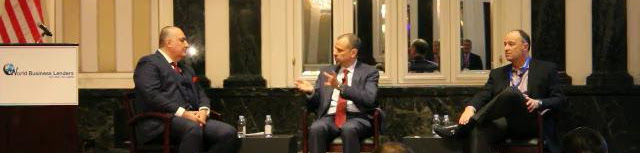
On a panel moderated by WBL Managing Director Alex Gemici, Brown and Glazer expressed their optimism for the industry’s future, but to some extent heeded caution. Brown specifically made reference to his prediction of a bursting bubble but conceded that he might have been off by a year or two. Glazer reminded the audience that both executives had weathered the financial crisis so that they had witnessed firsthand how a recession can affect their businesses, and made them stronger because of it.
WBL CEO Doug Naidus made a similar admission in his presentation, in that he thought that the bubble of unsecured lending would burst in 2015 but that it hadn’t happened yet. Still, he thinks it’s right around the corner. One of their primary hedges against a correction is that they secure their loans against real estate. Naidus has a background in mortgage lending so it’s a market they’re familiar with.

Another one of their key strategies is the franchise model. Over the last two years, WBL has acquired commercial finance brokerages and converted them into originating houses for their collateralized loan program. It has had a really positive impact on their growth and on their margins, according to information disclosed at the event. It’s expected that they will continue to pursue more acquisitions.


The sentiment of the event was rather festive and optimistic, with WBL enjoying a positive trajectory of growth and success.
Building An Alternative Lending Sales Profile
November 24, 2015 Merriam-Webster dictionary defines the word, independent, in a number of different ways, but one of the definitions provided relates this word to the concept of freedom. Most of us operate in this industry on an independent basis, which gives us a significant level of freedom that revolves around not having a boss, freedom to set our own schedules, freedom from being down-sized, freedom from office politics, but more importantly:
- freedom to craft our own business plans
- freedom to target our own market segments
- freedom to decide what we will sell
- freedom to create our own products
- freedom to negotiate our own market pricing
- … and freedom to innovate
With such high levels of freedom, you have to wonder why a lot of brokers in our industry don’t exercise such liberties? Why do we sell the same products (cash advances and alternative business loans)? Why do we use the same marketing tactics (UCCs and aged leads)? Why do we market, promote and sell to the same merchants (UCCs)? Why do we use the same “pitch”? Why do we submit to the same funders?
If we are truly independent contractors, why do we all look, act and sound the same?
As we continue The Year Of The Broker, I wanted to begin a discussion on a concept that integrates your capability of independent expression. It’s the concept of constructing an alternative financing sales profile. It allows you to display your level of true independence by pre-qualifying your prospective clients and recommending solutions that are different from the pack of brokers recommending the same “me too” solutions, seeking to submit the merchant to the same “me too” funders.
ARE YOU A “BROKER” OR NOT?
Are you paid only when you broker (fund) a deal?
If so, the generation of a financing lead or application in and of itself, doesn’t produce value as it doesn’t create revenue. Revenue is only created when you successfully broker a deal, which is to match a merchant with alternative funding needs and with a particular terms/conditions comfort range, with products funded by lenders whose pricing lines up with the particular comfort level of your prospective client.
As a broker, you are much more than a salesperson, you are more of a match-maker, an arbitrator, and an consultant. You can’t consult someone if you don’t know their current situation for one, and two, you can’t consult someone unless you have the resources to prescribe appropriate solutions.
See yourself more as a doctor than a salesperson, where as a salesperson has one or two products that he’s looking to “push” on a prospect using various tactics such as cost cutting and overcoming objections, a doctor isn’t trying to “push” anything out of the gate without firstly diagnosing the client through a series of questions. After said questions have been inquired and answers provided, the doctor creates a “profile” of said client and through his wealth of medication, he prescribes a couple of solutions to assist the client.
To help increase your chances of brokering (funding) your deals, you want to increase your level of pre-qualification and increase your level of product offerings, both of which will allow you to create firstly an alternative financing sales profile of your client, and then secondly allow you to go into your wealth of alternative financing products to prescribe an array of products.
EFFICIENT PRE-QUALIFICATION
Going forward, make sure to do serious pre-qualification to create an estimated risk profile as well as an estimated sales profile. You want to know all of the following: their credit, time in business, annual sales, cash flow situation, level of profitability, type of assets, outstanding commercial debt, any current tax or judgment liens, recent bankruptcies, and current status of commercial mortgage or commercial lease agreements.
From this information you are able to create an Alternative Financing Sales Profile along with an occupying Risk Profile for each product you will soon be recommending, to know which lender within that product category is best to serve your client.
YOUR WEALTH OF ALTERNATIVE FINANCING RESOURCES
So for example, say we have a restaurant owner that’s in need of $250k in working capital for expansion. You shoot him over the pre-qualification survey and receive the following: 700 FICO, 5 years in business, $1 million sales, zero NSFs/Overdrafts for 6 months, $10k average bank balances over the last 6 months, company has been profitable for the last 3 years, no tax liens, no judgment liens, no bankruptcies, current on commercial lease payment, outstanding debt that includes $25k on a credit card with $50k outstanding on a bank loan. The merchant’s commercial assets includes business equipment, free and clear, with appraised value of $150k.
As an alternative financing broker, you should have access to more than just merchant cash advances and alternative business loans, you should also have access to: merchant processing, equipment leasing, asset based lines of credit, inventory loans, SBA loans, business credit cards, factoring, purchase order financing, commercial mortgages and real estate hard money loans.
So based on the answers to the pre-qualification survey completed by the restaurant owner, in conjunction with his total financing needs, you might be prescribing an SBA loan, a merchant cash advance, and a sale-leaseback.
- You would seek to get him an SBA loan first and let’s just say he only gets approved for $50,000. So you guys complete the process to fund the SBA loan.
- Next, you would look at doing either a merchant cash advance for let’s say another $100,000 using split funding. You notice that his current processing rates are a little higher than market average pricing for Restaurants and show him a savings analysis with your interchange plus pricing structure with a 10BP mark-up that should be saving him $400 a year which is $1,200 over three years. So in the process of this you also convert his merchant processing over to one of your processing platforms that can handle split funding. Now you have raised $150,000 of the $250,000 funding goal that the merchant has in mind.
- Finally, you would look at doing a sale-leaseback on his pre-owned equipment that’s appraised for $150,000. With a 70% LTV, this comes to $105,000 in funding. Now you have successfully funded the merchant over $250,000 and in the process closed three different alternative funding products as well as converted over his merchant processing at the same time.
In an upcoming article, I will continue this discussion on pre-qualification by going into information on how this level of efficiency includes the creation of Risk Profiles that allow you to limit your submissions to your funders/lenders as to not clog up their underwriting pipelines with unnecessary submissions. It allows you to focus on submitting 10 applications and funding 5, instead of submitting 50 applications and funding 5.
Some Small Business Funders Are Pivoting or Closing Shop
October 20, 2015 One of the unique insights AltFinanceDaily gets as a company that sends a lot of email and snail mail to folks in the industry is the rejection rate. One day an entrepreneur is telling us all about their new lending business and the next day the Post Office returns their magazine for a vacant address. Sometimes there’s a change in the model or a partnership didn’t work out. Other times lead generation became too hard or too many merchants defaulted very early on. The truth is, as much as the industry is growing, some companies are pivoting or closing their doors.
At Lend360, there were whispers around the trade show floor that acquisition costs have spiked and it was being felt on the bottom lines. Broker houses are opening, closing, merging with each other and being acquired. Funders have reacted by giving them lines of credit to either help them grow or stay afloat, hoping that their sources of deal flow don’t fall apart.

On one conference panel titled, A Discussion of Best Practices: Advancing The Cause for Business Finance, veteran underwriter and industry consultant Andrew Hernandez of Central Diligence Group, said he’s watched a lot of new entrants in this industry make mistakes. “We’ve seen guys lose their shirt,” he said. He explained that too often small business funding companies look to cut their acquisition costs in the wrong places, like simply paying less for leads or paying brokers lower commissions. That only works to a point. “Underwriters can help keep the cost of acquisition down by funding the right deals and trying to get good deals done,” he said.
The owner of one funder summed up his dilemma for me, my brokers are making more on a deal than I am and I’m the one taking all the liability on it. Maybe I should become a broker instead. Not that there would be anything wrong with that. For some companies in this industry, the best path forward is achieved through trial and error. For example, World Business Lenders’ Alex Gemici said at the conference that they started off by making unsecured loans and now only do loans secured by real estate. Gemici also said he believes the industry is heading for a major shakeout within the next three years and that irrational exuberance keeps him up at night.
If he’s right, an economic downturn could squeeze out a lot of players that are already feeling the pinch of high acquisition costs.
For those newer to the industry, they might not remember that the effects of the 2008-2009 financial crisis and ensuing recession was brutal. More than half of the providers of merchant cash advances went out of business, some within weeks when their credit lines were pulled.
A lot of the “industry leaders” of 2008 aren’t around anymore: First Funds, Fast Capital, Second Source, Merit Capital, iFunds, Summit, Infinicap, Global Swift Funding, and more.
Given the favorable economic climate and regulatory environment, this is a bad time to be struggling. 2015 may be one of the last years to pivot in a major way before it’s too late.
World Business Lenders Makes Credit Prediction, Employs Different Model
October 19, 2015World Business Lenders (WBL) Managing Director Alex Gemici thinks the next credit correction will take place within three years, he told a crowd at Lend360 last week in Atlanta. When he and his fellow panelists were asked what keeps them up at night, Gemici said, “irrational exuberance.” He clarified that by saying that there was an incredible amount of capital pouring in right now and insinuated that it’s not all being deployed intelligently. He also pointed to the country’s economic history and said we’re naturally due for a shift in the credit cycle.
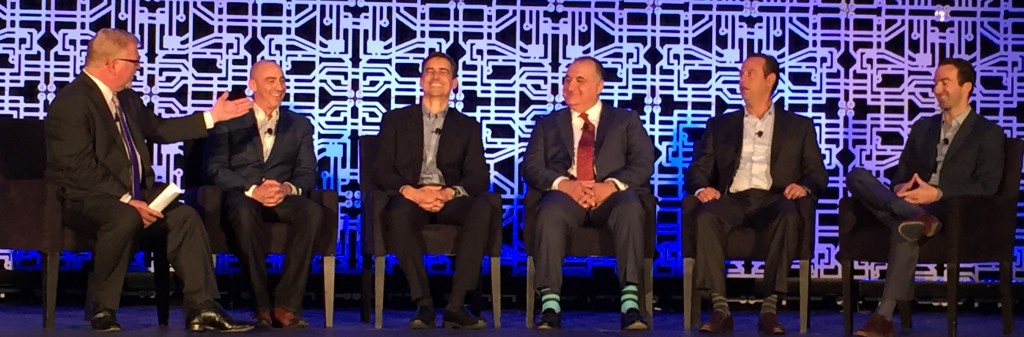
From Left to Right: Bob Coleman of the Coleman Report, Jason Rockman of CAN Capital, Craig Coleman of ForwardLine, Alex Gemici of World Business Lenders, David Gilbert of National Funding and Jeremiah Neal of Biz2credit
Part of WBL’s hedge (if you could call it that) against a future industry shakeout, is that their loans are actually collateralized, though they didn’t start out that way. When they launched in 2011, they initially offered unsecured loans and eventually evolved towards collateralizing them with all different types of assets. They have shifted even further in that direction and today the only collateral they accept is real estate. That makes WBL’s model quite traditional by comparison to competing products like merchant cash advances and OnDeck loans. Gemici says however, that they believe in technology and data mining to make better underwriting decisions, just like today’s unsecured fintech lenders.
But while they use technology, their process isn’t fully automated and that’s because Gemici believes algorithms aren’t advanced enough yet to make decisions on their own. You can’t ask Siri whether she’d approve a business loan yet, Gemici joked.
Will business loans backed by real-estate give them a long-term edge over unsecured lenders? Only time will tell. One thing many people agree on however is that there will most certainly be a shakeout when the next economic downturn hits.
Creditor Fails to Navigate Usury Law “Minefield”, Ordered to Refund $1.3 Million to Debtor
October 5, 2015 A recent court decision demonstrates the complexity and dangers faced by creditors attempting to navigate California’s usury laws. In the case, a lender agreed to purchase a debtor’s promissory note from a bank and refinance it for a lower amount. The entity that the lender used to purchase the note from the bank was a licensed California real estate broker. Simultaneously with the purchase of the note by the first entity, the lender assigned the note to a second entity under its control. Later the debtor defaulted on the note and filed bankruptcy.
In the bankruptcy proceeding, the lender filed a claim against the bankruptcy estate for the remaining amount due on the note. The debtor objected to the claim and argued that the interest rate that had been charged by the lender was usurious. As such, the debtor asked that the court order the lender to refund the usurious interest that had been paid.
While the lender agreed that the rate charged on the note exceeded the maximum rate set by California’s usury law, the lender argued that the purchase of the note had been arranged by a licensed real estate broker and therefore the transaction was exempt from the usury restrictions. After a two day trial, the court found in favor of the debtor and order the lender to refund over $1.3 million to the debtor.
In its decision, the court noted that the California legislature had provided an exemption from the applicability of California’s usury laws by exempting “any loan or forbearance made or arranged” by a licensed real estate broker and secured by real estate. The court went on to explain, however, that the exemption only applies where the broker was acting on behalf of another. Where a broker is acting as a principal, the exemption does not apply.
After examining the relevant loan documents, the court found that the purchase of the note by the first entity had been done on its own behalf and not on behalf of the entity to which the note was later assigned. The court rejected the lender’s argument that the lender had done little to formally structure the transaction as a broker-principal arrangement simply because it controlled both entities and knew it would be transferring the note following the purchase from the bank. For that reason, there was no “need to report anything to [itself]”. The court was unpersuaded by this argument and stated that “[t]he usury laws present a minefield that people in the [lender’s] position, with their… status as licensed brokers, can readily navigate. This time they did not navigate carefully.”
In light of this case, lenders doing business in California should be careful to “navigate carefully” the complex usury laws of that state, lest they too become a victim of its “minefield” of statutory dangers.
In re Arce Riverside, LLC, 2015 Bankr. LEXIS 3275 (Bankr. N.D. Cal. Sept. 28, 2015)
Fake Business Loan Application Fees Leads to Two Convictions
October 5, 2015 Two men were convicted last week of perpetrating an advance fee fraud scheme. David C. Jackson and Alexander D. Hurt defrauded more than 40 individuals out of $4.5 million, mainly by directing small businesses hoping to get a loan to pay phony application fees, collateral fees, or commitment fees. “These defendants and their co-conspirators took advantage of individuals and business owners who had limited options in acquiring business loans in the difficult financial environment that existed after the recession of 2008,” states a report issued by the Department of Justice.
Deirdre M. Daly, United States Attorney for the District of Connecticut, said that people need to be careful about loan offers online. “Those seeking business loans need to be wary of any provider of funding that requires significant fees in advance—especially those who use the Internet to prey upon trusting people who are unable to verify the representations made,” Daly said.
“Jackson was previously convicted of federal bank fraud and money laundering offenses in October 2006 and was sentenced to 41 months in prison, followed by five years of supervised release,” the DOJ report says. “He was released from federal prison in September 2009 and operated this advance fee fraud scheme while on supervised release.”
The two used a slew of personal aliases and business names to cover their trail. The business names included:
- Jalin Realty Capital Advisors, LLC
- American Capital Holdings, LLC
- Brightway Financial Group, LLC
An archived version of American Capital Holding’s website said the following on the home page:
“In today’s economic climate, finding reliable funding sources can be frustrating. Fortunately, we are partnered with an investment fund that provides commercial real estate development and acquisition projects. Due to our professionalism & honesty we have achieved massive trust worldwide.”
One lesson here would be to cautious of anyone who says they have “achieved massive trust” but another is to conduct background checks on the online lender you’re considering.
And of course never pay a fee upfront for the promise of a loan in return.
Is The Small Business Administration An Ally to Alternative Lenders?
September 16, 2015 Add the Small Business Administration (SBA) to the list of organizations likely to understand the rise of tech-based business lending. Miriam Segal, a research economist for the SBA, recently published a report titled, Peer-to-Peer Lending: A Financing Alternative for Small Businesses. In it, she opens with a line that is all too familiar in the merchant cash advance and non-bank lending industry. “Imagine that you own a small bakery and you need $15,000 to buy a new oven,” she writes. She later adds, “Data suggest that peer-to-peer lending may be a viable financing alternative for small businesses, particularly given the post-recession credit market.”
After having read the recent Federal Reserve study that essentially concluded that small business owners are just too confused to make sound financial decisions, the SBA report is a welcome sign that there is little to fear from “alternative lending.”
While the SBA is sometimes cast as a villain to the private sector, what with their ability to assuage banks into making small business loans at very low interest rates with the assurance of default guarantees, a practice viewed by some economic ideologues as anti-free market, there hasn’t actually been much competition with alternative lenders. The average SBA loan is about $371,000, much higher than the average merchant cash advance transaction of about $30,000. And although they are a government agency, the SBA is scrutinized far more than today’s alternative lenders are. Politicians have sought to shut the agency down for decades but it has managed to survive. If any small business lending group knows what it’s like to be a political football, it’s the SBA. They’ve even been accused of similar antics, like being a participant to predatory lending.
Chris Hurn, Fountainhead Commercial Capital’s CEO, offered his opinion on such in the Huffington Post when he wrote, “I realize that calling some behaviors ‘predatory’ will raise some hackles, but what else would you call a virtually systemic practice of convincing small business owners to accept an inferior loan program on commercial real estate transactions, which almost certainly puts these borrowers in future harm’s way, only so a bank can maximize its income?”
Where have we heard this viewpoint before?
In the SBA report, Segal acknowledges a wide array of working capital options including merchant cash advance products. “P2P lending may fill a gap in small business lending for entrepreneurs seeking small amounts of capital when existing options are not suitable or available (e.g., bank loans, credit cards, and merchant cash advances),” she states.
She also gets to the heart of the issue that those touting the superiority of long term loans seem to be missing and that is that, “the majority of small business borrowers appear to be interested in relatively short-term loans in relatively small amounts.” Using data made available by Lending Club, 56% of small business owners applied for loans of $15,000 or less. Although the SBA will guarantee really small loans, it’s uncommon for banks to spend time and effort underwriting these, not to mention that many small businesses lack collateral and other minimum requirements for eligibility.
The reality is that alternative lending is for the most part the world outside of the SBA’s scope. “For some small businesses, an expensive loan may be better than no loan,” Segal concludes.
Given the variations in application process, interest rate, loan amount, and term length across loan products, it is apparent that each option presents a unique set of pros and cons. Peer-to-peer loans offer the benefits of expedited application processing, smaller loan amounts, and shorter terms, but borrowers pay for these conveniences in the form of higher interest rates.
– Miriam Segal
Research Economist, SBA
From the perspective of small business advocacy, the report gets it right. “Peer-to-peer lending to small businesses is rising while the origination of small business bank loans is decreasing. Micro businesses are interested in borrowing small amounts of money, although their credit applications are the most likely to be rejected. Therefore, the financial regulatory environment in which P2P lending exists is particularly important to small businesses.”
And it concludes, “Peer-to-peer lending has the potential to change the landscape of small business financing for the better. In order for this to happen, financial regulations must reflect the need for investor protection and simultaneously allow small businesses to access the capital that many individuals are willing to provide—no small task.”
As the wider industry is being researched by regulators, it is an especially important time to discover who shares the same understanding of the facts. Although not an immediately obvious choice of ally, the SBA is undoubtedly qualified to communicate the needs of small business. That makes them an especially good candidate to help explain the story about the what, why, and how of the changing landscape.