What’s Lending Got to do With Cryptocurrency?
January 10, 2018 Facebook and Snapchat might be the last things that employees are being distracted by these days. Instead it’s Coinbase and Blockfolio, two cryptocurrency apps, that are quickly stealing the attention of young finance professionals. And the interest in Bitcoin, Ethereum and alt coins is causing some in the industry to wonder if the phenomenon can somehow be connected to online lending and merchant cash advance.
A meetup hosted by partners of Central Diligence Group (CDG) on Tuesday night in NYC, for example, was geared towards cryptocurrency enthusiasts. CDG is a merchant cash advance and business lending consulting firm. Those that attended, talked candidly about Ripple, Bitcoin, Ethereum, and the hot topic of Initial Coin Offerings (ICOs). And it did seem all connected. Companies successfully raised more than $3 billion through ICOs in 2017, for example, some of them online lending companies.
 ETHLend and SALT, blockchain-based p2p lenders, each raised $16.2 million and $48.5 million respectively through ICOs. What’s more, their crypto market caps currently stand at $325 million and $754 million respectively. The latter is nearly twice as valuable as online lender OnDeck. The founder of Ripple, meanwhile, briefly became one of the richest men in the entire world.
Whether these valuations are overdone is besides the point. A smart phone is all that’s required to get in on the action and trade thousands of cryptocurrencies online, many of which move up and down by astronomical percentages over the course of a day. Becoming a millionaire overnight by hitting on the right one is a dream sought after by many. And young people, especially millennials, are become unconsciously comfortable transacting in non-government-backed currencies through technology that completely shuts out banks.
And that may be the shift in all of this to pay attention to. It isn’t that a local restaurant is going to collateralize their Bitcoin to get a loan and outcompete an MCA company, but that a portion of the monetary system eventually starts to sidestep banks.
Trying to collect on that judgment? Good luck tracing the money in cryptos.
Need to freeze funds? You can’t freeze someone’s Bitcoins if they’ve got them stored on their own hardware.
Evaluating a business’s bank statements? The transactions can only be verified on a blockchain.
You might not believe me, but it’s incredibly likely that you’ve encountered a client that has defaulted on an MCA or loan whose stash of money has been obscured in cryptos all the while their bank statements appear to show insolvency.
It’s also likely that you’ve encountered a client that has used the proceeds of their MCA or loan to buy a crypto. Maybe not the whole amount, but with some of it. One study, for example, revealed that 18% of people have purchased Bitcoin using credit. Bloomberg reported that the phrase “buy bitcoin with credit card,” just recently spiked to an all-time high.
People are even taking out mortgages to buy Bitcoin, according to CNBC.
If you think cryptocurrency is an industry completely independent of your business, consider that the market cap of cryptocurrencies is currently valued at more than $700 billion. That’s nearly twice the market cap of Goldman Sachs and JPMorgan, COMBINED. The #3 cryptocurrency by market cap, Ripple, is being pitched almost entirely to traditional financial institutions.
Bet all you want on the prediction that this bubble will burst. Maybe it will. But the underlying technology, transacting without banks in non-government backed currencies that may be difficult to trace and recover, is a genie that’s not returning to its bottle anytime soon.
In the meantime, now might be a good time to poll your employees or colleagues about their knowledge or use of cryptocurrency. You may be surprised by what you find, especially among the younger crowd.
——–
Disclaimer: I currently hold a material amount of Ether, the currency of the Ethereum blockchain.
The AltFinanceDaily Golf Outing 2017 Was a Success
August 28, 2017 Thanks to everyone that attended AltFinanceDaily’s first ever industry golf outing at Marine Park Golf Course in Brooklyn, NY. And thank you to all the sponsors who helped make it a success!
A PHOTO ALBUM IS NOW LIVE

- SOS Capital
- Elevate Funding
- Hudson Cook, LLP
- Yellowstone Capital
- Signature Printing & Consulting
- Grassi & Co
- Central Diligence Group
- Sure Funding Solutions
- Unique Funding Solutions
- Imperial Advance
Official photos from the event should be available soon. In the meantime, follow us on Instagram to see them when they come out.
P.S. The inaugural conference for MCA and business loan brokers is COMING SOON. Visit http://brokerfair.org to receive updates on Broker Fair 2018.
The CAN Capital Shakeup Is A Sign of the Times
November 30, 2016Update 11/30 7:30 pm: CAN says they are still open for business and still providing access to capital for current customers and renewal business. They are not actively seeking new business at this time, but will evaluate it as it comes in.
 Part II of the industry’s season finale has begun. On Tuesday afternoon, CAN Capital confirmed that CEO Dan DeMeo had been put on a leave of absence. The chief risk officer and chief financial officer have also reportedly stepped down. Parris Sanz, the company’s chief legal officer, is now running the company, a CAN spokesperson said. His new title, acting head (which is how their statement referred to him), is perhaps a subtle clue that the company did not plan these moves far in advance. And it’s the phrasing that’s used to describe the departure of these executives that’s worth raising an eyebrow. A leave of absence? A curious fate indeed.
In an exclusive interview AltFinanceDaily conducted with DeMeo last year, he said of CAN at the time, “it’s a self-sustaining business. We’re not forced to approach the capital market to cover our burn rate. We’re cash-flow positive.”
But more recently, there’s a different tone. A spokesperson for CAN said that the company had “self-identified that some assets were not performing as expected and that there was a need for process improvements in collections.” The sudden decapitation of the company’s top officers seems a harsh consequence for this apparent underperformance, especially given that CAN has long been on the short-list as a potential IPO candidate. DeMeo himself had been with the company since 2010, having started originally as the CFO and rising to the CEO position in 2013.
While CAN Capital is a private company, they are notable in that they have originated more than $6 billion in funding to small businesses since 1998 and secured a $650 million credit facility led by Wells Fargo just last year.
Some of CAN’s ISOs report being told that originations have been put on hold until January. A source with close knowledge of the company however, said that’s not correct. The Financial Times reported though that CAN had paused new business until the end of the year and would only be servicing current customers. And they might indeed need time to upgrade their systems since American Banker cited an unnamed source that said “problems arose when CAN Capital used old systems, which were not designed to require daily repayments, to collect money owed by term loan borrowers.”
Some outsiders are not surprised by what’s going. Alex Gemici, the chief revenue officer of World Business Lenders (WBL), said that it’s an indicator that uncollateralized lending is not the panacea everyone thought it was. “What we’ve been saying all along is right there on AltFinanceDaily,” Gemici said, while directing me to the prediction they made a year ago that appears right on this website. At a December 2015 event at the Waldorf Astoria, WBL CEO Doug Naidus told a crowd comprised mostly of his company’s employees that he believed the bubble was about to burst. He doubled down on that prophecy in an interview four months ago in which he chided companies for having forsaken sound underwriting.
Is he right? In the last six months, the CEOs of Lending Club, Prosper and CAN Capital have all stepped down. Avant shed a lot of its staff. Dealstruck, Circleback Lending and Windset Capital have stopped funding. Confidence in the business side of alternative finance has also started to slip on a measurable basis before the election even happened.
“I believe companies are experiencing higher than normal losses due to a serious lack of proper underwriting practices, policies, and procedures,” said Andrew Hernandez, a managing partner at Central Diligence Group, a company that specializes in risk analysis who wasn’t commenting about any lender specifically. “As I say to people not familiar with the space, ‘putting the money out is the easy side of the business; getting it back is what proves to be the most difficult.'”
But CAN has not specifically fingered underwriting practices as the reason for their management shakeup, instead leaning towards it being a lapse in their process as the company grew. “It became clear that our business has grown and evolved faster than some of our internal processes,” they said in their statement.
The only alternative business lender funding more annually is OnDeck, a company that has garnered its fair share of criticism over its lackluster financial performance. Their stock is currently down a whopping 77% from the IPO price, but they have put on a good face for the industry they lead. The familiarity of their famous CEO and the decade in business under their belt arguably even has a calming effect on the tumultuous world of financial technology startups.
OnDeck too though, has been referenced in the context of bursting bubbles. Less than two years ago, RapidAdvance chairman Jeremy Brown voiced concern that the industry was heading into unsustainable territory, even going so far as to call out OnDeck by name. “When I see some of the business practices, offers, terms and other aspects of our business today, I am worried,” he wrote. “I am worried because I believe that 2008 has been too quickly forgotten, and very few, other than those of us that were on the front lines on the funding side at that time, appreciate what happened to outstanding portfolios at that time when average duration was 6 months and no deals were written over 8 months.”
For risk experts like Hernandez of Central Diligence Group, he thinks the newness of everything has been part of the problem. “I believe [funding companies] have faced a big hurdle in acquiring talent,” he said while adding that funding companies can be forced to hire underwriters with no prior knowledge of the product just to keep up with the growth.
While still very little is known about what exactly happened at CAN Capital, most people that AltFinanceDaily spoke with were shocked that anything could happen there at all. “It’s insane,” said the chief executive of another competitor who wished to remain anonymous. “This is CAN we’re talking about.”
A sign of the times?
Fundry’s Isaac Stern Hosts Successful Fundraiser for Hatzalah of Union County
December 6, 2015 ‘Tis the season of giving for Fundry’s Isaac Stern and the dozens of folks that attended the December 5th winter fundraiser at his home in Hillside, New Jersey. The event, which served up 550 pounds of barbecue and included a Scotch taste testing bar hosted by representatives of Glenfiddich, raised over $60,000 for Hatzalah of Union County, a local non-profit all-volunteer emergency medical service organization.
Founded in 2004, Hatzalah EMS provides basic life support in medical emergency situations. They cover Union County NJ including the towns of Elizabeth, Hillside, Union, Roselle and Linden. Today, Hatzalah is staffed with 3 ambulances, 24 EMTs and 18 dispatchers all under the medical direction of a physician and two paramedics.
Hatzalah Chief Yudi Abraham told AltFinanceDaily that Yellowstone Capital (a Fundry subsidiary) has been a long-time supporter of their organization. A few years ago, when the squad was undergoing a transition of directors, Chief Abraham reached out to Isaac Stern for financial help. At the time, Hatzalah was in serious need of replacing an older ambulance as well as covering monthly operating expenses. “Isaac didn’t waste any time and sprang right into action,” says Chief Abraham. “He immediately convened his employees and his associates and came through for us in a huge way.” Yellowstone Capital raised the funds in under two days for Hatzalah to buy a fairly used ambulance. Ever since then, Stern and Chief Abraham have been working closely together to ensure that other expenses were covered. Over the years, Yellowstone Capital has helped donate the funds to purchase two additional ambulances that currently make up Hatzalah’s fleet. The Yellowstone Capital name appears on the side of each of them.

The most recent event kicked off with a $10,000 personal donation from Stern, prompting others to give too while enjoying the festivities.
“With the help of Yellowstone Capital we are able to maintain our level of service and continue providing the best possible emergency care for our patients,” said Chief Chaim Cillo. “We at Hatzalah will forever be most appreciative for such an incredible company that cares and gives back to the community in such a large way.”
Stern and Yellowstone were also presented an award for their continued generosity.
 Chief Yudi Abraham (left) and Fundry CEO Isaac Stern (right)
In attendance at the event were Fundry employees, friends, family members, and others from the non-bank finance industry.

 From left to right: Andrew Hernandez of Central Diligence Group, Sean Murray of AltFinanceDaily, and Andy McDonald of Yellowstone Capital/Fundry
 Michael Samuels (left) and Steve Weinrib (right) both of Yellowstone Capital/Fundry
Hatzalah means “rescue” or “relief” in Hebrew and for many guests the event fell on the eve of the Hanukkah holiday. The volunteer EMS crew of course helps all people in need of care.
“Our pay,” said Chief Abraham, “is helping our patients and saving lives.”
Some Small Business Funders Are Pivoting or Closing Shop
October 20, 2015 One of the unique insights AltFinanceDaily gets as a company that sends a lot of email and snail mail to folks in the industry is the rejection rate. One day an entrepreneur is telling us all about their new lending business and the next day the Post Office returns their magazine for a vacant address. Sometimes there’s a change in the model or a partnership didn’t work out. Other times lead generation became too hard or too many merchants defaulted very early on. The truth is, as much as the industry is growing, some companies are pivoting or closing their doors.
At Lend360, there were whispers around the trade show floor that acquisition costs have spiked and it was being felt on the bottom lines. Broker houses are opening, closing, merging with each other and being acquired. Funders have reacted by giving them lines of credit to either help them grow or stay afloat, hoping that their sources of deal flow don’t fall apart.

On one conference panel titled, A Discussion of Best Practices: Advancing The Cause for Business Finance, veteran underwriter and industry consultant Andrew Hernandez of Central Diligence Group, said he’s watched a lot of new entrants in this industry make mistakes. “We’ve seen guys lose their shirt,” he said. He explained that too often small business funding companies look to cut their acquisition costs in the wrong places, like simply paying less for leads or paying brokers lower commissions. That only works to a point. “Underwriters can help keep the cost of acquisition down by funding the right deals and trying to get good deals done,” he said.
The owner of one funder summed up his dilemma for me, my brokers are making more on a deal than I am and I’m the one taking all the liability on it. Maybe I should become a broker instead. Not that there would be anything wrong with that. For some companies in this industry, the best path forward is achieved through trial and error. For example, World Business Lenders’ Alex Gemici said at the conference that they started off by making unsecured loans and now only do loans secured by real estate. Gemici also said he believes the industry is heading for a major shakeout within the next three years and that irrational exuberance keeps him up at night.
If he’s right, an economic downturn could squeeze out a lot of players that are already feeling the pinch of high acquisition costs.
For those newer to the industry, they might not remember that the effects of the 2008-2009 financial crisis and ensuing recession was brutal. More than half of the providers of merchant cash advances went out of business, some within weeks when their credit lines were pulled.
A lot of the “industry leaders” of 2008 aren’t around anymore: First Funds, Fast Capital, Second Source, Merit Capital, iFunds, Summit, Infinicap, Global Swift Funding, and more.
Given the favorable economic climate and regulatory environment, this is a bad time to be struggling. 2015 may be one of the last years to pivot in a major way before it’s too late.
BFS Capital Joins the Ranks of Consolidated Powerhouses in Alternative Lending
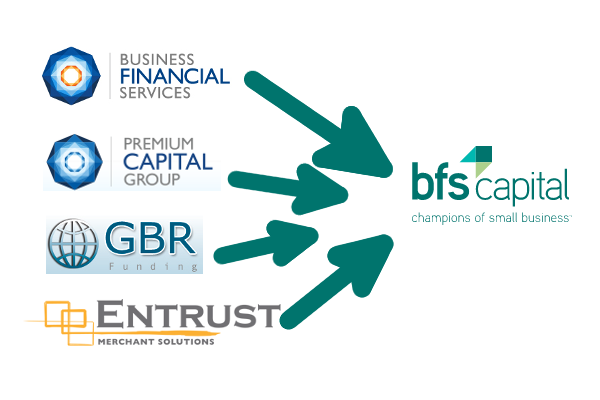
September 21, 2015 Coral Springs, FL-based Business Financial Services has joined the ranks of consolidated powerhouses with the announcement of their rebrand to BFS Capital. As part of the move, the company has unified its North American business affiliates.
Entrust Merchant Solutions, GBR Funding and Premium Capital Group will now also use the BFS Capital name. Entrust, who was acquired by BFS Capital on August 26th, has become the firm’s direct sales division. Ilya Fridman, Entrust’s former CEO, is now a Senior Vice President of BFS Capital and will oversee sales.
Boost Capital, their UK arm, is not changing its name.
BFS Capital is the latest small business funding provider to consolidate their affiliates and change their name.
Already this year, Merchant and Cash and Capital became Bizfi, AmeriMerchant became Capify, and RetailCapital became Credibly. Industry insiders have noticed one thing in common about all these changes, that they’re memorable.
“I think people are thinking about going public and want names that are easily identifiable more than wanting to sound techy,” said John Celifarco, Sales Manager at NY-based Sure Payment Solutions. “Maybe a little of both.”
When AltFinanceDaily previously asked Rory Marks, a Managing Partner of NY-based Central Diligence Group, about the name recognition-value of certain funders in the industry including Business Financial Services, he said “when choosing to use words that are ubiquitous in the industry, it could be difficult to distinguish yourself. Ultimately this could potentially impact the customer’s ability to fully understand the nature of your business.”
Business financial services could be confused as a genre or a category, a few insiders commented, instead of a company name.
The BFS Capital brand should remedy any confusion, although Justin Benton, Executive Loan Producer of Lenders Marketing shared, “a simple name that conveys what you do has value, not only in the eyes of your potential clients, but in the eyes of search engines like Google. At the end of the day, if you do your job well and the client is pleased with the loan product and service you provide, your name will be positively associated as a trusted resource.”
Business Financial Services has long been referred to as BFS by industry insiders so unlike other funders that completely transformed during their rebrand, BFS Capital may retain more of their previous name’s goodwill.
“Bringing all your companies under one umbrella can bring each company’s unique strengths together in one collective effort, rowing towards one common destination,” said Benton.
BFS Capital has been a hot news item this summer. In July, they surpassed $1 billion in lifetime funding.
AltFinanceDaily Photo of the Day
August 18, 2015This photo of the Central Diligence Group team was recently posted to our forum. By the look of their reading material, it appears they are thoroughly deBanking.

Central Diligence Group is an NYC-based MCA underwriting & consulting firm.
Thanks for sharing this!
Generating Leads and Acquiring Borrowers Not Easy in Business Lending
July 21, 2015 “Banks are almost always losing money on small business lending,” said Manish Mohnot, TD Bank’s Head of Small Business Lending, on a panel at the AltLend conference in New York City. It’s a loss leader within the small business segment, he explained, because banks want to bring in deposits.
Funding Circle’s Rana Mookherje concurred. “Banks just can’t make a loan under $500,000 profitably,” he said.
It’s a conundrum few outside banking think about. When consumers and businesses picture banks, they might think of loans, but when banks think of consumers and businesses, they think of deposits. The sentiment amongst the experts at AltLend was that traditional banks and alternative business lenders were not competing with each other for the same customers because each party was after a different objective.
And even when banks think about loans, because obviously they do, they just don’t approach them the way that alternative business lenders do. To that end, ApplePie Capital CEO Denise Thomas said, “Most community banks are looking to make loans backed by an asset. They just don’t want to underwrite [loans] one by one under a million dollars.”
Bankers are genuinely surprised by how alternative lenders subjectively or manually approach business loans, a subject covered just yesterday here on AltFinanceDaily. Charles Green, the Managing Director of the Small Business Finance Institute and moderator of the New Pioneers panel said he never saw banks use bank transaction history to make underwriting decisions in his 35 years of banking.
The factors paraded as being more important above everything else in alternative lending today have apparently been non-factors in traditional lending for years. “There is no substitute for banking information when reviewing a client for approval,” said Andrew Hernandez, a co-founder of Central Diligence Group, in Do Bank Statements Matter in Lending? Business Lenders and Consumer Lenders Disagree. These kind of statements are mind-blowing in traditional lending circles.
Nevertheless, banks watch in awe as alternative lenders not only make small commercial loans, but do it profitably. But how they source borrowers isn’t rocket science. Jim Salters, the CEO of The Business Backer pointed out that some alternative lenders are marketing on a large scale by running TV or radio commercials. But that level of investment isn’t for everyone, especially younger companies.
“Direct mail isn’t sexy, but it converts,” said Candace Klein, the Chief Strategy Officer of Dealstruck. She also said that her company is doing radio advertising.
Matt Patterson of Expansion Capital Group is well versed in digital marketing and incorporates SEO and online paid advertising such as Facebook in his strategy. There’s a difference in the conversion rate in advertising on Facebook versus something like Google, he explained. On Google, business owners are looking for something whereas on Facebook they stumble across it.
Everyone agreed that Pay-Per-Click marketing such as Google Adwords was very expensive in this competitive landscape.

Jim Salters, CEO of The Business BackerBut where can funders and lenders reliably turn to acquire deal flow cost effectively? Salters revealed the industry’s worst kept secret, brokers. The Business Backer acquires about half of its volume from brokers and the other half directly, according to Salters.
“The broker channel is one of the most cost effective channels for us,” said Klein, who would not say on the record exactly how much of Dealstruck’s total business was from brokers.
Patterson agreed with the favorable ROI of using brokers, but saw benefits to communicating with small businesses directly. “Everything about that relationship is better when you’re talking directly to that merchant,” he said. And yet, “our direct leads convert much lower than our broker leads will,” he added.
The panelists generally agreed that this was because brokers have essentially already gathered the documents and closed the deal by the time the lender or funder is finally seeing it.
But aren’t brokers and humans the antithesis of tech-based lending?
Brett Baris, the CEO of up-and-coming lender Credibility Capital said, “We were actually a little surprised by how much a human is needed.” Baris’ company acquires most of its leads through a partnership it has with Dun & Bradstreet. Most of their borrowers are prime credit quality.
“The human element is very important to get the higher quality borrowers to the finish line,” Baris noted. TD’s Mohnot was not surprised. For applicants doing $5 million to $6 million a year in revenue, they want somebody to walk them through the loan process, he opined.
“Merchants love talking to people,” Patterson said. “Some of that comes from the frustration of calling their bank and not being able to talk to people.”
But would that mean the assumptions about automation are wrong? Not quite, explained Mohnot. It’s the younger business owners who have the impulse desire to do things fast or online, he said.
And Klein said that observing merchant behavior at least at her company has shown that those all too eager to apply for a loan in an automated online fashion are typically looking for smaller amounts like $20,000 to $40,000. Meanwhile Dealstruck’s loan minimum is $50,000.

Not everyone is as fortunate as Baris, who is able to generate leads through the trust inherent in a conversation that originated with a D&B rep, but real actual bank declines are making their way to alternative lenders. They’re not the holy grail that everyone thinks they would be though.
“Conversions tend to be lower from bank leads because they’re expecting 6% and are insulted when they hear [a higher %],” said Klein. And Salters who refers to his company as a “turndown partner of choice for upstream lenders,” shared how hard it is for a bank to partner with an alternative lender in the first place. Years ago, banks were aghast by his hands-on, manual underwriting approach that he felt was his company’s core competency. The banks were afraid their regulators would freak out over something so subjective.
And yet Merchant Cash and Capital’s founder, Stephen Sheinbaum and Credit Junction’s CEO Michael Finkelstein both told an audience that they saw banks as collaborative partners.
Meanwhile, Dealstruck actually has a graduation system where merchants graduate out of their loan program and become eligible for a real bank loan. Klein explained that a small business could be referred to them by the bank and then after a couple of years of good history, they’ll refer it back to them.
The acquisition secret however seems to be in finding your strength. ApplePie is focused exclusively on franchises. Expansion Capital Group has formed relationships with several trade organizations. Credibility Capital goes hand-in-hand with D&B.

Still, there is no doubt that the broker channel is alluring, but it can be a slippery slope. Raiseworks CEO Gary Chodes cautioned that “brokers are incentivized to follow the money.” Klein also expressed concern. She knows firsthand how challenging brokers can be since she’s had to terminate some in the past for bad behavior.
“Transparency is extremely important,” Finkelstein proclaimed in regards to the customer experience. This means that lenders can’t simply work off the ROI metric alone. But that ROI is the envy of banks nationwide.
Banks want to refer their clients to alternative lenders because if they get approved, then the lender is going to deposit those funds at their bank, Mohnot alluded.
It would seem that there is not one particular methodology that works better than all the others to acquire a borrower and that’s okay. Alternative lenders struggling to maximize their ROI can take comfort in the fact that banks, with all the resources they have at their disposal, accepted a long time ago that it was impossible to even make money at all in small business lending.
If you’re at least in the black, you’re probably doing just fine…