How Mike Brooks Battled in the Ring and Won Top Broker in Equipment Financing
March 6, 2025
“Equipment Financing is HUGE,” declares Mike Brooks, CEO of New York-based Best Connect Capital and recent winner at Broker Battle 2025 in the equipment finance category at AltFinanceDaily CONNECT MIAMI. If his name sounds familiar, it’s probably because he appeared on stage as one of six finalists in the previous year’s competition. He refused to give up after his loss and returned this year for round two, leading to him securing a title and prizes along with it. To hear him tell it, it had been a long road to get there.
When Brooks got his start as a 27-year-old broker in 2015, for example, he had technically been battling in a ring for most of his life already.
“I had [boxing] on my mind in high school, without any influence,” says Brooks, “and I walked into a gym one day and the rest was history.” That history includes 60 fights in just amateur-level boxing, resulting in 45 wins and 15 losses. When he followed that at the pro level he went 11-2-1.
“I started fighting at the regular club shows, the Golden Gloves, the metro tournaments, national tournaments, and at one point, I was ranked number seven in the whole country,” Brooks recalls. “I beat some really good fighters, lost to some really good fighters and I made it to the highest levels in the country.”

Some of those fights even aired on live TV. As he bobbed and weaved for years in the ring, he started to think about what a possible career in business might look like afterwards. When that day came, he went to work for a local financial service company on Long Island who taught him about helping small businesses access working capital. Eventually he realized it was a business that he was uniquely suited for and now he runs his own company doing it.
First, there’s the endurance aspect, he explains. There’s a lot of calls, leads that don’t pan out, and heartbreak that hits when deals get declined at the finish line.
“A very small percentage of people can be a successful broker,” Brooks says. “You have to be able to take rejections all day long.”
To that point, Brooks noticed that as the industry grew he was not the only broker offering revenue-based financing to a client. Sometimes there were even as many as four or five other brokers talking to the same client at the same time, which meant that he wasn’t going to win every one and he did not want to bend his ethics just to eke it out. That’s when he started considering another approach and expanded his offerings.
“An equipment financing deal was my first big check during [the covid] lockdowns,” Brooks says. It was a $200,000 deal for a packaging plant. The terms were very attractive and he had the help of an equipment finance veteran who mentored him through it. When it worked out, he knew he had something very big in his arsenal and he’s been offering it ever since to anyone that qualifies for it.
 “I said to myself anybody that needs equipment, this is a no brainer right here,” Brooks recalls of it. Now Brooks says when there is competition, he’s almost always the only one asking questions about equipment and the only one prepared to actually move forward with a deal tied to it. Of that experience, Brooks says he’s realized that some brokers have become so accustomed to the mindset of telling customers to take a specific deal, that they don’t stop to consider what they actually want. So his approach is to go in and diagnose what it is they’re trying to do first and then advise them of their options accordingly. And that’s what he does day after day.
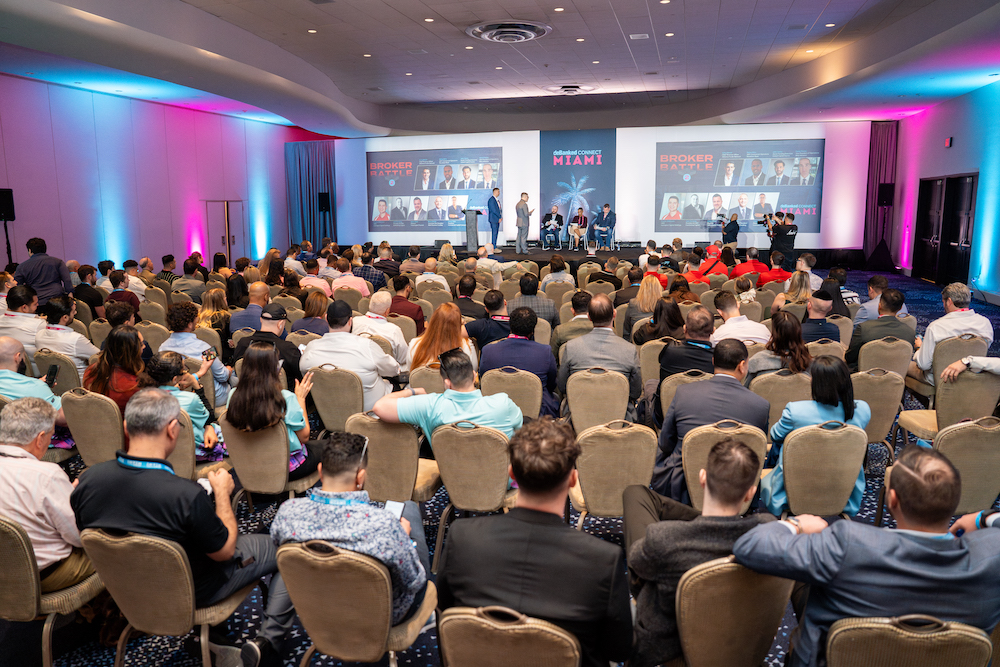
At Broker Battle 2025, it was very much like time spent in the office. He was expected to be his normal self, but on stage in front of a large audience, while three judges played the role of prospective client and asked him questions about what they should do. The end result of it all was that Mike Brooks, former fighter in the ring, walked away as the Broker Battle champion in the equipment finance category in 2025.
“It felt amazing to be able to showcase what I do on a daily basis,” Brooks says, making it a point to say that even the venue took note of his win and offered him a personal congratulations on social media.
In the final photo-op on stage with his prize check, Brooks was the epitome of his dual life—the suit and tie spoke of business, while the cigar and sunglasses hinted at his former life in the ring. “I was a crowd pleaser,” he jokes. “You want to be like ‘bam bam bam’ and the crowd to be like ‘AHHHH!!!’ I want them to do that. I had a great time at AltFinanceDaily.”
Super Bowl Sunday: Battle of the Mortgage Brokers
February 2, 2021 This Sunday in Tampa Bay, the Chiefs, and the Buccaneers will duke it out, while a second mortgage-based rivalry plays out in the ads between plays.
A year ago, millions watched as Rocket Mortgage and United Wholesale Mortage (UWM) went head-to-head with competing multi-million-dollar ads. This year, they will both return, but it looks like they might play nice after a grueling pandemic.
Last year, Rocket appeared for their third consecutive Super Bowl, but then in an upset came the #BrokersAreBetter ad campaign. UMW called out their biggest competitor: “Playing with rockets is great when you’re a kid, but when it’s time to get a mortgage, you quickly realize a rocket is complicated and expensive,” and promoted FindAMortgageBroker.com.
It was a jab that earned millions of tweets, but this year Rocket has a chance to reply, and “double down” with two ads, this time highlighting local brokers as well. Rocket Companies today launched a national mortgage broker directory on its website.
“The directory not only includes the 43,000 individual loan officers who work with us but every mortgage broker in the country,” said Austin Niemiec, the executive vice president of Rocket Pro TP, in a statement. “This new resource is not about us; it’s about giving consumers more choice and assuring they know how an independent loan officer in their community can help them.”
UWM is also running an ad showing an imaginary tinder-swiping house hunting app, again featuring the FindAMortgageBroker.com directory.
“We believe we’re the one genuine partner of mortgage brokers nationwide,” said Sarah DeCiantis, chief marketing officer of UWM, in a statement. “We thought this ad would not only be relatable and entertaining given the pandemic’s acceleration of online dating but also educate consumers that brokers are their number one resource for finding a mortgage that fits their financial situation.”
Both firms are deciding to buy ads while other major brands are pulling out; For example, Budweiser’s decision to put ad money toward covid vaccine distribution. These brands will be saving money, as a 30-second spot during the Super Bowl runs for an estimated $5.5 million, the AP reports.
Next year’s Super Bowl 56, will be played in SoFi Stadium.
The Battle Against MCA in Texas
June 12, 2025David Roitblat is the founder and CEO of Better Accounting Solutions, an accounting firm based in New York City, and a leading authority in specialized accounting for merchant cash advance companies.To connect with David or schedule a call about working with Better Accounting Solutions, email david@betteraccountingsolutions.com.
 Texas, a state associated with limited government intervention and freedom of business to operate and succeed in a capitalist society, stands at a crossroads.
Governor Greg Abbott has until June 22nd to decide whether to sign House Bill 700 into law—a decision that could fundamentally reshape how small businesses access capital in the Lone Star State. If he signs it, or simply lets the deadline pass without action, this sweeping legislation will take effect on September 1, 2025. The action will potentially cut off vital funding sources for thousands of Texas entrepreneurs, in a direct assault on the merchant cash advance industry that has been a lifeline for the people of his state.
The stakes couldn’t be higher. While supporters frame HB 700 as consumer protection, this bill targets sales-based financing—financial tools that have become lifelines for small businesses shut out of traditional bank lending.
Small business owners know the frustration of walking into a bank and walking out empty-handed all too well. Traditional lenders have tightened their belts, especially for newer businesses, minority-owned enterprises, and companies in industries deemed “risky.” When a restaurant owner needs quick capital to fix a broken freezer, or a contractor requires funds to purchase materials for a big job, they can’t wait weeks for a bank’s approval process. They need solutions now.
That’s where alternatives come in. Revenue-based financing provides capital based on future sales, not credit scores or lengthy financial histories. Yes, they can be more expensive than bank loans—but they’re also available when banks say no.
This financing drives business growth, job creation, and the health of Main Street. When small businesses can access capital quickly, they expand, hire employees, and strengthen their communities.
HB 700 goes far beyond simple disclosure requirements. While transparency is important—and most responsible providers already provide clear terms—this bill creates a regulatory maze that could price many providers out of the Texas market entirely.
The bill imposes sweeping new requirements that will fundamentally change how sales-based financing companies operate in Texas. Companies providing commercial sales-based financing must register with the Office of Consumer Credit Commissioner by December 31, 2026, including both direct providers and brokers, with mandatory annual renewals and fees.
For any financing under $1 million, sales-based financing providers must provide extensive disclosures covering everything from total financing amounts and disbursement details to payment schedules, additional fees, prepayment penalties, and even broker compensation arrangements. The operational restrictions go much deeper, voiding confession of judgment clauses entirely and requiring companies to obtain recipient signatures on all disclosures before finalizing any transaction.
Perhaps most problematic is the prohibition on automatic debiting of recipient accounts unless companies hold a “validly perfected first-priority security interest”—a legal standard that’s nearly impossible to meet in practice and effectively kills the streamlined payment processes that make revenue-based financing work for the funders, and by extension, the merchants.
The Finance Commission of Texas gains broad authority to identify and prohibit “unfair, deceptive, or abusive” practices, though interestingly, they cannot set maximum interest rates or fees. Violations carry steep civil penalties of $10,000 each, and the law applies to any provider offering services to Texas recipients via the Internet, regardless of where the company is physically located. These aren’t minor regulatory adjustments—they represent a complete overhaul that could drive legitimate capital providers out of the Texas market entirely.
This isn’t just bureaucratic red tape. It’s a fundamental misunderstanding of how modern business financing works. Revenue-based financing depends on streamlined payment processes tied to daily sales. Without this mechanism, the entire business model becomes unworkable.
If HB 700 becomes law, the consequences will ripple through Texas’s economy. Small businesses already struggling with inflation, labor shortages, and supply chain disruptions will lose access to flexible financing options. Rural businesses, minority-owned enterprises, and startups will be hit hardest—exactly the businesses Texas should be supporting.
The irony is stark. Texas has built its reputation as a business-friendly state, attracting companies fleeing overregulation in other states. HB 700 threatens to undermine that competitive advantage by making it harder for small businesses to access the capital they need to grow.
The voices of actual small business owners have been largely absent from this debate. Many don’t even know this legislation exists, despite its potential impact on their operations. Those who are aware express frustration that lawmakers are making decisions about their financing options without understanding their real-world needs.
Governor Abbott faces a clear choice. He can sign legislation that will likely drive responsible funders out of Texas, or he can recognize that small businesses need access to diverse financing options.
The goal should be protecting businesses from truly predatory practices while preserving their ability to access capital when traditional banks won’t help. That requires nuanced policy, not broad restrictions that treat all alternative finance providers as predators.
The battle against MCA regulation in Texas isn’t really about merchant cash advances—it’s about whether Texas will remain a place where small businesses can find the capital they need to thrive. Governor Abbott’s decision will determine not just the fate of HB 700, but the future of small business financing in Texas.
The countdown has begun. Texas small businesses are watching and waiting.
Going All In: How Joe Sasson Saw the Opportunity of Being a Broker Early On
April 7, 2025 “For me, the biggest approach to the industry that I took was honoring integrity and transparency to our clients more than anything else.” That’s what Joe Sasson, Chief Sales Officer at Advance Funds Network (AFN), attributes his success to in the small business finance industry. Sasson saw the vision and the potential of this business at a younger age than most of his peers. That’s because he started as a summer intern for AFN right before his freshman year of college at George Washington University, when he was only 18.
“I said I could use some money, obviously, going into school being a freshman, so why not?” Sasson explained. “And then I really enjoyed it that summer. I kind of discovered that sales is kind of a knack for me, and correlates well with the way I like to operate, the way I like to do things. So it kind of just stuck with me.”
The company had a mutually good feeling about his abilities, and they agreed to extend the arrangement, which consisted mostly of making sales calls, even while he was in school. By the time summer rolled around again, they handed him the reins for the entire internship program. The student was now the teacher for 20-25 eager high school juniors and seniors hoping to learn the ropes, an experience he recalls fondly. That was in 2019, and its impact is still felt today since some of those interns are still with AFN. But it was a crossroads for Sasson because his college curriculum required him to be in Washington, D.C., but AFN’s office was in New York. Ultimately, he said his eyes had been opened to the opportunity.
“I saw that our company really had the right values and the right approach to the way we do things,” Sasson said. “Thank G-d I was I was able to kind of recognize that early and that I was working with really good people.”
Sasson transferred to Baruch in New York, a school much closer to AFN. It was a move that paid off since he’s risen up to become part of the C-suite. His day-to-day is managing new business, overseeing dozens of agents, and helping them out wherever he can. That means at any given moment he could be giving advice, helping an agent finish a deal, or on the phone with a lender. Knowing a lender’s box is only part of it, as he says that relationships play an important role in AFN’s success.
Last year, when AFN’s Chief Revenue Officer, Irving Betesh, had earned a spot as one of six finalists to compete in the live inaugural Broker Battle at AltFinanceDaily CONNECT Miami, it was Sasson who roleplayed with him to practice beforehand, which they did in front of the whole company as both a teaching experience and entertainment. As fate would have it, the roles reversed because it was Sasson himself who ended up on stage in person for Broker Battle 2 this past February, where he secured the runner-up position in a strong matchup after he made it to the championship.
Roleplaying and practice are important at AFN. Sasson said that the company is really good at training new talent, regularly conducts fun motivational contests, and even hosts an annual retreat to get the team out of the office and away from the grind, though sometimes they find themselves having to handle a deal or two on the beach, an unavoidable part of the business even though they definitely try to wind down.
As someone who’s been in the business since before the Covid era, he’s seen a remarkable amount of change. In his opinion, less expensive options, more creative options, and quicker options are now more widely available than when he started. That means he and others have to constantly stay on top of what’s changing and be able to deliver to their clients. That also means knowing what all their lenders are doing, staying on top of AI, monitoring the tariff situation, and more.
Through it all, doing good business with good people seems to be a recurring theme, whether that be the internal team or partners they work with.
“I’ve been doing this for a while now, quite well,” Sasson said. “And I would say, since I started seven years ago, we do a lot of business with a lot of the same people still. So for us, the relationships really do matter more than anything else.”
How AI is Scaling a Veteran Small Business Financing Brokerage to New Heights
March 19, 2025 “There are [AI] voice systems out there that have just blown me away,” said Cheryl Tibbs, owner of Atlanta-based Commercial Capital Connect. “So we are using those and I’m implementing some in my office in my day to day—we have an AI receptionist that answers the phone, it just frees up time.”
As a broker, Tibbs recognizes the value of being able to answer a potential client anytime, anywhere, but there needs to be time to sleep, train others, and expand as well. And thanks to the advent of actual AI, it’s now become increasingly possible to scale on multiple fronts where it wasn’t before. Tibbs told AltFinanceDaily that she’s been using AI to duplicate herself across anything she can.
“So we train these models on everything about our business, everything about us, and it can just answer questions, either through chat or having a conversation,” she said.
AI can call leads or qualify a customer through online chat at three in the morning if need be—not theoretically; it’s doing it for her already.
“Some mornings I wake up, I see full conversations between the conversational AI and somebody that filled out a lead form,” she said. “The chat agent has the ability to send them a text message with our full application link, or book them on our calendar.”
But more customers coming in the door means more questions from her team about where to place a deal. She’s got a solution for that, a bot she created named BrokerBuddy that can answer on her behalf when she’s not available to do it herself.
“I trained it on most of the lender guidelines that we work with, so they can just go in and just type a question, you know, ‘hey, BrokerBuddy, I’ve got a customer with a 680 FICO score.’ He says, ‘two years time in business, looking to buy a $40,000 skid steer. What else should I ask him? Which lender in our organization do you think will do this deal?'”
There’s a role for AI to just skip the questions and place a deal all by itself using advanced algorithms, something many tech companies tout these days, but the human nuance is a key component to her service, since any deal could be equipment financing, SBA, or working capital rather than solely one thing. It’s not always immediately obvious which one it’s going to be or what the customer would prefer. Way back in the day, Tibbs started purely with MCAs, back when they could only be done via a credit card machine. Since then she added equipment financing, working capital loans, and SBAs. For a long time now, she’s offered it all. She pairs up customers with the best fit and relies on her knowledge and relationships to know what’s going to work and what’s not.

“SBA is a hot button right now and merchants are really excited to know that this is definitely a possibility,” Tibbs said.
One opportunity with SBAs in particular is to consolidate MCAs, which, if the business owners qualify, can have a tremendous impact. Sometimes these business owners find her by seeing her posts online, and they reach out. Maybe it’s her they’ll get right away, or maybe it’s her AI. In any case, all of her experience has long since led other brokers to refer their own business to her, since she has a reputation for being able to get the deals done.
“I’ve been operating as a super broker most of the 20 to 25 years that I’ve been in this alternative space,” she said, “and as a super broker, I’m able to offer my broker partners more stuff than they even thought about. […] I study this stuff. I eat, live, and breathe it.”
While it’s unclear if AI qualifies as alive, her band of automated agents are beginning to breathe the rush of it all right alongside her. So many brokers (and lenders) are diversifying their product sets that her referral business is escalating, and she wouldn’t be able to scale without the assistance.
“Even though we get appointments, if we’re not on the phone with that merchant usually within three to five minutes, sometimes it’s hard to get them back on the phone. And even if they make an appointment, they may not show up. Having that instant engagement it definitely helps.”
Brokers: Making the Leap from Working Capital into Equipment Financing
March 13, 2025 “We can finance anything that doesn’t shoot, fly or float,” says Josh Feinberg, CEO of Everlasting Capital. “So no planes, no boats, no guns.” But any other type of equipment and he’s ready to chat. As a seasoned veteran of the equipment finance industry, that conversational starting point of knowing what to ask and how to answer takes a lot of practice to develop.
“Roleplaying is like stretching before going for a run,” said Feinberg. “It makes it possible for you to be fast on your feet and really be able to have the answers.”
Everlasting Capital is a broker shop based in Rochester, NH that believes strongly in practicing calls with colleagues to develop their skills. It’s a role play. Many shops do it. But becoming seasoned at it for one product doesn’t mean that a broker automatically becomes an expert at any type of call.
“A lot of [working capital] brokers think that they’re the ones that are trying to figure out if the business owner qualifies, but to be honest with you, in the equipment space, it’s vice-versa,” Feinberg said. “The customer is actually trying to qualify you to see if you are apt to be able to finance their equipment.”
Equipment financing flips the stakes and the direction, and with that a fresh need for practice toward managing it successfully. And that’s where some brokers used to other products get stuck, because their confidence drops in being able to navigate something they don’t fully know. To that point, it can feel intimidating to discuss machinery they’re not familiar with or trucks they’ve never driven.
Feinberg believes that anyone can learn this, however, simply by talking to business owners about these things. One doesn’t need to actually spend 20 years in construction to finance equipment in that industry, for example, though it certainly wouldn’t hurt. Feinberg’s own start in the business is very simple to replicate.
“I just started talking to business owners, figuring out what they want. A lot of times [in the very beginning] I didn’t even know what the equipment did. I would have to Google it while I was on the phone with them.”
 That, of course, has changed with experience. Now he and his firm have become so well acquainted with certain industries that they’ve integrated themselves within them. The dump truck market, for example, has become one of their core areas of expertise.
Despite this attainable path to success, some brokers throw up their hands and assume the process will be too hard or the financial incentive too low to even try equipment financing—even though that is generally not the case. In an era where working capital has become so competitive, it should be considered as an additional offering to maximize value at the bare minimum.
“[When] you have the one person calling like, ‘hey we have monthly payments that are single digit rates, and we can do monthly payments one to five years.’ It’s really easy to spark up a conversation and be able to ask the questions that you need to do, and then get answers back,” he said.
Advocating for other brokers to adopt his approach might seem like it would increase competition, but Feinberg explained that the market is wide open with opportunities. Moreover, he feels strongly about matching business owners with the right solution. To that end, he is also the co-founder of Equipment Broker School, a system designed for anyone needing a jump start or a refresher on the art of equipment financing. His company previously starred in an online reality show where new salespeople were trained in person in the office, and Feinberg himself recently appeared as a judge at AltFinanceDaily CONNECT’s Broker Battle in Miami Beach this past February. The event was a roleplaying competition that evaluated brokers on their ability to diagnose needs and propose solutions. It was like just another day in the office for him.
“It made me really excited to be able to be a part of the Broker Battle, just as a lot of people know, and you know especially just for myself, being able to train people on how to be able to promote, how to be able to work, and how to be able to just partake in equipment financing,” Feinberg said. “It has been a super big passion of mine, especially just within the AltFinanceDaily community as a whole.”
Compete to Be The Top Broker in Person and Win Cash, Trophy, and the Title
January 23, 2025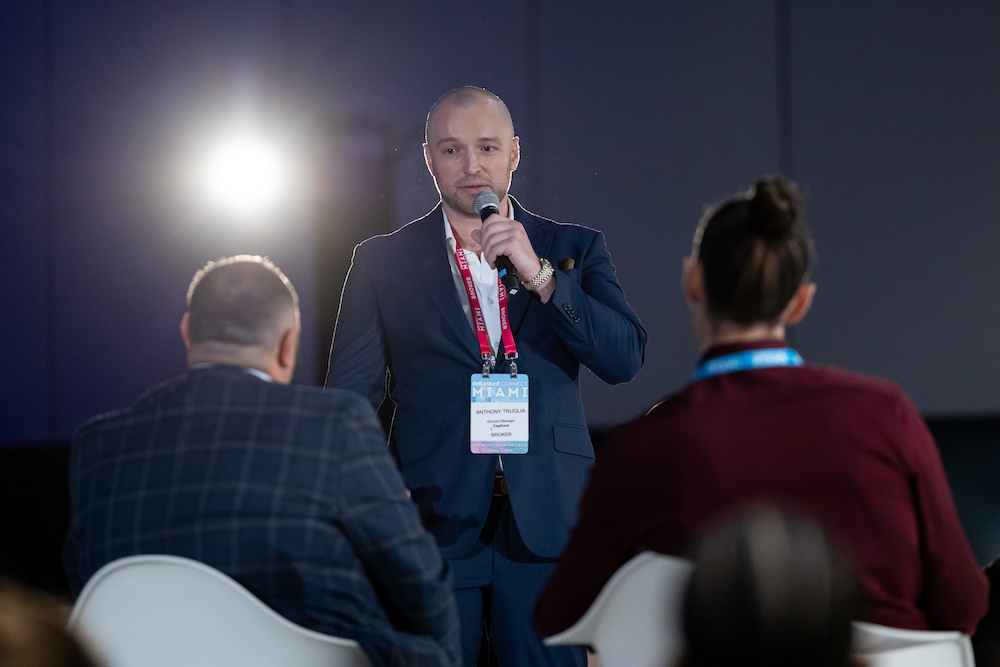
If you sell revenue based financing, SBA lending, or equipment financing, AltFinanceDaily MIAMI invites YOU to compete in Broker Battle 2 in Miami Beach at the Fontainebleau on February 20th. It’s simple, just register to enter it here if you’re already attending the event, and be judged in a short qualifying round in person during AltFinanceDaily MIAMI. The two highest scored contenders for each of the 3 aforementioned categories will compete on stage at the conclusion of the event for a short championship.
THE WINNER OF EACH CATEGORY GETS:
- $3,000
- TROPHY
- TITLE OF BEING TOP BROKER
- INTERVIEW WITH ALTFINANCEDAILY (AT YOUR DISCRETION)
This year, Anthony Truglia, the winner of Broker Battle 1, will return as an MC! The judges are a mix of previous participants and industry veterans who are ready to make the competition one you won’t want to miss participating in. All attendees of AltFinanceDaily MIAMI will get to watch the battle as part of the day’s normal course of activity. See the photos from last year’s inaugural battle here or watch the full video to see what it was all about below!
Are You The Top Broker?!
November 21, 2024
Broker Battle returns on February 20, 2025 at AltFinanceDaily CONNECT MIAMI. The competition, now the 2nd ever after last year’s very successful launch, is back with an improved format that allows for almost any qualified broker the opportunity to be tested LIVE in person. Broker Battle TWO will also have 3 separate broker categories versus last year’s catch-all. Those categories are Revenue Based Finance, SBA Lending, and Equipment Financing.

All competing brokers will be vetted, tested, and scored through very short judging rounds on the showcase floor. The two top scores from each category will actually compete on stage for the championship.
That means that as opposed to last year’s 6 total contestants and 7 separate battles on stage, this year’s competition could feasibly manage up to 100 contestants for which there will only be 3 total battles on stage (each being a championship). The format allows for more brokers to prove themselves in person while reducing total stage time for the final grand performance.
Each broker will win a cash prize and the distinction of being Top Broker (in their category). To be eligible for entry, you must be an active broker with good ethics and a positive reputation. You must also be registered to attend AltFinanceDaily CONNECT MIAMI where it will take place and enter yourself in the battle itself here.
Broker Battle intends to foster best practices.