OnDeck / Enova Merger Overwhelmingly Approved by Shareholders
October 8, 2020The drama surrounding what OnDeck allegedly did or did not disclose to shareholders about the Enova merger presumably came to an end on Wednesday. 38 million voting shares approved the deal while less than half a million voted against it.
However, shareholders sent a message by voting against “the compensation that may be paid or become payable to the Company’s named executive officers that is based on or otherwise relates to the merger.”
OnDeck has said that the merger is expected to be completed in the fourth quarter of 2020.
Following Nine Lawsuits, OnDeck Discloses Supplementary Details Behind Planned Enova Merger
September 28, 2020
After OnDeck announced its planned merger with Enova, it was sued nine different times (See here and here) by shareholders that accused the company’s Board of Directors that they had failed to disclose material information about the deal.
OnDeck formally responded on Monday, September 28th, wherein they disclosed that plaintiffs in all of those actions had agreed to dismiss their claims in light of the release of this supplemental information:
The Company and Enova believe that the claims asserted in the Actions are without merit and that no supplemental disclosures are required under applicable law. However, in an effort to put the claims that were or could have been asserted to rest, to avoid nuisance, minimize costs and avoid potential transaction delays, and without admitting any liability or wrongdoing, the Company has determined to voluntarily supplement the Proxy Statement/Prospectus as described in this Current Report on Form 8-K to address claims asserted in the Actions, and the plaintiffs in the Actions have agreed to voluntarily dismiss the Actions in light of, among other things, this supplemental disclosure. Nothing in this Current Report on Form 8-K shall be deemed an admission of the legal necessity or materiality of any of the disclosures set forth herein. To the contrary, the Company and the other defendants specifically deny all allegations in the Actions that any additional disclosure was or is required and expressly maintain that, to the extent applicable, they have complied with their respective legal obligations.
OnDeck first re-explained its background situation leading up to the Enova deal:
Starting in April 2020, OnDeck management commenced a review of potential financing options to secure additional liquidity and potentially replace the Corporate Line Facility and began contacting potential sources of alternative financing, including mezzanine debt. OnDeck contacted, or was contacted by, more than ten potential sources of mezzanine or alternative financing, and received pricing indications from four sources. The interest rates offered by those alternative financing sources ranged from 1-month LIBOR plus 900 basis points to 1,700 basis points (in addition to an upfront fee) and all but one required a significantly dilutive equity component. The one proposal that did not include an equity component was at an interest rate of 1-month LIBOR plus 1,400 basis points to 1,700 basis points. Based on the initial term sheets proposed, OnDeck engaged in negotiations with each of the four potential sources of alternative financing. As these negotiations progressed and COVID-19’s impact on the macro economy and OnDeck’s loan portfolio intensified, two of the four potential sources of alternative financing ceased to actively participate in negotiations. Discussions with the final two potential sources of alternative financing remained ongoing through the time that OnDeck and Enova entered into the merger agreement. Throughout the Process, OnDeck management reported the status of such negotiations on a frequent and ongoing basis to the OnDeck Board for its deliberation in the context of OnDeck’s standalone plan, and the OnDeck Board considered the significant uncertainty of being able to reach agreement on alternative financing in its decision to enter into the merger agreement.
Of particular contention in the deal were OnDeck’s financial projections, prepared to estimate OnDeck’s trajectory as an independent entity. Shareholders complained that there were two sets of books and that they only got to see one. The other set, dubbed Scenario 1, had been used to shop OnDeck around to other suitors. OnDeck published both sets in their supplemental materials on Monday.
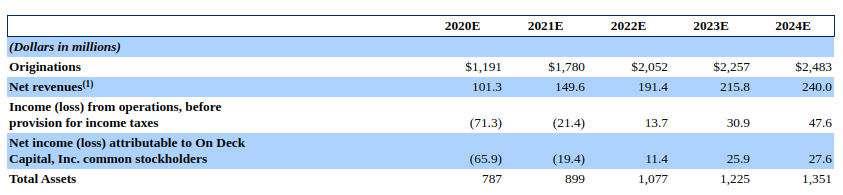
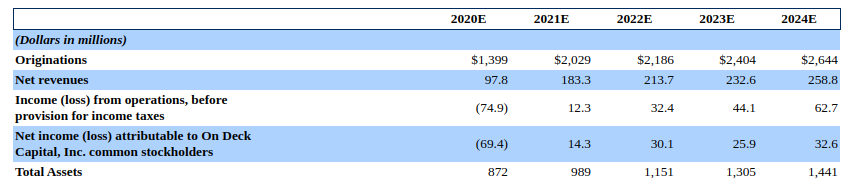
The difference is stark. Originally disclosed to shareholders was a projected cumulative net loss of $20.4 million through the end of 2024. The other set of projections, Scenario 1, state a cumulative net income of $33.5 million over the same time period, a difference of over $50 million.
The original predicted a 2021 net loss of $19.4 million while Scenario 1 predicted a net income of $14.3 million.
One reason offered for selecting the less optimistic of the two is that OnDeck’s management determined that loan originations were trending below both sets of projections as of July 12th. OnDeck announced the Enova deal about two weeks later.
Shareholders will cast their votes on the merger on October 7th. OnDeck’s Board “unanimously recommends” that they vote in favor of the proposed merger with Enova.
Additional Lawsuits Filed Against OnDeck Directors Over Enova Deal
September 14, 2020At least three federal lawsuits have been filed against the directors of OnDeck relating to the announcement that the company is being acquired by Enova. These suits allege securities act violations with regards to how the technical aspects of the deal were disclosed while the initially reported action in the Delaware Court of Chancery alleged a breach of fiduciary duty.
The federal securities lawsuits are:
Daniel Senteno v. On Deck Capital, Inc. et al – Case 1:20-cv-01179-MN
Eric Sabatini (on behalf of a class) v On Deck Capital, Inc et al – Case 1:20-cv-01166-MN
Mohamed Aboubih v On Deck Capital, Inc. et al – Case 1:20-cv-07319-Vm
OnDeck Directors Sued in Class Action For Allegedly Withholding “Material Information” From Shareholders To Make Enova Deal Happen
September 8, 2020 An OnDeck shareholder is asking the Delaware Court of Chancery to halt the sale of the company to Enova until OnDeck discloses allegedly material information that would appear to put the landmark deal in an entirely new light.
On September 4, Conrad Doaty filed a class action lawsuit against Noah Breslow, Daniel S. Henson, Chandra Dhandapani, Bruce P. Nolop, Manolo Sánchez, Jane J. Thompson, Ronald F. Verni, and Neil E. Wolfson for breaching their fiduciary duties owed to the public shareholders of OnDeck.
According to Doaty, the Enova offer of $90 million ($82 million stock, $8 million in cash) was not even the best bid that OnDeck received but he alleges that OnDeck’s directors and executives took it because they were individually offered “exorbitant personal compensation” including “millions of dollars in severance packages, accelerated stock options, performance awards, golden parachutes and other deal devices to sweeten the offer.”
Doaty makes reference to other bids for OnDeck with specifics including two all-cash offers, one that valued OnDeck at between $100 million and $125 million and one that valued it at between $80 million and $110 million. He says that no explanation for their rejection was disclosed.
Doaty also alleges that OnDeck relied on two sets of financial projections to evaluate a sale of the company, one for all prospective bidders (that projected a quick economic recovery) and another set that was used only for Enova (that projected a slow economic recovery). Doaty’s point is that Enova’s valuation was based on less optimistic data and that OnDeck did not publicly disclose to shareholders the more optimistic version that all the other prospective buyers of the company got to see.
“Most significantly, is that it is not pressing time to sell,” Doaty says. “The company was not facing imminent financial collapse or financial ruin.” He continues by pointing out that the company had $150 million of cash on hand and that it had successfully navigated workouts with its creditors over issues caused by the pandemic.
“Yet as a result of the frantic and unreasonable timing of the sale, the consideration offered for OnDeck is woefully inadequate.”
In addition to “exorbitant personal compensation” promised to the Board members, Doaty argues that a cheap price benefits parties who sat on both sides of the transaction, namely Dimensional Fund Advisors LP, BlackRock, Inc., and Renaissance Technologies, LLC, all of whom are said to hold greater than 5% beneficial ownership interest in both OnDeck and Enova. None of them are named as defendants.
“…even if the exchange ratio is unfair,” Doaty argues, “those institutional investors will still benefit from seeing their positions in Enova benefitted. Non-insider stockholders, on the other hand, will not be parties to the benefit.”
The law firm representing the plaintiff in Delaware is Cooch and Taylor, P.A.
Case ID #: 2020-0763 in the Delaware Court of Chancery.
You can download the full complaint here.
As an aside, AltFinanceDaily mused two days prior to the filing of this lawsuit that the sales price of OnDeck was so low that early OnDeck shareholders stand to recover less of their investment as a result of this deal than investors in a rival company that was placed in a court-ordered receivership by the SEC.
Become CEO Eden Amirav Speaks Optimistically About Kabbage and OnDeck Acquisitions
August 31, 2020 Eden Amirav, CEO and co-founder of Become, shared his optimistic insight into what the recent round of acquisitions in the fintech lending world might mean. With the purchase of Kabbage by AMEX and OnDeck by Enova, the industry is moving toward consolidation.
“For many years, we saw many different players and high competition, now we’re starting to see consolidation,” Amirav said. “When a big player like AMEX puts in close to $1 billion [allegedly] in an acquisition of the IP and tech of Kabbage- an amazing technology for underwriting- we think that it’s a very good sign of belief in the industry, it shows the huge potential that AMEX sees in it.”
Eden said from the beginning, Become was happy to be a part of the journey of Kabbage as a partner.
Become is a company that empowers small businesses to improve their fundability and choose lending options through proprietary tech that rates businesses for their loan potential. Become has been a partner with Kabbage in the past, the company says.
Last year, Become underwent a rebranding, adopting a contact-free tech-only mindset. Needless to say, that move came with some unforeseen benefits- contact-free finance is now the name of the game.
Become partnered with Kabbage for loan facilitation in PPP, and Amirav said it was a huge opportunity for alternative finance.
“At the beginning [of the pandemic] there was no supply – practically all the lenders stopped lending,” Amirav said. “We built a very quick process that allows small business to sign the PPP and get the forms ready and get access to the funds as quickly as possible.”
Amirav said that it is because of the dire need for capital and traditional institutions’ inability to respond that alternative fintech markets became so attractive. He hopes that through the purchase, Become will have the opportunity to keep working with Kabbage and feature AMEX on the platform.
“Now that PPP is over we will start seeing alternative lending come back with a more important role- and I think the fintech lending industry as a whole has proven that it has an important role in assisting small business,” Amirav said. “Banks are serving big companies and traditional clients, fintech companies are really there to serve the mom and pop shops.”
Enova & OnDeck: Behind The Biggest Deal of 2020
July 29, 2020 Enova CEO David Fisher kicked off his company’s 2nd quarter earnings call on Tuesday and one could tell from the pitch in his voice that he was excited. And why shouldn’t he be? Despite the catastrophe that gripped the nation over the months of April, May and June, Enova still manages to report a consolidated net PROFIT of $48 million.
But that’s not even it. After a long introduction about a major acquisition, a rather familiar voice is asked to deliver some prepared remarks.
“Thanks David, I am equally excited…”
It’s Noah Breslow, the CEO of OnDeck. Less than an hour earlier it was revealed that Enova had bought 100% of OnDeck’s outstanding shares for $90 million in a deal paid for almost entirely with stock. And now suddenly he’s here on this call talking about how great it is that the companies are combining forces.
“Following an extensive review of our strategic options, we believe this is the right path forward for our customers, employees, and shareholders,” Breslow says.
That OnDeck has been acquired is no surprise. The devastating impact of COVID in Q1 reveals weaknesses in the company’s business model and the share price drops by 80% from the period of February to July. This all while two of their competitors in the small business lending space, Square and PayPal, experience enormous gains of more than 40%.
 In May, Forbes reported grim news, that OnDeck is being shopped around in “what amounts to a fire sale.”
The rumor creates further despair in an industry that is preoccupied with survival. If this can happen to OnDeck, then…?
The truth is, OnDeck’s momentum had stalled long before COVID. The company walked away from a sale to Wonga in 2012 that had valued them at $250 million and they went on to have a successful IPO in 2014 at a value of $1.32 billion on the selling point that they were a tech company.
But by mid-February of this year, the company’s market cap is down to less than $250 million, turning the clock backwards by about eight years. After losing the partnership with Chase in 2019, OnDeck seemed to have lost its swagger and direction. They planned to pursue a bank charter and do a stock buyback. Then the news pretty much stops.
COVID happens and it hits them hard. The company stopped lending entirely, although they still recorded originations of $66 million in Q2.
As a standalone entity, OnDeck’s upside had greatly diminished. Getting back to where it was pre-COVID may not have been an entirely enticing prospect for investors. Its market cap recently plummeted to less than $50 million and so by the time the Enova price of $90 million is announced, it sounds almost generous. (Knight Capital sold for $27.8M in November).
Enova says that the acquisition increases their concentration in small business lending from 15% to 60%. That puts consumer lending, their historical core business, now in the minority. This is not by accident. On the earnings call, Enova executives say that they believe that “there will be strong demand for capital from small businesses as the economy begins to open back up.” They even believe the opportunity is better than the consumer lending market right now, particularly from a regulatory perspective, they say. Therefore it makes sense to “double down or triple down” on the small business side, they contend.
Enova’s small business lending business was largely spared by COVID. Unlike OnDeck’s brutal Q1, Enova had reported something “very much manageable” thanks to not having “large exposures to entertainment, hospitality and restaurants.”
“Our portfolio has been extremely stable,” Enova says on the call. With the acquisition of OnDeck, the company appears to be gearing up for the opportunity they believe awaits in small business lending right around the corner.
7/17 Update: OnDeck Still Negotiating Workouts With Creditors
July 17, 2020This morning, OnDeck disclosed that it was still actively engaged in securing workout arrangements with its creditors.
For its corporate debt facility, OnDeck’s lenders consented to an additional two week extension on the increased monthly principal repayments that OnDeck is required to pay as a result of the company’s covid-impacted portfolio triggering a rapid payout event. The circumstances mean that OnDeck has to make millions of dollars in loan payments but temporary workouts like these are enabling the company to slow them down.
OnDeck’s asset-backed revolving debt facility, meanwhile, has been spared the consequences of a borrowing base deficiency under a renewed agreement to suspend any designation of such to at least through August 18th.
Layoffs At Ondeck
July 10, 2020 OnDeck issued a round of layoffs this week, new former employees report.
One said that the company had “made changes needed to navigate these unprecedented times.” The layoffs were announced on Wednesday and appear to span both the company’s New York and Denver offices.
Ironically, when AltFinanceDaily sent an email to OnDeck’s head of corporate communications to obtain a comment on the news, the message was returned with an auto response that said that he too was no longer with the company.