
On Deck Capital IPO, An Insider’s Perspective
August 16, 2014It was August 23, 2011, the day the Virginia Earthquake could be felt all the way up in New York City. The four of us were enjoying outdoor seating at a restaurant on the Upper East Side. The ground shook, my drink spilled and Ace looked at each one of us and said, “Okay so I’m putting you down for five deals this month.” OnDeck Capital’s relationship managers were aggressive. If you were a small Independent Sales Organization (ISO), they didn’t expect to get all of your dealflow so they roped you in little by little. It was hard to say no. If five deals was too much, Ace would say three and if three was too much, then he’d put you down for three anyway. Zero was not in the cards. OnDeck owned a specific niche and if you didn’t send your premium credit clients to them, then any ISOs you were competing against would. That was a death knell in those days. Just a few years earlier I would’ve shrugged them off, but public sentiment was changing. Merchants were embracing the fixed daily payment methodology and the merchant cash advance industry would never be the same.
OnDeck Capital is now going public. Will you buy stock?
 I’m in a unique position to discuss OnDeck. I started my career in this industry before they even existed. I’ve competed against them as an underwriter at a rival firm, worked with them as a referral partner when I was in sales, and covered them in my capacity as Chief Editor of an industry trade publication.
I left my post as Merchant Cash & Capital’s Director of Underwriting in late 2008. I was 25, about a year or two older than the average employee in the industry. Several of MCC’s rivals got demolished in the financial crisis but OnDeck wasn’t one of them. They also weren’t much of a competitor either. Struggling to define themselves as the anti-merchant cash advance, their product ran counter to the spirit of the industry’s rise. The single biggest allure of a merchant cash advance wasn’t that it was easy to obtain but that there was no fixed repayment term. The funds came with a pre-determined net cost but no specific date on when the delivery of future sales would be due.
Outsiders like the news media aren’t exactly sure what separates merchant cash advance from OnDeck except for maybe the cost of funds. Cash advance just sounds expensive, doesn’t it?
Outsiders identify the company by three characteristics.
1. They’re a non-bank business lender
2. They’re more expensive than a bank
3. They’re a tech company
These bullet points gloss over the fact that OnDeck’s loans require payments to be made every day. Can you imagine a credit card company forcing you to send a payment every day of the month? Or your landlord asking for rent on the 1st of the month, the 2nd, the 3rd, 4th, 5th, and so on every day until your lease is up?
This is not to say that this system is necessarily bad for borrowers, but that it is quite possibly the most unique and important part of what makes OnDeck different. It’s their secret sauce. It is why OnDeck gets lumped in with merchant cash advance companies in many conversations. OnDeck and the legion of copycats they have spawned are part of a broader industry that includes merchant cash advance companies. I call them daily funders. Daily funders provide financing on the condition that payments are made daily. I don’t call them daily lenders because traditional merchant cash advance products are not made by lenders, but by a unique group of investors that purchase future revenue streams.
Transition
Under company founder Mitch Jacobs, OnDeck had established themselves as the de facto loan option.
The merchant’s not biting on merchant cash advance? Send it to OnDeck. The merchant doesn’t accept credit cards? Send it to OnDeck.
They were every merchant cash advance ISO’s frenemy. They’d solicit you for your deals and then throw you under the bus to journalists as evil purveyors of expensive financing. They needed us to source dealflow and we needed them to maximize closing ratios but neither was quite satisfied with the arrangement.
When the company’s first employee took over as CEO in June 2012, the rhetoric changed. While still happy to be portrayed as the anti-merchant cash advance, OnDeck transformed their image from a niche Wall Street lender to a Silicon Valley-esque tech company. Noah Breslow was a curious choice. He has a BS from MIT and an MBA from Harvard Business School. He’s tall, charismatic, and he introduced vocabulary words such as algorithm to an industry that relied entirely on manual human underwriting.
At a recent lending conference, the younger crowd characterized Breslow as the Steve Jobs of business loans. He commands a cult-like following inside and outside the company, and in 2013 was embraced by New York City’s Mayor Bloomberg.
Breslow fast tracked OnDeck. With only $43 million raised in the first 5 years, the company went on to raise more than $300 million in the first 24 months under Breslow’s leadership.
This was their plan all along
In November 2012, OnDeck entertained a buyout offer from UK-based payday lender Wonga in which they reportedly received a $250 million valuation. The deal fell apart in the late stages but at the time I believed the negotiations were all a ploy for OnDeck to get a true market valuation. With a solid offer on the table, they knew both where they stood and where they needed to go. Last week the WSJ reported that preliminary IPO discussions valued them at $1.5 billion, six times higher than where they were two years ago.
With stock options being offered to new employees at least as far back as 2012, the plan to go public should come as no surprise. Later this year, those employees may actually get to do something very few startup workers ever get to do, convert those options into real shares.
So will OnDeck ride off into the sunset of billion dollar bliss? Not so fast say several industry insiders, some of whom are itching to short the stock on the first day they can.
 Smoke and mirrors?
As OnDeck took advantage of the swing in public consensus (that fixed terms were better and lower costs increased the attactiveness ), insiders began to ask an important question. Why weren’t merchant cash advance companies collectively countering with lower prices to remain competitive? Greed was fingered by journalists especially in the wake of the financial crisis. But greed is a weak prerogative if you consider that merchant cash advance companies were filing for bankruptcy left and right in 2009.
And oddly or perhaps even ominously, an entire segment of merchant cash advance companies began to raise their prices just as OnDeck was lowering theirs. When I wrote The Fork in the Merchant Cash Advance Road in April 2011, I said:
While the margins earned on high credit accounts shrank, funding providers were dealing with another challenge simultaneously, defaults. Whether the business owner intentionally interfered with their credit card processing or the store went out of business altogether, bad debt in the MCA world was mounting…FAST!
Risk was and still is the number one reason that merchant cash advances cost so much. While it’s true that OnDeck serviced higher credit businesses, insiders speculated that the spreads were too thin. For years, OnDeck’s merchant cash advance competitors have doubted the soundness of their model.
 It’s a debate that continues even to this day and yet OnDeck has secured hundreds of millions in investments from companies like Google Ventures, Goldman Sachs, Peter Thiel, and Fortress Investment Group. Their notes got an investment grade rating from DBRS. And as far as volume is concerned, they have likely eclipsed the industry’s all time reigning giant CAN Capital. If they had reached none of these milestones, OnDeck would have little credibility to convince critics of their sanity.
With a mountain of circumstantial evidence through big name backing in OnDeck’s favor, it seems to be indicative that the skeptics are wrong. But maybe they’re not. Could their model be both seriously flawed and superior at the same time?
It’s all about eyeballs
Going back to the 1990s, Internet companies have been judged, valued, and made famous by the price of eyeballs and the number of site visits. It’s a measure that’s never disappeared and according to USA Today is making a comeback. And while OnDeck Capital has always been based in New York City, true to their Silicon Valley form, their model has been to conquer market share first  and take on profitability second. In their case, it’s not eyeballs or site visits, it’s loan origination volume.
Five months ago Breslow was quoted in the WSJ as saying OnDeck is “imminently profitable“. With seven years in business, it’s proof that their critics have been right all along, that their model doesn’t make money.
What scares their competitors though, is that this strategy has been intentional. Very few if any players in the industry have had the luxury, guts, or the purse to lose money for seven years as part of a coup to conquer the market. Disbelievers in this long term wildly risky strategy are salivating at the opportunity to inspect the company’s financial statements in the IPO.
In When Will the Bubble Burst?, RapidAdvance CEO Jeremy Brown, whose company became part of the Quicken Loans family last winter, fired shots at OnDeck, “To accomplish high growth rates, which may be driven by a desire or need for an IPO or to raise investment or to sell to private equity, assets are being overpaid for through higher than economically justified commissions (I’ve heard 12-15 points upfront from the more aggressive companies) and stretch the repayment term of the MCA or loan even further (On Deck24, I am talking about you).”
Insiders testify that OnDeck’s strategy has not so much been about lower costs but about growth at all costs. Among the evidence is the sudden removal of an industry-wide practice of verifying the business owner is current on their rent. Repayment terms are getting stretched out, commissions have shot up, and for a while they ran a program that allowed applicants to get funding with the submission of just a single bank statement.
Merchant cash advance companies look at their own default figures and scoff at the notion that OnDeck’s aggressive practices could produce low single digit defaults as they’ve publicly claimed.
Imminent
 Through it all, there remains the fact that OnDeck has never claimed their methodologies to be profitable, at least not yet. Red ink at IPO time might reward their detractors with a certain delicious satisfaction, but what will they say if and when they become profitable?
I’m reminded of The 20 Smartest Things Amazon Founder Jeff Bezos ever said. Below is a few of them.
- “There are two kinds of companies: Those that work to try to charge more and those that work to charge less. We will be the second.”
- “Your margin is my opportunity.”
- “We’ve done price elasticity studies, and the answer is always that we should raise prices. We don’t do that, because we believe — and we have to take this as an article of faith — that by keeping our prices very, very low, we earn trust with customers over time, and that that actually does maximize free cash flow over the long term.”
- “If you never want to be criticized, for goodness’ sake don’t do anything new.”
- “Invention requires a long-term willingness to be misunderstood. You do something that you genuinely believe in, that you have conviction about, but for a long period of time, well-meaning people may criticize that effort. When you receive criticism from well-meaning people, it pays to ask, ‘Are they right?’ And if they are, you need to adapt what they’re doing. If they’re not right, if you really have conviction that they’re not right, you need to have that long-term willingness to be misunderstood. It’s a key part of invention.”
I wonder if the executive team at OnDeck would share these philosophies.
They’ve always claimed themselves to be a tech company, much to the bewilderment of their competitors. Will technology come through for them?
The data available on businesses has changed. Bank statements and a credit report might’ve been all there was to go on when the company first started, but in Automated Intelligence Breslow said, “the fact is most businesses operating today, in 2014, are already technology focused to one degree or another. They have computers, they have online banking, they use credit card processors, their customers are reviewing them online, there are public records, etc. All this electronic data helps paint a deeper and more accurate picture of the health of a business.”
With such easy access to important data, it might be possible that through the use of 2,000 data points, OnDeck doesn’t need to do all the manual investigations that their competitors still place high values on. The available data might be able to predict loan repayment success just as well as a human analyst.
And if that’s true, then they can reduce the cost of overhead as they scale. As their predictive algorithms get fed more data, they might be able to eliminate humans altogether. At the May 2014 LendIt conference, Breslow admitted that 30% of their loans were still manually underwritten but said that “if customers want full automation, we are prepared to deliver it.”
By that charge, a sustainable model should not be that far out of reach. Through advanced data analysis and decreasing fixed costs, profitability may indeed be imminent.
Winner
If the story of the merchant cash advance industry has been a race to the top, then OnDeck might be declared the winner in a successful IPO. It would be an ironic achievement for the company that positioned itself as the anti-merchant cash advance. In their wake today are hundreds of daily funders offering fixed payment products.
 OnDeck’s critics are in a paradoxical position because a successful IPO is good for them too. They want to believe OnDeck’s model never worked, can’t work, and have it be proven a failure. But if it goes the other way, the legitimacy of the daily funder universe will be solidified in the mainstream. What’s good for the goose is good for the gander.
As AmeriMerchant CEO David Goldin said to Inc, “the OnDeck IPO shows that Wall Street is now taking this industry seriously.”
So does that mean he’d buy stock? Somewhere out there at a restaurant in New York City, an OnDeck relationship manager is probably putting Goldin down for five shares.
Cue the earthquake, the industry will never be the same.
Curious how it will change it exactly? Read my magazine published prediction, The Retail Investor.
Is Alternative Lending a Game of Thrones?
April 8, 2014 It was the best of times, it was the worst of times, it was the age of wisdom, it was the age of foolishness, it was the epoch of belief, it was the epoch of incredulity, it was the season of Light, it was the season of Darkness, it was the spring of hope, it was the winter of despair, we had everything before us, we had nothing before us…
This blog has been many things over the years, all of it relative to who the reader was. It has encouraged and deterred, informed and confused, made people laugh or stoked their anger. The merchant cash advance industry it spoke of had been small. Annual funding volume was a billion or two or three, a blip of a blip on nobody’s radar. There was a sense of unity, a shared objective amongst competitors. They were guided by one dictum, “grow, but don’t rock the boat.”
But opportunity enticed everyone, the good, the bad, and the unexpected, and it brought a relatively peaceful chapter to an end. Winter is coming, Eddard Stark would likely say of the uncertainty that hangs in the air. Merchant cash advance has become a spoke in the alternative lending wheel that is spinning forward uncontrollably. Non-bank financing has become a worldwide phenomenon virtually overnight, setting the stage for the lords of funding to play a game of thrones. Investors with bottomless pockets are emptying them, government agencies are assessing the landscape or crafting responses, and journalists stand ready to shape public opinion.
This is a transformational moment in human history, perhaps bigger than what Facebook did for social media. Individuals are taking control of the monetary supply. Strangers pay each other in bitcoins, neighbors are bypassing banks for loans and lending to each other instead, and businesses are rising and falling with the funding they get from other private businesses. Winter is coming for traditional banking. The realm calls for a new king.
Wonga’s epic rise is being countered by both regulatory and religious resistance, and the man who dared the world to lend algorithmically has admitted defeat. Peer-to-peer lenders have encountered massive regulatory setbacks on their road to stardom and merchant cash advance companies are currently engaged in a civil war over best practices. Winter is coming indeed.
The Kings
 Lending Club
In what is perhaps their first step towards an IPO this year, Lending Club is reducing transparency over its loan volume. Up until April 3rd, anyone could see how many loans they issued on a daily basis. Now this information will only be available quarterly. Peter Renton in his Lend Academy blog shared his belief that the move was entirely tied to the impending IPO. “Without this daily loan volume information their stock price will be less volatile and they will be able to “manage the message” with Wall Street every quarter,” Renton wrote.
OnDeck Capital
OnDeck Capital is also in contention for an IPO this year. A year ago a company executive hinted that becoming a public company would not be on the agenda for consideration until 2015, yet I am hearing rumors that they may make a late 2014 go at it. Such rumors hold weight in light of reports that they are cleaning up their ISO channel. Insiders on DailyFunder are saying that resellers with abnormally high default rates are in jeopardy of being cut off.
OnDeck Capital is unique in that outsiders chastise them for their rates being too high while insiders argue their rates are too low to be profitable. It’s a classic example of how tough the court of public opinion can be on a lender even if they are not getting rich off their loans.
Kabbage
Kabbage came and conquered the entire online space before anyone had a chance to blink. PayPal, ebay, Amazon, Etsy, Yahoo, Square, they claimed those territories for themselves and then launched an attack into the brick and mortar space. Kabbage’s secret value is their patents. They are a serious player on a serious path.
CAN Capital
CAN Capital’s greatest weakness is their lifespan. They’ve managed to stay on top after 16 years in the business but that makes them old enough to be Kabbage’s grandfather by today’s tech standards. As a pre-dot com era business, it’s impossible to argue against their sustainability. If anyone has alternative lending figured out for both the good times and the bad, it’s CAN Capital.
The Lords
The Government
 Peer-to-peer lending has already been under strong scrutiny from the Federal Government. Lending Club and Prosper are regulated by the Securities and Exchange Commission these days, but they may never be free of oversight. Just two months ago, the Federal Reserve published a report on trends in peer-to-peer business lending. They hinted at further regulation.
As small business owners are increasingly turning to this alternative source of money to fund their businesses, policy makers may wish to keep a close eye on both levels and terms of such lending. Because such loans require less paperwork than traditional loans, they may be considered relatively attractive. However, given the relatively higher rate paid on such loans, it may be in the best interest of the business owner to pursue more formal options. More research is required to understand the long-term impact of such loans on the longevity of the firm and more education to potential borrowers is likely in order.
– a 2014 Federal Reserve study
The Merchants
Once upon a time nobody talked about alternative lending online except for the companies offering it. Merchants didn’t talk about it with each other or there were too few businesses to give rise to centralized discussions. Today, merchants communicate and compare notes:
Merchants discuss PayPal’s working Capital program: http://community.ebay.com/t5/PayPal/PayPal-Working-Capital-Loan-DONT-SIGN-UP/td-p/17630207
Merchants discuss Square’s merchant cash advance program: http://www.mrmoneymustache.com/forum/welcome-to-the-forum/square-to-offer-small-business-loans-at-exorbitant-interest-rates/
Merchants discuss Kabbage: http://community.ebay.com/t5/Part-time-eBay-Sellers/Kabbage-quot-loans-quot/td-p/3002329
OnDeck Capital’s 30+ Yelp Reviews: http://www.yelp.com/not_recommended_reviews/FOndxpkaBRP6LVIlOv6Dfw
Potential Lending Club borrowers make their cases: http://www.lendacademy.com/forum/index.php?board=3.0
The Machines
Are computers better predictors of performance than humans? Some people think so. This debate will play a pivotal role in the future of alternative lending.
The Media
Public opinion will be at their mercy.
The Vulnerabilities
 Commissions
The bigger alternative lending gets, the juicier the stories become. Just last week, Patrick Clark of BusinessWeek dove head first into the reseller model, revealing insider commissions, the truth about buy rates, and the alleged antiquated practice of enlisting a broker to secure funding. On trial was a documented 17% commission, an example I believed to be an extreme case. For a long time commissions ranged between 5% and 10% on average. But there are some big names paying up to 12 points and others boasting of 14. All were topped by the mass solicitation I received a few days ago that promised a 20% commission. These kind of figures if they continue will become an easy target for journalists looking to portray the industry in a negative light.
Stacking
There is a raging civil war within the merchant cash advance community specifically over stacking. This is the instance that a merchant sells their future revenues to two or more parties at the same time, leading to multiple daily deductions from their sales. This debate is bound to spill out into the mainstream if it cannot be resolved on its own.
Technology
Some funding companies intend to license their automated underwriting technology to banks, potentially handing the keys of alternative lending’s greatest asset (speed) to traditional bankers. It is unlikely that banks would engage in some of the high risk deals that alternative lenders target but they could recapture the top credit tier borrowers that have been flocking away from them.
Also at stake here is the sustainability of algorithmic underwriting. There are critics that believe computers appear to make great decisions during good economic periods but suffer during downturns. Do the technology based funding companies have enough data to weather a future economic storm?
So many things are happening at once, that it’s impossible to know what fate awaits the realm. Will there be a new king or will alternative lending fall apart like a house of cards?
For those of us climbing to the top of the food chain, there can be no mercy. There is but one rule: hunt or be hunted.
-Frank Underwood
May the best man win.
Is There Cause for Alarm?
March 8, 2014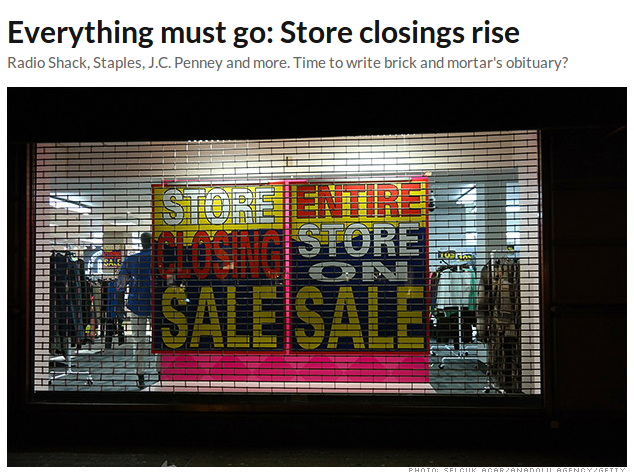
Brick and mortar chain stores died this week, after a long illness. Born along Main Street, raised in shopping malls across post-World War II America, the traditional store enjoyed decades of good health, wealth and steady growth. But in recent years its fortunes have declined. Survived by Amazon.com and online outfits too numerous to list.
– CNN 3/7/14
Just a day after Jeremy Brown’s new CEO Corner post appeared on DailyFunder with an overt bubble warning, CNN’s Chris Isidore alluded that the era of brick & mortar retail may be drawing to a close. In Isidore’s brief sensational article, he fingers an overabundance of retail space, a weak economy, and the Internet as the culprits behind Main Street‘s decline.
In the broad alternative business lending industry, the sentiment is quite the opposite. Small business demand for working capital is surging and no one is predicting anything less than stellar growth for the foreseeable future. But is the growth real?
Jeremy Brown is the CEO of Bethesda, MD-based RapidAdvance and he explains the growth may not be what it appears to be on the surface. Some cash providers are overpaying commissions, stretching out terms longer than what their risk tolerance supports, and are growing by funding businesses that have already been funded by someone else (a practice known as stacking).
If the industry collectively booked 50,000 deals in 2013 and increased that to 100,000 deals in 2014, you’d have 100% growth, or at least it would appear that way on the surface. What if the additional 50,000 deals funded this year were not new clients but rather additional advances and loans made to existing clients? It’s a lot easier to give all of your clients money twice instead of acquiring new ones.
This all begs the question, is demand for non-bank financing really growing by leaps and bounds? Or does it just appear that way because those that have already utilized it are demanding more of it?
Brown left his readers with this conclusion, “There will be a rebalancing at some point. And it will not be pretty.”
Chime in with your thoughts about this on DailyFunder.
—–
When Will the Bubble Burst? by Jeremy Brown will also appear in the next print issue of DailyFunder. If you haven’t subscribed to the magazine already, you can do so HERE.
Google Penguin 2.1 Takes Swing at Merchant Cash Advance Industry
October 5, 2013 If you noticed a shuffle in search rankings for industry keywords last night, it’s because Google unleashed Penguin 2.1.
Penguin 2.1 launching today. Affects ~1% of searches to a noticeable degree. More info on Penguin: http://t.co/4YSh4sfZQj
— Matt Cutts (@mattcutts) October 4, 2013
Penguin focuses on spammy or purchased backlinks so if you did one or the other, you probably got harmed. Given the high cost of traditional marketing and Pay-Per-Click Internet Marketing, many funders, ISOs, and lead generators have turned to SEO to boost their visibility in organic search. Whether undertaken by inside employees or outside contractors to do the job, there is no doubt that building links has been part of the strategy. Some have had major success in rising up through Google’s search results but most haven’t. It’s not easy getting to page 1, but if you get there, don’t celebrate. You won’t be there forever.
Less than two weeks ago on DailyFunder, someone took to the board to pat themselves on the back for ranking #2 for the keyword: merchant cash advance. Wikipedia is #1. They admitted it took a lot of hard work over the course of 8 months. Last night they were thrust back to position #65. That’s on page 7 where they will never be found. 8 months of work for 2 weeks of ranking. You might be saying, “Well my SEO guy will just roll with the punches and get us right back.” Unfortunately with Penguin, it doesn’t work that way. Penguin is basically a permanent penalty, an algorithmic barricade to prevent you from ever ranking for your keywords again. According to a poll on Search Engine Roundtable, only 7% of respondents claimed to have made a full recovery after Penguin 2.0. Most SEOs would advise that you torch your domain, buy a new one and start a whole new website. That’s not exactly an easy thing for a big brand or company to do.
There’s a flaw in all the SEO being done in the merchant cash advance industry anyway and that’s the notion of being on page 1 to begin with. If you read David Amerland’s Google Semantic Search, he explains that “there is no longer a first page of Google”. The results you see on the first page of Google depend completely on whether or not you’re using a desktop or mobile device, what zip code you’re accessing the internet from, what you’ve searched for in the past, and whether you’re logged into your gmail account. And if you use Google+, then forget it! The first page results for someone that uses Google+ are ultra personalized. To rank on their first page, they’ll pretty much need to follow you socially first.
So if you’re thinking about ranking higher in search as a means to generate more leads, you sure as heck better understand how the results work these days. What you see on your screen is not what I see on mine. A site that’s #65 for me, may be #4 for you.
The other angle of Google’s foray into Semantic Search is their desire to be an answer engine, not a search engine. Google wants to answer questions for searchers without them having to click a link. Here’s an example of Merchant Processing Resource acting in that role:

What is voice authorization you ask? Boom! Answered! No need to click anything. That’s where search is going. What this means for companies that are trying to get customers is that they either need to become the absolute authority within their industry or they need to throw in the towel and do Pay-Per-Click.
When I search for merchant cash advance from my desktop in NYC, 7 out of the top 10 results are not company pages, which is astounding considering how much effort companies are putting in to rank high for this keyword. I see:
- 1 Wikipedia
- 4 News articles
- 1 Press release
- 1 Youtube video
Did you get hit by Penguin 2.1? Are you optimized for Semantic Search?
Previous merchant cash advance SEO articles:
- Your Merchant Cash Advance Press Release May be Hurting You 8/8/13
- Is Google Your Only Web Strategy? 12/31/12
- The Other 93% 7/13/12
- Google Penguin Kills Survivors 5/6/12
- The SEO War Continues 4/4/12
- The SEO War for Merchant Cash Advance 2/12/12
Merchant Cash Advance Competition
June 3, 2013 If I had a dollar for every time someone told me that Kabbage wasn’t a competitor in the Merchant Cash Advance space, I’d have my own funding company. It’s been argued that they only care about Ebay or Paypal and that their business model revolved around strengthening Ebay’s PowerSellers for the good of Ebay. I never really believed that was the case.
On September 11, 2012 I wrote this about Kabbage:
Some people feel that they are not a serious challenger to the status quo and that their tactics, methods, and headlines are merely shock value fodder for the rest of us to laugh at while we all rant and rave about ACH deals being the hottest thing since Square. We believe Kabbage is a company everyone should keep an eye on.
Kabbage analyzes many pieces of data in their underwriting including how many facebook fans a business has or added. And as of 2 weeks ago, what do you think happened?
Kabbage expanded their cash advance programs to brick and mortar businesses… (BusinessWeek)
And so here we are with yet another fierce well-capitalized competitor, a company that isn’t struggling to add technology but is rooted in it. Not only that, but last I heard they don’t work with brokers or agents. They cut out the middleman, much like Square did with ISOs.
Which brings me to the next few companies to keep an eye on:
Amazon: People say that their goal is to finance Amazon retailers for the good of Amazon. Sound familiar? I admit that Kabbage wasn’t owned by Paypal but there was a solid relationship there. Is it that ludicrous to think that Amazon will enter the brick and mortar cash advance business?
Groupon: They’ve been sniffing around this industry for quite a while. Keep an eye on them.
American Express: They already have their own cash advance program for premium merchants that accept a high volume of amex transactions. Every six months or so, their standards loosen. It’s only a matter of time until they have enough data to loosen their standards even more and compete head to head with the rest of the alternative business lending industry and cash advance industry.
———-
Scott Griest, the CEO of American Finance Solutions wrote in Disruption in the Alternative Business Lending Space that when all the dust settles in a couple years down the road, there will be only 4-5 large alternative business lenders. Consolidation and competitive pressure will thin out the herd and the strongest will prevail. The question is, will those 4-5 funding companies be the grass roots companies that propelled the industry to where it is today or will it be the big mega-corporations who are looking at our the industry like a delicious snack?
In one of the most read ever articles of MPR, I made this prediction in The End of an Era:
2014 will eliminate the weaker firms that remain and by 2015, Merchant Cash Advance will no longer be a term that anyone uses. Big banks and billion dollar technology companies will go on to rebrand all that which the funding warriors of the last decade have worked so hard to establish. MCA will simply assimilate into other financial products. The metaphorical Sally, Joe, and Tom will probably still be in the business, but be working for companies like Capital One, Wells Fargo, and American Express.
We weren’t kidding…
Merchant Cash Advance Industry is Busy at Work
May 16, 2013 After what was one of the wildest two weeks in Merchant (MCA) history, the game-changing news finally subsided, but no one is taking a deep breath. Instead, everyone is busy working their butts off trying to help small businesses grow.
UPDATE 5/16: RapidAdvance has acquired the operating assets of ProMAC. First Instance of consolidation that we’ve been predicting would happen this year. See news release detailing the acquisition HERE.
There is just loads of capital available right now and the technology is catching up quick to support the mass deployment of it. A writer for the American Banker believes that the MCA industry is even beginning to threaten community banks.
Many community bankers would be open to using online applications and other technological tools to make faster loan decisions, says Trey Maust, co-president and chief executive at the $121 million-asset Lewis & Clark Bank in Oregon City, Ore. But most community banks use a business model that requires more hands-on interaction with borrowers, he says.
Hands-on is another term for driving back and forth to the bank for appointments, having the bankers visit your business, all the while they try to sign you up for other bank products, like checking accounts that incur a monthly fee.
Who’s at Work
We know some of the major industry players but it’s interesting to see who else is doing significantly large volume. Pearl Capital recently reported funding $7 million in a single month and United Capital source came in at a tad shy of $4 million in just this past April. These are firms you may have heard of already, but they’re now sitting at the big kids table.
What the Generals are Saying
If you haven’t been paying attention to the DailyFunder.com forum, 4 Chief Executives have contributed to the site in a very meaningful way by sharing their thoughts on the MCA industry at large. This is the kind of wisdom you would normally get in bits and pieces through occasional citation in the Green Sheet or other publications, but the full monty has materialized in the very exclusive CEO Corner. Some key highlights from what they’ve shared so far:
Excerpts from Jeremy Brown, CEO of RapidAdvance:
Those of us that have been in this business for 5 years or more – Rapid started in 2005 – are excited at the positive press we get today vs. several years ago and how we are becoming embraced and accepted as a mainstream product. More PE firms, banks, and others want to invest in or lend to the industry. Those groups have always been intrigued by the returns in this industry but the conversations are different today.One thing I think will be different next year are fewer deals offered over 12 months in payback period. When you look at the data over an extended period of time, 18 month term loans don’t make sense for the merchants that are funded. It’s not the most efficient use of funds, limits the ability for the merchant to renew and the longer term deals are far riskier. (See: Year in Review and What Next Year May Bring)
Isn’t that the point of a 6 month MCA – to meet a current need and have the merchant be able to draw again in 4-6 months for the next capital need? That is the problem with the 15 – 24 month deals that are being offered to merchants today. Our industry is based on providing working capital to merchants. By its very definition, working capital is less than 12 months. Longer term deals are permanent capital, even when they are repaid over 15-24 months.it was no surprise when the economy tanked in late 2008 that the merchants in our portfolios at that time took a major hit to sales and therefore the funding companies losses increased by 50% or more on their outstanding portfolios. So what happens when the next recession – big or small – hits and funders have portfolios out to 24 months? It doesn’t take an MBA from Harvard to figure out that answer. (See: Working Capital or Permanent Capital
Haven’t gotten into the industry myself in 2006, I can totally validate the complete 180 in press coverage. I’ve put all my energy into MCA and it’s gratifying to finally hear the praises so many years later.
Excerpts from Steve Sheinbaum, CEO of Merchant Cash and Capital:
The industry already services hundreds of thousands of small business merchants with cash advances for growth and other purposes based upon monthly credit card receipts. For years this has been the basic model of operation. But, what about the substantial number of businesses that require quick and easy access to capital who don’t accept credit cards or don’t produce enough in monthly credit card receipts to qualify under the normal MCA guidelines? Tens of thousands of businesses could use the capital infusions the industry provides daily but either don’t think they’ll qualify or, because of our lack of creativity, the industry hasn’t produced a means of addressing their needs. These businesses would make great customers but because of the rigid requirements we have in place to protect our livelihoods we’ve left money on the proverbial table.That’s not the case anymore. (See: Creativity in the C-Suite…Another way to Fund!)
In regards to advances on gross revenue instead of just credit card payments, he’s absolutely right.
Excerpts from Andy Reiser, CEO of Strategic Funding Source:
the most important part of any deal is the people. We rely heavily on the relationships we have with the client and most importantly with our ISO partners and ISO syndicate partners who invest side by side with us. Valuing these relationships is far more important than relying solely on the numbers and how sophisticated our technology is.Over our 8 year history, we have noticed that the performance of a deal has more to do with the relationship we have with our ISO partner and ISO syndicate partner, then with the deal itself. We have all kinds of tools available to help us analyze the potential success of a deal – FICO scores, due diligence checklists, signed affidavits, warranties and representations, scoring models, algorithms, etc. And yet, some of the ugliest deals on paper have been some of our best performers, while some of the most attractive deals on paper have been nothing but trouble. (See: Business and Baseball Fantasies)
During my time as a head underwriter, I witnessed the exact same thing. Solid referral partners had solid performing clients even if they didn’t look so good on paper. Likewise, the shakier resellers had clients that underperformed across the board, including the deals that looked cleanest.
Excerpts from Craig Hecker, CEO of Rapid Capital Funding
As each MCA company grows and creates a positive reputation, we all grow as an industry…together. But as our popularity grows, however, so does our competition. We already know that Amazon, eBay, and Google are stepping into the market, and AMEX is looking to expand their short term financing portfolio. These big business industry leaders will help build our brand of finance and benefit our portfolios, but I also think it is fundamental that we market ourselves as the alternative to big business finance and identify ourselves with the small business owner. (See: Small Business and How MCA Can Bridge the Gap to Success
We’ve got some big names in the industry now, whether they are financing the merchants directly or backing the funders that do the financing. I agree that you need not be intimidated by competing against these established brand names. Positioning yourself as the funder next door, people that have walked a mile in the merchant’s shoes (literally) can actually be a strong advantage.
What’s Next?
We’re pretty confident there will be more big headlines in the near future but for now we can’t confirm or say anything. DailyFunder.com is also lining up additional industry captains to participate in the CEO Corner and I’m sure there will be plenty of nuggets for us all to dissect. They’re probably the best source of MCA information that you can possibly get.
Stay tuned.
– Merchant Processing Resource
../../
MPR.mobi on iPhone, iPad, and Android
MCA Industry Continues Expansion
April 3, 2013 It’s said that one way to measure success or growth of an industry is to count how much capital is being raised. In that case, Kabbage and On Deck Capital have been on fire lately.
Early this morning, Kabbage announced they had secured a new $75 million line, after having just raised $30 million 6 months ago. The Forbes article announcement states that Kabbage has funded 60,000 deals to date and predicts to fund 100,000 deals in 2013 alone, a figure hard to comprehend considering that’s equivalent to the amount of transactions Capital Access Network has managed to do over the course of 15 years. I understand that Kabbage may do smaller, shorter term deals, but Capital Access Network has dominated MCA for a long time. Could Kabbage really do 100,000 deals this year? I’m unsure about this one.
Are traditional MCA funders missing out by letting Kabbage rule Ebay, Amazon, and Etsy unchecked? Is the Internet really that different than the brick and mortar market? Late last year, Amazon entered the financing market but for the purpose of strengthening their selling partners, so there are several reasons funders are tapping that market.
Paypal has been sitting on the sidelines and is perhaps considering jumping in the ring themselves. They are beta testing now with Ebay sellers.
Merchant Cash Advance is exploding in all directions. Did you hear that Yellowstone Capital funded $700,000 to a restaurant with the help of Strategic Funding Source? That’s a lot of money for a restaurant!
Funding for Startups – An Ongoing Struggle
March 6, 2013Startup. Some people like the term and some people hate it. It doesn’t even mean the same thing to everyone. To some, the mega giant Groupon is a startup and they’ve been in business for almost 4 years and earned $638 million in revenue last quarter. To others, a startup is simply an idea for a business that hasn’t gotten off the ground yet. And to the Merchant Cash Advance industry, startups are people who don’t qualify for funding but manage to come storming through the front gates demanding loans while waving around business plans. There’s a real dilemma in this country. Millions of people aspire to go into business for themselves and very few have any idea what to do. I get exhausted just thinking about this because for many years, I’ve been trying to tackle what you’d think would be a simpler problem, funding people that ALREADY have a business.
 It’s finally gotten much easier for existing businesses to obtain capital, so much so that I started to warn the lenders in a recent article about getting too aggressive with their programs. But all that aside, these lenders have been plagued with an ongoing problem for years, a problem that has caused marketing costs to skyrocket, and have made loans for everyone more expensive. That problem is startups. It’s not that startups aren’t appreciated, it’s just that imagine opening a hair salon and seeing there’s a line of a thousand people waiting outside the door to get in. At first, you’d probably think “wow! we’re going to need to hire 50 more stylists to satisfy all this demand,” but then you find out that 900 of the people waiting were men that were completely bald. It’s awesome that they were interested to come out and get a perm, but without hair, there’s nothing for the stylists to do. The business ends up spending a lot of time and money telling folks with no hair that a mohawk will not be possible, causing the price of haircuts to go up for everyone else.
 Some lenders are so inundated with startups that they stop marketing altogether. Others try to board up their pay-per-click ads with specific instructions for startups to STAY AWAY. It doesn’t reflect very well on the brand to do this, but if bald guys were overrunning a hair salon, the poor stylists would have to do something so they weren’t driven out of business. I’m not making fun of startups per se, I’ve been a part of 3 startups, including my own. I’ve been in the position where I was unsure of what to do first, especially since I never knew anyone that funded people whose businesses weren’t already up and running. Yes, I was the guy who knew tons about business lending and I had no idea how to raise capital for a business that hadn’t yet started.
Oh I knew how to set the gears in motion: perform market research, talk to potential customers about what they want, draw up a plan, incorporate, get the necessary permits, draw up an operating agreement, pay for legal advice, and set aside a large enough cash cushion to pay for at least 3 months expenses in case nothing went as planned. I had enough experience to know what I needed to be ready, but I guess I was still shocked the day I went to a bank to finally open a business account. With my account, the bank granted me a substantial unsecured line of credit. I’m fortunate to have an excellent credit score and that definitely played a role, but try to understand that I walked into the bank with no job and no income. I told them I was starting a business, wanted to open a bank account, and had all my business document ducks in a row and within 2 minutes I was approved for a line. This is after I’ve been hearing for years that no banks were lending, businesses with excellent credit couldn’t get money, and startups had no place to go.
Keep in mind though that I didn’t just walk into the bank and tell them all my good ideas and sum it up by asking for money. Heck, I didn’t even ask for money at all, though it was really nice to have it. I went in showing I meant business and walked out with something that everyone said is impossible to get in this country. I’ll admit there’s a few caveats. I live in New York City, have a decent net worth, have great credit, and have a background in business financing. So I’m not going to pretend that what worked for me is what’s going to work for everyone else.
I’ve always wanted to help the people I couldn’t. So I’ve been wracking my brain for some time as to what to do if a hair salon had 900 bald customers waiting on line. Do you help them regrow their hair first?
 I totally believe in the old fashioned way of raising money, which means making sure you have enough of your own money saved up and taking every measure possible to be ready to launch before looking elsewhere for help. I realized though that many people don’t have the capital to get them as far as opening day, some don’t have strong enough credit to be confident that a bank line would ever be possible, and others just have a dream of something they want to do but have no money to even put their idea to the test. I’d say they were out of luck, but new friends of mine were telling me that’s not exactly right.
Crowdfunding – Get familiar
I recently spoke with Rachael Alford, a crowdfunding consultant who told me that you didn’t need to approach startup capital the old fashioned way. A bank? What’s that? The exact conversation between us is available online and I learned that folks with a serious idea can actually raise money just on the IDEA alone. Crowdfunding means raising money from other people so a lot of effort is required to make it work for you. When you go to a bank, the bank is forced to acknowledge that you applied and then decide to either approve or reject your application. With crowdfunding, your campaign to raise money can be outright ignored. It’s not a “hi, please approve me, bye” experience. Rachael said, “the problem is, people think it is as easy as making a page (on Kickstarter, GoFundMe etc.) and then they can just tweet or share the funding request and that is it.”
Driving interest to your crowdfunding campaign to raise money is kind of like a test to sell your product on opening day. If you can’t get anyone interested in your campaign, how in the heck are you going to get them interested to buy your product once it’s done? It should be mentioned that crowdfunding doesn’t necessarily require you pay back the money raised with interest like a loan. Some campaigns can be donation based. Others can be in return for a prototype of the product. Rachael shared this example with me to better explain: “Say Joe has an idea that may or may not cure XYZ disease but he needs to buy a super xyz widget before he can prove his hypothesis. No one will loan him the $10,000 he needs to see if it can work. With crowdfunding, he can’t offer (as a reward) to cure backers who pledge $1,000 or more. He should offer what he has: limited edition t-shirts that read: I’m a hero, I helped Joe Smith try to cure XYZ. Get the point? If it’s a food start up don’t offer to cater a wedding, offer to name a brick, booth etc.”
 So having the idea is a starting point but you have to sell that dream HARD to get people to invest in it. Fortunately, it’s easier than making appointments with scary Silicon Valley venture capitalists and having to sweat out a presentation and then being told at the end that your idea is terrible.
Rachael teaches classes specifically to help people approach crowdfunding in the most efficient manner. If you’d like to know more about crowdfunding, I highly suggest you connect with her.
P2P Lending – Have you really not tried this yet?
On the flip side of raising capital is peer to peer lending. This type of financing has been around for quite some time. Websites like Prosper.com allow people to post loan requests so that individuals can collectively contribute to the amount wanted. Unlike crowdfunding, peer to peer lending is… lending. You can’t offer to name bricks after your peers instead of paying them back. In the case of Prosper.com, they act as the loan servicer but they also determine based on your credit rating the interest rate that your peers will have to charge. Prosper.com works for personal loans and for startup loans, but the key again here is that you can’t post a request and walk away. Instead you to have to rally people to your cause. Prosper.com sums it up with this tip on their website: “Asking your friends and family to invest in your listing and give you a recommendation will increase your chances of having your listing fully funded.”

Selling on Ebay or Amazon makes you official already
A third option for startups is Kabbage. Though they are technically a Merchant Cash Advance financing provider for established businesses, they specifically fund people with ebay and Amazon stores. I find that many people that want a shot at starting their own retail business have already tested out their skills on ebay or Amazon. What they may not know is that Kabbage sees these sellers as businesses already and that they need not feel like a startup at all!
There is no sleep-while-you-get-funded method of raising capital
Alas, raising money for a startup means work. Whether that work means being ready to cut the tape at the grand opening before applying for a loan or furiously banging the social media drum to mobilize people to your cause to invest. To the entrepreneurs that read this, I hope you’re a little bit more informed about where to start. To the lenders, the good news is that startup financing does exist, we just need to guide these people to the right places.
Perhaps there is an opportunity for lenders to set up peer to peer lending or crowdfunding campaigns on behalf of all the serious startups that call in. They could top it off by contributing the first 10% of capital needed to help them generate buzz to raise the rest. Let the market decide if the business plans are viable. If successful, then you can consult them through their grand opening and up through the point that they become eligible for a merchant loan. I would think a fee for this service would be reasonable. Everybody wins.
We need not struggle!
– Merchant Processing Resource
../../
MPR.mobi on iPhone, iPad, and Android