Shopify Capital Originated $363M in MCAs and Business Loans in Q2
August 4, 2021 Shopify Capital originated $363M between merchant cash advance and business loans in Q2, bringing the first half total to $671.6M.
“Not only does Shopify Capital help fuel our merchants’ growth,” said Shopify President Harley Finkelstein in the quarterly earnings call, “our data tells us that merchants that accept Capital stay with Shopify longer as they succeed on the platform and take more of Shopify’s other solutions, namely Shopify shipping, apps, themes and domains and maybe most importantly, extending capital when their business needs it, reinforces the trusted relationship that we have with our merchants, one that goes beyond what they have with their bank or any other vendor. When we talk about Shopify’s flywheel, this is exactly what we mean.”
Shopify Capital is in the same league as rivals Square and Enova in terms of small business financing volume. Square Loans originated $1B for the first half, for example, while Enova has originated $722M.
And The Best Online Bank is… LendingClub?
July 25, 2021 The online lending community that once offered borrowers the opportunity to “bypass the banks and get better rates” is now technically the best online bank. Radius Bank, awarded best online bank of 2020, fully merged itself into LendingClub this month following the acquisition earlier this year. Radius bank’s website now points to bank.lendingclub.com.
It may be a bit jarring to those who remember Lending Club as a peer-to-peer lending platform, to see the FDIC-insurance guaranty at the bottom alongside offerings like a checking account. Bankrate.com added LendingClub to its rankings this weekend. It gives the company a score of 4.3, a good number of notches below the top score held by Ally Bank at 4.9.
LendingClub is just one of several fintech lenders that are fully transitioning to banks. Square flexed its new banking status starting this month, while Kabbage, under the American Express umbrella, has been pushing business checking accounts pretty hard.
Marqeta Goes Public on The NASDAQ
June 9, 2021 Marqeta went public on the Nasdaq this afternoon, raising $1.2 billion and pricing higher than expectations. The firm priced 45.5 million shares at $27, and prices rose to over $30 a share.
Marqeta sells payment tech designed to detect fraud by issuing physical cards to independent contractor firms like DoorDash and Instacart. Contractors use Marqeta cards at point-of-sale in restaurants and supermarkets. Marqeta also enables Square’s Cash App debit card and Buy Now Pay Later fintech firms Affirm and Klarna to move money.
The firm applied for a public offering on May 15th, posting an annualized first quarter 2021 revenue growth of 123% to $108 million and a 2020 annual revenue that had doubled to $290.3 million.
Can’t Wait to Become a Bank? Buy One
March 15, 2021 Major fintech companies can’t wait to become chartered banks, and some don’t have the patience to wait for the paperwork to go through.
Last week, SoFi bought California-based Golden Pacific Bank (GPB) for $22.3 million to speed up its mission to become a nationally chartered bank. SoFi paid for the cash purchase and will apply to take ownership of the bank’s OCC charter- swapping out their pending application to become a bank outright.
“By pursuing a national bank charter, we will be able to help even more people get their money right,” CEO Anthony Noto said. “We are thrilled to have found a partner in Golden Pacific Bank to both accelerate our pursuit to establish a national bank subsidiary, as well as begin to expand our offerings in SoFi’s financial products.”
SoFi, once an anti-bank fintech was preliminarily approved by the OCC for a charter earlier this year.
A year ago Varo started the buy/apply banking trend after receiving approval for an FDIC Bank Charter. LendingClub, a former Peer-to-Peer lender, soon after joined the club by picking up Radius Bank. Square just two weeks ago became a bank, announcing it received an industrial banking license.
Other lesser-known fintechs have been moving toward chartered banking as well. In February, Brex, an online banking fintech, began the process of opening a Utah Based industrial bank as well. Jiko, a small online banking and payments firm, bought Mid-Central National Bank in Minnesota.
There are other up-and-coming fintech banks, like Chime and even blockchain banking contenders, like Figure Technologies. Figure is a home equity lender that is currently applying for a banking charter without the normal FDIC-insured deposits but instead deposits over $250,000 that would act as uninsured high yield loans.
If Sofi’s plan works, the firm aims to contribute $750 million toward digital lending while maintaining GPB’s community banks’ business and branches. The deal should be completed before the end of 2021, and GPB will operate as a division of SoFi Bank.
NYC Fintech Women Ring Closing Bell
February 26, 2021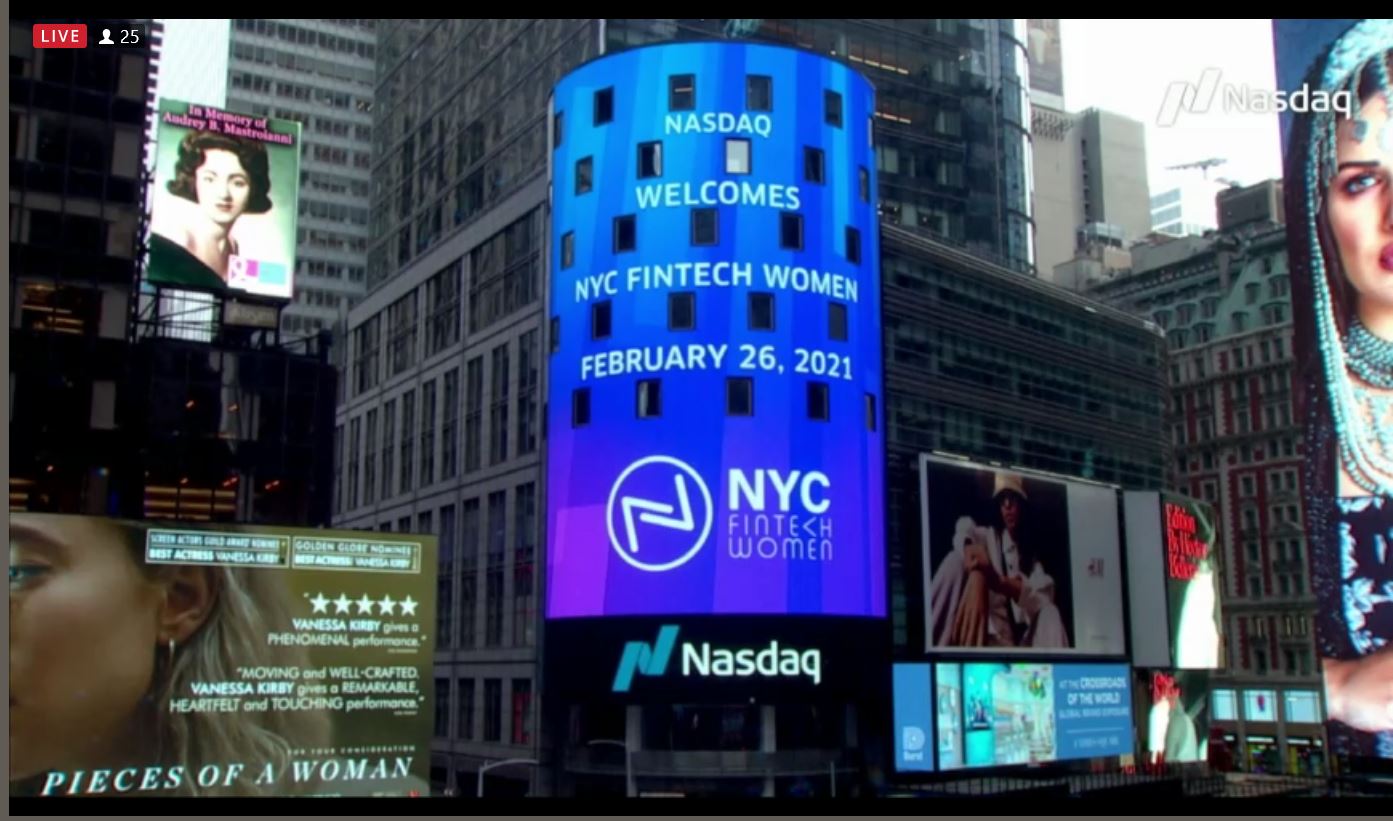 NYC Fintech Women rang the closing bell at the Nasdaq exchange with a speech by founder Michelle Tran. Photos of the members could be seen on the big Nasdaq board in Times Square.
“I’m so proud to be standing with the team as we ring the closing bell for NYC Fintech Women and all women in FinTech! I started NYC FinTech Women 3 years ago to build a community of strong female FinTech leaders and male allies to support each other in our professional advancement in FinTech,” Tran said before the event. “I absolutely LOVE hearing the stories of how this community has helped with stories of women finding new roles, getting promoted, getting more pay, and finding their own personal board.”
The organization said the bell was rung on behalf of all women in fintech and promoted an upcoming international women’s day event featuring Nasdaq and the UN on March 8th.
The 5,000 member strong organization was founded in 2017 to provide members of any gender with opportunity and connection.
Affirm Goes Public at $11.9B Valuation and Climbing
January 13, 2021Affirm, an online buy-now-pay-later platform, was listed on the Nasdaq on Wednesday at $49 a share under the ticker AFRM. Based on outstanding shares sold to IPO investors, the company saw an $11.9B valuation. Minutes after public sales began at noon, the price shot up to $100/share.
Company founder Max Levchin spoke through the big Nasdaq screen in Times Square as he virtually rang the starting bell. Levchin championed the hard work of the Affirm team.
Hear from the CEO of @Affirm, Max Levchin (@mlevchin) on the company improving the lives of consumers by empowering shoppers with honest financial products. @Affirm joins us this morning to ring the Opening Bell in honor of its IPO. #AFRM pic.twitter.com/QfkZsgXItM
— Nasdaq (@Nasdaq) January 13, 2021
Affirm makes money when a customer uses their tech to make a purchase at the point-of-sale.
Levchin is a member of the “PayPal mafia,” a co-founder of the online payments firm that went on to establish massively successful tech startups. Members of the “mafia” include Tesla’s Elon Musk, Linkedin chairman Reid Hoffman, and Yelp founder Jeremy Stoppelmen.
After publishing earnings this summer, the San Francisco-based firm filed for an IPO on Nov 18. The move revealed revenue of $465M for the first 3 quarters of 2020 with a $66M net loss.
Embedded with the company’s S-1, were comments from Levchin that said:
“The barely-readable fine print makes only one thing clear to consumers: You’ll never know exactly what your purchase will really cost you,” Levchin wrote. “With most of the payments industry deriving profits from late fees, overdraft charges, and gimmicks like deferred interest, it’s not hard to agree that there has to be a better way; it’s time to evolve payments again.”
Levchin took to Twitter to post about the firm, championing the millions of transactions the platform has serviced since 2013, all without one late fee.
“More than eight years ago, we set out to take on credit cards and change the way we pay,” Levchin wrote. “We built Affirm from the ground up to align with the needs of consumers and merchants and to succeed when they succeed.”
PayPal Still Leads in Unsecured Small Business Lending
November 12, 2020PayPal recently disclosed the dollar amount of receivables it had “purchased” between its working capital and business loan program for the first 3 combined quarters of 2020. The figure was $1.5B, down by more than half from over the same period last year. That would seem to suggest that the actual origination figure is probably $1.3B, which is still larger than some of its closest competitors. Numbers from rivals like Kabbage (recently acquired by Amex) and Amazon were not readily available.
For a larger comparison chart, click here.
2020 YEAR TO DATE:
| Company | Q1 2020 | Q2 | Q3 | YTD TOTAL |
| PayPal | $1.3B | |||
| OnDeck | $592M | $66M | $144M | $806M |
| Square Capital | $548M | $0 | $155M | $703M |
| Shopify Capital | $162.4M | $153M | $252.1M | $567.5M |
DailyPay Allows Early Paychecks, Sees Adoption Rise in Pandemic Era
October 9, 2020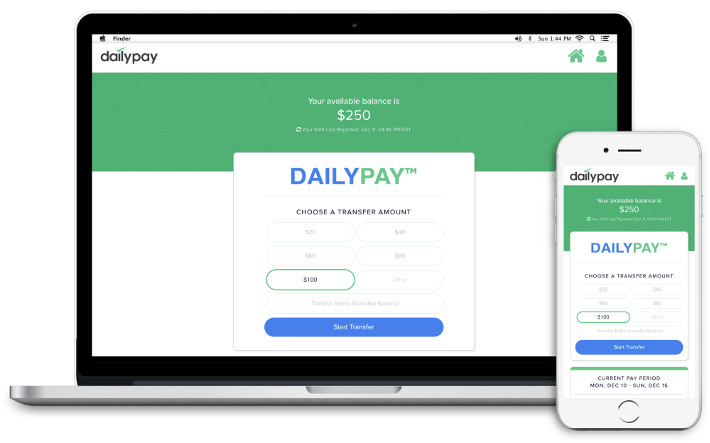 Americans are worried about paying their bills. DailyPay, a payment flexibility platform, gives businesses the ability to let workers access their paycheck early. For customers using the platform— no more waiting for payday.
DailyPay has offered flexible payment since being founded in 2015. Recently, Fortune 500 companies have begun to slowly offer services like it. Last month, Square allowed a select few businesses to let employees cash out using their payment platform, but Vice President of Public Policy Matt Kopko said DailyPay stands apart, offering a payday loan-and-overdraft-killer for just $2-$3.
“We’ve created this industry that’s called the on-demand pay industry,” Kopko said, “which is essentially a technology that allows workers to get paid whenever they want without having to disrupt the employer’s payroll schedule.”
The system works as an employer-sponsored benefit; with business permission, the service collects time clock data, payroll data, and accounting data. DailyPay uses that data to estimate how much money a worker can collect after every shift, or in some cases, every hour worked Kopko said. If a worker is getting paid $2,000 a week, but after withholding gets a $1,300 direct deposit, DailyPay will be able to calculate it.
“So our technology essentially integrates all those systems, allows you to monitor your balance on a constant basis,” Kopko said. “To say: ‘Well, my work yesterday actually accumulated net of all my tax withholdings $123’ and then it’s essentially an ATM for your paycheck.”
Kopko said the product is geared toward the two out of three people in America that are only paid once or twice a month. If the first of the month comes around, but it’s a week to payday, that’s when an employee needs DailyPay- to pay rent when they have no other option.
With pandemic unemployment and state closures, the team at DailyPay has seen an increased interest in the platform. At the beginning of the shutdowns in March, DailyPay saw a 400% increase in users in just three days.
Without using a service like DailyPay, the way these consumers make payments is through overdraft on bank accounts or payday lending, Kopko said. Surveys of DailyPay customers show one in four overdraft two to four times a month. After using the service, that number went down from 25% to 5%. Kopko shared that after using DailyPay, the number of customers relying on overdraft went down 40%.
“We’ve estimated that [customer] financial savings are approximately $1,200 a year,” Kopko said. “It’s not just about a tool for convenience; it’s about putting hundreds of dollars back into people’s pockets, the most vulnerable among them.”
Overdrafts have long been used as evidence toward claims that traditional banking harbors abusive, predatory practices toward the lowest-income working families. In 2017, the CFPB found that nearly 80% of overdrafts originated from the lowest 8% of account holders. That year Americans paid $34 billion in overdraft fees, according to MarketWatch.
Kopko said the platform is not just good for consumers, but businesses as well. He said DailyPay stats show an average of 40% increase in employee retention.
“For employees, we’re seeing tons of financial benefits, and for the employers, we’re seeing financial benefits,” Kopko said. “And it’s all because essentially we created the ability to have new control over your pay.”