Peter Thiel’s Fund Invests $100M in Consumer Lending Startup Affirm
April 15, 2016 There’s another unsecured consumer loan lender on the block and it raised $100 million from PayPal founder, Peter Thiel.
Thiel invested in long time friend and PayPal cofounder Max Levchin’s startup Affirm which finances online purchases like high end furniture, jewelry and gym equipment to be paid back in monthly installments.
Thiel’s Founders Fund led the latest round, bringing the total capital raised by Affirm to $425 million since 2013. Affirm’s consumers are typically immigrants and recent college grads who do not own credit cards and have no credit history.
The San Francisco-based company’s loans are funded by Cross River Bank and its investors include marquee Silicon Valley names like Lightspeed Ventures, Khosla Ventures and Andreesen Horowitz.
“The financial industry has managed to avoid significant disruptive innovation since the mid-90s, and we are working hard to change that. Our first goal is to bring simplicity, transparency, and fair pricing to consumer credit,” says Levchin on the company website.
Affirm is just one of the many upstarts that are eager to bring ease into people’s financial lives. Another millennial lender, Pave Inc recently raised $8 million from Maxfield Capital that included existing investors C4 Ventures and Seer Capital. The four year old company lends unsecured personal loans, typically used for skill-based vocational training offered at institutions like General Assembly.
To provide some bird’s eye view context, recent data from Transunion showed that most borrowers securing personal loans jumped close to 30 percent in recent years, to 13.72 million in 2015 from 10.57 million in 2013, with 24 million Americans likely to obtain one this year alone.
With more loans comes the probability of more defaults? Data from Transunion further noted that In 2015, the average balance was $7,235, up more than 7 percent from the year earlier. As more money is available for lending, lenders are going after borrowers that might be otherwise deemed subprime by credit reporting standards like FICO scores. Companies like Affirm, Avant and Prosper loans have thus created propriety credit risk models which they claim go beyond traditional credit metrics and assess a consumer’s ability based on filters like the school they attend, rents, utilities etc.
California DBO Releases Report on Alternative Lenders
April 15, 2016 The results of a survey that the California Department of Oversight issued late last year to 14 alternative lenders are in. Affirm, Avant, Bond Street, CAN Capital, Fundbox, Funding Circle, Kabbage, LendingClub, OnDeck, PayPal, Prosper, SoFi and Square all responded. CircleBack Lending declined to take it.
The DBO requested data on term loans, lines of credit, merchant cash advances, factoring transactions and other products.
Other than determining that billions of dollars are being deployed from these companies, they found that median consumer loan APRs ranged between 5.37% APR and 35.94% APR. For businesses, the median APR ranged from 18.56% APR to 51.40% APR.
The number of delinquent (30 days or more past due) consumer financing dollars as a share of total dollars outstanding ranged from .99% to 20.30%
The number of delinquent business financing dollars as a share of total dollars outstanding ranged from .55% to 6.79%.
The Top 10 Alternative Small Business Funders
April 12, 2016At Lendit yesterday, I learned the 2015 origination volume of two additional small business funders that I was not able to ascertain previously. They are CA-based National Funding and GA-based Kabbage. Below is a list of the original top 8 funders that has been amended to form the top 10.
RANKINGS
| Company Name | 2015 Funding Volume | 2014 Funding Volume |
| OnDeck | $1,900,000,000 | $1,200,000,000 |
| CAN Capital | $1,500,000,000 | $1,000,000,000 |
| Funding Circle | $1,200,000,000 | $600,000,000 |
| Kabbage | $1,000,000,000 | $400,000,000 |
| PayPal Working Capital | $900,000,000 | $250,000,000 |
| Bizfi | $480,000,000 | $277,000,000 |
| Fundry (Yellowstone Capital) | $422,000,000 | $290,000,000 |
| Square Capital | $400,000,000 | $100,000,000 |
| Strategic Funding Source | $375,000,000 | $280,000,000 |
| National Funding | $293,000,000 |
An even larger list exists in the current issue of our magazine. To subscribe to future issues for free, click here.
Amazon Wants to Add Fintech Companies to its Shopping Cart
April 5, 2016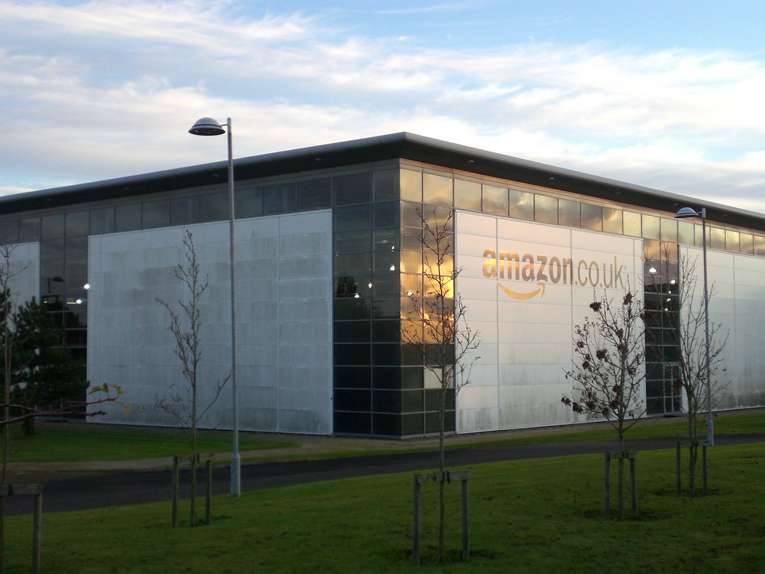
It’s Amazon’s turn to go shopping and it wants to buy fintech companies.
The e-commerce giant just turned the heat up on fintech and said that it will look to acquire startups as the dust around valuations settles. It made its foray into payments in 2013 with ‘Pay with Amazon’ a payment tool integrated on other websites for Amazon customers. Now, the service has 23 million users worldwide.
On Monday, (April 4th), at the Money 2020 Summit in Copenhagen, it announced that it will extend the service to third party merchants hosted on its marketplace.
“The Amazon Payments Partner Program provides Partners with the tools and resources needed to extend the trust and convenience of the Amazon experience to their merchant customers,” Patrick Gauthier, vice president of Amazon Payments, said in a press release. Which is another way of saying that wherever merchants go, Amazon will follow.
This announcement comes after Square released a similar service last week (March 30th) with APIs of its payment integration tool for merchants to use on their sites. Amazon is simultaneously stepping into the turfs of PayPal and Visa while threatening smaller but strong rivals like Square and Stripe. As far as customer acquisition goes, the company doesn’t have to look beyond its own marketplace and what seems like a small step for Amazon could be a giant leap for the industry. The company coincidentally also makes loans to its own customers, just like both Square and PayPal.
Startups in payments and lending are making hay while the sun shines bright. And in this case, that’s nearly half of all the fintech dollars invested. If Amazon is hunting for a good deal, it might be a bit longer in what still seems to be a seller’s market — there are over 152 fintech startups deemed ‘unicorns’ or having valuations of at least $1 billion.
But maybe Amazon is the corrector the market needs?
Square Baits New Merchants with Payments
March 30, 2016
Jack Dorsey wants Square to be a one stop shop and is baiting merchants with its new payment integration tool.
Square launched new API tools on Wednesday (March 30) for online and retail stores who “with few lines of codes can seamlessly integrate Square into the checkout process.” The company is going after payment giants like PayPal, Braintree and Stripe alluring merchants with an easier-to-use payment tool and is priced similarly at 2.9 percent and 30 cents per transaction.
For its erstwhile customers, picking Square over rivals makes sense given the integration between online and offline sales and for the businesses that do not use Square, the company wants to handcuff them.
At the time of founding, Square’s primary business model was a merchant-first approach. It went after 27 million micro merchants who hitherto were invisible to incumbent players in the space. It took in these small heterogenous group of merchants and equipped and trained them with a dongle to accept card payments for a flat fee.
And now its plan to consolidate a fragmented customer base seems to be working thus far. It recently swapped out its merchant cash advances for bank loans again, similar to PayPal’s loan products.
But why launch a payment tool now? Almost 46 percent of shopping cart abandonment happens at the payment stage frustrating buyers with a lengthy checkout form. And this new API allows online stores to integrate a simple checkout form for card details unlike Stripe which requires an e-wallet sign up. It also launched an API for inventory, payroll management and for registers which can integrate Square’s payment tool with custom point of sale software.
Square is hoping that merchants come for payments and stay for more. “Sellers, even if they don’t have an offline presence today, will have ambitions for where their business wants to go and will choose a provider that, regardless of how their business grows, will be there with them,” Square’s head of engineering Alyssa Henry told Forbes.
What’s next for Square’s gung ho growth?
Square Swaps Out Merchant Cash Advances for Business Loans
March 25, 2016 Square’s merchant cash advance program is already among the biggest in the world, but they’ve got even bigger plans, or maybe just different ones.
The company announced on Thursday that they will now be offering true business loans as well through a partnership with Celtic Bank, an industrial bank chartered by the State of Utah. The WSJ reports that loan payments will also be made via a split of future credit card sale activity but with the caveat of there ultimately being a fixed term. This is coincidentally how PayPal’s loan product works.
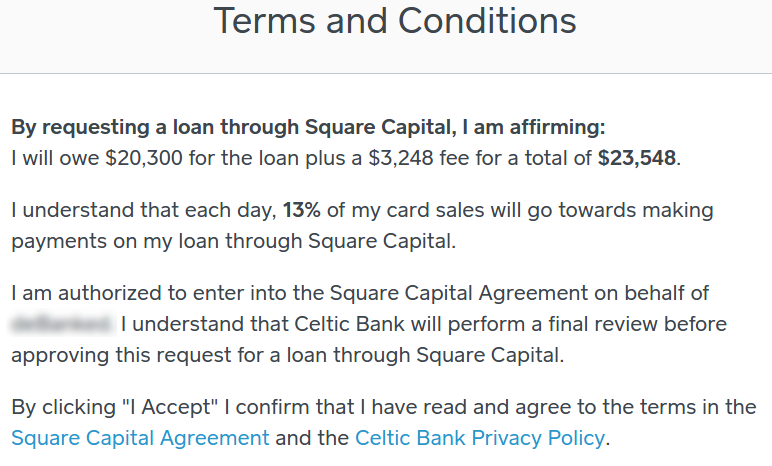
The WSJ makes it seem as if both products will run alongside each other, but a Square merchant revealed to AltFinanceDaily that all of the language on Square Capital’s application portal has changed from advances to loans. Even the promotional materials have changed to reflect that it may take more than just an automated review of historical credit card sales activity to get approved and funded. Also, all Square loans are subject to credit approval, whereas no credit check was required for merchant cash advances. Applicants may be required to produce a photo ID and other documents for further verification. North Dakota businesses are prohibited from borrowing altogether.
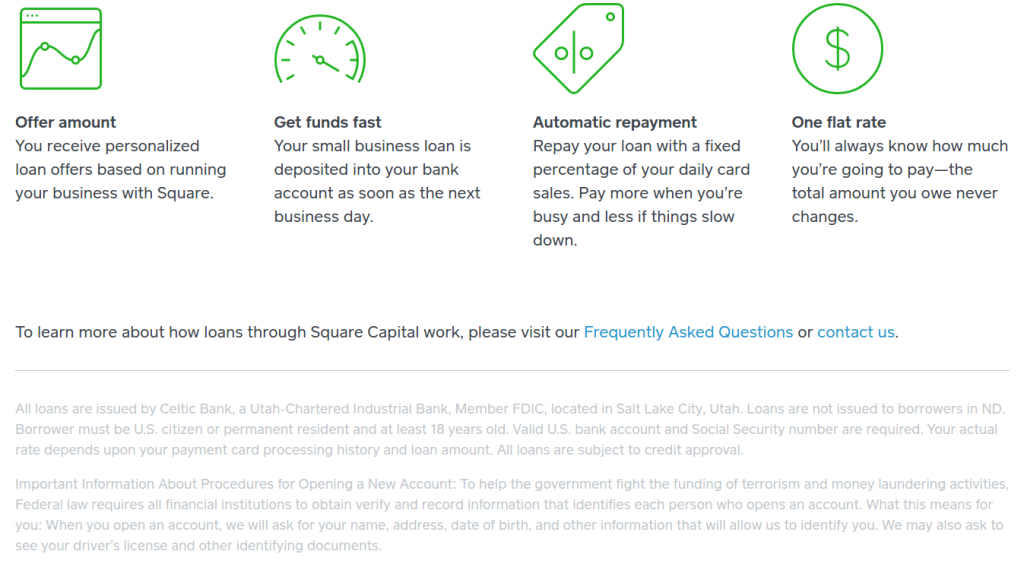
Square’s loans require that merchants process at least $10,000 or more a year. Borrowers must pay at least 1/18th of their initial loan balance every 60 days. PayPal by comparison requires that their borrowers pay down 10% of their loan amount every 90 days.
A Square merchant was not able to locate any mention of the merchant cash advance program. It’s all loans now.
Did Square really just add business loans to their arsenal or have they traded MCAs for the bank charter lending model?
Update: 3/25 2:54 PM Square confirmed that they have indeed replaced their merchant cash advance program with the loan program.
Our Square Capital program is transitioning from merchant cash advances to flexible loans. https://t.co/oUyRtNgVSS pic.twitter.com/ELXC7ayJyU
— Square (@Square) March 25, 2016
Google Culls Online Lenders – Pay or Else?
March 15, 2016Can you become one of the biggest or most successful online lenders without Google? A search layout update may be inadvertently culling the herd.
In late February, Google eliminated ads from the right side of the page while adding another layer to the top and bottom. When factoring in features like site links, the effects on organic search has been devastating. Non-paid links are now entirely below the fold for many commercial keywords, which means users may limit their selections entirely to ads. Here’s an example of a full screen browser window on a Macbook Air when searching for Business Loans:
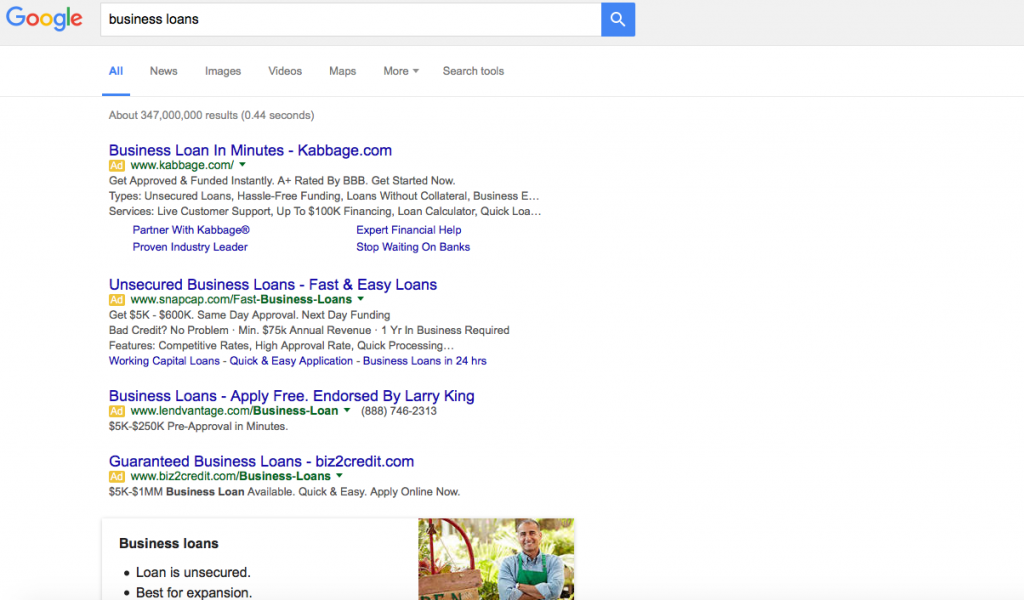
Brad Geddes, a Google Adwords marketing author, expert and consultant, has said the Click-through rate (CTR) on this new 4th ad placement is skyrocketing. “Depending on the keyword, position 4 is going to have a 400%-1000% CTR increase,” he said on Webmaster world. And while side links and bottom links were never a huge factor anyway (less than 15% of click-throughs), Geddes believes a consequence of this change is that fewer ad slots means higher cost bids to rank on the 1st page. “Companies with thin margins are going to have a lot of words fall to page 2,” he wrote.
In summary: Fewer ad placements, higher costs per click, decreased likelihood of organic click-throughs.
And the online lending industry is already feeling the burn. Several funders and ISOs on the commercial side have told AltFinanceDaily in confidence that the online lead gen battle has been lost or that they have been temporarily sidelined by the increase in costs. At least one funder is refocusing their efforts entirely on the ISO channel after a horrible experience with Pay-Per-Click.
 And it’s not just the costs, it’s the quality of leads, they say. The searchers clicking their expensive ads and running up their bills sometimes literally meet none of the qualifications their ads stipulate. Yet many searchers click anyway, rendering the ads’ carefully scripted messages moot. One study might explain why that is. In it, users spent around .764 seconds considering the first paid search result and a total of only 4.5 seconds scanning the first five results. That’s not a whole lot of time to read each ad, digest them and consider whether or not there’s an appropriate fit.
On one industry forum, ISOs have reported that the cost of acquiring a merchant cash advance or business loan deal from Pay-Per-Click is ranging from $700 to $1,200. “PPC for premium keywords as high as $40 at times. Ugly. Real ugly,” one user wrote. Another user wrote, “It’s not just Adwords that is saturated. The whole market is saturated. Lenders and the onslaught of new brokers are making it tough. Lenders with programs like Funding Circle and Kabbage, and with all the advertising money in the world to burn and get direct traffic.” And still another believes that online ads are simply inviting the lowest hanging fruit. “Internet leads have the highest level of fraud,” said one sales manager.
Notably, many of the top 8 funders are only competing for a limited number of competitive keywords or may not even be running Adwords at all. PayPal and Square for example, focus only on their existing payment processing customers despite being “online lenders.”
It’s too early to tell what effects Google’s ad changes will have on the online lending industry, though a couple of companies who were paying just enough to extract clicks from side ads have indicated the change is for the worse and they have suspended their campaigns.
The natural alternative to paid search, organic search, is seldom discussed anymore as a realistic strategy these days, in part because the rankings might be rigged anyway.
One irony that’s pervasive in the online lending industry is that borrowers are being targeted offline where it’s potentially more affordable. In a discussion thread that garnered 76 posts last fall, ISOs and funders suggested that direct mail, referrals, UCCs, cold calling, radio and even going out and shaking hands, were pegged as “what’s next” for marketing. Pay-Per-Click was only mentioned once and only in the context of it being something that had long ago been made too expensive for small and mid-size companies.
The cost of making these things work might be why so many funders are hoping that brokers can figure it out. “We decided that the best way to grow is to build relationships to avoid the overhead, compliance, training and manpower that a sales team would require,” said Nulook Capital’s Jordan Feinstein in an interview with AltFinanceDaily last month.
With Google becoming even more competitive now though, perhaps United Capital Source’s Jared Weitz summed it up best. “Marketing is getting more expensive and only the ones who can afford to pay can play,” Weitz said.
Square’s Merchant Cash Advance Program Now Among Biggest in the World
March 10, 2016Square originated more than $400 million worth of merchant cash advances advances in 2015, according to their Q4 earnings report. Their average deal size was just shy of $6,000. The result is a 300% increase year-over-year and makes them one of the largest players in that industry worldwide.
RANKINGS
| Company Name | 2015 Funding Volume | 2014 Funding Volume |
| OnDeck | $1,900,000,000 | $1,200,000,000 |
| CAN Capital | $1,500,000,000 | $1,000,000,000 |
| Funding Circle | $1,200,000,000 | $600,000,000 |
| PayPal Working Capital | $900,000,000 | $250,000,000 |
| Bizfi | $480,000,000 | $277,000,000 |
| Fundry (Yellowstone Capital) | $422,000,000 | $290,000,000 |
| Square Capital | $400,000,000 | $100,000,000 |
| Strategic Funding Source | $375,000,000 | $280,000,000 |
A much longer list will be available in AltFinanceDaily’s March/April 2016 Magazine Issue. SUBSCRIBE FREE to make sure you obtain a copy.