
Virginia Hops on the Commercial Finance APR Disclosure Bandwagon
January 14, 2022 Add Virginia to the list of states introducing initiatives to codify disclosures in commercial finance. Virginia House Bill 1027 is aimed squarely at “sales-based financing providers.”
The Virginia bill calls for an estimated APR to be disclosed on sales-based financing contracts using methods conceived in New York’s recent legislation.
As has been witnessed, however, New York’s regulators recently discovered weaknesses in their own law.
The Virginia bill is in its very early stages. It was introduced on Wednesday, January 12th by Delegate Kathy K.L. Tran (D).
Nuula, Still in the Business Lending Game, Lays Groundwork for Larger Ecosystem
December 29, 2021 Nuula, formerly known as BFS Capital, has 5,000 merchants on a waitlist to access a line of credit after just four months of its application process being made available.
But there’s more.
“Nuula is built to not only deliver our own financial products, but it’s developed to help us provision and deploy third party financial products that come from our ecosystem,” said Mark Ruddock, Nuula’s CEO. “So what we’re trying to do here is not really be a broker, but we will carefully curate products.”
“That could be larger, longer loans from one partner, it could be insurance from another partner, it could be entrepreneur wealth management from a third partner,” he continued.
“So we bring those partners onto the platform, and then we expose their functionality within the app, in a way that’s consistent with all the other tools in the app. So yes, there is room for third party lenders.”
Ruddock spoke about how as of now, Nuula’s infrastructure only offers opportunities to those interested in directly funding businesses. The company profits via revenue sharing when businesses are provided with capital from a third party funder on the platform.
Despite not being available yet, he hinted at possibly incorporating broker-esque products as the app’s financial product suite grows.
“Today, we don’t see a near term role for brokers on the app, because we’re not really trying to create a marketplace of a multitude of products, we’re really trying to curate things very, very carefully,” said Ruddock. “However that’s not to say say that we will not over time provide the ability for the more digital brokers or intermediaries to play a role as we seek to broaden the portfolio of tools that we offer.”
“I would say no to brokers in the sense that we really don’t have a compelling offer for them at the moment, but yes to other financial services providers.”
Ruddock described how Nuula is serving a niche customer base, a tech-centric merchant who is looking for an easy-to-use mobile software that can manage their businesses’ X’s and O’s. Not only is this type of merchant underserved and beginning to substantiate in numbers according to Ruddock, but they are extremely eager for access to capital.
“It’s a fundamental change in the way underwriting has been done, away from kind of a rearward looking model, towards a real-time forward looking model, and that’s what we believe is going to be required to unlock capital to this new generation of businesses.”
“[Nuula] reimagines underwriting in a way that says ‘don’t just look at the last six months of bank statements’,” Ruddock said. “[We] look on not only of the day of lending, but the lifetime of your relationship, and how those businesses are recovering, growing, and thriving.”
He spoke about how with real-time data being accessible through Nuula, businesses that are building their creditworthiness can have a mobile reference point for the data that they need to see their real-time financial state, while simultaneously giving lenders a live picture of the businesses’ books.
“So even if a business is not strong enough for credit today, it might be in three months, and we can go watch your progression through this period and unlock the capital when the time is right, and then if that business grows out of the pandemic and recovers and is stronger, we’re going to be able to a broader and richer portfolio of credit.”
Although their target customer seems to be a digitally native merchant, Ruddock says that Nuula’s onboarding process is designed to be simple enough for a merchant who may not be as familiar with fintech.
“I’m a fifty-plus year-old CEO of a fintech company, and I would say I’m as digitally savvy as a twenty year-old, so it isn’t really about age anymore,” said Ruddock. “It’s by the way which [merchants] have embraced technology.”
“What we’ve done with Nuula is we’ve tried to make this product intuitive and simple for a first time app user and we’ve tried to help these folks get access to the data that now is sitting in a multitude of systems. While we believe people who have grown up in an app-centric world are going to be amongst the first adopters, we’re trying to make this product accessible for the fifty year-old restaurant owner too.”
Nuula plans on expanding their data harnessing tools with other fintechs early next year. “Over the next two weeks, we will actually unlock the ability for [merchant] sales data from Shopify or Square,” said Ruddock.
Buy Now Pay… Now?
December 22, 2021 During this year’s online Christmas shopping you may have noticed a new button at checkout from your favourite BNPL providers – “Pay Now”.
The pay in full option allows shoppers to initiate a direct bank transfer without pulling out a credit card. Both Klarna (through their acquisition of Sofort) and Affirm have launched theirs.
This begs the question… umm why?
Customer preference. “I thought the whole point of BNPL was to spread your payments out over time?” Merchants attract more shoppers, shoppers receive interest free loans. It’s a win-win.
Correct. But not all shoppers are looking to defer payments in installments or to the end of the month on their credit cards. By offering a one-click pay in full option, BNPLs widen their net to shoppers not interested in financing.
Regulation. As with all financial products, regulators are sensitive to marketing; particularly ensuring that consumers are not being encouraged to take on more than they can afford. A pay in full option sends a strong sign to both regulators and consumers that BNPLs are completely aligned with any payment preference.
Banking > Lending. BNPLs are expanding beyond POS finance to a full banking suite of products:
- Klarna recently launched virtual cards in the UK.
- Affirm launched a cash-back savings account.
- Afterpay is now part of the artist-formerly-known-as Square (Block), and will be integrated into their suite of small business banking solutions.
- PayPal has gone the opposite way, starting with checkout and expanding into BNPL themselves and through their acquisition of Paidy in Japan.
All four of these companies are converging around an online banking model that goes well beyond payments and lending.
Payment processing. Payments are a zero-sum game. At checkout, there can only be one winner per transaction. A shopper either pays with cash, cards, or more recently installments (over simplification). Visa and Mastercard have expressed concern that BNPL eats into the demand for revolving credit, and in turn their payment rails. A pay now option will take even more traffic away from these rails, allowing BNPLs to compete head to head with the payment titans.
Kabbage Re-enters Small Business Funding Arena
December 8, 2021 When Kabbage stopped lending in the Spring of 2020, many assumed they would pick up where they left off when they were acquired by American Express. Not quite. Since the deal in August 2020, Kabbage had been repurposed as a checking account service.
On Wednesday, however, Kabbage finally announced a return to funding.
“Kabbage from American Express today launched Kabbage Funding™, offering eligible small businesses flexible lines of credit between $1,000 and $150,000—now with the powerful backing of American Express. With Kabbage Funding, small businesses can apply in minutes to access working capital 24/7 to help manage their company’s cash flow.”
The only strange thing about it is the marketing that makes it sound as if Kabbage had never actually been in the funding business until just now.
Kabbage had been one of the largest online small business lenders in the country in 2019, generating approximately $2.7 billion in loan originations. At the time, it was more than Square, OnDeck, ClearCo, Funding Circle, Amazon, and Shopify.
NYC Rapper’s Experience With Fat Joe is Becoming an NFT
November 5, 2021
Rami Even-Esh, better known by his rap name Kosha Dillz, went viral last week after hip-hop artist Fat Joe joined him in his ritual of rapping for Knicks fans outside of Madison Square Garden before and after home games. When Fat Joe approached him while he was rapping, Even-Esh’s life changing moment spiraled into a world of opportunities. Now, he’s trying to turn a once in a lifetime experience, along with other highlights from his life, into NFTs.
Even-Esh spoke with AltFinanceDaily at NFT.NYC on Wednesday about his performance at the event, after he just showed up and was given a stage—subsequently stealing the crowd away from the speaker’s showcase in the next room, and towards his crypto-inspired rhymes.
“Fat Joe heard me rapping on the beat, got on the mic, and tipped me twenty bucks,” said Even-Esh, when describing the incident he wishes to mint. “He got on the mic and spit a verse that I knew word for word, from Big L’s ‘Enemy’, it’s a very classic song. That went to one page, then it went to another page, and then that was it. Game over. You know, we probably hit about nine million views and now more people are posting it.”
After the iconic moment outside of Madison Square Garden, Even-Esh immediately hopped on a flight to Colorado to try and make another connection with Fat Joe during one of his shows there.
“I showed up on my own flight, and went there unannounced. Then he saw me, embraced me, there were bunch of cameras around us. Fat Joe sent his people to bring me backstage, they interviewed me, and then they said man, we’re going to put you on stage.”
 “That’s when I told Fat Joe, I said, my whole life is changing man, we should make this into an NFT.”
Even-Esh has had impressive bouts in the music industry prior to this event, which are what he hopes to build upon when he mints NFTs out of his experiences. His website mentions collaborations with rappers like Matisyahu and Rza, and even a tour with Wu Tang Clan. According to Spotify, Kosha Dillz has almost 16,000 monthly listeners on their platform.
Even-Esh has long taken interest in the crypto space, and talked extensively about what NFTs and blockchain technology mean to communities like his who are trying to make a name for themselves while also trying to pay their bills.
“With NFTs, you can mint a moment. There’s so much stuff that happens. That could be a whole series of NFTs, moments that weren’t documented that offend people, or moments of people [that are] in trouble, that could be a thing,” said Even-Esh.
“Moments where great rap music happened but no one ever saw— these could be NFTs.”
Even-Esh appears to be hoping to turn these his minted life experiences into a revenue stream. He claims that all of the places he has been to along with the people he has met create value for potential buyers. “I’m looking to mint more of my experiences because I think my experiences are gold. I have golden life experience.”
Whether it is the NFTs or his music that takes off, the exposure that the moment with Fat Joe gave Even-Esh has set his life on a new path.
He shared his advice to others after appearing to be inspired by the publicity he has received. “Someone told me there’s a million dollars out there for everybody. You have to seek it, go out, and find it.”
The timetable on the minting of his experiences is still undetermined, but that is only because of the amount of attention he has gotten, and the more opportunities that have come his way.
“I’ve been approached by a lot of record deals. Lawyers, agents, major companies, you know that’s what I’m trying to do, investors to take my thing to the next level and sell my story. My job is to tell my story.”
New Jersey Continues to Heavily Court Fintech Companies
September 30, 2021 New Jersey’s recent announcement of tax breaks to the fintech company Fiserv in exchange for the company’s commitment to a major hub in the state showcases one of the top private corporate tax breaks in Governor Phil Murphy’s tenure. The move is one of many by the state in recent years as they continue their push to establish a permanent home for fintech.
Fiserv is seeking the benefits of the state’s Emerge program, an economic development plan that provides businesses with tax incentives based on the number of jobs created. Fiserv’s relocation to a brand-new 428,000 square foot campus in Berkeley Heights will probably come alongside approximately 2,000 new hires, according to the company.
“This announcement from Fiserv is exactly what we envisioned when we created the Emerge program – an innovative company that provides high-paying jobs choosing to expand in New Jersey,” said Murphy. “We’re excited that Fiserv sees what we see in New Jersey, and we look forward to the company’s continued success.”
 Fiserv’s brass noted that the move to the new offices is a great opportunity to expand their presence while providing opportunities in an area where current employees and customers are familiar with.
“[This company] has been in New Jersey for decades” said Frank Bisignano, President and Chief Executive Officer of Fiserv. “Our new location in Berkeley Heights will be a dynamic hub of collaboration and innovation, bringing our people together in an inspiring workplace environment to create opportunity for unmatched energy and career growth experiences as we move payments and financial services forward on behalf of our clients.”
The neighborhood is also embracing the company’s big arrival, as the move drew support from local politicians. Mayor of Berkeley Heights Angie Devanney praised the move, referring to Fiserv as a “great partner” of the city.
“The company’s technology focus and commitment to diversity are an ideal complement to our community, and we look forward to a long-term partnership that will continue to grow,” said Devanney.
According to Fiserv, they have intentions to partner with universities in the area to create programs for students and graduates. Programs with universities would allow Fiserv to have a direct pipeline from top colleges in New Jersey to their employment applicant pools. Rutgers University was the only school mentioned by name in the company’s press release.
Already employing over a thousand New Jersey residents, the move will have more of an impact on how the company is perceived in the area. Their new offices will have a “Leadership in Energy” and “Environmental Design” (LEED) certificate, alongside a pledge to provide $50 million to help minority-owned small businesses return to pre-pandemic normalcy.
Fiserv’s top executive expressed the company’s desire to have a positive impact on its new community as its tax-motivated investment comes to fruition. “As part of our investment in this new Fiserv location, we look forward to being a force for good by engaging in and creating positive and meaningful impact in the Berkeley Heights community,” Bisignano said.
Google to Purchase Manhattan Building in Mega Deal
September 21, 2021 In the footsteps of other giant companies like Facebook and Amazon, it seems that Google has joined in on buying a tremendous piece of New York City office space, as Google’s parent company Alphabet has announced a tentative $2.1 billion deal Tuesday to purchase the building they already lease.
Under extensive renovations, Google plans on making a 1.7 million square foot community of office space by adding the former freight terminal to their New York offices— competing with some of the biggest names and workspaces in the city.
Google will remain in complete control of two other office spaces in Soho and Greenwich Village in conjunction with the new acquisition on the Hudson. The combination of these three offices will create a campus-esque environment for the tech giant. All the offices are within about a mile radius of one another.
First reported by the Wall Street Journal, the purchase is New York’s largest single office building sale since pre-pandemic days, while also being one of the biggest purchases in New York City commercial real estate history.
As smaller fintech companies are seemingly leaving the city in droves, it is the big players in the industry who are looking to stick around and ride out Manhattan’s post-pandemic and remote work woes.
It seems that Google, along with the other tech giants, are expecting a large in-person working environment to return to New York. According to CEO Sundar Pichai in an announcement on Google’s blog from August 31, the company plans on keeping remote work an option for all employees until January 10. After that, they are leaving it up to local officials to dictate if employees can be asked to return in person.
“To make sure everyone has ample time to plan, [employees will] have a 30-day heads-up before [they’re] expected back in the office,” Pichai wrote.
With Facebook’s acquisition of office space at Penn Station and Amazon’s purchase of Lord and Taylor’s former 5th Avenue landmark building, Google is late to the Manhattan real estate grab. These giants are paying top dollar for these spaces, as eight-figure real estate deals are status quo for a city that is littered with empty storefronts and a questionable future for many of its longtime tenants.
Google has a track record of building a presence in New York. An east coast presence is nothing new for the company. “Our investment in New York is a huge part of our commitment to grow and invest in U.S. facilities, offices and jobs,” wrote SVP and CFO Ruth Porat on a Google Blog back in 2018 when the lease agreement for the building was made.
Earlier this year, the company committed to a $150 million investment in New York workspaces.
Google’s new offices will serve as the main hub of their New York City offices. As the new year arrives, Google expects to see 1/5 its workforce still remote. With their new offices already functioning, the new office should complete the Google campus in 2023.
It seems that Silicon Valley’s presence may be creeping East as the finance industry continues to head South. With the price of commercial real estate sky high, the reputation for the city at a low, and a political climate that is creeping its way into business, it seems as if New York may be evolving into the East Coast Silicon Valley hub.
Affirm Continues Surge after Exclusive Amazon Deal
August 30, 2021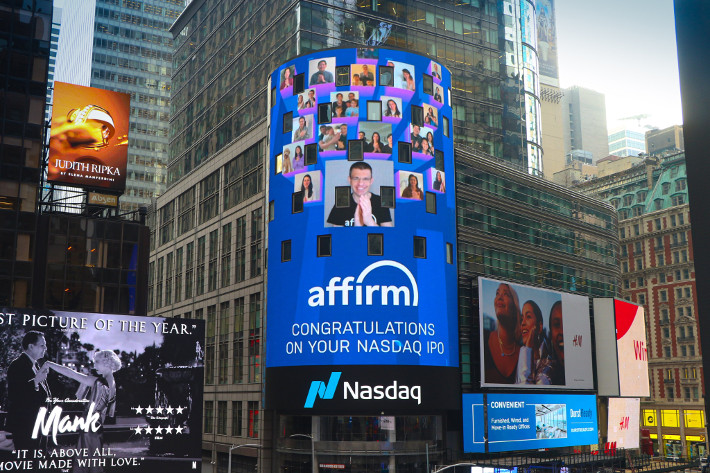 In a move announced Friday that can change the way consumers interact with the largest online retailer, Amazon and Affirm have partnered together to bring flexible payment options to Amazon customers. A leader in the buy-now-pay-later (BNPL) space, Affirm saw share prices soar as high as 40% Monday morning after inking the exclusive agreement.
According to the deal, Affirm plans to offer financing options for purchases greater than $50 for qualified Amazon customers. Buyers are approved, given the cost of financing and the price of their product prior to purchase upfront, and allowed to make payments via installments on those products. Customers who choose to finance through Affirm will not be charged any late or hidden fees.
“By partnering with Amazon we’re bringing the transparency, predictability and affordability that Affirm provides today to the millions of people who shop on Amazon.com in the U.S.,” said Eric Morse, Senior Vice President of Sales at Affirm in a press release. “Offering Affirm’s alternative to credit cards also delivers more of the payment choice and flexibility consumers on Amazon want.”
After an exclusive deal with Walmart in February of 2019, the company is continuing their attempt at a market takeover by striking a deal with Apple’s Canadian market and Shopify in the states — both within the last month. Affirm is quickly beginning to show dividends by putting together some of the largest exclusive flexible payment option deals out there.
With competition heating up in the BNPL industry, Affirm isn’t the only one trying to incorporate exclusive deals with large markets. Square, a company founded by Twitter’s Jack Dorsey recently acquired the Australian firm Afterpay for $29 billion. Paypal has also made their presence known by offering similar services. With a market cap at over $26 billion, Affirm will be in the fight to compete in the flexible payment option space. With competition from companies like Paypal and moguls like Dorsey, Affirm CEO Max Lechvin is in familiar territory. Prior to starting Affirm, Lechvin was a co-founder at Paypal.
With transparency a major component of their business model, Affirm customers may begin to spend more while initially paying less, a move that can provide a better experience for customers— something that seems like a no-brainer for any company selling pricey consumer-based products.