
Learn Merchant Cash Advance or Else…
December 15, 2011If you don’t know about Merchant Cash Advance (MCA), you’re not qualified to work in the payments industry! As indicated by the Electronic Transactions Association (ETA), Certified Payment Professionals (CPPs) should be savvy with MCA financing. According to the ETA: “The [new] CPP program sets the standard for professional performance in the payments industry and is a symbol of excellence. It signifies that an individual has demonstrated the knowledge and skills required to perform competently in today’s complex electronic payments environment.”
CPP candidates can preview exam sample questions in the official handbook, one of which asks:
An established merchant that processes $25,000 in bank card transactions per month has no marketing budget, but has been offered a sponsorship opportunity. What product/solution should the payments professional recommend?
The answer is “merchant funding” AKA MCA. Believe it folks. The MCA financing product is here to stay, has benefitted thousands of businesses, and payment professionals must be well versed in it if they are to become certified.
But there is more than a test to become a CPP.
[The ETA says] to be eligible to sit for the CPP examination, candidates must demonstrate the following qualifications:
|
|||||||||
|
CPP candidates will then be required to sit for and pass a Certified Payments Professional written examination. Upon successful completion of the exam and the attainment of the CPP credential, certificants will be required to meet renewal / recertification requirements every three years, to include continuing professional education from ETA / QSP’s or the successful completion of the test.
|

The next exam dates are May 1 – 31, 2012. You can learn more about registering and what it mean to be a CPP on the ETA’s official site. And don’t forget to learn about Merchant Cash Advance. 🙂
Largest Merchant Cash Advance in History Ends in Default
September 27, 2011 Six months ago, news headlines publicized just how far the Merchant Cash Advance (MCA) product had reached. Once the ‘Plan B’ option for retail businesses in need of capital, the sale of future card payments was utilized to finance a project at a Las Vegas casino. And it was no small figure. New York based Strategic Funding Source (SFS) in collaboration with Vion, shelled out $3.147 Million in return for $4.092 Million of the Las Vegas Mob exhibits’s future sales. That’s a cost factor of 1.30, a price that typifies the average MCA deal.
While SFS was given high praise from their peers, some began to speculate if transactions that large were practical. After all, the costly financing of a MCA is priced in accordance with the risk of default, not in accordance with big profits for the financier. When your portfolio is in great shape, it can be easy to forget what the pitfalls are. And since the MCA industry paraded the Las Vegas Mob exhibit as the $4 Million deal that changed everything, we’re eerily reminded of the words by Jeff Mitelman, the CEO of AdvanceIt who was quoted two years ago as asking: “How prepared are you to lose $4 million dollars?”
We won’t pretend to know what led to the downfall of the Las Vegas Mob exhibit or why it went south so quickly. SFS could potentially lose 98% of their investment, a hit that will surely change their outlook on doing large deals in the future. The VegasInc article alleges gross mismanagement and fraud, factors that are difficult to foresee in the course of underwriting.
Industry message boards have been abuzz with comments on the default, with some competitors of SFS being accused of kicking a man while he’s down. “you ought to do smart funding, not just showing off your Balls,” one broker fired off at them. SFS has a stellar reputation and is one of the most knowledgeable firms in the MCA space. We have no doubt they inspected the merits of the deal backwards, forwards, and upside down. But nothing is perfect.
The default is expected to attract attention of the news media, leaving many to wonder how this transaction will be interpreted under the public eye. We assert that it will put to rest any criticism the MCA product has ever received about high costs.
Risk vs. Reward
Back in March when the deal was written, an outsider could claim that SFS just had an easy million handed to them. This view clashes with the Risk vs. Reward philosophy that MCA providers hold dear. To the MCA providers, the question was never “how can I make an easy million?” but rather, “how prepared am I to lose $4 Million?”
Any business that can’t get a bank loan, can’t get one for a reason. There’s a measurable value of risk that’s not worth taking. MCA providers fill the gap but compensate to offset defaults. There’s a term for something like this. It’s called a Happy Medium.
Merchant Cash Advance is the happy medium financing option for small businesses. And for the immediate future it is likely to stay within the small business niche. We all know now what can happen when the concept is applied to a multi-million dollar project. The outcome was not so happy and the loss not so medium.
But it will all even out in the end…
– Merchant Processing Resource
The Stigma of Merchant Cash Advance?
September 6, 2011Bankcard Funding, a Long Island based Merchant Cash Advance (MCA) provider, recently blogged about the “stigma” of Merchant Cash Advance. While we don’t deny that there is one, we don’t agree with their basis for it.
To quote them:
“Many people do not believe that a merchant cash advance is a legitimate type of financing. This is because many merchant cash advance companies take advantage of naïve clients who are uneducated in the process, take them for a ride, and then focus on the next“sucker.” NOTE: As of 9/13, we noticed that they have updated their article and the above quote no longer appears.
This is a weak argument, especially since it inflames the target market’s concerns. If you market your company by claiming everyone in the industry is a scam artist except yourself, you’re not going to reassure your prospects. But Bankcard Funding is not alone in their assessment so maybe they’re on to something. We’ve heard similar rhetoric in private groups on LinkedIn where seasoned professionals vented their frustrations. Some of the anonymous comments include:
 This guy is screwing it up for me!
It seems too many industry professionals are casting the blame on malevolent third parties. If the competition was as evil as you think, then your work should be cut out for you. Business owners are intelligent people. That’s why they’ve managed to successfully work for themselves. If given the choice between a malicious salesman and an honest one or a good deal and a bad deal, they’re inclined to go with the honest guy with the good deal.
The point being… If you feel that you are losing prospects because the competition is muddying up the industry’s reputation, you simply need to sell better. If the few evildoers (and there’s a bunch in every industry) are defining the industry itself, then it’s time to rethink your marketing strategy. The companies with the highest rates and the nonsensical fees shouldn’t be beating you. If anything, they should be making it easier for you to grow.
So the good guys have a marketing problem and it’s about time we addressed that…again. Reread The Colossal Marketing Failure of the Merchant Cash Advance Industry in which we highlight some of the problems in advertising.
Some people have asked us about the purpose of the erotic photos we used in it. Why did you notice them? Did they stand out? Did you think about what the point of it was? If it got you wondering at all, then we did our job. Junk mail and cold calls don’t get your prospects to think about anything.
If we are to redefine the image of the industry, then the vehicle in which the message is delivered needs to change. Big financial firms like Bank of America have so many businesses applying for loans, that they can barely keep up with the demand. That’s the way it should be for MCA providers, especially given the state of the economy.
The only people claiming there’s a stigma are the ones selling the product. Guess what? That’s not a winning strategy…
A Line of Credit and a Term Loan are Different Things
August 24, 2011Posted on July 27, 2011 at 12:22 AM
According to Gary Honig on Lendio.com, business owners sometimes ask for one type of financing but describe another. Get the facts and make sure you get what you need:
A line of credit (LOC) is usually considered a short-term loan. The payments are interest-only, based on the outstanding funds in use.
A term loan is a fixed, funding transaction. It is a one-time loan based on cash flow of the business plus certain collateral pledged against the loan.
Let’s Play ‘Solve That UCC Filing!’
August 23, 2011
Underwriters have shared with us that it is more challenging than ever to determine if a merchant has an existing MCA balance already. Integrity Payment Systems, a merchant processor in Chicago, recently stated that they have signed on nearly 100 split funding partners. This is astounding given that we only list 24 officially recognized funding firms in our database. Sounds like we could use an update.
The challenge is not so much that WE don’t know who is funding merchants, but rather MCA firms don’t know. We’ll be the first ones to tell you that a retrieval percentage used to be black and white on a merchant statement. If not, you couldn’t miss that big fat UCC-1 lien by a known MCA firm. Those were the easy days when you saw “Secured Party: Fast Capital” and you could phone them up to verify a balance or find out what the scoop was.
Nowadays, there are lockbox programs, ACH debit programs (both variable and fixed payments), and a whole slew of creative structures to make MCA financing possible. The North American Merchant Advance Association(NAMAA) has an exclusive live network of funding activity. That means any NAMAA member can login to make sure that another member doesn’t already have an outstanding balance with the merchant they are about to fund. This database is an invaluable tool to the industry’s success and yet it has one major flaw, there are ONLY 12 members!
So let’s run through a scenario:
——
Mr. MCA Underwriter is analyzing an application and supporting documents. There is nothing being deducted from the 6 months worth of merchant statements. The bank statements look clean. The credit is good. Everything is pointing towards an approval until they do a UCC search. There are a few terminated UCC’s from over 5 years ago by Bank of America, back when bank lending actually existed. There is nothing since then, except for one by a so called ‘ABC LLC’. There is an address for ABC LLC but there is no contact information for them and a web search reveals nothing about their location or what it is. The UCC language is generic and indicates that it is a lien on the debtors property. Mr. MCA Underwriter has seen plenty like it before but asks the merchant about it anyway. The merchant indicates ABC LLC leased them all their equipment including a new oven and freezer. Everything adds up, the deal is approved, and subsequently funded.
Five days later Mr. MCA Underwiter gets a call from an upset individual with accusations that the merchant’s processing receivables already belong to someone else, an ABC LLC. The individual is a reseller of MCAs normally but has funded 5 clients with his own money(a trend becoming more popular. Read here). He funds those deals under a nondescript company, ABC LLC so that nobody will figure out what it is and solicit his client. Mr. MCA Underwriter explains there was no evidence of repayment of a MCA. It turns out the merchant defaulted 7 months prior and hence the 6 months worth of documentation were clean.
—-
For the past few years, it has been very common for resellers to search UCC databases by secured party, thus revealing ALL of the clients that particular secured party or MCA provider has funded in that state. Those clients are then solicited with the appeal of better rates on a MCA and incentives to get bought out. For some MCA providers, this has had a disastrous effect on retention.
ABC LLC successfully protected themselves on that front because no one was able to identify them as a MCA provider. Thus there was little chance their clients would be revealed. However, the strategy backfired when it became unclear that the merchant’s future credit card receivables had been sold.
ABC LLC’s strategy is becoming extremely common. Many MCA providers are resorting to using code names as the secured party to throw UCC hunters off the trail. We list a lot of those code names HERE. Combine that with the fact that hundreds of people are now funding their own accounts and we have a big mess of no UCCs, confusing UCCs, and incorrectly filed UCCs(some funders are filing them in the state they operate in instead of the state the merchant operates in).
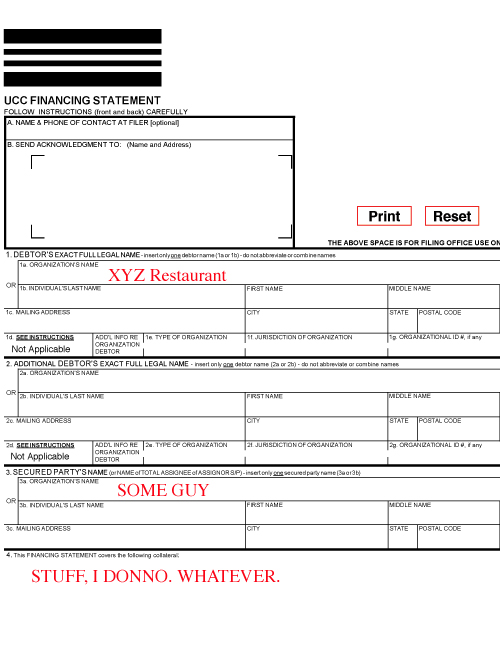
Mr. MCA Underwriter is facing a lack of clues and it would not be surprising if the industry starts to see a resurgence in advance stacking. If anyone would like to anonymously share UCC code names that we do not have included in our records, please e-mail them to merchantprocessingresource@gmail.com
As the industry evolves, so will the issues. In our opinion, MCA providers should be plainly clear on the arrangement they have with their clients. No judge is going to listen to a story about code names, misleading UCC language, or why you don’t file at all. A UCC-1 is intended to be a public notice and is meant to be found. Small businesses will benefit by the expansion of the MCA industry but poor use of UCCs will inhibit the rate of growth.
And that’s our 2 cents…
-The Merchant Cash Advance Resource
../../merchantcashadvanceresource.htm