California Commercial Financing Disclosures Bill Still a Work in Progress
May 8, 2018 SB-1235, a bill that would require APR disclosures on all types of commercial financing products transacted in California (including some types of factoring, leasing, and merchant cash advance), survived the Judiciary Committee hearing on Tuesday. The bill was previously debated by the Senate Committee on Banking and Financial Institutions, where key provisions like a uniform APR disclosure came under fire.
Since then, Senator Steve Glazer, the bill’s author, is now proposing an alternative Annualized Cost of Capital metric rather than an Annual Percentage Rate in an attempt to compromise with the opposition that says the metric will not work for non-lending products.
On Tuesday, two trade association representatives continued to press their case for a collaborative solution that would work best for all parties, especially small businesses.
Scott Riehl, VP, State Government Relations at the Equipment Leasing and Finance Association (ELFA) said that his association, whose members include Caterpillar and Hewlett Packard, was not on board with the bill as currently drafted. No one in the financial community has ever even heard of the term Annualized Cost of Capital, Riehl said.
Katherine Fisher, Partner at Hudson Cook, LLP, who was there on behalf of the Commercial Finance Coalition, testified that it would not be possible to calculate an annualized rate when the timeframe of products like factoring and merchant cash advances were indeterminate.
Judiciary Committee Chairwoman Hanna-Beth Jackson wrapped up the lively debate by saying that ultimately California “wants a robust small business community” after several of her committee members voiced concerns that the bill in its current form could potentially deter commercial finance companies from providing capital in their state.
The hearing concluded with only 3 aye votes, putting the bill “on call,” wherein no decision was formally reached.
Update: Before the close of the day, the committee secured a 4th aye vote, pushing the bill forward.
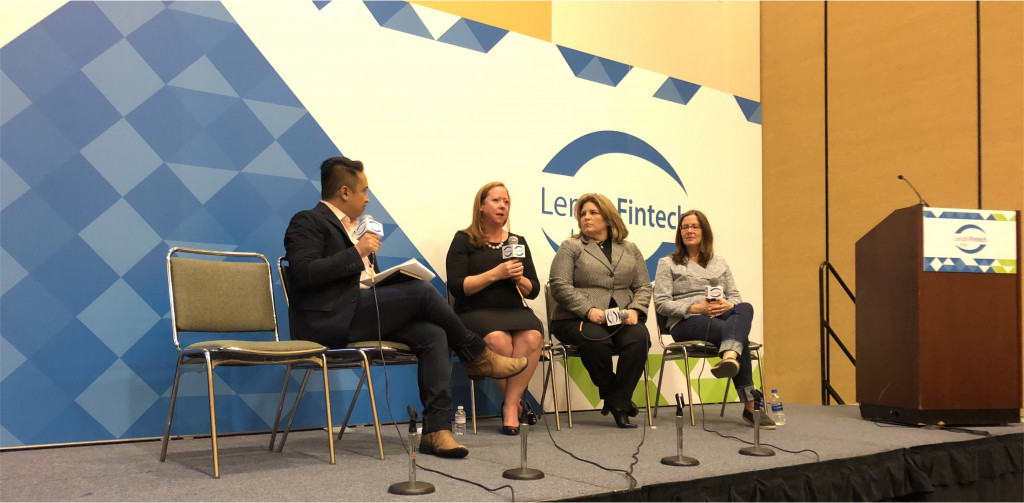
LendItFintech In Photos and Sound Bites
April 10, 2018
when speaking about the increase in mortality rate for people who have faced major financial distress

when interviewed on stage by Bloomberg’s Selina Wang

when interviewed by Jo Ann Barefoot

When asked by Bloomberg Technology reporter Emily Chang if Goldman Sachs would be considered a competitor

when interviewed by Lendio’s Brock Blake

When asked who will win the race for marketshare
When asked if it’s harder to underwrite loans above $50,000

talks business at the company booth

Below: Ocrolus account executive John Lowenthal stands in front of the company booth





Technology Drives Changes in CRE Lending Space
December 21, 2017 Online technology, which paved new paths for consumer and small business lending, is making similar inroads with the commercial real estate industry.
Over the last few years, several online marketplaces have been established to try and match commercial real estate borrowers with lenders quickly and efficiently using technology. In the past, commercial real estate lending depended heavily on having local connections, but online platforms are blurring these lines—making geographical borders less relevant and opening doors for new types of lenders to establish themselves.
While banks remain the largest source of commercial real estate mortgage financing, non–bank players—including credit unions, private capital lenders, accredited and non–accredited investors, hedge funds, insurance companies and lending arms of brokerage firms—have become more formidable opponents in recent years. Online platforms offer even more opportunity for these alternative players to gain a competitive edge.
At present, most of these commercial real estate marketplaces are purely intermediaries—they’re matching borrowers and investors, not actually doing the lending. Certainly, it’s an easier business model to develop than a direct lending one, but things could change over time, as borrowers become more comfortable with the online model and develop confidence that these platforms can perform, industry participants say.
 “You have to be viewed as credible with a certainty of funding for borrowers to come to you. You can’t just put up a flag and say ‘Hey we’re making loans’ because borrowers won’t trust you and they won’t have the confidence that the loan is going to close,” says Evan Gentry, founder and chief executive of Money360, one of the few online direct lenders in this space. “However, once you develop a reputation of strong performance, the tide turns very quickly and that confidence is established,” he says.
For now, however, many of the marketplaces say they are content to remain intermediaries and offer business opportunities to lenders instead of competing with them. The sheer size of the market— commercial/multifamily debt outstanding rose to $3.01 trillion at the end of the first quarter, according to data from the Mortgage Bankers Association—and the fact that is an enormously diverse industry with no plain vanilla product makes it more likely that several platforms can co–exist without completely cannibalizing each other’s business, observers say.
Each of the online marketplaces has a different business and pricing model. Some marketplaces focus on small loans, while some have larger minimums; some focus on just debt; some focus on a mixture of equity and debt. Some sites cater to institutional lenders and accredited investors to help fund loans. Other sites invite non–accredited investors who meet certain criteria to participate in loans, opening doors to a segment of the population which previously had minimal access to commercial real estate deals. While the sites differ in their approach, the upshot is clear: banks—while still formidable competitors in commercial real estate lending—are no longer the only game in town for funding these deals.
The struggle for lenders is how to work most effectively with these marketplaces. “If you can acquire customers through only your own channels, then of course you’re going to do that,” says David Snitkof, chief analytics officer at Orchard Platform, which provides data, technology and software to the online lending industry. Otherwise, these marketplaces present a viable opportunity to expand distribution, he says.
GROWTH OPPORTUNITIES ABOUND
The surge of new companies acting as marketplaces between borrowers and lenders of all kinds comes as the commercial real estate industry is finally coming up to speed with respect to technology. The commercial real estate business has been static for decades in terms of how loans are processed and originated, according to industry participants.
“The use of technology is going to be an enormous disrupting force in that space,” says Mitch Ginsberg, co–founder and chief executive of CommLoan, one of the newer marketplaces for commercial real estate lending. Commercial real estate lending is “probably one of the last industries that hasn’t been touched by technology, and it’s ripe for massive disruption,” he says.
CommLoan of Scottsdale, Ariz., was founded in 2014, but the marketplace has only been fully operational since 2016. The platform targets borrowers seeking $1 million to $25 million of capital for all types of commercial real estate loans. It works with more than 440 lenders—including banks, credit unions, commercial mortgage companies, private money lenders and Wall Street firms. Altogether, CommLoan says it has processed more than $680 million in commercial transactions.
Online marketplaces can help make the commercial real estate industry more efficient and transparent, says Yulia Yaani, co-founder and chief executive of RealAtom of Arlington, Va., another new online commercial real estate marketplace. “People are tired of paying huge fees as a result of the market being so opaque,” she says.
RealAtom began operating in 2016 and targets borrowers who are seeking commercial real estate loans from $1 million to $70 million. The lenders on the platform include banks, alternative lenders, insurance companies, pension funds, hedge funds and hard money lenders. The company processed $468 million in commercial loans in its first 11 months of operating, according to Yaani.
Another benefit of online marketplaces is that they “create a liquid, national marketplace where lenders all across the U.S. can bid on a borrower’s business,” says Ely Razin, chief executive of commercial real estate data company CrediFi, which operates the upstart CredifX marketplace. Historically people who own commercial real estate have only been able to get financing through a local relationship with a bank or broker. “For borrowers, this means more certainty of obtaining a loan and optimized capital not limited by the relationship with the local lender,” he says.
CredifX started operating earlier this year to match commercial real estate borrowers, brokers and lenders including banks, finance companies, mortgage companies, hard money and bridge lenders. The platform is for loans of $1 million to $20 million across all major property types in the commercial space. It matches borrowers with appropriate lenders using the information that parent company CrediFi collects and analyzes. The company declined to disclose how much it has processed in commercial transactions.
To be sure, it’s hard to say how the marketplace model will evolve over time and which players will withstand the test of time. Certainly a similar model has faced challenges on the consumer and small business lending side.
“I think the pure marketplace will become more rare as time goes on,” says Peter Renton, founder of Lend Academy, an educational resource for the P2P lending industry. “There are examples of successful companies with a pure marketplace, but they are rare and difficult to scale. The only well-established company that seems completely wedded to the pure marketplace is Funding Circle; pretty much all other companies have switched to a hybrid model of some sort,” he says.
Commercial vs Residential
While much of the recent growth has been within commercial real estate, there are also some marketplaces that cater to residential borrowers or offer a mix of commercial and residential opportunities.
 Magilla Loans, for instance, started out in 2016 as a solely commercial marketplace, but expanded outside this silo because customers were asking for residential and other types of loans, says Dean Sioukas, the company’s founder. The company now connects borrowers with lenders for a whole host of loan types—commercial, residential and others like franchise loans and equipment loans. Lenders on the platform include roughly 130 banks, mortgage loan originators, accredited investors, credit unions and online non-depository institutions. The average loan size is $1.4M for business loans and $500K for home loans. Nearly $4 billion in loans has been channeled through the platform since January 2016; of that 70 percent is tied to commercial real estate, according to the company.
While there are marketplaces that focus on residential mortgage lending, some industry participants say that side of the business isn’t as appealing to new online entrants in part because the cost to acquire customers is really high and there are more challenges to working on a national scale.

“It may not be that commercial is more attractive. It may just be easier. Going directly to borrowers in the residential space has proven harder than many companies expected,” says Brett Crosby, co-founder and chief operating officer of PeerStreet, a marketplace for accredited investors to invest in high-quality private real estate backed loans. Experience seems to suggest that for residential mortgage origination, “it’s much better to have a good ground game and know your local market,” he says.
To be sure, as the online market for real estate matures, it’s not so surprising that companies would shift business models to find their own sweet spot. RealtyMogul.com is one example of a company that has morphed over time. The online platform began operating in 2013 in both the residential and commercial space, but has since moved away from the residential business. Accredited investors, non-accredited investors and institutions can use the platform to find equity or debt-based commercial real estate investment opportunities, and borrowers can apply for private hard money loans, bridge loans and permanent loans.
Money360 is another example of a company that has shifted gears. It started out as a pure marketplace, but changed its business model to become a lending platform in 2014. Now the online direct lender in Ladera Ranch, Calif., provides small-to mid-balance commercial real estate loans ranging from $1 million to $20 million. It’s one of the only companies targeting the commercial real estate space in this way and has closed nearly $500 million in total loans since 2014.
Gentry, the company’s founder, says he would expect to see more industrywide changes as the online commercial real estate business continues to evolve. The key to success, he says, is executing well and “knowing when to pivot when you realize something’s not working just right.”
Ultimately, Gentry predicts more online lenders will target the commercial real estate space. He says technology-based alternative lenders have an advantage because they can operate more quickly and efficiently while still being very competitive from a pricing perspective.
“You put all those things together (speed, efficiency and competitive pricing) and that’s what borrowers are looking for,” Gentry says.
Canadian Merchants Show An Appetite For Capital
November 25, 2017In Canada, the average deal size for a merchant is anywhere between $20,000 and $30,000 in funding, depending on who you ask. That’s why when one startup recently funded a $300,000 CAD advance from its balance sheet to a Canadian merchant, the deal turned some heads. While it’s unclear whether this amount could be indicative of a trend unfolding at our neighbors to the North, Canadian small businesses are preparing for some changes in the industry landscape in 2018.
SharpShooter Funding, whose name depicts the famous wrestling move of the WWE’s Bret “The Hitman” Hart, was behind the $300,000 deal with an Eastern Canadian grocer.

If you’re wondering how a merchant funder and WWE legend became partners, chalk it up to a combination of fate and timing. Paul Pitcher, SharpShooter Funding managing partner, has been Hart’s biggest fan since he was a kid. Pitcher got the opportunity to meet his hero when was just 10 years old. It was then that the green shoots of friendship formed, and today the WWE’s Hart is acting commissioner of SharpShooter Funding, having helped to launch the business.
Canadian Merchant Landscape
To get a taste of the Canadian merchant financing landscape, consider that the three top Canadian funders deploy $20 million and $25 million per month combined, explained David Gens, president and chief executive of Merchant Advance Capital, which is included among the top three funders. That’s up from a range of $15 million to $20 million earlier this year.
And while a $300,000 advance may not seem like something to write home about for U.S. funders, it’s a big deal in the Canadian market. The culture among small businesses in the Great White North is different and more conservative than their US counterparts.
“It’s a function of the size of the merchant,” Gens explained. “The typical single-location storefront merchant is going to qualify for $30,000 to $50,000. It takes a larger and more established business, whether it’s a multi-location merchant or a business that is in the B-to-B space, a manufacturer, distributor or wholesaler to be large enough to qualify for large financing.”
Meanwhile there are some changes to small business taxation that are coming down the pike that may influence demand for credit, Gens noted, though the precise shape any changes to the tax law will take remains unclear.
“They will reduce the small business taxation rate on the face of it. But for businesses where they hold cash or need to hold cash, it’s a gray zone as to whether or not they will be able to hold financial assets in those businesses. The government is going after companies that are holding investments. But there’s a gray line as to what is a holding company that is holding an investment and an operating company holding a buffer because of seasonality or cyclical demand. We have yet to see what the rules end up being exactly,” Gens said.
Anatomy of the Deal
In the case of SharpShooter Funding, the grocer merchant originally came to the funder for less than $300,000 but qualified for more, bringing the funder’s tally for a single day’s deals to more than $500,000.
“We never thought we’d hit this milestone in the Canadian market. But the file was right, and the timing was great,” Pitcher told AltFinanceDaily. Now that they’ve gotten a taste of it, SharpShooter Funding hopes to do more deals of this nature. “For a small funder like us to double the size of a big funder was a big moment for us, especially in the Canadian market,” Pitcher said.

Merchant Advance Capital’s Gens said his company is prepared to take on the risk for deals at even a higher threshold. “Our average is $35,000 to $40,000, and the largest deal we’ve ever done was $600,000. I don’t want to steal their thunder, but there have been larger deals,” said Gens. “A few funders may syndicate when deals get that big, but it’s not an inconceivable size.”
OnDeck, which similarly has Canadian operations, lends up to $250,000 CAD in Canada. OnDeck has extended more than $7 billion in online loans across 70,000-plus customers across the United States, Canada and Australia.
As for SharpShooter Funding, Pitcher said the funder has been on the sidelines for larger deals because they don’t want to grow too fast. He’s been turned off by other funders doing deals within a couple of months of launching and then being forced to close their doors.
“Our capital has always been strong. It’s not that we can’t afford to lend larger amounts. It’s because we want to make sure we’re doing it right from the start,” Pitcher said, adding that SharpShooter Funding has only had its doors open in Canada since June 2015, though its corresponding U.S. business, First Down Funding, has been around since 2012. “It’s been a work in progress, and I love every day of it! We’re only getting started, and I am 100% excited for the future,” he said.
The Canadian grocer reached out to SharpShooter Funding in response to Google advertising. The affiliation with the Bret Hart association didn’t hurt. Pitcher explained there is a seasonality tied to the merchant’s business, evidenced by a couple of months or more each year in which revenue is spotty, that made the grocer unattractive for banks to fund. “That’s why those sized deals are difficult to put out and banks won’t put out, because of seasonality,” Pitcher said.
SharpShooter Funding was not deterred by that. “We were really able to gain in-depth trust and visibility into this merchant from the first call to the last call. There was never a problem with him mixing up stories. Just the honest truth. From his references to his landlord, everyone involved made it clear he was here to work with us and not to play games,” Pitcher said.
Pitcher was impressed by the business owner’s work ethic. “He’s a roll-up-your-sleeves entrepreneur who didn’t borrow $1 million from his father. No bank loans. Six years ago, he rolled up his sleeves and made it work. Now he’s in a situation where banks won’t lend to him. But we will,” he said.
The merchant’s bank statements also made sense to the funder given their consistency, predictability and transparency. “Whenever we ask for finances from someone and that merchant can get them to us in an organized fashion in less than an hour, it speaks wonders. It means they’re honest and ready to play ball. And that’s what we want,” Pitcher exclaimed.
The merchant plans to use the capital for an expansion into a new food product line. If he pays off the advance early the funder will lower the rate.
The Bad Broker And Merchant Due Diligence
November 15, 2017 There may be a rogue broker on the loose. The scam involves a fraudulent Letter of Intent (LOI) falsely claiming to be that of a major funder designed to resemble the real McCoy. Events like this place a spotlight on the risks associated with this market and is a reminder that not all small businesses are armed with the right information.
AltFinanceDaily was contacted by a victim of the fraud, Noah Grayson, managing director and founder of Encino, Calif.-based South End Capital. Grayson said the real victims are the merchants who get taken advantage of by these scams. In this case it was a New York-based small business owner who took on too many MCAs.
Grayson is quick to point out the MCAs were not at fault and each may have even thought they were the first position funder since it all unfolded so quickly. “They’re just trying to do business and provide financing to businesses, and they got burned as well. They’re going to take some degree of financial loss because of this and maybe more,” Grayson said.
False Pretenses
When Grayson reviewed an email that he received from the borrower, which included a copy of the LOI, he knew immediately that it was fraudulent and the borrower had been misled. “It was a fraudulent LOI and we had no record of the borrower or the brokers who provided it in our system,” Grayson exclaimed.
As it turns out, the borrower was tricked by the fake LOI that sought to leverage the reputation of South End Capital’s brand to coerce him into taking out $260,000 of MCAs from four separate funders. They did it under the false pretense that South End Capital would then consolidate those positions in 10 days and extend as much as $900,000 more in working capital to grow the business.
To be clear, South End Capital does offer a genuine MCA consolidation loan program. Grayson had never agreed to consolidate the business owner’s MCA positions, however, or provide an additional $900,000. That part was fabricated. This left the merchant holding the bag for more than a quarter of a million dollars in MCAs, placing his business, which has been successful since the 1960s, on the brink of bankruptcy protection in the interim because of the crippling weekly payments.
Fraud Prevention
Andi McNeal, research director at the Association of Certified Fraud Examiners, or ACFE, said she has seen this before, only on the consumer side of the industry. “Loan consolidation fraud for credit card debt is very common in the consumer space, and it’s not surprising to know that similar schemes are popping up in the small business space, too,” she said.
She went onto explain that because a small business is typically run by a small management team who typically aren’t trained in fraud prevention, they often adopt the same mindset as they do in personal finances. They don’t always have the necessary checks and balances in place, which can place them at risk of being victimized by such schemes.
“Sometimes they’re not savvy enough to detect those types of scams coming at them,” she noted. “Certainly, big businesses can fall prey to this, but it’s less common.”
Staying on Defense
The recent saga unfolded over a period of six weeks. Meanwhile Grayson has outlined some red flags for small businesses to watch out for to prevent becoming the next victim to a new fraud.
“If what you’re being told seems suspicious or doesn’t make sense, question it. Ask questions and get more information,” said Grayson.
Another rule of thumb is to stick to the document in front of them. Again, this may just be a case of a few bad apples spoiling the bunch, but sometimes brokers tell small businesses something contrary to what appears in front of them on the official document. “The LOI spells it out,” said Grayson, adding that when in doubt the borrower should defer to the document.
The merchant should also take it upon themselves to call the lender whose name is on the LOI to verify its authenticity before signing it or providing any upfront fees.
“In this case, it was a fraudulent document and it didn’t help out the borrower but calling us to confirm it initially would have. Most of the time, looking at what’s written out on paper from the verified source will help and getting a verbal or email confirmation from the actual lender, certainly will,” Grayson said.
Another defensive step merchants can take is to simply review the website of the brokers and funders and look for names, press releases and past closings, details which Grayson noted were all missing from the broker in question’s site.
“Anybody can say they make loans and provide financing. They could tomorrow put up a website for a couple bucks and say they’re a lender and start taking applications. But just because there’s a website doesn’t mean they’re legitimate,” Grayson said.
He’s suggesting merchants check out the names of the principals and employees on the site. Google is their friend to check for any history of loans closing. Look for closing announcements and any complaints tied to the entity in question. Call the Secretary of State Department and inquire about any complaints.
At the end of the day, it comes down to the merchant doing their homework. “A lot is on him. He should have done more research, absolutely. But anybody can be coerced or tricked if the right things are said,” said Grayson.
If a merchant does find themselves in a situation where they fall victim to a fraud, there are steps they should take. McNeal said that while each situation is unique, a good first step is always going to be to reach out to a trusted legal counsel.
“They can help guide you through the process of what the options are. Do you have recourse? Does the situation call for insurance to help cover the losses? They also can advise on which law enforcement or government agencies are the most helpful – should the case be referred to the local authorities or do they need to bring in the FBI,” the ACFE’s McNeal advised.
More Pervasive
Grayson’s fear is that this is not an isolated incident. He has reason to be cynical, as this was the second incident this year resembling the most recent situation that they have experienced.
The first incident was relayed to South End Capital by a handful of borrowers about one specific MCA broker. No fraudulent documents were ever recovered, but the borrowers recalled the harrowing details of the incident
“Per the multiple borrowers, the broker used our real LOIs and lied to borrowers about how to interpret them to coerce tens of thousands of dollars in upfront fees from them. For example, for an LOI we issued for our SBA loan program that listed what SBA guarantee fees would be due at closing, he would convince them that that fee was his and they needed to pay it to him upfront to proceed,” Grayson explained.
The small business owner at the center of the scandal declined to comment, and it’s unclear whether they were the one to initiate the original communication with the broker or vice versa.
CFC on the Front Lines of the MCA Regulation Battle
November 6, 2017
As the US Senate attempts to reach a bipartisan agreement on relaxing some of the rules in the Dodd Frank legislation of 2010 that would treat banks more favorably, the MCA industry is having to fend off legislation and regulation of its own at the state and federal levels that could position funders in a similarly crippling position.
MCA regulation has been thrust into the spotlight for a number of reasons, not the least of which has been the Consumer Financial Production Bureau (CFPB). The CFPB is moving forward with the Dodd-Frank Section 1071 rulemaking process for data collection regarding small business lending, a sector of the market for which they do not have jurisdiction, sources say.
Front and center in the policy discussions has been the Commercial Finance Coalition (CFC), a merchant cash advance trade association that is coming up on its two-year anniversary in December. While federal policymakers appear to be listening, state legislatures have been a more difficult nut to crack.
The CFC’s Influence
In its short two-year history, the CFC has been one of the most vocal if not the most influential trade organization lobbying on behalf of the MCA industry, having attended 70 congressional meetings and having led advocacy efforts for the industry in the halls of Albany, Sacramento, Illinois and Washington, D.C.

Dan Gans, executive director of the CFC, has been the voice of the MCA industry on Capitol Hill and has been invited to testify in key congressional hearings. “For whatever reason, the CFC has really become the voice and has taken an active part in the so far successful advocacy efforts to educate and mitigate potential harm to our members’ ability to deploy capital to small businesses that need access,” Gans told AltFinanceDaily.
Most recently the CFC participated in a fly-in, one of two such events this year, to Washington, D.C. in which the association’s counsel Katherine Fisher of Hudson Cook, LLP testified.
In her testimony Fisher said: “The MCA and commercial lending spaces are sufficiently regulated by existing federal and state laws and regulations. Both MCA companies and commercial lenders must comply with laws and regulations affecting nearly every aspect of their transactions, from marketing and underwriting through servicing and collection.”

She went on to explain: “Even if they comply with every applicable law and regulation, small business financers must also be wary of the Federal Trade Commission’s powerful authority to prevent unfair or deceptive acts or practices.”
Fisher told AltFinanceDaily she received a “positive” response to her testimony from funders but has not heard anything from lawmakers.
Gans said Fisher did a fantastic job in articulating the needs and status of the industry.
“She presented a very good case as to why the industry is currently adequately regulated. We don’t feel there is a need for federal regulation. In some cases, less regulation would allow our members to deploy more capital and help more small businesses,” Gans said.
The sweet spot for MCAs, Gans explained, are transactions under $100,000 and probably in the $24,000 – $40,000 range. He said the industry does a fantastic job of being able to deploy financial resources to small businesses in a timely manner that neither banks nor SBA lenders can match. He’s not suggesting MCA is for everybody but for some businesses it’s an essential product that can help. There have been many success stories.
“Competition is all over the place. But that’s great for the merchant. The more options that merchants have, the more we can enforce best practices and more competitive rates. And the more we can keep the government from impeding people from getting into this space, the better off small businesses are going to be,” said Gans.
Setting the Record Straight
The CFC was formed with the mindset that the organization, which is currently comprised of CEOs of small- and medium-sized funders, would take a proactive rather than a reactive approach to industry regulation. In its two-year history the CFC has tasked itself not only with educating policymakers on the role of MCA funders for small businesses but also with undoing the misinformation and misconception surrounding the anatomy of an MCA.
“Unfortunately, because MCA uses the term cash advance in its product name, uninformed people will often confuse MCA as some form of payday lending. And so that has been one of our biggest challenges, educating members of congress and committees that there is absolutely no correlation between MCA products and what their views of consumer payday loans is,” said Gans, adding that the CFC has had to communicate that MCA is a version of factoring has been around for more than 1,000 years.
A common thread that the CFC has been able to weave with lawmakers has been the diverse geographical representation of both the trade group and the House and Senate.
“Most venture capital is deployed in a few spots – New York, California and Texas – and it’s a cliff to get to those three states. So, one nice thing that I take pride in is my members are looking all around the country regardless of the geographic location. That helps us with policymakers, most of whom are not from the New York City metropolitan area or Silicon Valley. It’s nice being able to look at them in the eye and tell them we care just as much about your district as you do,” he said.
The Road Ahead
The CFC has an ambitious long-term agenda, one that includes raising their profile in the industry and participating in events.
“I think one of the ambitions we have is to have an organization where funders and brokers can be at the same table and work though some of the issues impacting the industry and try to make sure people are doing things in the right and best way.”
The trade group is planning to partner up with AltFinanceDaily for Broker Fair 2018 and they’re looking to bolster membership.
“The industry has had a lot of free riders that are benefiting from our advocacy efforts but not supporting it. So, from my perspective, if you’re in this industry, particularly in the MCA space, we’d like to expand membership. If we grow our membership, we can do more things, engage more states and expand our lobbying team,” said Gans. “The more members we have, the more we can do to advance the ball and protect the interests of the industry.”
The CFC will need all the help it can muster given the fight ahead to fend off regulation particularly in Washington, Albany and Sacramento. “I think we could see some harmful regulations and potentially legislation over time. Some of those bad ideas that emanate in states have a tendency to percolate into Washington. If at some point there is a less business-friendly administration in the future, we could see all those ideas get some traction at the federal level,” Gans warned.
6th Avenue Capital Secures $60 Million Commitment For Merchant Cash Advance Funding
November 2, 2017Highly Experienced Executive Team Offers Flexible Financing Options to Small Businesses
New York City – November 2, 2017 – 6th Avenue Capital, LLC (“6th Avenue Capital”), a leading provider of small business financing solutions, announced today its securement of a $60 million commitment from a large institutional investor. The investor made their commitment based on 6th Avenue Capital’s industry-leading underwriting, compliance standards and processes. 6th Avenue Capital will draw from this commitment to offer merchant cash advances to small businesses through its nationwide network of Independent Sales Organizations (“ISOs”) and other strategic partnerships, such as banks and small business associations.
6th Avenue Capital launched formal operations in 2016 to help finance small businesses that are often ineligible for funding due to traditional underwriting criteria. 6th Avenue Capital evaluates each application for funding individually and keeps the merchant’s short and long-term needs in mind including, most importantly, what they can afford. 6th Avenue Capital also understands that small businesses may need funding quickly. The company’s data-driven underwriting processes, expertise and technology can give the merchant secure and equitable approvals of qualified requests and funding within hours.
Leading the team, CEO Christine Chang oversees all strategic aspects of 6th Avenue Capital. She also serves as COO to sister company Nexlend Capital Management, LLC. She brings more than 20 years experience in institutional asset management, including alternative lending. Previously, Chang served as Chief Compliance Officer at Alternative Investment Management, LLC, COO at New York Private Bank & Trust and Vice President at Credit Suisse. She serves on the board of Blueprint Capital Advisors, LLC and Bottomless Closet, a not-for-profit empowering economic self-sufficiency in disadvantaged NYC women.
“Our mission at 6th Avenue Capital is to help small businesses grow, and we continue to expand our existing network of ISO and strategic partners to ensure these businesses have access to capital in hours,” said Chang. “Our leadership team of financial industry experts has extensive experience navigating multiple economic cycles. We know how to serve merchants and how to deliver quickly while meeting the highest operational standards for our investors.”
COO Darren Schulman joined the team in March 2017. Schulman is a 20-year veteran of the alternative finance and banking industries. He is responsible for oversight of 6th Avenue Capital’s origination, underwriting, operations and collections, as well as strategic initiatives. Schulman served previously as COO at Capify (formerly AmeriMerchant), a global small business financing company, and President and CFO at MRS Associates, a Business Process Outsourcing (BPO) company specializing in collections. In addition, Schulman was an Executive Vice President at MTB Bank.
“We form strong relationships with the merchant and consider it essential for our underwriters to speak to every merchant, on every deal, regardless of its size,” said Schulman. “We also make our underwriters available for discussions with ISOs whenever necessary. We are proud to offer competitive volume-based commissions, buyback rates and white label solutions.”
About 6th Avenue Capital, LLC
6th Avenue Capital is changing the small business financing landscape by offering a data-driven underwriting process and fast access to capital. The company employs a unique blend of industry experts and is committed to the highest operating standards, high touch merchant service, including a policy of direct merchant access to underwriters. 6th Avenue Capital is a sister company of Nexlend Capital Management, LLC, a fintech investment management firm founded in 2014 and focused on marketplace lending (consumer loans). For more information, visit www.6thavenuecapital.com.
# # #
Goodbye Liens and Judgments
October 28, 2017 Justice can require sacrifice. Take the example of a decision by the three major credit bureaus – Equifax, Experian and TransUnion – to stop including some liens and most judgments in their credit reports.
The change makes life a little less unfair for consumers who fell victim to reporting errors. Many invested precious time and large amounts of money trying unsuccessfully to correct their credit histories and restore their reputations.
But for the alternative small-business finance industry, omitting data on liens and judgments increases costs, creates extra work and can even give rise to an unsettled feeling in the pit of the stomach. “You’re not looking at a full credit report anymore, which is kind of scary,” one alt funder admits.
Yellowstone Capital CEO Isaac Stern provides an example to illustrate what’s at issue. “Imagine I’m the Ford Motor Co. and I want to do a lease with you,” he says. “But I don’t have the information that you happen to have judgments from Chrysler, Chevy and BMW, so I approve your lease. Imagine that! Without full information, how do you make accurate decisions?”
Operating without the data could prove dangerous, agrees David Goldin, who sold his U.S. Capify operations to Strategic Funding Source in January but still runs Capify UK and Capify Australia and remains open to U.S. opportunities. “The IRS could come in and seize credit card processing accounts and prevent the lender from getting paid,” he says. “Once you have a judgment a creditor could come in and freeze bank accounts.”
Fears aside, the change in reporting probably won’t dry up alternative small-business credit – even in the short run, Goldin predicts. Alt funders will adjust quickly, he says, noting that they can compare the old and new credit scores of long-time customers to spot patterns and apply those patterns to their calculations. The industry can also tap alternative sources of information.
Even with those reassurances, the transition would have been easier if the industry had more advance notice, alt funders say. “We found out July 31 when a Reuters rep emailed us and said this is going into effect tomorrow,” recalls Stern. “That was really weird – I’ve got to tell you.” Experian didn’t provide a heads-up even though Yellowstone is one of its largest New Jersey customers, he notes. “We were a little bit annoyed, but what are going to do?” Meanwhile, Goldin says he didn’t begin researching the situation until AltFinanceDaily asked him about it. “I don’t think anyone really knew about it” much in advance, he says.
But the industry is finding out and taking action. Yellowstone, for example, is performing a performing a workaround by integrating the judgments and liens section of the Clear investigative platform into the information underwriters see when they open a file, Stern says. The integration required a couple of weeks of hard work by the Yellowstone tech team, he notes.
 Clear, which is provided by Thomson Reuters, amasses public records that can date back 20 years and can fill more than a hundred pages, he says, adding that you have to know where to look for the relevant information. “You have to dig through it,” he says.
In the past, Yellowstone performed a Clear report on most files just before funding them, Stern explains. Now, the Clear report is scrutinized more extensively and earlier in the process – before the file is approved. As a result, Yellowstone underwriters will have all the information they need, but it will take them a little longer to get it, he says.
Yellowstone incurred the expense of obtaining additional user licenses from Clear, which cost it $800 to $900 monthly Stern says. Experian now charges the same price for less information, he notes.
Accommodating the changes didn’t require more underwriters but it became necessary to hire four additional data entry clerks to input information until the integration with Clear was completed, Stern says. Now that Clear and the Yellowstone systems are working together, the four extra clerical workers will shift their attention to inputting data from the increasing number of applications coming into the company, he says.
Most Alt funders won’t need to employ more people in their underwriting departments because changes to their models will be automated, Goldin says. “I don’t think this is as much of a game changer as people think it is,” he says of the credit bureaus’ new approach to reporting.” It’s just one extra step. It’s more of a nuisance issue than a manpower issue.”
However, a challenge arises for underwriters because leaving out the liens and judgments will result in higher credit scores for some loan or advance applicants, Goldin says. That means some alt lenders may need to go to the trouble and expense of tweaking their risk models to compensate for the change in the scores reported by the credit bureaus, he maintains.
The impact may be greatest among alt funders who rely on quick online decision-making, Goldin says. Adding extra steps to the process increases the difficulty of maintaining the speed that provides a selling point and a source of pride for those companies.
 While Clear is helping to fill the gap at Yellowstone, it’s not the only company providing much-needed data. LexisNexis Risk Solutions isn’t a credit bureau and will thus continue to disseminate information it gathers from courtrooms on lien and judgments, Goldin notes. Alt lenders who weren’t already using the vendor’s service or were using it only when an application reached a predetermined threshold will face added expense because of the credit bureaus’ decision, he says.
Indeed, LexisNexis Risk Solutions views the credit bureaus’ hiatus on some liens and judgments reporting as a business opportunity to increase its sales by supplying the missing data, according to Ankush Tewari, senior director of marketing planning in the company’s business services section. The company was already selling data on liens and judgments and anticipates selling much more of it, he observes.
 For 15 years LexisNexis Risk Solutions has been selling RiskView Solutions, a product that contains liens, judgments and other information not generally found on credit reports, such as the assessed value of a consumer’s home or a list of a consumer’s professional licenses. It offers no data on loan repayment but its other information helps define a consumer’s creditworthiness and character, Tewari says. Lenders can combine that peripheral information with credit scores for a more complete customer profile that outperforms the credit score alone, he suggests.
And there’s more. LexisNexis Risk Solutions has reacted to the credit bureaus’ decision by creating RiskView Liens & Judgments Report, which lists only those two types of records. “The credit bureaus announced these changes a year ago, and we knew there would continue to have a need for that data,” Tewari says. The company prices the RiskView information based upon the transaction volume, he notes, so a lender pays less per transaction as volume increases.
With this emphasis on liens and judgments, one might well wonder who tracks down the information. Companies like LexisNexis Risk Solutions gather and disseminate public records on liens and judgments from courthouses throughout the United States, says Tewari. Over the years the company acquired some of its competitors and eventually was spun off from its sister company, LexisNexis, which built its name partly as an aid for lawyers researching cases, he notes.
For decades, LexisNexis Risk Solutions has been providing the credit bureaus with raw data not only on liens and judgments but also on bankruptcies, Tewari says. The bureaus have then parsed those files electronically and appended the data to credit reports, he continues.
Problems arose because the credit bureaus’ tech systems could not always link the court documents to the right person when the courts provided only a name and address, Tewari maintains. Courts often limit information in their records to those two identifiers because they’re reluctant to divulge additional identification that criminals could intercept and use to commit fraud, he says.
Tewari traces the bureaus’ inaccuracies in matching court records to the right people to what he calls the bureaus’ “DNA.” The bureaus are accustomed to receiving “clean” information from lenders on a regularly scheduled basis. Conversely, some of the LexisNexis Risk Solutions data, gathered from obscure places like county deed offices, may arrive in a form that’s far from clean, he notes.
 However, that lack of court information or inconsistencies in the presentation of that information doesn’t pose problems for LexisNexis Risk Solutions because the company cleans the data before analyzing it. Tests indicate its linking methodology works accurately with just a name and address more than 99.9 percent of the time, Tewari contends. Thus, the company can establish that John Smith at 1234 Maple Street is the same person as John A. Smith at 1234 Maple Street, he says. He considers that linking technology the core of the company’s operations.
The information LexisNexis Risk Solutions can supply becomes vital to lenders because studies indicate that people who have a lien or judgment on file are twice as likely as people without them to default on a consumer loan and five times as likely to default on a mortgage, Tewari says. “The data didn’t become less important because the credit bureaus decided not to include it anymore,” he maintains. “It’s still just as predictive as it was.”
Meanwhile, other types of information can also help lenders make decisions, notes Eric Lindeen, vice president of marketing for ID Analytics, a credit risk and fraud risk management company that offers a credit score called Credit Optics, which it bases on a combination of traditional and alternative credit data.
Alternative credit data is defined as anything the credit bureaus don’t include in their reports, Lindeen says. Examples include the bills consumers pay for cell phones, utilities and cable television, he notes, adding that rent is also sometimes considered alternative credit data. The category also encompasses records from marketplace lenders.
A consumer’s tendency to pay those bills on time, late or not at all can reflect on creditworthiness, Lindeen maintains. That history becomes relevant for alt funders because the small businesses they serve constitute a hybrid of consumer and commercial credit, he says.
Using that data, ID Analytics can spot people who are good credit risks when the credit bureaus still consign them to “thin file” status — the limbo where applicants don’t have enough credit history to evaluate their creditworthiness, Lindeen maintains. About 60 percent of near-prime applicants qualify for credit when lenders factor in alternative data, according to an ID Analytics study he says. At the same time, alternative data can also expose weaknesses among individuals with excellent traditional credit scores, he observes.
Combining alternative data with traditional data has become more important with the bureaus’ decision to stop supplying data on liens and judgments, Lindeen says. Leaving out that data will raise some credit scores, and the effect will be strongest among near-prime individuals with good but not great traditional scores, he notes. With those consumers, a 10-point shift could make a big difference in qualifying for credit, he says.
“Even though it’s a small population, it’s a critical population,” Lindeen says of those newly minted prime applicants. They may number only one in a hundred of a particular funder’s portfolio, but they may advance to another risk pool and consequently invalidate a risk model, he suggests. Over time, risk managers will adapt to the change and oversee a “risk migration,” he predicts.
 Overall, between 6 percent and 9 percent of consumers will see their credit scores rise because of the bureaus’ new policy, Lindeen estimates. The change usually won’t exceed 20 points, he says. Still, about 700,000 will see an improvement of 40 points or more, he continues. “That’s a significant increase for a nontrivial population,” he says. “It’s likely their performance will stay the same as their score goes up.”
A study by VantageScore Solutions, the company that provides the VantageScore credit scoring model to the credit reporting bureaus, projected scores would increase an average of 10 points for slightly more than 8 percent of the scorable U.S. population.
Those changes are characterized as “minimal” by Francis Creighton, President & CEO of the Consumer Data Industry Association, a trade group that represents the three major credit bureaus as well as about a hundred other companies – mostly smaller credit bureaus around the country, resellers of credit bureau information and background screening companies.
The credit bureaus decided to curtail reporting of judgments and liens as part of the National Consumer Assistance Plan, or NCAP, Creighton says. NCAP is an agreement reached in March 2015 among the three major credit bureaus and the attorneys general of 31 states, who were pressing for fairness in credit reports. Many observers call NCAP a “settlement” but the agreement did not result from a lawsuit, he notes.
Under NCAP, the bureaus will continue to include bankruptcies in their reports because the records meet the standard of providing a name, address, Social Security number and date of birth and because visits to the courthouse to update records occur at least every 90 days. About half of liens don’t meet those standards and will be removed from credit reports, and nearly all judgments fail to adhere to the standard and will no longer appear on the reports.
Although Creighton declines to say how many consumers were victims of credit reporting errors, he emphasizes the severity of the problem for each victim. “If you were one of the people who had a name similar to somebody else or a similar Social Security number, it would impact you a lot,” he maintains. “I don’t know how widespread it was, but it was disruptive enough for individual people that it’s better just not to have it.”
A Federal Trade Commission study released in 2013 reported that a sample of 1,000 credit reports indicated that 25 percent had at least one error that could reduce scores, according to published reports. Such findings prompted state attorneys general to seek remedies that resulted in NCAP.
The bureaus planned to implement another major portion of NCAP in September when they were to begin waiting 180 days before reporting medical debts, Creighton notes. At the same time, debts for medical expenses covered by insurance policies were to be omitted from credit reports, he says.
Changes brought by NCAP represent part of ongoing efforts to improve the system, according to Creighton. “We want accurate information in the reports,” he says. “That’s good for everybody.”