
BROKER FAIR IS BACK! – NYC
May 2, 2022 Broker Fair is coming back to New York City on October 24th at the New York Marriott Marquis in Times Square. Anticipated to be the biggest Broker Fair ever, brokers from the small business lending, commercial financing, revenue-based financing, leasing, factoring, and MCA industries, will come together in the heart of New York.
“It’s amazing to have participated in the industry’s growth over the last four years,” said Broker Fair founder Sean Murray. “Our first event launched in Brooklyn in 2018 and now the demand has brought us into a massive newly-renovated venue in the middle of Times Square.”
Brokers, lenders, funders, factors, equipment financiers, fintechs, and the whole small business finance ecosystem can expect a full day of education, inspiration, and high quality networking opportunities.
Register here. For inquiries or questions, email events@debanked.com.
See last year’s sizzle reel:
University of Delaware Fintech Building Calls for $6.5 Million to Complete
April 3, 2022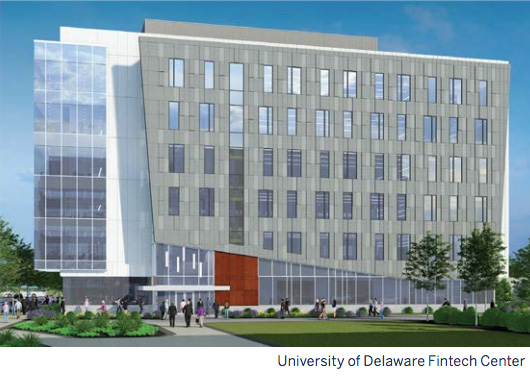 In 2020 the University of Delaware began the construction of a new Fintech Center on its Science, Technology, and Advanced Research (STAR) campus. Cinnaire, a community building company, supported the development of the new 100,000-square-foot-building with a New Markets Tax Credit investment.
The financial services technology building is expected to be completed by November of this year. The University’s President Dennis Assanis is asking the state legislature for $6.5 million to furnish and equip the establishment.
Assanis stated, “Construction of the building is only the first step. It needs about $14 million in fit-out-in partitions and cabling, in wiring and furnishings, in other work to make it suitable for occupancy and to have the labs that we need in the building.”
Three million dollars has already been provided by the state through the Higher Education Economic Development Fund along with $4.5 million from industry partners.
This new space on campus will serve as an economic driver for the state. According to Assanis, “The extensive investments that the university is making are helping to drive progress in healthcare, in engineering, in business, and many other areas that would benefit Delawareans today and for many years to come.”
The building is owned by the Delaware Technology Park (DTP) and will hold a partnership along with UD and Discover Bank. DTP will fund it with a below-market-rate loan from Discover.
Other tenants will include NIIMBL workforce development; Discover Bank; the Kendal Corporation, a senior living company; Financial Health Network, a nonprofit research organization; The Venture Center, a national Fintech incubator; Tech Impact, a nonprofit digital workforce development organization; RAAD360, a supply chain IT startup; and Grain Exchange, a new restaurant from Grain Craft Bar + Kitchen.
Virginia Passes Landmark Sales-Based Financing Bill
March 7, 2022 The Virginia State legislature unanimously passed HB1027 on Monday, a law aimed squarely at revenue-based financing providers. Virginia Delegate Kathy Tran (D) celebrated the passage on twitter by saying that the law will “protect small business owners from merchant cash advances.”
The law will require “a provider or broker of sales-based financing to register with the State Corporation Commission (the Commission) in accordance with procedures established by the Commission,” the legislative summary reads. Furthermore, it will require “a sales-based financing provider to provide certain disclosures to a recipient at the time of extending a specific offer of sales-based financing.”
That is just the tip of the iceberg. The bill’s language changed somewhat since it was first introduced in January.
Despite some industry pushback, there was no opposition to the bill on either side of the political aisle and it passed through both chambers unanimously. Virginia has become the third state, following California and New York, to pass a commercial financing disclosure law.
Today, we had the final vote on my bill HB1027 – it passed unanimously and is headed to the Governor! We’re taking key steps to protect small business owners from merchant cash advances, a predatory financial practice. Thanks to @TCIFiscal @VPLC @rbrexperience for your support! pic.twitter.com/Wv8NRL9SOp
— Kathy Tran (@KathyKLTran) March 8, 2022
Delegate Tran thanked The Commonwealth Institute, the Virginia Poverty Law Center, and the Richmond Black Restaurant Experience for their support in making the law happen. The bill now just needs the governor’s signature to become law.
Tomorrow’s Broker/Funder Relationship, According to Funders
February 23, 2022 “In the end, we all press zero to talk to someone.”
The conversation about what characteristics will make up tomorrow’s loan brokers is surrounded with ideas latched in fintech, social media, and more. Brokers from around North America have been showcasing these new strategies on social media or in chats with AltFinanceDaily, which sparked the question — what do the funders think of all of this?
Efraim Kandinov, CEO of FundFi Merchant Funding, has a lot of ideas about how brokers should function in a constantly changing financial landscape. According to him, it’s not the style of funding or modernization of business logistics that will make tomorrow’s broker, but it’s leveraging ethics with both merchants and funders to preserve future business down the line.
“I believe more and more merchants look for the digital aspect and remove the broker because of the dishonesty that we usually uncover and want something clean without interpretation. Many issues with merchants in my opinion [stem] from being misled by the broker, promising something after to just take this deal or promising to get payments lowered and take an overleveraged position.”
Other funders think much differently, identifying a sense of community being brought about by tech, having a ‘we’re in this together’ type of mantra to hold the legacy industry up.
“There’s a sense of familiarity when dealing with my brokers,” said Amanda Schuster, CEO and President of Fundhouse LLC. “We’re your friends, we get you, we get your business.”
Schuster believes that relationships between funders, brokers and merchants alike will help them weather the storm of tech’s emergence into their industry.” We are your business and it’s just as important to us that you succeed,” she said. “I have business owners that I still speak to this day, that I funded over five years ago.”
Schuster dismissed companies like PayPal, Square, and Shopify’s takeover of small business lending, circling back to the interpersonal value that a broker provides as a face to a financial product.
“At the end of the day, business is always about the people,” she said. It’s about creating a need and filling it. You can’t do that on a website.”
When asked about the value of this happy-go-lucky community of brokers, funders and merchants, Kandinov brought up how some brokers have found ways around the ‘repeat business’ model of funding deals, thus making relationships between brokers and merchants pointless.
“I think brokers are less caring of repeat business because they have discovered a short term model of stack, stack, stack, and then put in a reverse. This front loads commission. I believe a broker has a huge advantage in creating the relationship. [This] unfortunately is starting to take a back seat to a new way to score big commissions.”
Kandinov spoke about brokers who will say anything to make a sale carelessly shooting themselves in the foot when it comes to forming a book of business. By saying whatever they need to get paid now, merchants are either going straight to the funders to big tech for their next source of funding.
“Jaded merchants then look to only speak to the funding house in the future and stay or just prefer the direct to consumer model of fintech,” said Kandinov.
Despite these feelings, Kandinov does believe that there’s a bright outlook on the future of the broker/funder relationship if some change occurs.
“[Brokers] deserve their high commissions as they do a lot of work. I think funding houses have much less overhead with the broker model, but lately with the broker behavior it is almost pushing themselves out if it continues. I do not believe fintech alone is advantageous, just in speed and clarity. It’s a byproduct of poor behavior.”
Bitty Advance’s New Suite
February 22, 2022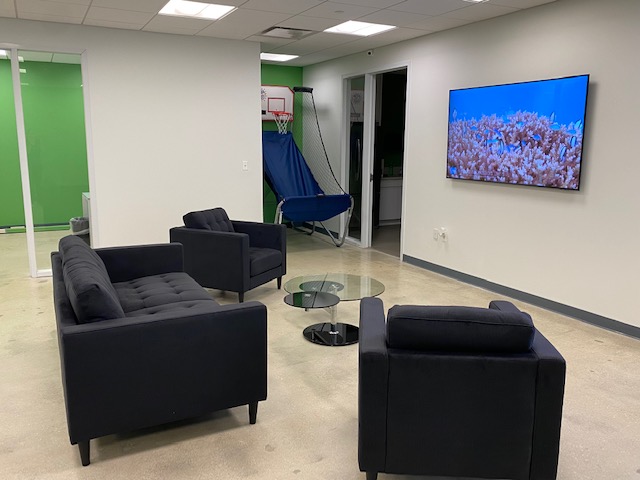 Bitty Advance hopes that an enticing in-person environment will bring people back to the office. As part of that, the company recently moved into a new space.
“We want to give our team both the flexibility of working from home and having a premier office space for collaboration,” Bitty Principal and CEO Craig Hecker told AltFinanceDaily. “…making our space open and dynamic, with comfortable couches, TVs, and relaxed meeting areas was important, we are also incorporating fun things like resting areas and table tennis to promote wellness and engagement.”
The new office is immediately adjacent to Dania Pointe, a 102-acre premier mixed-use development with almost one million square feet of retail and restaurants, luxury offices, hotels, luxury apartments, and public event space.
Bitty is seeking to acquire tech talent in many areas as they expand platform offerings for their white-label application intake process, affiliate online checkout referral page, payment processing & management interface, and self-service customer portal.
“Bitty is a tech company first. All of our focus is on utilizing technology to revolutionize the MCA space,” said Hecker.
Não é bom: When Split-Payment Business Loans Fail
February 20, 2022 As tech companies like Square and Shopify capitalize on their respective abilities to collect loan payments from borrowers by withholding a percentage of their credit card sales, similar companies have replicated that model across the world. StoneCo, for example, which is traded on the Nasdaq but operates in Brazil, had a market cap last year of over $25 billion. More recently, however, it’s dropped to nearly $3 billion.
In Brazil, StoneCo used its wide reaching payment business to start originating small business loans that were paid back through their customers’ credit card sales. That business seemed to hold up quite well early on in the pandemic but then took a turn for the worse. According to Bloomberg, distressed businesses came up with ways to circumvent their payments. “…[B]usinesses started jumping to other payments firms, meaning Stone no longer had access to their card purchases,” it said.
“Lockdowns pressured businesses’ cash flows and several sought ways to not pay back their loans,” StoneCo CEO Thiago Piau said.
Historically, diverting sales through another payment processor to avoid this type of obligation was known as “splitting.” It’s an inherent risk to finance companies that make underwriting decisions based on the assumption that the customer is unable to exit the relationship without seriously disrupting its business.
StoneCo was hit so bad that it stopped lending altogether and a significant percentage of its customers went into default. In the company’s Q3 2021 earnings call, Chief Strategy Officer Lia Matos said that they intend to get back into lending again but with some adjustments.
“So, those improvements are, for example, the inclusion of personal guarantees from the business owners and potentially other business they may have, improve risk scoring through additional data,” said Matos.
Covid may have been less damaging to similar companies in the US like Square, for example, because Square was able to repurpose itself to a PPP lender. The incentive to move to another payments platform may have been diminished by the allure of leveraging a pre-existing relationship to secure PPP funds.
StoneCo in Brazil is an example of what can happen to a fintech lender reliant on recouping credit card sales when that relationship doesn’t stick.
To help ensure the team gets things right in the future, StoneCo recently acquired Gyra+. Described as “a data-driven SME lender, which operates under a fee-based, asset-light approach,” the company plans to gently ease back into lending.
“I think that we are not ready to provide a specific guidance in terms of scaling the credit,” said CEO Thiago Piau in November. “We are really focused toward engineering and getting the feedback of clients and all the clients’ experience that we have learned throughout this.”
Brazil has a population of 212 million people.
Pick a Niche or Go Far and Wide? SMB Financiers Weigh in
February 18, 2022 As big tech continues to pave the way for new avenues for providing capital for small businesses, the legacy infrastructure in place has their own ideas of how to compete in funding a digitally native business owner. While some say that the strength is in finding a niche, others disagree— claiming that the key is to expand business, avoiding a one-dimensional aspect of funding. On top of this, some commercial finance brokers even claim that an ability to handle digital assets will give them an advantage over a larger tech company, too.
“Finding the niche as far as who you’re funding, and what type of deals you’re funding, will lead to continuing growth,” said Matt Rojas, Senior Lending Officer at Ironwood Finance. While Rojas believes the strength of a smaller brokerage is the ability to service a niche client, he expressed the idea that larger companies getting into the space are going too deep too quickly—resulting in an unsustainable rate of expansion.
“I see the biggest problem with the fly-by-night brokers, these bigger MCA shops that you’re seeing entice brokers to send the clients to them,” Rojas said. “I don’t see how that will sustain long term unless they continue to meet milestones to acquire their capital. I just had a merchant [get] bought out from our firm [by another funder] for over 40K plus, [but] their cash flow could only sustain an 18K MCA max. I’ll never understand how these firms are going to operate on a larger scale unless they are bought by the big firms.”
Other people in small business lending think that the strength is to offer a variety of financial products and options to give merchants choices. “The only way to keep up with the big boys of the industry is to simply just not be a one-trick pony,” said Juan Caban, Managing Partner at Financial Lynx. “Just like they are adapting into new markets and products, we as lenders and brokers need to also enhance our offerings.”
 While people like Caban are molding products based on the competitive flow of the industry, Rojas seems to believe the system will bleed the big players dry. “It’s my understanding that as a lender we don’t need to compete with each other on rates like you’re seeing,” Rojas said. “I believe they call this the cash burn stage.”
“They’re going to burn as much cash to acquire clients,” Rojas continued. Then, the dominos fall. […] It’s like a story that paints itself over and over again. The same thing will happen to these bigger firms you mentioned due to the simple fact that their underwriting process doesn’t factor NSFs, non-repayments, or defaults.”
While Rojas focused on what the bigger companies are doing, Caban spoke on what brokers can do on the fly to adjust. He expanded on the idea of using old tactics in new ways, saying that traditional sales tactics may work if implemented with a well-researched and modern spin.
“Before cold calling, research and understand who your target market is and be prepared,” Caban said. “When cold calling, no one merchant has similar needs and goals. We need to ask the right questions, learn about the business, then find customized solutions that are in line with their financial needs and goals.”
A merchant will always appreciate a broker or lender who takes an interest in their business and find solutions that are in line with their goals rather than [their own] financial interests.”
Some brokers have gone outside of the box when it comes to how they will compete in the future of small business lending, saying that traditional currencies have been won over by big tech, and it’s digital assets that will open a brand new market for the next-generation small business lender.
“Since 2008, technology has changed a lot more than just the process in which small business owners find and acquire funding,” said Nicholas Saccone, Senior Funding Advisor at Proto Financial. “As you know, cryptocurrency is becoming more and more mainstream by the day with the Fed scrambling to get control over it. Whether you believe in crypto or not, it will [change] the way we see money.”
Saccone expressed that brokers who embrace learning about digital assets will not only be able to compete with large tech lenders, but beat them out.
“PayPal, DoorDash, and Square can make it easy for companies to secure fiat currency, but as crypto becomes more mainstream, brokers will fulfill a new role as they help educate clients on the new financial system that is upon us,” Saccone said. “It will be physically impossible for large tech companies to integrate crypto into their current systems without brokers doing the dirty work.”
“Mass adoption comes from the top down,” Saccone continued. “Digital collateral tokens, such as Flexa’s AMP, will change the payment processing industry forever. Transactions will become instant and it is my belief within the next ten years, merchants will be utilizing digital assets more than fiat cash.”
Dorsey Focuses Tweets on Bitcoin and Anti-Web3 Since Leaving Twitter
January 18, 2022 Jack Dorsey’s departure from Twitter didn’t leave him without a job. He’s still the CEO of Square (now Block), a payments company that is one of the largest small business lenders in the country. Still, all that extra time on his hands must mean he has plans in the works, especially since he believes hyperinflation is right around the corner.
If his tweets are any indication, Dorsey is focused mainly on Bitcoin as both an answer to inflation and as a counter to the burgeoning “web3” concept attributed mainly to projects on the ethereum blockchain.
“You don’t own ‘web3.’ The VCs and their LPs do,” Dorsey tweeted on December 20. “It will never escape their incentives. It’s ultimately a centralized entity with a different label. Know what you’re getting into…”
“The VCs are the problem, not the people,” he later added.
His comments rubbed some in Silicon Valley the wrong way.
I’m officially banned from web3 pic.twitter.com/RrEIAuqE6f
— jack⚡️ (@jack) December 22, 2021
Since being “banned by web3,” Dorsey announced that Block is building an Open Bitcoin Mining System to help make mining more distributed and efficient. A tweet thread he shared by Block Hardware Manager Thomas Templeton explained exactly what that means:
“We want to make mining more distributed and efficient in every way, from buying, to set up, to maintenance, to mining. We’re interested because mining goes far beyond creating new bitcoin. We see it as a long-term need for a future that is fully decentralized and permissionless.
We started by digging into two big questions. 1) What are customer pain points today? 2) What are the specific technical challenges? We spoke with members of the mining community to learn more about their experiences. Here’s what we’ve found so far:
1/ Availability. For most people, mining rigs are hard to find. Once you’ve managed to track them down, they’re expensive and delivery can be unpredictable. How can we make it so that anyone, anywhere, can easily purchase a mining rig?
2/ Reliability. Common issues we’ve heard with current systems are around heat dissipation and dust. They also become non-functional almost every day, which requires a time-consuming reboot. We want to build something that just works. What can we simplify to make this a reality?
3/ Performance. Some mining rigs generate unwanted harmonics in the power grid. They’re also very noisy, which makes them too loud for home use. Unsurprisingly, all miners want lower power consumption and higher hashrates. What’s the right balance of performance vs other factors?
Developing products is never a solo journey, and evaluating existing tech is always part of our practice. For this project, we started with evaluating various IP blocks (since we’re open to making a new ASIC), open-source miner firmware, and other system software offerings.
We are interested in performance *and* open-source *and* our own elegant system integration ideas. Which tech and which partners should be on our list to consider? We’ve learned so much just from these preliminary conversations and we want to keep this going.
Team. We’re incubating this investigation within Block’s hardware team and are starting to build out a core engineering team of system, asic, and software designers led by @afshinrezayee. A few of the open roles are Electrical Engineers, Analog Designers, and Layout Engineers.
Thanks for engaging with our work. If you have questions, want to share more feedback about the pain points or missing features of the existing mining solutions, or know someone we should be talking to about our open roles, you can reach us at miningsystem (at) block (dot) xyz”
As for inflation, well Dorsey’s not so shocked that the number continues to tick upwards.
damn Santa didn't take the transitory inflation away https://t.co/P1CFEIQyNV
— jack⚡️ (@jack) January 12, 2022