
Alternative Lending Took Over Transact 14 (PHOTOS)
April 13, 2014Think the payments industry is just about banks and hardware companies? Think again! The ETA conference continuously hosts the largest gathering of alternative lenders and merchant cash advance companies year after year. Below are some photos from the Transact 14 show:
The Money Team AKA Merchant Cash Group were out in force.

Noah Breslow and Paul Rosen of OnDeck Capital

American Finance Solutions having fun at their booth:
Booth 339 at ETA still rocking the show at 100% pic.twitter.com/V8SMqhhpOZ
— AFS (@AFSBusinessLoan) April 10, 2014
Seth Broman of Merchant Cash and Capital showing off CAMS

Renier showing off Swift Capital’s 1 hour funding program

Seth Broman (MCC), myself (AltFinanceDaily), Matthew Washington (Fora), Michael Hollander (NLF), and Andrew Mallinger (Fora) roughing the frozen tundra of Minus5 Ice Bar

Mitch Levy (AmeriMerchant) and myself.

Strategic Funding Source is all business…
We had such a great time meeting you all at #ETATRANSACT by @ElecTranAssoc! Can't wait until next year! pic.twitter.com/V3b6ybtTBw
— Strategic Funding (@SFSCapital) April 11, 2014
I spy RetailCapital
Working the ETA show #transact14 pic.twitter.com/FQzaDfA0j9
— RetailCapital (@RetailCap) April 9, 2014
Everyone’s shoes were shiny thanks to IOU Central
CAN Capital went big as usual
We're sponsoring the today's CEO roundtable at #ETATRANSACT – come check us out after at booth #825! pic.twitter.com/Xz3l38CVlp
— CAN Capital (@CANCapital) April 10, 2014

Attendees were all like

There were sweet views from the parties hosted by North American Bancard and Priority Payments, but what happened at them stayed in Vegas. 😉


Want to be included? Send me your photos or links to your photos! e-mail me at sean@merchantprocessingresource.com.
Is Alternative Lending a Game of Thrones?
April 8, 2014 It was the best of times, it was the worst of times, it was the age of wisdom, it was the age of foolishness, it was the epoch of belief, it was the epoch of incredulity, it was the season of Light, it was the season of Darkness, it was the spring of hope, it was the winter of despair, we had everything before us, we had nothing before us…
This blog has been many things over the years, all of it relative to who the reader was. It has encouraged and deterred, informed and confused, made people laugh or stoked their anger. The merchant cash advance industry it spoke of had been small. Annual funding volume was a billion or two or three, a blip of a blip on nobody’s radar. There was a sense of unity, a shared objective amongst competitors. They were guided by one dictum, “grow, but don’t rock the boat.”
But opportunity enticed everyone, the good, the bad, and the unexpected, and it brought a relatively peaceful chapter to an end. Winter is coming, Eddard Stark would likely say of the uncertainty that hangs in the air. Merchant cash advance has become a spoke in the alternative lending wheel that is spinning forward uncontrollably. Non-bank financing has become a worldwide phenomenon virtually overnight, setting the stage for the lords of funding to play a game of thrones. Investors with bottomless pockets are emptying them, government agencies are assessing the landscape or crafting responses, and journalists stand ready to shape public opinion.
This is a transformational moment in human history, perhaps bigger than what Facebook did for social media. Individuals are taking control of the monetary supply. Strangers pay each other in bitcoins, neighbors are bypassing banks for loans and lending to each other instead, and businesses are rising and falling with the funding they get from other private businesses. Winter is coming for traditional banking. The realm calls for a new king.
Wonga’s epic rise is being countered by both regulatory and religious resistance, and the man who dared the world to lend algorithmically has admitted defeat. Peer-to-peer lenders have encountered massive regulatory setbacks on their road to stardom and merchant cash advance companies are currently engaged in a civil war over best practices. Winter is coming indeed.
The Kings
 Lending Club
In what is perhaps their first step towards an IPO this year, Lending Club is reducing transparency over its loan volume. Up until April 3rd, anyone could see how many loans they issued on a daily basis. Now this information will only be available quarterly. Peter Renton in his Lend Academy blog shared his belief that the move was entirely tied to the impending IPO. “Without this daily loan volume information their stock price will be less volatile and they will be able to “manage the message” with Wall Street every quarter,” Renton wrote.
OnDeck Capital
OnDeck Capital is also in contention for an IPO this year. A year ago a company executive hinted that becoming a public company would not be on the agenda for consideration until 2015, yet I am hearing rumors that they may make a late 2014 go at it. Such rumors hold weight in light of reports that they are cleaning up their ISO channel. Insiders on DailyFunder are saying that resellers with abnormally high default rates are in jeopardy of being cut off.
OnDeck Capital is unique in that outsiders chastise them for their rates being too high while insiders argue their rates are too low to be profitable. It’s a classic example of how tough the court of public opinion can be on a lender even if they are not getting rich off their loans.
Kabbage
Kabbage came and conquered the entire online space before anyone had a chance to blink. PayPal, ebay, Amazon, Etsy, Yahoo, Square, they claimed those territories for themselves and then launched an attack into the brick and mortar space. Kabbage’s secret value is their patents. They are a serious player on a serious path.
CAN Capital
CAN Capital’s greatest weakness is their lifespan. They’ve managed to stay on top after 16 years in the business but that makes them old enough to be Kabbage’s grandfather by today’s tech standards. As a pre-dot com era business, it’s impossible to argue against their sustainability. If anyone has alternative lending figured out for both the good times and the bad, it’s CAN Capital.
The Lords
The Government
 Peer-to-peer lending has already been under strong scrutiny from the Federal Government. Lending Club and Prosper are regulated by the Securities and Exchange Commission these days, but they may never be free of oversight. Just two months ago, the Federal Reserve published a report on trends in peer-to-peer business lending. They hinted at further regulation.
As small business owners are increasingly turning to this alternative source of money to fund their businesses, policy makers may wish to keep a close eye on both levels and terms of such lending. Because such loans require less paperwork than traditional loans, they may be considered relatively attractive. However, given the relatively higher rate paid on such loans, it may be in the best interest of the business owner to pursue more formal options. More research is required to understand the long-term impact of such loans on the longevity of the firm and more education to potential borrowers is likely in order.
– a 2014 Federal Reserve study
The Merchants
Once upon a time nobody talked about alternative lending online except for the companies offering it. Merchants didn’t talk about it with each other or there were too few businesses to give rise to centralized discussions. Today, merchants communicate and compare notes:
Merchants discuss PayPal’s working Capital program: http://community.ebay.com/t5/PayPal/PayPal-Working-Capital-Loan-DONT-SIGN-UP/td-p/17630207
Merchants discuss Square’s merchant cash advance program: http://www.mrmoneymustache.com/forum/welcome-to-the-forum/square-to-offer-small-business-loans-at-exorbitant-interest-rates/
Merchants discuss Kabbage: http://community.ebay.com/t5/Part-time-eBay-Sellers/Kabbage-quot-loans-quot/td-p/3002329
OnDeck Capital’s 30+ Yelp Reviews: http://www.yelp.com/not_recommended_reviews/FOndxpkaBRP6LVIlOv6Dfw
Potential Lending Club borrowers make their cases: http://www.lendacademy.com/forum/index.php?board=3.0
The Machines
Are computers better predictors of performance than humans? Some people think so. This debate will play a pivotal role in the future of alternative lending.
The Media
Public opinion will be at their mercy.
The Vulnerabilities
 Commissions
The bigger alternative lending gets, the juicier the stories become. Just last week, Patrick Clark of BusinessWeek dove head first into the reseller model, revealing insider commissions, the truth about buy rates, and the alleged antiquated practice of enlisting a broker to secure funding. On trial was a documented 17% commission, an example I believed to be an extreme case. For a long time commissions ranged between 5% and 10% on average. But there are some big names paying up to 12 points and others boasting of 14. All were topped by the mass solicitation I received a few days ago that promised a 20% commission. These kind of figures if they continue will become an easy target for journalists looking to portray the industry in a negative light.
Stacking
There is a raging civil war within the merchant cash advance community specifically over stacking. This is the instance that a merchant sells their future revenues to two or more parties at the same time, leading to multiple daily deductions from their sales. This debate is bound to spill out into the mainstream if it cannot be resolved on its own.
Technology
Some funding companies intend to license their automated underwriting technology to banks, potentially handing the keys of alternative lending’s greatest asset (speed) to traditional bankers. It is unlikely that banks would engage in some of the high risk deals that alternative lenders target but they could recapture the top credit tier borrowers that have been flocking away from them.
Also at stake here is the sustainability of algorithmic underwriting. There are critics that believe computers appear to make great decisions during good economic periods but suffer during downturns. Do the technology based funding companies have enough data to weather a future economic storm?
So many things are happening at once, that it’s impossible to know what fate awaits the realm. Will there be a new king or will alternative lending fall apart like a house of cards?
For those of us climbing to the top of the food chain, there can be no mercy. There is but one rule: hunt or be hunted.
-Frank Underwood
May the best man win.
Fund it and Ask Questions Later
March 25, 2014 Ever since OnDeck Capital stopped doing verbal landlord references, the underwriting landscape of alternative lending has changed dramatically. Kabbage will supposedly fund applicants in just 7 minutes. Everybody’s under the gun to streamline their process, fund deals faster, and produce record breaking numbers month after month.
And why shouldn’t they? Investors are practically foaming at the mouth to get in on any and all kinds of alternative lending. Even Lending Club has thrown in the towel by no longer allowing investors to ask applicants questions. Prior to March 19th, applicants on Lending Club’s platform had the option to answer standardized questions about themselves and their purpose for seeking out a loan. This was set up to help investors feel more informed and comfortable. Once the loan was posted, prospective investors could ask the applicant additional questions of their own to help them decide if it was a deal they wanted to participate in. For example, “what are the interest rates on the credit cards you claim you want to consolidate?” That’s a fair question to ask someone seeking a debt consolidation loan.
Lending Club did away with the Q&A in the name of privacy but conceded in their blog that people are funding deals so fast that no one cares what applicants have to say.
We know that in the past some investors enjoyed reading these descriptions and answers, but as the platform has grown, fewer and fewer investors are using this approach to inform their decisions. Fewer than 3% of investors currently ask questions and only 13% of posted loans have answers provided by borrowers. Furthermore, loans are currently funding in as little as a few hours – well before borrower answers and descriptions can be reviewed and posted.
Loans are being fully funded by institutional investors and mom & pop investors before the applicant can even finish filling out the questionnaire.
 The demand to invest outpaces the amount of loans that Lending Club can originate. In a call I had with Lending Club today as a potential investor, I was told that businesses were not even allowed to invest on their platform at this time because they’ll take up all the loans and leave nothing for the average mom & pop investors, the ones which have made their peer-to-peer fame possible.
In the Lend Academy blog forum, mom & pop investors debated the usefulness of the Q&A system. Some argued that responses from applicants allowed them to weed out folks with poor spelling and grammar. Others believed that a poorly worded response was better than someone who didn’t respond at all because it showed that they actually cared about the loan they were applying for.
There were folks that analyzed the applicants language on a scientific level, with one going so far as to cite this study: Peer-to-Peer Lending The Relationship Between Language Features, Trustworthiness, and Persuasion Success.
I am reminded of my underwriting days conducting merchant interviews prior to a final decision. There were applicants that looked good on paper that came across as completely clueless about their business over the phone. Like beyond clueless. And then there were applicants that looked ugly on paper that really impressed me with their command of business subject matter. What shocked me were the former and it’s a testament to how tricky business lending is. Those phone calls impacted my final decision all the time.
But in today’s world where funders are dealing in kilos of cash instead of nickels and dimes, there’s a growing impatience over non-automated things like interacting with the applicant. Fund the deal and ask questions later!
 The vast majority of merchant cash advance companies still conduct applicant phone interviews and there’s a part of me that hopes that never changes. As investors grow restless for new pools of loans or advances to participate in, I fear there will be more underwriting sacrifices to satisfy that demand.
It was only a year ago that I laughed at my friend in commercial banking when he told me a small business loan application begins with lunch and a few rounds of golf. “It’s about relationships,” he said. That couldn’t be less true in peer-to-peer lending where the goal is to know as little as possible about where the money is going. I see that mentality creeping into merchant cash advance as well. Sure, there are folks that point to thousands of data points aggregated through online sources but it only takes a 5 minute phone call to determine that an applicant is completely full of crap.
Maybe Jeremy Brown of RapidAdvance was on to something. When Will the Bubble Burst?
Join the discussion about this on DailyFunder.
Kabbage Has Leverage With Patents
March 23, 2014 If you’re planning on introducing new technology to the merchant cash advance or alternative business lending space, you might want to start filing a patent, or else end up violating someone elses.
I’ve brought up Kabbage and patents before, but another one of theirs caught my attention. In their invention named, Method and Apparatus to Evaluate and Provide Funds in Online Environments, they claim the right to an automated application, scoring, approval, and funding model for online businesses.
Will their claim interfere with what the rest of the industry is already doing or has set their sights on?
Kabbage CEO Rob Frohwein is no amateur to the intellectual property game. With more than 30 patents to his name, Intellectual Asset Magazine once referred to him as one of the world’s top intellectual property strategists. That makes Kabbage a rather dangerous foe in the booming world of alternative lending.
The above referenced patent is summarized as:
(a) receiving mandatory information about a user and storing the mandatory information in an electronic computer database; (b) allowing a user to choose whether to enter optional information about the user, and upon receiving the optional information, storing the optional personal information in the electronic computer database; (c) computing a score using the mandatory information and optional information if provided; and (d) determining whether to approve a transfer of funds using the score, and upon approval initiating an electronic transfer of funds from a cash server to an account associated with the user, (e) wherein upon the user entering the optional information the user receives an incentive.
If you read through the entire description of the patent and scan through the photos, you’ll notice they included an option for applicants to submit additional data that could reward them with a higher approval. Such data includes sharing all their LinkedIn and Facebook friends with Kabbage, which Kabbage says it will use to systematically evaluate, determine the ones that are business owners, and solicit them.

Additionally, it outlines how such optional data could be used in their assessment of the applicant:
TABLE III
site metric significance
FACEBOOK user has more friends favorable
FACEBOOK user has less friends unfavorable
FACEBOOK fan page existsf or user favorable
FACEBOOK no fan page for user unfavorable
FACEBOOK more people like user’s fan page favorable
FACEBOOK less people like user’s fan page unfavorable
FACEBOOK more people comment on user’s fan page favorable
FACEBOOK less people comment on user’s fan page unfavorable
FACEBOOK new articles posted more frequently on user’s favorable fan page
FACEBOOK new articles posted less frequently on user’s unfavorable fan page
TWITTER user has more followers favorable
TWITTER user has less followers unfavorable
TWITTER user’s followers have more followers favorable
TWITTER user’s followers have less followers unfavorable
LINKEDIN user’s company has more employees favorable
LINKEDIN user’s company has less employees unfavorable
LINKEDIN user’s profile has more views favorable
LINKEDIN user’s profile has less views unfavorable
In their filing they also submitted what they believe to be the definition of a merchant cash advance.
A merchant account advance is an advance by an advancing party that uses a seller’s merchant account in order to receive payments by the seller for the amount advanced. For example, a seller uses their merchant account to receive payments by credit card (e.g., VISA, MASTERCARD). Once payments are processed the amounts go directly into the seller’s merchant account. When a merchant account advance (or “merchant cash advance”) is made, when a payment is processed, instead of it going directly into the seller’s account the payment may go directly into an account of the advancing party. There are alternative ways to implement merchant cash advance, including a simple advance against future receivables, but when these receivables are received they still go into the existing payment account.
That last line totally acknowledges the ACH payment phenomenon. Hopefully they didn’t file for a patent on that too. Then there might really be trouble.
Whether or not your inventions or technology is patentable or conflicts with a Kabbage held patent would best be determined by consulting with an attorney. Let this be a reminder or notice though that the battle taking place in alternative lending is happening on many levels. As the industry matures, patents could become an Ace in the hole.
The Growing Divide
February 28, 2014 It wasn’t too long ago that everyone in this industry knew everyone else. If not personally, then at least through their credit inquiries or UCC names. You crossed paths and acknowledged each other. It was a small world then. Today, not so much.
As the barriers to entry have remained low, the simplicity of ACH repayment has drawn in people by the thousands to become brokers, syndicates, and funders. Anyone can be any one of those three or all three at the same time. There’s still the originals out there, the guys who go to the trade shows and visit offices regularly to stay in touch. But then there’s another crowd, the newcomers that don’t file UCCs, attend shows, or interact much with everyone else. They’re funding a half million, a million, or even $5 million a month and no one really knows they exist except for their own clients. The merchant cash advance industry which was once a shadowy market in its own right now has its own shadowy sector within it.
At the Factoring 2014 conference in April, the President of Fora Financial is poised to debate the Business Development manager of Credit Cash on the subject of whether or not merchant cash advance transactions are true sales. The truth is that I have seen so many variations of funding contracts out on the street that the merits of that debate may be flawed. No one knows what a merchant cash advance is anymore. It’s a point I argued in You Can’t Ask How Big it Is Without Defining What it is in January’s issue of DailyFunder.
The industry is made up of people that deal in daily payments. How these deals are structured vary widely. Indeed there is a growing divide.
Emotions are running high in 2014 and some grievances are practically coming to blows. Stacking is as polarizing a debate as Obamacare. There are folks that believe there is no precedence for dealing with stacking, but stacking is as old as MCA.
Many years ago it was cut and dry. If one company purchased the future revenues of a small business, it was contractually impossible for a second company to buy that same block of future revenues. “How could someone else buy what has already been sold?” so the argument went…
In 2007-2008, stacking was a merchant problem, whereby small business owners would devise ways to get double or triple funded in a very short amount of time so that each company didn’t know about the other until long after the money had been wired. Much of the arguments in favor of stacking back then came from the merchants themselves who felt that MCA contracts bordered on being unlawfully restrictive because it prevented them from obtaining virtually any outside financing unless the MCA was satisfied in full. Without the capital to satisfy their entire outstanding MCA balance, they were locked into renewing with the same company indefinitely with little leverage to negotiate future terms, so the argument went…
Today, it’s the funding companies that bear the brunt of criticism from their peers for stacking, mainly because they do it willingly and are not being deceived by merchants. It is perceived as a funder problem.
In March of 2008 (a full 6 years ago), the Electronic Transactions Association (ETA) established the following guidelines on the issue in their MCA white paper:
In order to effectively manage risk and prevent a merchant from becoming over-extended, merchants should not knowingly be allowed to “stack” advances (obtaining an additional advance when an outstanding balance on a previous advance exists). In the event additional advances are sought, the original advance should be paid off directly to the previous Merchant Cash Advance Company [MCAC] by the new MCAC (to ensure that the merchant does not retain funds due to the previous MCAC) with a portion of the proceeds given on the current advance.
The ETA calls for many common sense standards such as fair retrieval rates, sound underwriting, and legal collections practices. The advice is timeless and I suggest everyone read it. The industry might be growing apart but many of the fundamentals are the same.
Still, with the new crowd of near-anonymous funders, it is impossible to know what everyone’s intentions are. Given the low barriers to entry, there’s also the question as to whether or not the newcomers are legally prepared to book such deals. The industry is fraught with risks and always has been.
I just hope that as the divide grows, we are all united by a common goal, acting in the best interest of small businesses.
How to Value a Merchant Cash Advance Company (or Alternative Lender)
February 9, 2014If you’re at all interested in the future of the merchant cash advance industry, you need to read Wall Street Evaluates Merchant Cash Advance in the first issue of DailyFunder. It offers a fresh perspective through the eyes of financiers outside the industry looking in.
Names include:
- Jason Gurandiano, Managing Director in Deutsche Bank’s Financial Technology Group
- David Cox, Managing Director at Evercore Partners
- Thomas McGovern, Vice President at Cypress Associates
- Steven Mandis, adjunct professor at Columbia Business School.
The article is relatively broad but it communicates some very important points:
1. Some players in the space exist as lifestyle businesses. They’re not scalable, their success is largely attributed to what the owner does for it, and company’s long term vision is to basically make sure the owner takes home a nice paycheck.
2. Some of the big players in the space are on similar growth trajectories. Nothing differentiates each of them from the pack, and none of them really have an advantage over the other.
 3. EBITDA is a bad valuation measure and growth is a good one.
On point #1, a lifestyle business is no good to a professional investor in this space. Aside from the success usually being owner-dependent, one question an investor is certain to ask a prospect is, “If I gave you $100 million today, what would you do with it?” There are many wrong answers to that question. If you said solicit more ISOs, buy more leads, or hire more sales people, they’re going to wonder why you haven’t done those things already.
On the same token, those answers would communicate that you’re going to do the exact same thing you’re already doing. It’s a mistake to think that scaling in such a manner will keep the original margins intact. It also does nothing to protect the company against change or enable it to grow exponentially.
On point #2, it’s great to be big, established, and growing at a moderate pace, but what good is that to an investor looking to double, triple, or quadruple their money? And who’s to say that a moderate growth strategy will continue as it has in the past?
Many many many (did I say many yet?) people have come into this space with visions of grandeur, to be bigger than CAN Capital in less than 24 months. What do their plans usually consist of? Pay higher than average commissions and fund deals they shouldn’t be funding. To date, none of those companies are bigger than CAN Capital and some of them are out of business. A growth plan can’t consist of funding deals you don’t want to and paying commissions you can’t afford. That’s called a suicide mission and it’s very effective.
Some big funding companies may appear sustainable on the outside but they’re woefully fragile on the inside. Jason Gurandiano said it best with this quote, “The general knock on merchant cash advance has been that they are an ISO-centric model.” I’m not discounting the value of ISOs in this business. To some extent they rule the roost, and that’s the problem in the eyes of investors. Many merchant cash advance companies rely on a handful of symbiotic relationships. The ISO relies on the funding company for commissions and the funding company relies on the ISO for deals. But what happens if:
- The ISO is enticed with higher commissions or better service with somebody else
- The ISO’s deal flow slumps
- The ISO goes out of business
- The ISO uses unscrupulous sales practices when selling the funding company’s product
- The ISO uses their relationship as leverage on the funding company to make bad decisions
- The funding company needs to reduce commissions but the ISO can’t sustain it
An ISO-dependent merchant cash advance company doesn’t have much control over growth. Believe me, I’ve been on those phone calls where the ISO is asked to send more business. But what happens if they have no more to send? Or what if they would just rather do most of their business elsewhere?
Again, there is absolutely nothing wrong with a purely ISO-centric model in general, but it is much less attractive to investors looking to do a deal in this industry and that’s the theme of this post.
 Point #3 is unique because it addresses the how to value a company once you’ve found one worth investing in. Earnings Before Interest Taxes Depreciation and Amortization (EBITDA) is not a viable valuation formula here as it doesn’t make sense to measure the worth of a company dependent on expensive debt by stripping away the cost of that debt.
According to Aswath Damodaran, debt to a financial service company should be treated like a raw material. In his 2009 paper, Valuing Financial Services Firms, he states, “debt is to a bank what steel is to a manufacturing company, something to be molded into other products which can then be sold at a higher price and yield a profit.” It is a perfect analogy for a merchant cash advance company.
Damodaran’s analysis covers a range of situations but I find an Asset Based Valuation intriguing. It states, “How would you value the loan portfolio of a bank? One approach would be to estimate the price at which the loan portfolio can be sold to another financial service firm,” There isn’t a lot of precedent for that in this industry unfortunately. Damodaran continues though with, “but the better approach is to value it based upon the expected cash flows.” For certain, one would have to take into account the renewal rate, renewal commissions, the average recovery timeframe, and the default rate.
If you bought $100 million in RTR today, how much would you get back 1 year from now or 2 years from now? This number is going to differ from company to company.
An Asset Based Valuation might be in order for a funding company that is winding down and shedding its existing portfolio, but it’s not appropriate for one with growth. One should assume that they’re buying a growing business when investing in a merchant cash advance company, not a packaged portfolio.
One question an investor might ask is, “what am I buying?” The average merchant cash advance company can be perceived as nothing more than a vehicle to maximize the spread between revenue and borrowing costs. They’re not really businesses in the traditional sense, more like arbitrageurs. They buy leads and/or they pay commissions, there are some fixed costs, but there’s not a whole lot more to it. There are virtually no barriers to entry and anybody can replicate the model. So you invest in the people who are doing it currently and their system (assuming it’s working so far). The value of that might only be equivalent to 1x – 4x annual profit. Why pay more when competition can drag margins down, regulations could disrupt the space in the future, or the investor could just as easily start their own company with the funds they have instead?
With that said, the average merchant cash advance company is more attractive to a lender than an equity investor. Additionally, they can also offer a nice monetary return by allowing people to participate in the funding of individual deals. Both are indeed what many investors choose to do, either lend money to these companies or syndicate. Why buy the cow when you can get the milk for free?
Merchant Cash Advance companies that make the headlines with big equity investments are not average. They create value, rather than just engage in arbitrage. They’re building something, changing something, disrupting something. They don’t profit off spreads in the market, they create the market and dominate it. Today this typically happens through technology, and not just any technology, but technology that leads to substantial future earnings. There’s a difference between spending a million dollars on a platform to make things more efficient and spending a million dollars on a platform that causes earnings to increase by 1,000%. Too many companies view technological investments in the former sense, a cost that eats into the spread instead of one that can blow the roof off of it.
Investors are looking for companies that plan to soar from Point A to Z, not ones that are moseying along from A to B.
RapidAdvance was said to have gotten an Enterprise Valuation in excess of $100 million when being acquired by Rockbridge Growth Equity. For the most part that number reflects Total Debt + Total Equity – Cash. When you buy a company, you’re buying their debts as well. 90% of their enterprise value could potentially have been the value of their outstanding debts. Of course I doubt it was, but it should put their eye opening valuation into perspective.
Contrast the RapidAdvance deal with the most recent valuation of Lending Club at $2.3 billion. Lending Club earns substantially lower returns per deal but they have an engine for growth that is virtually unmatched. In the month of August 2012, they booked $70 million in loans. In January of 2014, they booked $258 million. That’s 3.7x the monthly volume they were doing less than 18 months ago. That’s what an investor calls an opportunity.
How do you value a merchant cash advance company? There’s no easy way to do it and it largely depends on whether or not they’re an arbitrage shop chugging along or one creating substantial value.
There’s plenty of free milk out there. Why would someone pay top dollar for your cow?
– Merchant Processing Resource
Meet the New UCCs
January 27, 2014 For all the small businesses that have gotten funded over the last few years, it’s been said that merchant cash advance companies and their lending counterparts have only filed UCCs against 50,000 unique merchants (not saying that’s correct). It’s an impossibly small number but those that have been in the industry a long time know that deals get recycled again and again. Some merchants have been using this product for a decade now. They jump from funder to funder or they stay with one for a long stretch until one doesn’t want to do business with the other anymore. I’ve seen merchants with a UCC history so long and so chronologically perfect that it’s like reading the book of Genesis. AdvanceMe begat funder B who funded the merchant for 365 days and begat funder C who begat funder D who put the merchant on a starter and begat a 2nd location with funder E, who begat 3 more funders each offering the merchant a 6 month program, Amen. And now they’re applying again still in 2014. Don’t get me wrong, it’s great that businesses have been able to put outside capital to use again and again, but it couldn’t hurt to have some fresh faces.
The market is saturated, the old school UCC market anyway. Businesses that have used a cash advance historically can potentially get up to 1,000 calls a year by UCC poachers trying to convince them to switch, stack, or do something else. It makes a lot of companies not want to file a UCC, and many don’t or they mask their filing name because of it.
Other companies in the greater alternative lending space would say, “A UCC? Why would we file that?” In the case of purchasing future revenues, it makes sense to put a public claim on assets purchased. Future revenues are an indeed an asset. But to an unsecured creditor, there are no claims to assets. So when I spotted Lending Club in the wild funding a business, I couldn’t help but check to see if they filed a UCC-1. They didn’t and they don’t. Unsecured business credit cards don’t file them either. I don’t think any unsecured creditor can.
With no UCC-1 on record, is merchant cash advance’s newest competitor invisible? Not quite. Each loan serviced on Lending Club’s platform is registered as a security with the SEC. Each deal has a prospectus and investors rather than “syndicates” can choose to participate in the loan based on limited information provided about the borrower. These loans only range up to $35,000.
Since each loan is registered with the SEC, all of that information is public. But there’s one catch, Lending Club’s borrowers are anonymous. As an existing investor on Lending Club’s platform, I can only see the borrower’s credit score range, location, and other basics. It’s like browsing leads on iBank and deciding which ones you want to buy but instead of paying to get their personal information so you can contact them and collect docs to underwrite, you have to fund them right then and there based on what you see. You never ever get to find out who they are or see their docs.
Here’s a screenshot of a real live business loan listing that any of their registered investors can participate in:
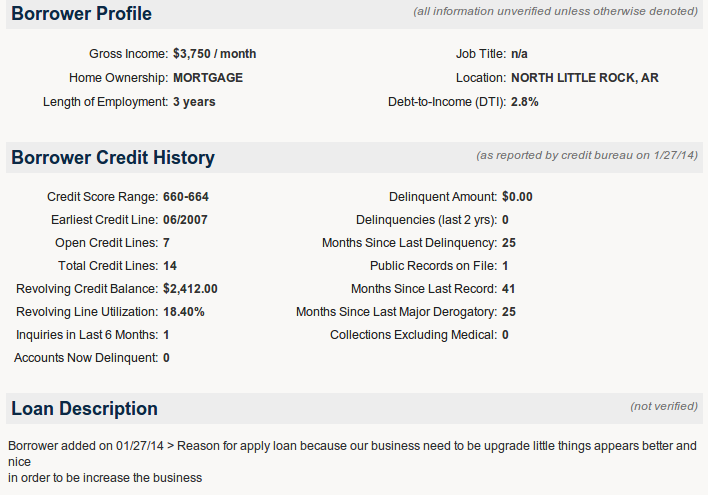
28 people are already participating in this loan. I think the smallest you can contribute is $25. Each loan gets filed with the SEC, which anyone can look up using Edgar.
But what you and I can see on the site seems to be all you can see in the SEC filings as well. Business location, credit, loan terms, and date filed, but nothing that identifies them personally. Unless of course you are smarter than I am and find a way.
Lending Club has made $3.5 billion in consumer loans in just a few short years. I have no doubt that they will be a billion dollar player in the business loan market as well. It sure would be nice to find out more about who they’re funding,especially since their cap is $35,000. There’s a good chance they’ll be underserving their clients’ capital needs.
The guys who figured out reverse UCC searching in MCA early made a fortune. Could reverse SEC filings be the next gold rush?
2014 Starts off With a Case of Red bull
January 10, 2014 Woah, slow down there fellas. Let us digest one thing at a time. We’re not even 2 weeks into the new year and already we’ve learned that:
CAN Capital raised another $33 Million (but that they didn’t need it?)
Merchant Cash Advance was the the feature story on the front page of the Wall Street Journal. Seriously…
Bloggers are learning about this industry for the first time. They’re having a bit of trouble getting it right.
PayPal, which just recently kicked off its own merchant cash advance program (or as they call it, their Working Capital Program) has already issued 4,000 advances.
Regulators are freaking out over the use of social media information in loan approvals.
DailyFunder will begin mailing out the first alternative business lending magazine a week from today. It’s free so sign up!