
Merchant Processing Resource is Now AltFinanceDaily
December 1, 2014 Back in July 2010, I launched www.merchantprocessingresource.com as an independent resource for merchant processing and merchant cash advance. At that time I was celebrating my 4th anniversary of working in the merchant cash advance business and realized there was little to no information about the industry online.
For the last 4 and a half years, this website under that name has been visited by hundreds of thousands of people, many of whom were new to the business or interested in getting into it. I’ve received thousands of emails and responded to an insane amount of questions.
In 2010, 95% of all merchant cash advances relied on merchant processing. For those that remember, funding was in many ways secondary to acquiring merchant accounts. But the industry has evolved and other related financial alternatives have sprouted up around it.
Over time I found myself exploring new avenues and relaying what I’ve learned or what I knew with the rest of the world.
Merchant Cash Advances may have started off as a product for those underserved by banks but it has morphed into an option for bankable businesses that would rather skip the bank. In a sense, today’s capital-seeking merchants are deBanking.
Consumers too are turning to peer-to-peer platforms and crowdfunding campaigns instead of credit cards and bank loans.
And then there’s myself. I started buying into Lending Club loans in January of 2014, almost a year ago. The returns crush what I could earn with a savings account or CDs. The bank is the least attractive option if you want to earn a return on your money.
But it goes beyond lending and earning interest. All the big conferences this year were filled with bitcoin enthusiasts, a payment technology and currency that is not only independent of government, but of banks. Of course I gave it a look and loved it. I shared my feedback in a post titled, My Journey to Bitcoin.
Merchant Processing and Merchant Cash Advance may have kicked off this blog, but four and a half years later, it’s time to acknowledge the other forces, many of which I have already been covering for quite some time.
With 2015 right around the corner, the world is deBanking in more ways than one.
I’m AltFinanceDaily.
Are you?
Income Correlates With Loan Performance
November 24, 2014 Now that I’ve bought into nearly 1,800 personal loans on Lending Club, I think I’ve got a good enough sample to start running analyses.
The data isn’t perfect especially since none of the loans have reached maturity yet. Most are still between two and four and a half years away from completion. But strangely, 70 loans paid off early and a good number have already defaulted or are more than 16 or 30 days late and are on their way there.
With at least that to work with, I compared three groups:
- Early payoffs
- 16+ days late or defaulted
- All others
I examined 4 initial factors and I will surely examine many more. While I saw some weak correlation regarding FICO score, it’s borrower income that really stood out.
Ignoring all other factors, the accounts that paid off early reported earning 29% more annual income than the accounts that are bad.
I had heard Peter Renton preach the high income borrower strategy and truthfully I ignored income as a factor in my decision making up until this point. On equities.com, Renton said, “I typically like more than $50,000 in annual income, although $75,000 is even better, and $100,000 is better still.”
Looking at my own sample, there is indeed correlation between the $75,000+ income earners with paying off Lending Club loans early.
Unlike some business loan products, Lending Club personal loans accrue interest rather than bake interest into a fixed total cost. That means a borrower that paid back a 5 year loan in just 3 months only paid 3 months worth of interest.
It was surprising to see that 70 borrowers repaid the loans in their entirety within a matter of months.
Regarding FICO, the score spread between bad loans and early payoffs was only 8 points, a lot smaller than I’d expect. But the portfolio is young and some loans have only just issued in the last few months. With another 2+ years left to go, the sample size of defaults will get bigger and I will be running the numbers on this again.
In in meantime, low income borrowers regardless of all other factors appear to be more risky investments. I guess you could say I’m not surprised, but it’s exciting to see data that supports a hypothesis.
Merchant Cash Advance Risks and Myths
October 24, 2014 The Lend360 Conference in New Orleans last week had a different vibe from the five other conferences I’ve attended this year. For one, I was a partner in it through DailyFunder. And further, there was a huge focus on best practices, ethics, and regulations. Expert speakers and panelists aired it out to dispel myths and disclose risks.
Most telling about the future was a response from Victory Park Capital’s Brendan Carroll about whether or not he feared looming regulations could hurt the merchant cash advance and alternative business lending industry. As someone who has invested heavily in Kabbage and more recently in Square Capital, he expressed concern about regulations in general but clearly was not convinced they were on the immediate horizon for the industry.
Lisa McGreevy, president of the Online Lenders Alliance moderated the two-man panel which also consisted of John Hecht of Jefferies and she did a great job of digging out the true thoughts from one of the room’s most powerful investors. It’s unlikely a company like Victory Park Capital would invest hundreds of millions of dollars in an industry they believed faced imminent regulatory upheaval.
Merchant Cash Advance regulation is not on any regulator’s immediate agenda but they are doing their homework. At Lend360, it was revealed that several members of the North American Merchant Advance Association met with the Federal Reserve in Washington D.C. months ago for a Q&A. There’s communication occurring now on some levels. Even I’ve been contacted by the Federal Reserve to comment as a part of a broad research assessment.
Eventually I believe the CFPB will try to play a role in the industry through Section 1071 of the Dodd-Frank Act. We’re a long way from there though and it doesn’t mean they’ll be successful. Even internal operatives have expressed doubt on business-to-business jurisdiction.
In the meantime, it’s not all blue seas and sunny skies. Robert Cook, an attorney at Hudson Cook, LLP explained at the conference that the industry is already in many ways supervised by the FTC. And with the FTC, it’s not a question of how high the costs are, it’s about how transparent those costs are. If they’re high, fine, but do the customers understand them and are they marketed accordingly?
Terms like guaranteed, 99% approval rate, and lowest rates can be deemed deceptive if not true.
 Transparency, ethics, customer experience, that’s what people in the business need to be focused on right now. Stacking, while a polarizing topic, seems to be a matter of contract law. Everybody’s caught up in the stacking debate believing it’s the lightning rod that will attract regulation. If left unchecked, it might draw interest, but it’s the fundamentals that get overlooked that could draw the ire of an agency like the FTC.
If your marketing says “rates from 1.10 and up”, while actually contracting 99% of your customers with 1.49s, that’s something you’ll probably want to address now. Think about the net cost your customer is likely to be charged. If a 1.10 is a buy rate and there’s a 10 point upsell, a 10% closing fee, and 10% origination fee that makes the end cost closer to a 1.40, you probably don’t want to market the cost as 1.10.
Right now it all basically comes down to doing good business in a transparent manner. Costs may be high but explain those costs, make sure the customers understand them. Don’t be deceptive. There will always be critics of high costs, but rational people are being exposed to the sober reality that you can lose money even at a 50% interest rate.
As a word of advice for new ISOs and brokers, stay away from funding companies that don’t even have a paid email account. If a funder is too financially strapped to afford a web domain, they probably are going to cut corners in other places too. The story about working off a gmail or hotmail account in the interim while they try to get their website set up is indicative that they’re getting ahead of themselves. There are way too many solid funding companies to choose from for you to entertain doing business with hotFunding4ISOsNow@hotmail.com. Even middlemen are accountable in the grand scheme of best practices and the customer experience.
Fund intelligently…
– AltFinanceDaily
Also read:
4/11/14 Regulatory Paranoia and the Industry Civil War
8/13/14 Should Licensing and Accreditation come to Merchant Cash Advance?
Did Google Penguin Hurt Your MCA Website?
October 22, 2014 Google struck again late on Friday the 17th with a refresh of the Penguin Algorithm. As posted on Search Engine Roundtable, the algorithm is still rolling out and will continue to do so over the next few weeks.
Those familiar with Penguin know that it targets backlinks, specifically: paid links, spam links, bad links, the whole gamut. Hit the trigger and your site can virtually disappear from search.
I monitor several keywords in our niche and I haven’t noticed much of a change between what I see now and what I saw prior to the 17th. Truthfully, some of the companies I see popping up now in the first 2 pages are exactly the type of companies I’d expect to see on a list offline. That’s a good indicator that something is going right.
The exact search results are different for everyone but amongst the top 20 results for the search term merchant cash advance, I get:
- OnDeck
- Kabbage
- AmeriMerchant
- Business Financial Services
- Capital for Merchants
- CAN Capital
- Merchant Cash and Capital
- Retail Capital
Years ago through spam manipulation, the first few results were dominated by random lead generation sites like fastcashfunding4unow.com. I see very few sites like that these days ranking well.
If you were wondering where your organic site traffic went in the last week, there’s a good chance you got Penguined. Good luck getting out of that!
Why Your Deal Got Stolen
September 16, 2014 Back in April, I presented the idea of trigger leads coming to the alternative lending industry. In subsequent discussions about that blog post, many folks particularly in merchant cash advance questioned whether such a concept could possibly exist or would even be legal.
For those not familiar, this is the methodology behind trigger leads using a hypothetical scenario:
- OnDeck runs the personal credit of a merchant using Experian.
- Experian sells the contact information of that merchant to OnDeck’s competitors immediately after credit is pulled.
- Competitors solicit that merchant and convince them to go with them instead.
Again, the reaction I get to the above scenario by most people is, “yeah, right. I don’t believe that could happen.” But if you look at the raw amount of ISOs complaining their deals got stolen, it’s evident that perhaps there is something else brewing than just the usual assortment of rogue underwriters and shady funders.
Most ISOs are convinced that if their client is working with them and only them, that a shady business dealing has taken place if that client is randomly called out of the blue with the knowledge that they’re pursuing funding. To them, the only conclusion is that their deal got backdoored.
 And while backdooring does seem to happen out there from time to time, another culprit may very well be trigger leads. Credit bureaus and big data aggregators are selling credit pull data in real time. UCC-1 leads are leads after the funding has taken place. Trigger leads are leads before the funding has taken place. But do they really exist?
Elsewhere in alternative lending, trigger leads are the backbone for how companies tailor their direct mail campaigns. If a consumer’s credit was pulled today by a mortgage lender, companies like Lending Club and Prosper will make sure that consumer receives a mail ad for a home improvement loan tomorrow.
Today at the Apex Lending Exchange conference in New York City, Ron Suber, the president of Prosper, referred to this trigger methodology as “getting to the right borrowers at the right cost.” In their sector, trigger leads are marketing 101. In merchant cash advance, it’s perceived as a pipe dream. Odds are that whoever is taking advantage of trigger leads in this industry would want to keep all the other players in the dark about it.
As much as you might hate to believe it, all of the backdooring paranoia that’s been rampant lately might actually be caused by the credit bureaus, not the funders. The lesson here is that as soon as your merchant’s credit is pulled, the clock is ticking until your competitors find out even if that merchant talks to nobody else.
I know ISOs want to believe that their merchant is only theirs, but in the age of advanced technology and big data, your merchant belongs to the cloud. As soon as your relationship with the merchant interacts with technology, somebody else will find out about it. And that’s why your deal got stolen.

On Deck Capital IPO, An Insider’s Perspective
August 16, 2014It was August 23, 2011, the day the Virginia Earthquake could be felt all the way up in New York City. The four of us were enjoying outdoor seating at a restaurant on the Upper East Side. The ground shook, my drink spilled and Ace looked at each one of us and said, “Okay so I’m putting you down for five deals this month.” OnDeck Capital’s relationship managers were aggressive. If you were a small Independent Sales Organization (ISO), they didn’t expect to get all of your dealflow so they roped you in little by little. It was hard to say no. If five deals was too much, Ace would say three and if three was too much, then he’d put you down for three anyway. Zero was not in the cards. OnDeck owned a specific niche and if you didn’t send your premium credit clients to them, then any ISOs you were competing against would. That was a death knell in those days. Just a few years earlier I would’ve shrugged them off, but public sentiment was changing. Merchants were embracing the fixed daily payment methodology and the merchant cash advance industry would never be the same.
OnDeck Capital is now going public. Will you buy stock?
 I’m in a unique position to discuss OnDeck. I started my career in this industry before they even existed. I’ve competed against them as an underwriter at a rival firm, worked with them as a referral partner when I was in sales, and covered them in my capacity as Chief Editor of an industry trade publication.
I left my post as Merchant Cash & Capital’s Director of Underwriting in late 2008. I was 25, about a year or two older than the average employee in the industry. Several of MCC’s rivals got demolished in the financial crisis but OnDeck wasn’t one of them. They also weren’t much of a competitor either. Struggling to define themselves as the anti-merchant cash advance, their product ran counter to the spirit of the industry’s rise. The single biggest allure of a merchant cash advance wasn’t that it was easy to obtain but that there was no fixed repayment term. The funds came with a pre-determined net cost but no specific date on when the delivery of future sales would be due.
Outsiders like the news media aren’t exactly sure what separates merchant cash advance from OnDeck except for maybe the cost of funds. Cash advance just sounds expensive, doesn’t it?
Outsiders identify the company by three characteristics.
1. They’re a non-bank business lender
2. They’re more expensive than a bank
3. They’re a tech company
These bullet points gloss over the fact that OnDeck’s loans require payments to be made every day. Can you imagine a credit card company forcing you to send a payment every day of the month? Or your landlord asking for rent on the 1st of the month, the 2nd, the 3rd, 4th, 5th, and so on every day until your lease is up?
This is not to say that this system is necessarily bad for borrowers, but that it is quite possibly the most unique and important part of what makes OnDeck different. It’s their secret sauce. It is why OnDeck gets lumped in with merchant cash advance companies in many conversations. OnDeck and the legion of copycats they have spawned are part of a broader industry that includes merchant cash advance companies. I call them daily funders. Daily funders provide financing on the condition that payments are made daily. I don’t call them daily lenders because traditional merchant cash advance products are not made by lenders, but by a unique group of investors that purchase future revenue streams.
Transition
Under company founder Mitch Jacobs, OnDeck had established themselves as the de facto loan option.
The merchant’s not biting on merchant cash advance? Send it to OnDeck. The merchant doesn’t accept credit cards? Send it to OnDeck.
They were every merchant cash advance ISO’s frenemy. They’d solicit you for your deals and then throw you under the bus to journalists as evil purveyors of expensive financing. They needed us to source dealflow and we needed them to maximize closing ratios but neither was quite satisfied with the arrangement.
When the company’s first employee took over as CEO in June 2012, the rhetoric changed. While still happy to be portrayed as the anti-merchant cash advance, OnDeck transformed their image from a niche Wall Street lender to a Silicon Valley-esque tech company. Noah Breslow was a curious choice. He has a BS from MIT and an MBA from Harvard Business School. He’s tall, charismatic, and he introduced vocabulary words such as algorithm to an industry that relied entirely on manual human underwriting.
At a recent lending conference, the younger crowd characterized Breslow as the Steve Jobs of business loans. He commands a cult-like following inside and outside the company, and in 2013 was embraced by New York City’s Mayor Bloomberg.
Breslow fast tracked OnDeck. With only $43 million raised in the first 5 years, the company went on to raise more than $300 million in the first 24 months under Breslow’s leadership.
This was their plan all along
In November 2012, OnDeck entertained a buyout offer from UK-based payday lender Wonga in which they reportedly received a $250 million valuation. The deal fell apart in the late stages but at the time I believed the negotiations were all a ploy for OnDeck to get a true market valuation. With a solid offer on the table, they knew both where they stood and where they needed to go. Last week the WSJ reported that preliminary IPO discussions valued them at $1.5 billion, six times higher than where they were two years ago.
With stock options being offered to new employees at least as far back as 2012, the plan to go public should come as no surprise. Later this year, those employees may actually get to do something very few startup workers ever get to do, convert those options into real shares.
So will OnDeck ride off into the sunset of billion dollar bliss? Not so fast say several industry insiders, some of whom are itching to short the stock on the first day they can.
 Smoke and mirrors?
As OnDeck took advantage of the swing in public consensus (that fixed terms were better and lower costs increased the attactiveness ), insiders began to ask an important question. Why weren’t merchant cash advance companies collectively countering with lower prices to remain competitive? Greed was fingered by journalists especially in the wake of the financial crisis. But greed is a weak prerogative if you consider that merchant cash advance companies were filing for bankruptcy left and right in 2009.
And oddly or perhaps even ominously, an entire segment of merchant cash advance companies began to raise their prices just as OnDeck was lowering theirs. When I wrote The Fork in the Merchant Cash Advance Road in April 2011, I said:
While the margins earned on high credit accounts shrank, funding providers were dealing with another challenge simultaneously, defaults. Whether the business owner intentionally interfered with their credit card processing or the store went out of business altogether, bad debt in the MCA world was mounting…FAST!
Risk was and still is the number one reason that merchant cash advances cost so much. While it’s true that OnDeck serviced higher credit businesses, insiders speculated that the spreads were too thin. For years, OnDeck’s merchant cash advance competitors have doubted the soundness of their model.
 It’s a debate that continues even to this day and yet OnDeck has secured hundreds of millions in investments from companies like Google Ventures, Goldman Sachs, Peter Thiel, and Fortress Investment Group. Their notes got an investment grade rating from DBRS. And as far as volume is concerned, they have likely eclipsed the industry’s all time reigning giant CAN Capital. If they had reached none of these milestones, OnDeck would have little credibility to convince critics of their sanity.
With a mountain of circumstantial evidence through big name backing in OnDeck’s favor, it seems to be indicative that the skeptics are wrong. But maybe they’re not. Could their model be both seriously flawed and superior at the same time?
It’s all about eyeballs
Going back to the 1990s, Internet companies have been judged, valued, and made famous by the price of eyeballs and the number of site visits. It’s a measure that’s never disappeared and according to USA Today is making a comeback. And while OnDeck Capital has always been based in New York City, true to their Silicon Valley form, their model has been to conquer market share first  and take on profitability second. In their case, it’s not eyeballs or site visits, it’s loan origination volume.
Five months ago Breslow was quoted in the WSJ as saying OnDeck is “imminently profitable“. With seven years in business, it’s proof that their critics have been right all along, that their model doesn’t make money.
What scares their competitors though, is that this strategy has been intentional. Very few if any players in the industry have had the luxury, guts, or the purse to lose money for seven years as part of a coup to conquer the market. Disbelievers in this long term wildly risky strategy are salivating at the opportunity to inspect the company’s financial statements in the IPO.
In When Will the Bubble Burst?, RapidAdvance CEO Jeremy Brown, whose company became part of the Quicken Loans family last winter, fired shots at OnDeck, “To accomplish high growth rates, which may be driven by a desire or need for an IPO or to raise investment or to sell to private equity, assets are being overpaid for through higher than economically justified commissions (I’ve heard 12-15 points upfront from the more aggressive companies) and stretch the repayment term of the MCA or loan even further (On Deck24, I am talking about you).”
Insiders testify that OnDeck’s strategy has not so much been about lower costs but about growth at all costs. Among the evidence is the sudden removal of an industry-wide practice of verifying the business owner is current on their rent. Repayment terms are getting stretched out, commissions have shot up, and for a while they ran a program that allowed applicants to get funding with the submission of just a single bank statement.
Merchant cash advance companies look at their own default figures and scoff at the notion that OnDeck’s aggressive practices could produce low single digit defaults as they’ve publicly claimed.
Imminent
 Through it all, there remains the fact that OnDeck has never claimed their methodologies to be profitable, at least not yet. Red ink at IPO time might reward their detractors with a certain delicious satisfaction, but what will they say if and when they become profitable?
I’m reminded of The 20 Smartest Things Amazon Founder Jeff Bezos ever said. Below is a few of them.
- “There are two kinds of companies: Those that work to try to charge more and those that work to charge less. We will be the second.”
- “Your margin is my opportunity.”
- “We’ve done price elasticity studies, and the answer is always that we should raise prices. We don’t do that, because we believe — and we have to take this as an article of faith — that by keeping our prices very, very low, we earn trust with customers over time, and that that actually does maximize free cash flow over the long term.”
- “If you never want to be criticized, for goodness’ sake don’t do anything new.”
- “Invention requires a long-term willingness to be misunderstood. You do something that you genuinely believe in, that you have conviction about, but for a long period of time, well-meaning people may criticize that effort. When you receive criticism from well-meaning people, it pays to ask, ‘Are they right?’ And if they are, you need to adapt what they’re doing. If they’re not right, if you really have conviction that they’re not right, you need to have that long-term willingness to be misunderstood. It’s a key part of invention.”
I wonder if the executive team at OnDeck would share these philosophies.
They’ve always claimed themselves to be a tech company, much to the bewilderment of their competitors. Will technology come through for them?
The data available on businesses has changed. Bank statements and a credit report might’ve been all there was to go on when the company first started, but in Automated Intelligence Breslow said, “the fact is most businesses operating today, in 2014, are already technology focused to one degree or another. They have computers, they have online banking, they use credit card processors, their customers are reviewing them online, there are public records, etc. All this electronic data helps paint a deeper and more accurate picture of the health of a business.”
With such easy access to important data, it might be possible that through the use of 2,000 data points, OnDeck doesn’t need to do all the manual investigations that their competitors still place high values on. The available data might be able to predict loan repayment success just as well as a human analyst.
And if that’s true, then they can reduce the cost of overhead as they scale. As their predictive algorithms get fed more data, they might be able to eliminate humans altogether. At the May 2014 LendIt conference, Breslow admitted that 30% of their loans were still manually underwritten but said that “if customers want full automation, we are prepared to deliver it.”
By that charge, a sustainable model should not be that far out of reach. Through advanced data analysis and decreasing fixed costs, profitability may indeed be imminent.
Winner
If the story of the merchant cash advance industry has been a race to the top, then OnDeck might be declared the winner in a successful IPO. It would be an ironic achievement for the company that positioned itself as the anti-merchant cash advance. In their wake today are hundreds of daily funders offering fixed payment products.
 OnDeck’s critics are in a paradoxical position because a successful IPO is good for them too. They want to believe OnDeck’s model never worked, can’t work, and have it be proven a failure. But if it goes the other way, the legitimacy of the daily funder universe will be solidified in the mainstream. What’s good for the goose is good for the gander.
As AmeriMerchant CEO David Goldin said to Inc, “the OnDeck IPO shows that Wall Street is now taking this industry seriously.”
So does that mean he’d buy stock? Somewhere out there at a restaurant in New York City, an OnDeck relationship manager is probably putting Goldin down for five shares.
Cue the earthquake, the industry will never be the same.
Curious how it will change it exactly? Read my magazine published prediction, The Retail Investor.
Are We in a $300 Billion Market?
August 7, 2014 Earlier today on a large group conference call with Tom Green and Mozelle Romero of LendingClub, I learned a few more details about their business loan program. In the Q&A segment, one attendee came right out and asked if they believed their competition was merchant cash advance companies and online business lenders.
According to Green, it’s not so much other companies that they feel they are up against but more of the broad challenge of market awareness. Their struggle is about getting people to know that there are non-bank options available and to make people aware of their existence.
It’s the same challenge merchant cash advance (MCA) companies have been dealing with for more than a decade. Notably though, there are many in the MCA industry that feel the market is saturated and thus a lot of the industry’s growth has been fostered through a turf war for the same merchants. Stacking (the practice of funding merchants multiple advances or loans simultaneously) is partially spurred by a belief that there are no more untapped businesses left to fund. The acquisition costs of a brand new untouched business that is both interested and qualified is so high, that it is not a pursuit some funders and brokers can afford to take on.
 Market Size
At present, daily funders, which are a combination of both MCA companies and lenders that require daily payments, are funding somewhere between $3-$5 billion a year. On the call Green said he believed the potential market was far larger than that, though he discredited the $200 billion figure that some independent research had predicted. That was only because LendingClub believes the potential market is substantially higher, more like $300 billion.
$300 billion?! That’s about 100x larger than the current daily funder market combined and starkly contradicts any belief that there’s no merchants out there who haven’t already gotten funded.
LendingClub’s minimum gross sales requirement is $6,250 a month and they have an upper monthly gross threshold on applicants at $830,000 a month, though they’ve had businesses apply who do even more than that. Their sweet spot as Green put it, is the segment doing $16,000 to $416,000 gross per month.
I can’t help but notice that’s the same sweet spot that daily funders have. And we mustn’t forget, LendingClub’s target business owner has at least 660 FICO. If it’s a $300 billion market for good credit applicants, then it’s got to be even bigger for the ultra FICO-lenient companies in MCA.
What’s a business?
LendingClub only needs someone with at least 20% ownership to both apply for and guarantee the loan, an unheard of stipulation in the rest of alternative business lending. One cardinal rule in MCA has been that there needs to be at least 51% or 80% ownership signing the contract. That’s had a lot to do with the fact that most MCA agreements are not personally guaranteed and the signatory is required to have absolute authority to sell the business’s future proceeds.
Summer of Fraud
 In 2013 the MCA industry experienced what many insiders dubbed the summer of fraud. Spurred by advances in technology, small businesses were applying for financing en masse while armed with pristinely produced fraudulent bank statements. Fake documents overwhelmed the industry so hard that today it is commonplace for underwriters to verify their legitimacy with the banks. This is done manually or with the help of tools such as Decision Logic or Yodlee.
Knowing this firsthand, I asked LendingClub if they also take the care to verify bank statements. In the majority of cases they do not. They rely greatly on an algorithm that detects fraudulent answers on the application but the statements themselves are not scrutinized except in very high risk situations. Considering they’re wildly less expensive than MCAs, I find it odd that they are exposed to this type of risk. Fraudulent documents are the norm and in these underwriting conditions, I would expect them to charge as much or more than MCA companies, not less.
At the same time it’s important to mention that at present, business loans on their platform are only funded by institutional investors. Retail investors can only invest in consumer loans. LendingClub has been very transparent about excluding retail investors here for the very purpose of shielding them from unevaluated and unforeseen risk. My guess is that as time goes on, they will do more to validate the bank statements which is the bread and butter of assessing the risk and health of a business.
$300 billion
In a FICO flexible environment, it’s possible the potential for daily funders is at least $300 billion. If true, that would mean that for the 16 years that MCA players have been around, they barely reached even 1% of their target audience. I’ve been saying it since I’ve started this blog 4 years ago, every business owner I’ve spoken to has never heard of a merchant cash advance… which means saturation is a myth.
Tom Green was right, the real competition is public awareness. 99% of the potential market is untapped. If you’re fighting with 5 other companies over the same merchant, you gotta:
You gotta keep on looking now
Keep on looking now
You’re looking for love
In all the wrong places
Six Signs Alternative Lending is Rigged
August 3, 2014There’s a lot of players at the alternative lending table but there are two that have won a string of lucky hands to put them on top. Neither were the first to draw cards, nor do either of them offer something that everybody else does not. These two lenders have something in common of course, special favor with the Internet gods. Is the game rigged?
OnDeck Capital is the most celebrated alternative business lender of our time. Their daily repayment loans and fast approval times are a hit with customers. In fact, as told in their recent securitization prospectus, OnDeck has been eroding its reliance on brokers and third parties to accommodate growth through their direct channel. Direct has been good for OnDeck, very good.
LendingClub on the other hand is the big dog in consumer lending, having funded more than $5 billion since inception. Every month they shatter the previous record for volume of loans funded and they’re expected to go public within the next year. LendingClub continues to pound their distant rival Prosper in monthly loan production. Are they just better at marketing?
Curiously I can’t help but notice they have something in common, they’re both owned by Google. Google Ventures led OnDeck Capital’s series D round and Google Ventures’ Karim Faris sits on OnDeck’s board of directors. Similarly, Google owns a minority stake in LendingClub.
While neither is outright owned or controlled, It’d be surprising if Google didn’t do something to foster the success of their investments. What could a billion dollar Internet giant possibly do to give them a little push?
Stop backlinking and SEO. The game is rigged
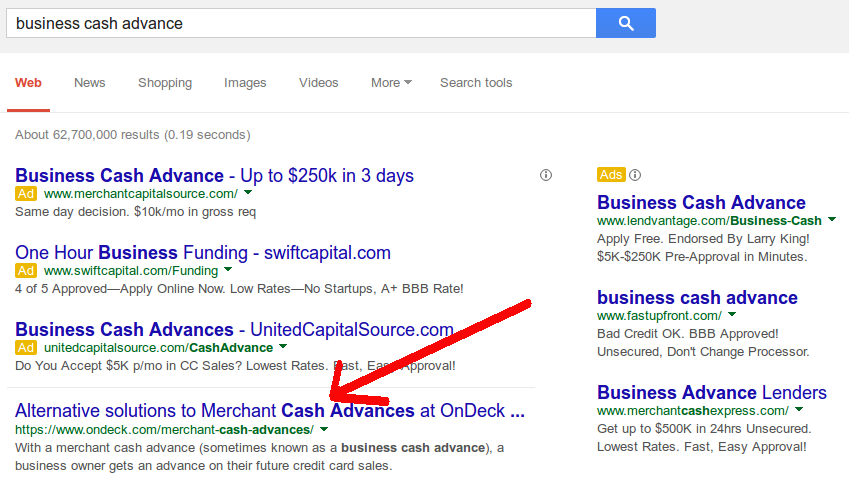





If you reproduce a search for the same keywords, you should know that results vary depending on what kind of device you’re using (mobile vs. desktop), what zip code you’re in, what time of the day it is, whether or not you’re logged into Gmail/Google+/Youtube, and whether you’ve searched for related topics before. I performed my searches with a fresh desktop browser on a Sunday evening in NYC with all cookies, cache, and Google account sessions wiped clean.
 You might not get exactly what I get and I realize that obfuscates the conspiracy I’m trying to establish here. If you do witness peculiar keyword domination though, keep an open mind that there might be more going on than good SEO and strong natural backlinking brought on by mainstream media publicity. Plenty of big businesses that dominate offline fail to rank well in the top ten results online.
Search engines say that if you’re popular, you’ll rank well. But there are plenty of cases where ranking well has made businesses popular.
Maybe, just maybe the game is rigged…