The Dumbest Guy in the Room
May 11, 2015 “This is the absolute dumbest thing I’ve ever seen,” she said while raising her voice. She was visibly agitated as if someone had just attempted to pass off a child’s crayon drawing as their doctoral dissertation. I began to laugh, not at her, but at the irony of the truth she was going on about.
“So what would need to be different in order for this to be a more viable idea? Like what would I need to change and come back with?” I asked.
“Come back?! COME BACK?! Don’t come back,” she shouted while taking my business plan and literally crumpling it into a ball and throwing it on the ground. She then got up and left. She was shaking from the rage. I was the dumbest person she ever encountered and it took effort for her not to kill me.
This experience happened to me three years ago when a NYC-based Venture Capital group sent out invitations to a free seminar and workshop. I liked the refreshing thought of hearing what VCs had to say, especially those not familiar with the merchant cash advance industry. Besides, I had a few concepts I wanted to get feedback on, and thought this would be a great opportunity to do it.
The seminar was more of a fireside chat, held by a zen-like VC I’ll refer to as Rain. He was in his mid-30s, wore a long flowy purple velvet shirt and sat indian style and barefoot in the front of the room. It was a stark contrast to the attendees in the audience, all of whom were wearing suits. Rain walked the crowd through his experience as a VC, most of which seemed to be an annoyance to him. Startups were full of personal drama of which he often got roped into. There was always a partner who was an idiot, a delusion the founder(s) couldn’t see past, or an insatiable need for additional funds.
And during the Q&A at the end, an attendee asked him if he would ever consider using a VC to raise money if he were not a VC himself. “Put the phones down guys, this stays here,” he said. “I wouldn’t.”
However confusing that might come across as, it didn’t change the energy in the room. Just about everyone who attended had an idea for a startup and desperately wanted VC funding.
Afterwards, you were allowed to schedule a one-on-one with one of their startup experts to develop your ideas further. It sounded cool and it was free, so I signed up.
I drafted up a concise business plan based upon a model that was just starting to take root in the merchant cash advance industry. It had its own little twist and I’m sure flaws too, but I believed this one-on-one would be a helpful conversation where I could get honest feedback without giving anything away to potential competitors.
Three minutes into the meeting, I was being scolded. “What do you mean it would break even for the first 2 years?!”
“Oh, well what I’m try –,” I attempted to respond. She talked over me. “You mean to tell me you would make no money in the first 2 years? Are you starting a charity?!”
“Well I was under the impress–,” I started, but she kept going. “This is the absolute dumbest thing I’ve ever seen.”
 It was the hardest no I had ever gone through. I looked around the room to see if the other one-on-ones being conducted were going the same way. They weren’t. Everyone else looked to be cozying up to each other, crunching numbers, sharing laughs, and possibly on their way to even getting funded.
Not me though. I was the dumbest guy in the room, too dumb to even come back with something better. It was a humiliating moment considering I thought this was supposed to be an instructional meeting where the experts would essentially help you master a business plan.
As I walked out of the office towards the elevator, I noticed that even the cheery receptionist who had excitedly welcomed me in, ignored me with her head down as I walked out.
There goes the dumbest guy that ever existed, I imagined she was thinking.
My world spinning as the elevator descended, I tried to recount how it went wrong so quickly. I had showed her a pro-forma P&L that broke even for the first two years as I would reinvest 100% of the profits back into marketing to scale. I personally didn’t like it that way. I wanted to make money, but everyone around me was bleeding red and raising tens of millions along the way. I had started to believe that sacrificing any shred of profitability in exchange for growth is what got investors excited.
My expert didn’t share that view. A business that wasn’t profitable wasn’t a business. It was dumb, and not just regular dumb, but the dumbest thing that anyone ever thought of. EVER.
A couple of days later when I had shaken off the blow to my self esteem, I was thankful for the experience. She was a New Yorker to the core and so was I. I had no inner desire to start a business that didn’t make money (for the sake of disrupting or whatever), but I was being swept up in the craze of companies that were doing just that. She brought me back to reality, though she left a lasting imprint of a boot on my ass.
Three years later, companies with models similar to the one I had cooked up have raised hundreds of millions of dollars. They don’t break even. They lose money, lots of it. But they are looked upon and celebrated as some of the brightest guys in the room. Many of those guys are smarter than me and are probably executing their concepts way better than I ever could. But the lose-a-lot-of-money and grow model isn’t meant for everyone. It all depends on who you’re talking to.
In HBO’s Silicon Valley, a hit that many view as more of a reality show than a sitcom, they poke fun at a truth purveying the California startup scene. Forget profits, the show explains, just having revenues hurts your chances of raising money.
 “If you have no revenue, you can say you are pre-revenue,” says the show’s billionaire Russ Hanneman. “You’re a potential pure play. It’s not about how much you earn; it’s about what you’re worth. And who’s worth the most? Companies that lose money! Pinterest, Snapchat, no revenue. Amazon has lost money for the last 20 years, and that Bezos motherfucker is the king!”
Two years ago, Bezos was worth $25 billion and was the 20th richest person in the world. Some experts might say a business model that loses money for 20 years would qualify as the new winner for dumbest thing that ever existed ever. It’s apparently just the opposite.
But once you find an investor that believes in the loss model, do you take the money and then go out and disrupt, hoping that somehow you’ll end up a billionaire?
Loan broker Ami Kassar is faced with that very dilemma. In his recent blog post, he wrote about the offer he has on the table from a VC, “While I could substantially grow my top line – the chances of making any profit are small and the chances of losing money are high.”
Fictional billionaire Russ Hanneman would surely approve, but over in realityville, Kassar is balking. “I can only speculate that they’re more interested in market share – than profits. Their investors want growth. They’re on the venture capital treadmill.”
Admittedly, I poked fun at Kassar, an entrepreneur I’ve often sparred with online. “Should I be worried that in their quest for growth they will build a train and run me over?” He asked in his blog.
Of course I linked to it in the following manner:

Kassar concludes that sustainable long term value is the only logical way forward. Is he wrong?
The current investment atmosphere where anybody with a model and a programmer is raising hundreds of millions of dollars to basically see how fast they can spend it all, is affecting those that have always believed in profits and longevity.
In another post by Kassar just a week earlier, he wrote, “Am I missing the boat and doing something wrong? That’s how I have felt lately as I’ve watched the emergence of the online small-business financing space. It seems every other week I wake up to another announcement about a company in the small-business financing space who has raised a lot of money from venture capitalists at a really high valuation.”
Just last week, consumer lending startup Affirm raised $275 million in a Series B round. Many people in the alternative lending community had never heard of Affirm but they are apparently so good that they can raise a quarter billion dollars.
Investors are scrambling. They don’t want to be left out. On multiple occasions, I have heard of investors skipping basic due diligence in a rush to capture a deal. Some of those deals blew up in a matter of weeks, others in months when they realized they didn’t even know who the owners were or what financial standing they were in.
Lending Club and OnDeck have received billion dollar valuations. That’s what everybody wants, though the market has temporarily cooled on OnDeck, a company that has lost money for almost eight straight years.
Even Shark Tank investor Kevin Harrington has gotten in on it, through his new business loan marketplace, Ventury Capital.
One thing looks certain three years after I met with that expert. The supposed dumbest thing that could ever be conceived of ever has made tons of people millionaires.
A year ago, Kevin Roose of New York Magazine wrote this of profitless startups, “They’re simply taking millions of dollars in venture capital with the hope of keeping prices low, pushing rivals out of the market, and eventually finding a way to turn a profit.” It can be predatory pricing, Roose argues. Basically large venture backed companies can sell below their cost using unlimited funds until the competition is out of business. Then with the entire market all to themselves, they can figure out a model towards profitability.
There seems to be a lot of this happening in the alternative lending space where the lenders backed by hundreds of millions of dollars are not only undercutting the competition at a loss, but they’re running lobbying campaigns that accuse their profitable brethren of being greedy and predatory. The media and general public eat this message up. There is no defense for a lender who has been accused of charging too much by one charging less even if the one charging less will need to declare bankruptcy if it does not raise a fresh round of new capital to sustain operations.
Only the rare observer can read between the lines as Forbes contributor Marc Prosser did. In his own research, he discovered that, “a company which loans money to small businesses at an interest rate of more than 50% was losing money.”
Though I won’t name names, there are a few players out there that believe the answer to their cycle of losses is to push regulatory agencies to attack profitable companies, or at least constrain them through penalties and new laws. Essentially, if it looks like they can’t win the war of attrition, then they might as well stick the government on them.
Speaking of the war of attrition, the race to bring costs to merchants down to zero doesn’t seem to be having the desired effect on the competition. In OnDeck’s Q4 earnings call for example, CEO Noah Breslow said the following:
Overall this market is still characterized by extreme fragmentation. The behavior that we see with our customers is that they might research other competitive options online but then when they actually apply to OnDeck and receive that offer, they kind of have this bird in hand dynamic, and there’s so much search cost associated with going out and looking at other places and so much uncertainty around that, they typically just take that offer that OnDeck has provided to them.
Translation: Once merchants have an offer from somewhere, they go with it. There is no price-competitive marketplace on the macro level.
OnDeck has been undercutting the entire merchant cash advance industry for years. None of their competitors have gone out of business, at least not because of a profit squeeze. Instead, everyone is growing, OnDeck included.
So why lose money?
In the case of OnDeck, they can argue that growth has allowed them to expand into Canada and Australia. They’ve forged partnerships with Prosper and Angie’s List. They’ve acquired more data because they’ve done more deals than most. And who is another billion dollar company likely to partner with in the lending space? Probably the one doing 10x the volume of everyone else, the one whose name is all over the place. They have the advantage to win the partnerships.
Five years from now, when the competition is trying to catch up in volume, all the lucrative partnerships might be snatched up already. Maybe it really is about who can spend the most the fastest. It’s a depressing thought.
Some startup vets will you tell that the most important aspect is actually the team. The CEO of 140 Proof for example has written, “You succeed or fail not on the strength of your idea or your product, but on the strength of your team. Venture capitalists fund teams, not business plans.”
With that in mind, I tried to imagine how that meeting three years ago would’ve turned out had I showed up with OnDeck’s CEO Noah Breslow and Lending Club’s CEO Renaud Laplanche in tow. “We’re going to disrupt lending,” I imagine the three of us tell the fierce startup expert.
The expert knew nothing about me. As far as she knew, I was just some random guy off the street holding a stack of papers with an incredulous plot to dominate the lending industry. I had never worked for a bank. I was young. I had no partner. I didn’t graduate from Harvard or MIT. It probably looked pretty ridiculous. “Duhhh so whaddya think?” I imagined I appeared to her.
With her guard down, she had no reason to hold back from saying what she really felt, that the plan was the absolute dumbest thing she’s ever seen.
Might the dumbest guy in the room only be that because he believed what she said? Or did she have it right all along?
CAN Capital Hits $5 Billion Milestone
May 7, 2015NEW YORK, NY, May 7, 2015 – CAN Capital, Inc., market share leader in the alternative small business finance space today announced that it has provided small businesses with access to more than $5.0 billion of working capital, more than any other company in the space. During its 17 years in business, CAN Capital has leveraged its proprietary data-driven models, technology and customer-focused delivery to cement its position as the largest and most experienced alternative finance company serving small businesses.
To date, CAN Capital has facilitated over 156,000 small business fundings in more than 540 unique industries. CAN Capital’s customer base continues to expand and its digital business grew 600 percent in 2014.
“Reaching this milestone underscores how CAN Capital’s innovative technologies have helped small business owners access much needed capital to grow their businesses,” says Daniel DeMeo, Chief Executive Officer, CAN Capital. “Small business owners have an appetite for investing in inventory, marketing and technology. We facilitate fast approvals and fundings so business owners can spend time focusing on these goals and running their businesses – instead of searching for capital.”
In April 2015, CAN Capital broke records by securing a $650MM credit facility from a dozen leading lenders including two of the three largest US banks – Wells Fargo and JP Morgan Chase – as well as two large international banks – UBS and Barclays. This transaction marks the largest of its kind to ever occur in the alternative finance industry. “Our performance and reputation as the vanguards in the alternative finance space position us for more success, more growth and a greater ability to serve even more small business owners,” says DeMeo.
“Small businesses are an incredibly important part of the American economy. We’re proud we’ve been able to support them over the past 17 years, and look forward to continuing to do so with new products that will help drive future growth for us and our customers.”
Hear the stories behind some of our successful small business customers here: YouTube.com/cancapital1.
About CAN Capital
CAN Capital, Inc., established in 1998, is the pioneer and market share leader in alternative small business finance, having provided access to over $5.0 billion in capital for tens of thousands of small businesses in a wide range of locations and different business types. As a technology-powered financial services provider, CAN Capital uses innovative and proprietary risk models combined with daily performance data to evaluate business performance and facilitate access to capital for entrepreneurs in a fast and efficient way.
CAN Capital makes capital available to businesses through its subsidiaries: Merchant Cash Advances by CAN Capital Merchant Services, Inc., and business loans through CAN Capital Asset Servicing, Inc. (CCAS). All business loans obtained through CCAS are made by WebBank, a Utah-chartered Industrial Bank, member FDIC.
For more information, please visit: www.cancapital.com. Follow CAN Capital on Twitter and Facebook.
The OnDeck Hedge
May 6, 2015 Days after OnDeck went public in December 2014, a handful of their competitors licked their lips and said, “Perfect. Now we can hedge ourselves.”
But can they really?
OnDeck isn’t quite merchant cash advance and not quite Lending Club. They might be heralded in news media as the poster child for the non-bank business financing movement but one could hardly say that they typify the average company in the industry. They do things their own way and always have. It’s the very reason they are often criticized by their competitors. OnDeck doesn’t represent an industry but rather an antithesis to an industry they were borne out of.
That’s not to say there aren’t many common denominators between their products and others such as merchant cash advances. There are. But as an outside investor who wanted to be long on the success of the merchant cash advance industry, OnDeck isn’t a perfect match. And if they wanted to be long on non-bank business lending, the daily payment short term system at the core of the company probably isn’t what an investor had in mind.
OnDeck presents only one investment opportunity, themselves.
But what if you short them? That’s the trade some funders and lenders talk giddily about over drinks as the answer (at least hypothetically) to an eventual economic downturn. How do you hedge your own portfolio’s losses? Just short OnDeck! or so the theory goes.
I don’t doubt that some folks have secretly placed the OnDeck hedge in their back pocket as a legitimate possibility, but I’m not sure anyone has really thought this through.
First, many funders rely on credit facilities from third parties to fund deals and scale operations. That means restrictions and covenants on how the money is allocated. I don’t think taking a multi-million dollar short position on a single stock was what the institutional lenders had in mind. Business lenders and merchant cash advance companies are not hedge funds. The immediate reaction to a downturn (whether miniscule or massive) should be to reduce the default rate, tighten underwriting, and cut costs, not take huge positions in the securities markets.
 The logic behind this trade is almost like realizing that the restaurant you own is on fire and instead of running for water to put it out, you call an insurance company and take out a policy on the neighboring businesses instead. If those businesses burn down, you get paid, and the loss from your own restaurant burning down will be offset. Except now your business is gone.
Second, OnDeck isn’t a perfect match for this trade. In Barroom small talk, the hypothetical circumstances surrounding a hedge are less often an economic downturn and more often about everything going to hell. If everything goes to hell, we can just short OnDeck!
Except there are many sane reasons why OnDeck would soar in such a scenario. If purchases of future sales were interpreted to be usurious loans, well then that might cause everything to go to hell for merchant cash advance companies but boost the value of OnDeck who has been cognizant of state usury laws and the complexities of being an actual lender for some time now.
And if business lenders issuing 5 year loans with monthly payments are all falling apart, it’s possible that OnDeck with their 1-year terms and daily payment schedules would be a refuge.
Just yesterday, OnDeck beat the street’s expectations and then for some reason immediately lost more than 15% of their market capitalization. Bloomberg’s Zeke Faux ran the following headline, OnDeck Tumbles as Competition Forces Online Lender to Cut Rates, despite OnDeck’s execs specifying TWICE in the earnings call that competition had no bearing in their decision to cut rates.
While beating the street and subsequently getting clobbered may lend credence to the phrase, “buy the rumor, sell the news,” there wasn’t anything particularly jarring in the report to warrant such a huge sell-off. OnDeck doubled year-over-year revenues and they funded an astounding $416 million in loans in a single quarter.
The 15+ day delinquency ratio increased from 7.2% to 8.4% year-over-year however. CEO Noah Breslow and CFO Howard Katzenberg defended this as normal Q1 seasonality but were non-committal to the direction this would move in future quarters. Maybe that’s what spooked investors? It’s tough to say.
Had CAN Capital been publicly traded too, should OnDeck have taken a short position on them when they saw their own 15+ day delinquency rate spike? And should OnDeck buy put contracts on competitors that also eventually go public, you know… just in case everything goes to hell?
Probably not.
The only investment OnDeck should focus on making is in themselves. Leave the trades to the hedge funds who may actually be in the business of buying insurance contracts on a burning restaurant’s next door neighbors.
The only hedge to a failing business is to create a business built to last. Shorting OnDeck makes for entertaining barroom chatter, but it cannot be a serious fallback for a funding company worried about their portfolio.
Merchant Cash Advance Was at Transact ’15
April 4, 2015The payments crowd was no doubt in the house at Transact ’15, but if you were wondering if there was anything else going on, check it out:


#TRANSACT15 – enjoying the show and having fun meeting new sales channels! #smallbusiness pic.twitter.com/1PxTVsUrbC
— RetailCapital (@Retail_Capital) April 1, 2015
Check out @CANCapital at @ElecTranAssoc on the exhibit floor. #TRANSACT15 pic.twitter.com/AVO3mJAyJh
— CAN Capital (@CANCapital) April 1, 2015

VPs Steven, Josh, Alan and Hellen will be at Booth 1600 this week to talk about #financing @ElecTranAssoc #TRANSACT15 pic.twitter.com/2cIy5Lfvp2
— Strategic Funding (@SFSCapital) March 31, 2015
Our dedicated Broker Services Manager is at #TRANSACT15 and ready to meet you! Stop by Booth 303 before the day ends! http://t.co/6Bl08VENoi
— National Funding (@NatFunding) April 2, 2015

Read: Is the MCA Industry Reverting Back to 2005?
How Syndication Has Made Millions for Partners
April 3, 2015 “How Syndication Has Made Millions for Partners” is a subtitle I borrowed from Strategic Funding Source’s print periodical, The Business Strategist. In the article penned by Ben Johnston, the company’s Chief Strategy Officer, the story how of syndication made its way into the merchant cash advance industry is explained in detail.
Of notable mention is that Strategic has had over 200 syndicate partners co-invest over $260 million of their own money into funded deals. That’s more than a quarter billion dollars from syndicates.
Their platform, which was the first one to operate on scalable level, provides same day payments to syndicates and access to detailed reports on a daily basis.
“Peer-to-peer lending and crowdfunding have become hot topics in the financial industry,” the article concludes. “But Strategic Funding Source has been crowdfunding with its own peers for years.”
A Return to the Fundamentals? (At Transact 15)
April 3, 2015 The Transact ’15 conference opened to a record crowd and there was no shortage of merchant cash advance players in attendance. Those facts were to be expected. And if you walked in and poked your head around, you might not have noticed anything to be different. Payment processors touted the latest mobile technology and at every turn security systems were being offered to prevent catastrophic breaches of cardholder data.
Everything looked normal… except the merchant cash advance companies.
Back to the fundamentals
Early on Wednesday, April 1st, CAN Capital kicked off a product announcement by raffling off free Apple watches. CAN’s new product is called TrakLoan, a revolutionary new loan program that allows merchants to repay via a split percentage of their credit card sales instead of fixed ACH.
April Fools?
The described advantage of TrackLoan is that there is no fixed term and that merchants only pay back at the pace that they generate card sales. Wait, Where have I heard of this before?
After slapping myself across the face a few times to make sure I hadn’t teleported to the year 2005, the rip in the space time continuum grew more apparent at the after parties.
Card processors Integrity Payment Systems, North American Bancard and Priority Payment systems are still among the hottest names in town for splits. The veteran MCA ISOs and funders are still boarding hoards of merchant accounts with them every month and are therefore building multi-million dollar residual portfolios in the process. It makes one wonder why so many people have turned their back on split-deals for the ACH methodology.
Years ago, merchant cash advance was a sideshow value-add that could be used to acquire what really mattered and what was reliably profitable, merchant accounts. Not everyone has forgotten that however.
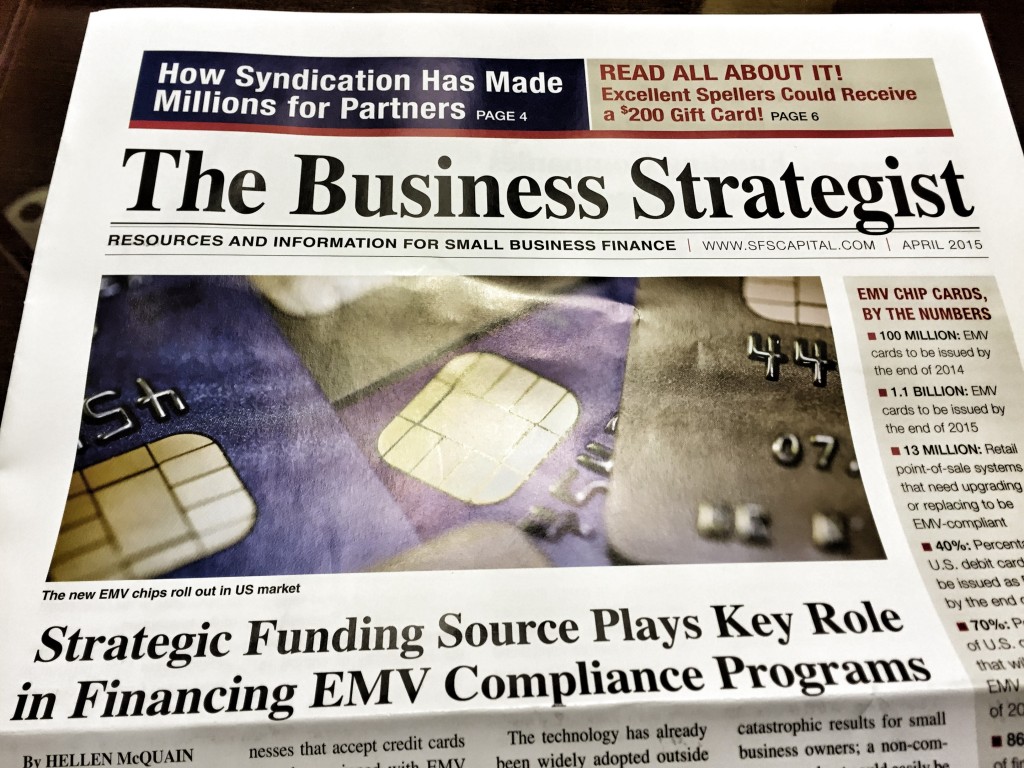 Over at Strategic Funding Source, Vice President Hellen McQuain is heading up a new merchant services division. In The Business Strategist, an SFS periodical, McQuain speaks the native tongue of the payments industry: EMV, PCI, NFC, etc.. Few, if any, of today’s new entrants in merchant cash advance could identify what those acronyms stand for, let alone explain the current climate of adoption.
So, is it time to get back to the basics?
Over the last six months, I have heard more gripes from funders about how to align a broker’s interest with theirs, other than by offering the opportunity to syndicate of course. The question comes down to, how can you get a broker to care about the outcome of a deal?
The answer should be obvious. Pay half the commission upfront and the other half as part of an ongoing performance residual. That gives the broker a stake in the outcome without having to syndicate. This is not a novel idea. This was how the entire industry operated from 2005 to 2011.
Might brokers resist such a compensation plan today in an upfront-only world? Maybe. But the greatest resistance I sense from funders, especially new ones, is that automated residual payments are too complicated for their current accounting systems.
That of course begs another question. How can this possibly be? Despite the rapid growth in technology, there is an entire segment of the industry that is ill-equipped to handle transactions that were commonplace and scalable five years ago.
While today’s systems are impressive, there are times when it seems like yesterday’s advanced technology was lost in a great flood, along with all the scientific texts documenting how to build the powerful machines.
To add to this, some of today’s edgy ideas are not new. A monthly payment loan for example is not an innovative idea. Weekly payments might acquire the merchant that wouldn’t do daily payments. And monthly payments might get the merchant that wouldn’t do weekly payments. These stretched out programs might make you popular with merchant cash advance brokers that are used to selling daily payment products, but they’re in no way new. It’s a return to the basics.
In 2015 we may apparently be going full circle.

A Peek Inside Yellowstone Capital
April 1, 2015When the banks say ‘no,’ alternative financing companies are saying ‘yes,’ sometimes. While costs may run high, there is still a limit on risk that a lender like OnDeck Capital and their competitors can accept.
In January of 2011, Kabbage stated their approval rate on volume-eligible applicants was only 55%. In February of this year, they said it’s about 80%. And a year ago, CAN Capital CEO Dan DeMeo told Forbes their approval rate was almost 70%. Similarly, a Biz2Credit report estimated the approval rate for alternative lenders in 2014 to be around 64% on average.
This indicates that approximately 20% – 35% of small businesses are being declined yet again. These are America’s exiles and they don’t fit into the neat little underwriting boxes that alternative lenders have crafted. Being declined by an alternative lender does not necessarily mean the business isn’t healthy or viable, but rather it could be because they exhibit some characteristic that today’s risk algorithms disqualify. Volatile sales activity, short time in business, poor credit, and atypical SIC codes are just a few of the reasons that a business could be rejected by a lender like OnDeck.
Consequently, an entire Plan C market has sprung up to service the small businesses that have been cast aside by the algorithms. And it’s huge. At the center of it all is Yellowstone Capital, a New York City-based merchant cash advance provider that has carved out its own niche. Founded in 2009, Yellowstone was one of a handful of pioneers that introduced ACH payments to an industry that relied entirely on split-processing.
 Yellowstone does not publish their annual funding volume, but according to insiders not authorized to speak on the record, the numbers dwarf many industry behemoths including Square Capital, a company that funded more than $100 million in the last twelve months. And there’s some interesting changes happening there behind the scenes.
Last year, Yellowstone gave up an equity stake to a New York-based hedge fund in exchange for capital. Just recently however, Yellowstone CEO Isaac Stern led a management buyout to reportedly better position themselves for growth.
As part of the arrangement led by Stern and backed by a private family office, the hedge fund has been bought out and Stern is the only remaining company co-founder to retain an equity stake.
Additionally, private equity turnaround expert Jeff Reece has come on as President. Reece is a former Director of Cogent Partners, a boutique, private equity-focused investment bank and advisory firm.
Josh Karp is remaining the company’s Chief Operating Officer.
Jake Weiser is staying on as General Counsel.
 Above all, the changes are more than just a few new faces in management. Yellowstone has already rented an additional floor at 160 Pearl Street, bringing the total floors they occupy there now to three.
Notably, the company has endured some negative press in the past of which they are well aware, but they have no shortage of supporters. I contacted two ISOs that claim to have worked with them and asked for their opinion on the Yellowstone experience.
Len Gelman of Allied Capital Corp couldn’t say enough good things about his account manager there, “He fights for every deal I submit, no matter how small or how difficult it may be to get done,” said Gelman. “He always takes my calls and responds to my emails and texts no matter how late it may be.”
And Arty Bujan of Cardinal Equity said, “Working with Yellowstone opened a door of business for me that really wouldn’t have existed without their unique approach to funding what some may call less desirable merchants.”
With a new management team and strong capital backing, Stern and Reece appear to be laying the groundwork to scale.
According to company insiders, Yellowstone is also working to expand their box beyond just high risk businesses and plan to service the middle market risk class. That would in effect also make them a Plan B option.
Their new underwriting depth could spare business owners from that second ‘no.’
The Unofficial Origin of Merchant Cash Advance (In Honor of St. Patrick’s Day)
March 16, 2015 In the late 1790s, two brave pioneers trekked across the North American continent in search of a bank loan alternative. A particularly harsh winter almost managed to dash their dreams, but they pressed on. “For the free market! For funding!” they cheered. Their optimism stood in stark contrast to the cold rugged landscape through which they traveled.
They weren’t the only two who sought change, but they were the catalyst. One of them was Sam Smith, an owner of Ye Olde Bar and Restaurant. His partner was John Stacker. John was the more wild and unpredictable of the two. They had always brewed their own ale but their customers had grown tired of the taste and were turning to local moonshiners.
Eager to win back their customers, Sam reached out to the distributor of a major lager but was told he could only make purchases in bulk. It would cost them $10, nearly the amount his bar would earn in a month. He was confident that if he raised the cash, he could sell it to their customers for far more than they paid for it and come out ahead. Sam knew there was only one place in town to borrow a hefty sum of $10, First American Bank and Trust. It wasn’t a national chain, but rather quite literally the first national bank and the only one that anyone could trust.
“A business loan for $10?” the bankers laughed. “Absolutely not!”
And so Sam realized that if it was capital they sought, they’d have to get it from someone out in the great beyond. John agreed, kind of. He didn’t want to settle for someone. He hoped to enlist the help of everyone.
After packing their bags and saying their farewells, the two partners set off on a 900-mile journey.
 Their wagon fell apart about halfway there. When it could no longer be patched up, they continued on horseback. When the horses died, they walked. When their legs gave out, they crawled and when their knees gave out they did the worm.
With barely any energy left and ready to give up, they came upon a charming red brick building in the middle of a desert. A sign was posted outside that said “Ye Olde Barter Shop. Trade Inside.” If for no other reason than to rest, they made their way toward the door.
Behind the counter of the establishment was a dapper old man with silver hair. He spoke with a brogue and was quite possibly of Irish heritage. “Come to trade have ya lads?” He had a warm inviting smile and it caused the two friends to feign an interest, even though they had nothing to trade.
 After some pleasant small talk, the Irishman asked what they were looking for. “We need money for our small business,” Sam responded. “Aye lad, well I’m not a banker ya know, but I might be able to work out a trade.”
Uninterested in anything other than money, they felt their time was being wasted and they turned to say their goodbyes. But the Irishman’s infectious voice called to them with an interesting offer. “I’ll trade ya lads. I will give you this $10 you seek, but in return you will give me $12 of your future sales. Tis’ a barter I just came up with.”
Sam was immediately interested, but had questions. “When do you need the $12 back by?” he asked. Before the Irishman could respond, Sam began to pick up on something he hadn’t before. What was a beautiful building doing in the middle of the desert? Why would an Irishman be bartering out here and wouldn’t the fact that his FICO score was below 680 be a deal breaker?
The entire experience almost seemed…magic, which made him even more receptive to the response he was about to get.
“The $12 is not due by any time. For every ten pennies you earn from your customers, take one and put it in a jar. When the amount in the jar reaches $12, you can bring it to me. As long as your bar is as consistent as you say and there’s no reason for me to believe that your business will close, I would like to invest this $10 for you to buy this fine lager. However lad, no lager is as fine as the true lager itself. I do hope this lager is Guinness.”
The Irishman continued but Sam was already sold. The stars had aligned. It was unsecured, it was fast, it was magic. As long as Sam could prove that they had no real problems with the tax man, they would receive $10.
 “We should do this with every barter shop in the country at the same time!” John exclaimed. Sam just glared at him.
After the Irishman pulled their credit, ran a UCC search, and examined their bank statements, they got funded. It was just that simple.
And so the end of the story is different depending on who you ask, though every version of it has a few common elements. Sam and John’s bar thrived and the townspeople loved them for it. John Stacker opened a separate bar that was all his own and he bartered his future sales all the way up to 12th position.
Other merchants began to tap into this kind of financing by trading their future sales in exchange for cash upfront. First American Bank and Trust was unperturbed and instead focused on how to charge people for holding their money, withdrawing their money, breathing and existing. Their goal was to one day become too big to fail, blow up, and then never lend to small businesses ever again.
And as for the barter shop run by the Irishman? Legend has it that they’re currently paying 14 points to brokers and gearing up for an IPO. They’ve also rebranded themselves in the public eye as a tech company. Private Equity is now all over them.
Happy St. Patrick’s Day. It’s okay to have some fun every now and then. 🙂