
Lendio Opens Franchise in Charlotte, NC
March 15, 2018
Today, Lendio announced the opening of its latest franchise in Charlotte, NC. Through the Lendio franchise program, Chris Cronk will help local businesses in the community apply for loans, review their options and secure funding.
The company has a network of over 75 lenders and its funding options include SBA loans, startup loans, equipment loans, commercial real estate loans and more. In the last fiscal year alone, Lendio facilitated more than $300 million in funding, according to the company.
“I’ve worked with numerous companies and witnessed their struggles to find capital,” said Cronk, who was a former investment banker for Bank of America Merrill Lynch where he advised and facilitated financing for companies of all sizes. “Charlotte is a fast-growing market and community. I’m excited to be a part of that growth by helping businesses in every industry find funding.”
How One Company is Helping MCA Brokers and Clients Through Credit Repair
March 5, 2018
Venture Credit Solutions, a New Jersey-based credit repair business, was created in 2016 by founder and CEO Joe Clapman. Because of extensive licensing and other legal conditions required to run a credit repair shop, the company didn’t start operating until the beginning of this year, with a soft launch at AltFinanceDaily’s Miami event in January.
Formerly an MCA broker, Clapman saw firsthand that really bad personal credit could hinder one’s ability to get cash advances for their businesses, along with home mortgages and even jobs. So he started a consumer credit repair business. He is very clear about what he can and cannot do.
“We get erroneous items that do not belong on your credit report, off,” he said.
He cannot recoup people’s money or eliminate credit card debt. He does not guarantee that he will improve your credit score, but he maintains that when negative erroneous data is removed, generally FICO scores go up and people become eligible for more credit or better credit.
This can benefit MCA brokers by allowing them to take unfundable or less fundable MCA clients and turn them into additional clients for credit repair. Clapman said that brokers for credit repair can get a commission similar to a $15,000 to $20,000 MCA deal.
“We don’t have some secret handshake with Equifax and Experian,” Clapman said. “We can’t do anything you can’t do on your own.”
Instead, Clapman told AltFinanceDaily that Venture Credit Solutions is a service-based company of researchers, who he calls “information givers,” that are trained in determining the accuracy of data on personal credit reports.
“Any data on your credit report has to be accurate to the letter,” he said.
Clapman and his team make money only when they are able to successfully prove inaccurate data and remove it from a customer’s credit report. Every line of a customer’s report is itemized and the customer is told beforehand how much they will pay Venture Credit Solutions if the company is able to prove that the data is inaccurate.
And data is either accurate or it isn’t.
“If someone tells me that something is accurately described on their credit report, it’s actually illegal for me to try and get it removed,” Clapman said.
While Venture Credit Solutions provides services to individual consumers, they do not advertise to the general public. Instead, they get business from brokers, who Clapman calls “referral agents.” These are MCA and real estate brokers, among others, who are trying to improve their client’s credit – if it has been inaccurately reported.
Clapman gave the example of an MCA merchant who signed a document allowing his broker to submit an application to only one funder. But the broker sent the application out to like 93 funders, severely damaging his credit because of all the credit inquiries.
“We can help him to get all these inquiries off,” Clapman said.
One of the core mantras at Venture Credit Solutions is “The client is your client.” This is important to Clapman because he wants to communicate to his referral agents that the company is not trying to steal their clients – by, for instance, finding the client a lower mortgage. Doing something like this would adversely affect the customer’s credit, which is exactly what Venture Credit Solutions is trying to improve.
“We’re trying to create a win-win process,” Clapman said. “The broker is winning because he’s not losing a client, he’s helping a client [and getting a commision.] And the client is winning because his credit is getting better.”
Clapman said that he is in talks with the New York and New Jersey police and fire departments to potentially help their members who might have erroneous data on their credit reports.
Venture Credit Solutions also has a program for startup companies, designed to improve and build the credit of entrepreneurs. The company now has 15 people working at its office in New Jersey and it plans to be onboarding at least an additional 30 within the next two weeks. Some will work remotely, but all will be in the US, Clapman said.
Nest Planner: The Story Of A Startup MCA Broker
March 4, 2018AltFinanceDaily interviewed Anthony Frisone, the founder of Nest Planner, a young ISO on Long Island, on how he got his start.

What were you doing before becoming an MCA broker?
I was doing real estate and then I got sick. I was having a hard time walking. And you can’t sell real estate when you can’t walk. I was bedridden for a long time [before I got better.] I was in a bad place, mentally and physically, and a friend of mine just said to me “you should try this out.” I knew nothing about it. So I went to his office and I actually grabbed a AltFinanceDaily magazine off of one of the desks in his office.
What’s the greatest challenge of being an MCA broker?
Being sick was easier than starting out in this business. It was rough. The first three or four months was an uphill battle. It was brutal. We did zero. No business at all. But I didn’t give up. We just kept dialing the phone. I couldn’t even get funders to send deals to. I was calling quite a few of them. And they were like “Who are you sending deals to now?” And I said, “No one. I’m brand new in the business.” And they were basically like “Come back to me when you have something under your belt.”
I had a whole list of people I was calling and I called up a place called Cardinal Equity, which came from the AltFinanceDaily website or magazine. The owner answered the phone and we were just talking, for a half hour, maybe an hour. I remember it was late at night and right before Thanksgiving, and he said “Call me next week and I’ll send you the application.” I was like “Oh wow, thanks.” [..] Finally he sent it to me and I sent it back to him. And he let me send him deals.
What about getting deals made?
Getting deals was a whole different story because I didn’t have anyone to tell me “Don’t take $5,000 a month accounts.” We were surrounded by no one that knew the business. So it made it even harder by not knowing what I was doing. But I had no choice. So I just came in everyday and worked. And something, little by little, started panning out.
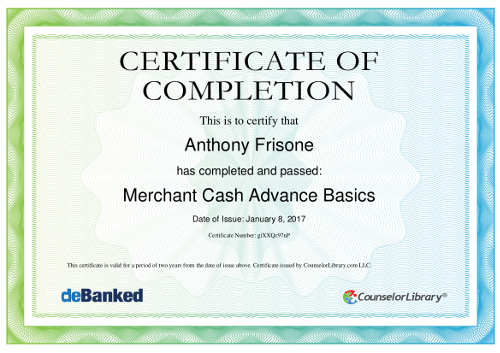 After Cardinal Equity, I didn’t get another funder until after I took the AltFinanceDaily “Merchant Cash Advance Basics” [online course] in January 2017. It was eye opening for me. Everything started making sense. I was able to have a conversation with funders and actually understand them. I started sending over my MCA Basics Certificate of Completion to every funder I could think of, and within a month’s time, I had over 30 different funders waiting for me to send them deals. However, [at the time] I had no merchants to send them.
So where have you found your best leads?
We tried out so many different places and spent so much money. But we had no one to guide us in the right direction. So we would look online and probably at AltFinanceDaily also. We called up a bunch of different places. None of them were fantastic, but none of them were terrible. So we knew it was a numbers game and we had to stay on the phone. So there was no set place. I bought a little bit from everywhere and a little bit worked from everywhere.
When did you start making money?
I started the business, called Nest Planner, in October 2016 all by myself. Just me and a desk and a laptop. And I didn’t start making money until March 2017. From October to March was a long 5 months. And in March I made close to $10,000 in advances. But by the end of last year, we hit the $1 million mark in advances. It’s not a lot, but it’s something that showed that we’re doing something right. And this year, it’s just February, and we have over $600,000 in [advances]. That’s huge for us and it’s just from us not giving up and pounding the phones.
How many people work for you?
Six.

How do you personally define success as a broker?
I guess the obvious part is the funds. If you make sales or close deals, it does feel good to make money. I have a wife and two kids and not taking home a paycheck is brutal. But what’s nice, also, is to see the people we hire make money. It’s nice to see them go home with a check.
How many applications do you typically send out?
So far, for January and February of this year, five of us sent in just under a 100 applications. And we funded 20 of them so far.
What resources do you wish you had that could have helped you made more deals in the beginning?
A CRM. I just had paper leads everywhere. We would just write it up on a piece of paper. No CRM and it’s rough. But it costs money. So we weren’t able to do it.
Apart from approving your applications, what do you look for in a funder?
Someone I could trust. Someone that returns calls. At the very beginning, it was hard. couldn’t get the time of day [from funders]. No one would call me back, except for Cardinal Equity. Now they’re actually calling me.
Want to become a better closer in this industry? Join your peers for training and networking at Broker Fair on May 14 in Brooklyn, NY! You can register here.
YieldStreet Gets $113M Closer to ‘Changing The Way Wealth is Created’
January 24, 2018New York’s YieldStreet, an alternative investment platform, closed a $113 million financing round earlier this month. The company announced that the round drew $12.8 million in Series A equity financing from the team of Greycroft and Raine Ventures, as well as a $100 million revolving credit facility from an unspecified entity.
Via release, YieldStreet said that the equity will enable it to “accelerate the transformation of wealth creation by investing in further product innovation and growing its loyal community of investors.”
CEO Milind Mehere expanded on this sentiment in the statement. “With the ultimate mission of ‘prosperity for all,’ YieldStreet is making it possible for individual investors to have wealth creation opportunities similar to the top 2%,” he said. “This funding will enable us to bolster our machine learning and data analytics capability for predictive underwriting models, launch new products for non-accredited investors and further fuel our growth towards our mission. I am excited to work with this strong syndicate of investors who understand this opportunity.”
The deal also includes the arrival of Alan Patricof, co-founder of Greycroft, to the YieldStreet advisory board.
“Before YieldStreet, retail investors never had access to institutional quality alternative products,” Patricof said. “We believe that YieldStreet’s leadership team is unmatched and well positioned to deliver on its mission to transform investing.”
Prior to this round, YieldStreet had only raised $3.7 million in equity capital as it focused on diversified alternative asset classes across real estate bridge loans, litigation finance, and commercial finance.
Technology Drives Changes in CRE Lending Space
December 21, 2017 Online technology, which paved new paths for consumer and small business lending, is making similar inroads with the commercial real estate industry.
Over the last few years, several online marketplaces have been established to try and match commercial real estate borrowers with lenders quickly and efficiently using technology. In the past, commercial real estate lending depended heavily on having local connections, but online platforms are blurring these lines—making geographical borders less relevant and opening doors for new types of lenders to establish themselves.
While banks remain the largest source of commercial real estate mortgage financing, non–bank players—including credit unions, private capital lenders, accredited and non–accredited investors, hedge funds, insurance companies and lending arms of brokerage firms—have become more formidable opponents in recent years. Online platforms offer even more opportunity for these alternative players to gain a competitive edge.
At present, most of these commercial real estate marketplaces are purely intermediaries—they’re matching borrowers and investors, not actually doing the lending. Certainly, it’s an easier business model to develop than a direct lending one, but things could change over time, as borrowers become more comfortable with the online model and develop confidence that these platforms can perform, industry participants say.
 “You have to be viewed as credible with a certainty of funding for borrowers to come to you. You can’t just put up a flag and say ‘Hey we’re making loans’ because borrowers won’t trust you and they won’t have the confidence that the loan is going to close,” says Evan Gentry, founder and chief executive of Money360, one of the few online direct lenders in this space. “However, once you develop a reputation of strong performance, the tide turns very quickly and that confidence is established,” he says.
For now, however, many of the marketplaces say they are content to remain intermediaries and offer business opportunities to lenders instead of competing with them. The sheer size of the market— commercial/multifamily debt outstanding rose to $3.01 trillion at the end of the first quarter, according to data from the Mortgage Bankers Association—and the fact that is an enormously diverse industry with no plain vanilla product makes it more likely that several platforms can co–exist without completely cannibalizing each other’s business, observers say.
Each of the online marketplaces has a different business and pricing model. Some marketplaces focus on small loans, while some have larger minimums; some focus on just debt; some focus on a mixture of equity and debt. Some sites cater to institutional lenders and accredited investors to help fund loans. Other sites invite non–accredited investors who meet certain criteria to participate in loans, opening doors to a segment of the population which previously had minimal access to commercial real estate deals. While the sites differ in their approach, the upshot is clear: banks—while still formidable competitors in commercial real estate lending—are no longer the only game in town for funding these deals.
The struggle for lenders is how to work most effectively with these marketplaces. “If you can acquire customers through only your own channels, then of course you’re going to do that,” says David Snitkof, chief analytics officer at Orchard Platform, which provides data, technology and software to the online lending industry. Otherwise, these marketplaces present a viable opportunity to expand distribution, he says.
GROWTH OPPORTUNITIES ABOUND
The surge of new companies acting as marketplaces between borrowers and lenders of all kinds comes as the commercial real estate industry is finally coming up to speed with respect to technology. The commercial real estate business has been static for decades in terms of how loans are processed and originated, according to industry participants.
“The use of technology is going to be an enormous disrupting force in that space,” says Mitch Ginsberg, co–founder and chief executive of CommLoan, one of the newer marketplaces for commercial real estate lending. Commercial real estate lending is “probably one of the last industries that hasn’t been touched by technology, and it’s ripe for massive disruption,” he says.
CommLoan of Scottsdale, Ariz., was founded in 2014, but the marketplace has only been fully operational since 2016. The platform targets borrowers seeking $1 million to $25 million of capital for all types of commercial real estate loans. It works with more than 440 lenders—including banks, credit unions, commercial mortgage companies, private money lenders and Wall Street firms. Altogether, CommLoan says it has processed more than $680 million in commercial transactions.
Online marketplaces can help make the commercial real estate industry more efficient and transparent, says Yulia Yaani, co-founder and chief executive of RealAtom of Arlington, Va., another new online commercial real estate marketplace. “People are tired of paying huge fees as a result of the market being so opaque,” she says.
RealAtom began operating in 2016 and targets borrowers who are seeking commercial real estate loans from $1 million to $70 million. The lenders on the platform include banks, alternative lenders, insurance companies, pension funds, hedge funds and hard money lenders. The company processed $468 million in commercial loans in its first 11 months of operating, according to Yaani.
Another benefit of online marketplaces is that they “create a liquid, national marketplace where lenders all across the U.S. can bid on a borrower’s business,” says Ely Razin, chief executive of commercial real estate data company CrediFi, which operates the upstart CredifX marketplace. Historically people who own commercial real estate have only been able to get financing through a local relationship with a bank or broker. “For borrowers, this means more certainty of obtaining a loan and optimized capital not limited by the relationship with the local lender,” he says.
CredifX started operating earlier this year to match commercial real estate borrowers, brokers and lenders including banks, finance companies, mortgage companies, hard money and bridge lenders. The platform is for loans of $1 million to $20 million across all major property types in the commercial space. It matches borrowers with appropriate lenders using the information that parent company CrediFi collects and analyzes. The company declined to disclose how much it has processed in commercial transactions.
To be sure, it’s hard to say how the marketplace model will evolve over time and which players will withstand the test of time. Certainly a similar model has faced challenges on the consumer and small business lending side.
“I think the pure marketplace will become more rare as time goes on,” says Peter Renton, founder of Lend Academy, an educational resource for the P2P lending industry. “There are examples of successful companies with a pure marketplace, but they are rare and difficult to scale. The only well-established company that seems completely wedded to the pure marketplace is Funding Circle; pretty much all other companies have switched to a hybrid model of some sort,” he says.
Commercial vs Residential
While much of the recent growth has been within commercial real estate, there are also some marketplaces that cater to residential borrowers or offer a mix of commercial and residential opportunities.
 Magilla Loans, for instance, started out in 2016 as a solely commercial marketplace, but expanded outside this silo because customers were asking for residential and other types of loans, says Dean Sioukas, the company’s founder. The company now connects borrowers with lenders for a whole host of loan types—commercial, residential and others like franchise loans and equipment loans. Lenders on the platform include roughly 130 banks, mortgage loan originators, accredited investors, credit unions and online non-depository institutions. The average loan size is $1.4M for business loans and $500K for home loans. Nearly $4 billion in loans has been channeled through the platform since January 2016; of that 70 percent is tied to commercial real estate, according to the company.
While there are marketplaces that focus on residential mortgage lending, some industry participants say that side of the business isn’t as appealing to new online entrants in part because the cost to acquire customers is really high and there are more challenges to working on a national scale.

“It may not be that commercial is more attractive. It may just be easier. Going directly to borrowers in the residential space has proven harder than many companies expected,” says Brett Crosby, co-founder and chief operating officer of PeerStreet, a marketplace for accredited investors to invest in high-quality private real estate backed loans. Experience seems to suggest that for residential mortgage origination, “it’s much better to have a good ground game and know your local market,” he says.
To be sure, as the online market for real estate matures, it’s not so surprising that companies would shift business models to find their own sweet spot. RealtyMogul.com is one example of a company that has morphed over time. The online platform began operating in 2013 in both the residential and commercial space, but has since moved away from the residential business. Accredited investors, non-accredited investors and institutions can use the platform to find equity or debt-based commercial real estate investment opportunities, and borrowers can apply for private hard money loans, bridge loans and permanent loans.
Money360 is another example of a company that has shifted gears. It started out as a pure marketplace, but changed its business model to become a lending platform in 2014. Now the online direct lender in Ladera Ranch, Calif., provides small-to mid-balance commercial real estate loans ranging from $1 million to $20 million. It’s one of the only companies targeting the commercial real estate space in this way and has closed nearly $500 million in total loans since 2014.
Gentry, the company’s founder, says he would expect to see more industrywide changes as the online commercial real estate business continues to evolve. The key to success, he says, is executing well and “knowing when to pivot when you realize something’s not working just right.”
Ultimately, Gentry predicts more online lenders will target the commercial real estate space. He says technology-based alternative lenders have an advantage because they can operate more quickly and efficiently while still being very competitive from a pricing perspective.
“You put all those things together (speed, efficiency and competitive pricing) and that’s what borrowers are looking for,” Gentry says.
Banks Set Sights on Small Business Loans Under $100,000
December 13, 2017BOSTON – One of the oldest lenders in the nation had a hand in developing technology intended to enable banks to win back the small business loan market from alternative lenders.

A tech incubator at Boston-based Eastern Bank, founded in 1818, has spun off Numerated Growth Technologies Inc., a startup that developed an online platform designed to identify and contact small businesses eligible for loans of up to $100,000.
Numerated Growth, which was founded in March, developed its tech in Eastern Labs and has generated about $100 million of volume since 2015. The model, which features real-time approval, is based on the tact banks first took with pre-approved credit cards in the 1990s, Numerated CEO Dan O’Malley told AltFinanceDaily.
“We’re just taking the same rules and applying them here,” he said. “And by the way, that’s what customers want.”
Numerated Growth, which employs 26 workers, came out of stealth mode in May with a $9 million seed funding.

O’Malley, Eastern Bank’s former chief digital officer, said Numerated is now selling the platform to other banks but declined to disclose the specific number. The cost per bank depends on the number of loans being processed, he said.
The average business loan is $40,000 and they can be approved and funded within five minutes of the business completing the online agreement.
Numerated Growth’s real-time platform could be considered loan origination software on steroids. But such software essentially enables a bank to enter an applicant’s information into a digitized system to assist in the approval process. Alternative lending startups have been improving on that model for several years. Competitors in that space include nCino Inc., Decision Lender (Teledata Communications), PerfectLO and defi solutions, LoanCirrus.
But loan origination software is very crowded and startups are constantly launching to reduce the time it takes to approve a loan without increasing the number of defaults.
 “Banks need to do things that are counter to each other,” David O’Connell, a senior analyst for the Boston-based Aite Group LLC, told AltFinanceDaily. “There’s a need to do a fast money transaction, but doing it diligently without making any bad loans.”
Combining the marketing and approval process is a credible approach because it keeps them on the same page in terms of targeting the most likely prospects. As a result, the number of “false positives” is lower, O’Connell said.
Instead of developing their own small business loan platforms, some banks are referring borderline borrowers to alternative lenders. But that can cause problems for the bank if the customer service doesn’t measure up to the bank’s standards and customers associate shoddy service with the entity that referred them, O’Connell said.
The best option is to develop in house. “Banks need to go as deep into the alternative lending market as they can with their own infrastructure and brand,” he said.
Because of its low value compared with other types of bank business, small business loan origination is one of the last remaining areas of banking to be targeted with innovation. “There’s not a huge price point,” said Kevin Tweddle, executive vice president for innovation and technology at the Independent Community Bankers of America.
Loan origination startups are trying to make such deals worth the bother. Yet the best tools tend to be developed by banking industry people because they understand the regulatory restrictions and integration factors, he said.
The goal of loan tech tools is two-pronged: make the approval process more efficient and make it convenient for borrowers. And so far, no software developer has risen above all the others to capture majority market share, Tweddle told AltFinanceDaily.
“It’s just too early; there’s too many of them still coming out,” he said. “We’re in the early innings of a nine-inning game.”
Market metrics
Banks can’t afford to ignore the demand for alternative lending tools.
In May, the University of Chicago’s Polsky Center for Entrepreneurship and Innovation reported that the alternative finance market slowed but continued to grow during 2016 in the United States, Canada, Latin America and the Caribbean. The market’s value reached $35.2 billion — a 23 percent increase compared with 2015.
More than 200,000 businesses used online alternative funding sources during 2016. In the United States, marketplace and peer-to-peer consumer lending accounted for the largest share of market volume with $21 billion in the U.S. last year, a 17 percent increase. Balance sheet business lending was the second-largest model in the U.S. with $6 billion originated, the report found.
In Latin America and the Caribbean, marketplace and peer-to-peer business lending was the largest alternative finance segment with $188.5 million last year, a 239 percent rise versus 2015.
The same principles fueling the car-sharing business are being applied to peer-to-peer lending. As a result, adoption is growing as people view the credibility of peer lenders on an equal level of traditional experts, said David Wong, senior director of the innovation and acceleration lab at the Chicago-based CME Group Inc.
“Whether P2P markets reach or exceed the size of the incumbent market platforms (ala Uber and Airbnb), or not, they are driving rapid innovation and new dimensions of competition across industries,” he said.
Early adoption
Industry observers agree that small business loans haven’t seen enough innovation from the banking industry because of its size compared with commercial lending and real estate deals. As a result, it has a long way to go to shorten the time it takes for approvals and improving the customer experience, O’Connell said.
“Banks that fail to embrace automation for their commercial lending lines of business will lose the valuable relationships, loan outstandings, and fee-based income abundant in the commercial and industrial market,” he said.
 After the 2009 global financial crisis, bank regulations tightened and data sets were required to be available and analytics-ready, providing another compelling need for commercial loan origination systems, O’Connell said.
No dominant players have emerged because neither traditional banks nor alternative lenders have figured out the best approach that satisfies both the lender and the customer, O’Connell said.
“Businesses don’t want money right away but they do want a quick and easy process,” he said. “My data tells me that in addition to providing underwhelming turnaround time, no particular lender has an edge over another. Nobody has it right.”
At Numerated Growth, O’Malley said the “initial wake-up call” signaling that a change was needed came in 2013 when Eastern Bank noticed solid small business customers paying off loans from alternative lenders such as On Deck Capital Inc. and LendingClub Corp. The pattern suggested that there was an unmet customer need.
Numerated Growth’s platform is designed to enable banks to proactively aggregate the data they need to identify prospective borrowers instead of requiring business owners to collect the data and present it to banks, O’Malley said.
“We’re making the banks do the work,” he said. “The same process that transformed the credit card industry will transform the financial products industry.”
Lights, Camera, Crypto-Transaction – How a Lending Journalist Raised Millions to Build Magic Lamps Through the Murky World of Initial Coin Offerings
November 15, 2017
This past July, the winner of the Best Journalist Coverage category at the 2017 LendIt Conference Awards, announced that he would be stepping outside of his journalistic endeavors to raise money for a futuristic lamp company. The product, dubbed Lampix, is described as a lamp with a projector, a camera, specifically placed light-emitting diodes (LEDs), and a cloud-enabled computer. On the company’s “Medium” blog, Lampix promises that the product is “designed to transform any flat horizontal surface into an interactive computer.”
The man behind Lampix, George Popescu (whose Lending Times news site competed against and beat out fellow finalist AltFinanceDaily at the LendIt Awards), makes for an interesting case study in alternative finance. That’s because Lampix shunned traditional capital-raising methods by relying on an Initial Coin Offering (or ICO), an unregulated blockchain-based corporate event which is similar to an initial public offering. Rather than purchasing shares, as is the case in an IPO, investors in an ICO receive digital tokens instead of shares. In August, Lampix raised $14.2 million through its ICO*.
 Popescu’s name popped up again a few months after the LendIt award on a regulatory blotter in the UK.
In case details published by the UK’s Insolvency Service on August 1st, the agency announced that Popescu was disqualified from serving as a company director.
Mr Popescu breached his fiduciary duties to act in the best interest of Boston Prime Limited (“Boston Prime”) and/or failed to ensure that both Boston Prime, as the regulated firm, and him individually, as the approved person, complied with the Financial Conduct Authority (“the FCA”) rules and guidance.
$6.2 million was transferred out of the company to a company named FXDD. Boston Prime’s receiver is presently suing FXDD seeking the return of the funds to the company. Proceedings are ongoing. Mr. Popescu is not under investigation and there are no legal proceedings at this time against Mr. Popescu.
It’s an inauspicious beginning for someone financing the “lamp of the future” using an unregulated and controversial strategy. Even so, when its ICO concluded on August 19, Lampix declared its gambit a success after raising $14.2 million through the sale of its digital tokens, which are known as PIX.**
By mid-November, the market value of those digital tokens, which exist on the Ethereum blockchain, had dropped by 50%, causing Lampix investors to suffer losses of $7 million. Unlike shareholders in publicly traded companies, token buyers have few investor protections. It’s not clear they are even considered to be actual investors at all. Buried in the fine print of Lampix’s 85-page “white paper” – a convenient way to avoid the label of prospectus – is a disclaimer. “Buyer should not participate in the [PIX] Token Distribution or purchase [PIX] Tokens for investment purposes. [PIX] Tokens are not designed for investment purposes and should not be considered as a type of investment.”
Additional disclaimers, moreover, declare that the white paper is not a prospectus, that the tokens “are not securities, commodities, swaps on either securities or commodities, or a financial instrument of any kind.”
But the distinction has not deterred people from joining in the frenzy of buying digital tokens like PIX. So much so, TechCrunch reports companies employing this strategy had raised nearly $800 million by means of ICOs in the first half of 2017.
And the SEC is not exactly excited about ICOs. “Fraudsters often use innovations and new technologies to perpetrate fraudulent investment schemes,” a July 29 directive by the SEC states. “Fraudsters may entice investors by touting an ICO investment ‘opportunity’ as a way to get into this cutting-edge space, promising or guaranteeing high investment returns. Investors should always be suspicious of jargon-laden pitches, hard sells, and promises of outsized returns. Also, it is relatively easy for anyone to use blockchain technology to create an ICO that looks impressive, even though it might actually be a scam.”
On September 29, moreover, the SEC brought an enforcement action against REcoin Group, charging Los Angeles businessman Maksim Zaslavskiy and two companies he controls with defrauding investors “in a pair of so-called initial coin offerings (ICOs) purportedly backed by investments in real estate and diamonds,” an SEC press release said.
The SEC alleges that Zaslavskiy and his companies –REcoin Group Foundation and DRC World (also known as Diamond Reserve Club) — have been selling unregistered securities, and that “the digital tokens or coins being peddled don’t really exist.”
 Meanwhile, telephone calls and an e-mail to the SEC seeking the federal regulator’s view on Lampix’s ICO drew a terse response from Ryan T. White, a public affairs specialist, who replied that the agency would “decline comment.”
Deborah Meshulam, a partner in the Washington office of law firm DLA Piper and a former SEC enforcement official, told AltFinanceDaily: “Regarding the lack of equity ownership, Lampix is seeking to establish that the tokens are not securities. Whether the SEC would agree should it decide to look into the offering depends on the facts and circumstances. The SEC staff would look past form to substance to assess whether the sale of the tokens constitutes an investment contract under legal standards. If so, then the SEC would view the Lampix offering as a securities offering. It may be that Lampix (or its lawyers) already vetted the offering with the SEC but I don’t know the answer.”
Popescu tells AltFinanceDaily in an e-mail interview, “We had to respect all securities rules and regulations of course, respect the Howey test and so on. There were no hoops to jump through as we are not trying to avoid anything or prevent anything. We honestly built a token to build a community to help us crowdsource (mine) pictures for all applications among which, Lampix.”
“Each PIX token,” the Lampix website explains, “will be used as a form of payment to picture image miners, voters and app developers or to purchase a Lampix, cloud computing and apps.”
Meshulam also notes that the June, 2017, date of the Lampix white paper pre-dates the SEC’s enforcement activity in this area. She adds, “The statement that ‘token sales or ICOs are not currently regulated by the U.S. Securities and Exchange Commission may be very literal in the sense that there is not a specific regulation, but the SEC has stated that, in the right situation, ICOs are subject to the US federal securities laws.”
Erin Fonte, an attorney in the Austin, Texas, office of Dykema Cox, and the leader of the firm’s regulatory & compliance group, says, “The ICO stuff is so up-in-the-air. The SEC is looking at it closely. But it’s fairly new. And some of them (ICO’s) have been tied to fraud and Ponzi schemes. If a client came to us (seeking advice), we’d want to vet the people behind the offering.”
But what of Lampix, the company that won the Augmented and Virtual Reality category of the South by Southwest (SXSW) Accelerator Pitch Event earlier this year in March – and put a pretty feather in the cap of Popescu?
Popescu’s resume is no doubt impressive. He holds a trio of master’s degrees in various scientific and technological disciplines, including one from Massachusetts Institute of Technology. And he is a serial entrepreneur who lays claim to having founded 10 companies: they include, according to his LinkedIn profile, online lending, a craft beer brewery, an exotic sports car-rental space, a hedge fund, a peer-reviewed scientific journal, and a venture-debt fund.
He’s charmed journalists like Forbes contributor Roger Aitken, who declared: “The founders (of Lampix)…believe that Lampix will impact humans as much as computers or smart phones in the future…Think Tom Cruise in Minority Report. Imagine your room in five years: you will be able to use any surface around you as if it was a computer. The ability to transform any surface into an interactive computer (augmented reality) is going to unleash applications we have not even conceived of.”

The Lampix website hyped its ICO with the aid of an infographic listing “active product inquiries” the company has in its pipeline, the likes of which includes Amazon, Apple, Samsung, Microsoft, Sony, IBM, BMW, Bloomberg, PwC, and the Aspen Institute. With all of these names seemingly lining up, it begs the question: Why did Lampix choose the controversial route of an ICO to raise capital?
But it’s hard to determine the seriousness of these corporate relationships. Florin Mihoc, Lampix’s Strategic Partnerships & Development Advisor, said he could not assist us with confirming any of them, citing the slow and cumbersome bureaucracy of dealing with Fortune 500 companies. He did invite us to try reaching out to some of them on our own, which we did.
Bloomberg is one of the few acknowledging a relationship with Popescu’s company. Chaim Haas, head of innovative communication at Bloomberg, told AltFinanceDaily that the New York-based media and financial communications company “collaborated” with Lampix. Bloomberg, he says, “has used Lampix hardware in its fellowship program (Bloomberg AR Fellows) as a prototype for augmented reality applications.” But Haas declined to elaborate on whether Bloomberg’s relationship with Lampix was more than an experimental one.
Edward Caldwell, director of public relations for East Coast markets and sectors at Pricewaterhouse Coopers, the Big Four accounting firm, declined to comment about Lampix. “We can’t discuss individual companies, clients or engagements,” he reports.
Douglas Farrar, senior manager for communications and public affairs at the Aspen Institute, told AltFinanceDaily that he could find no business relationship between Aspen and Lampix. “I have gone down quite a few rabbit holes here,” he said in an e-mail, “But I’m coming up empty.”
When Popescu was directly confronted about this, he wrote, “The companies would only figure [in the infographic] if they actually themselves reached out to us and we exchanged emails with somebody from that entity. Most of these entities have many people and most of the companies’ people will have no idea [that] somebody else in the company is talking to us.”
Telephone calls and e-mail requests for comment to Microsoft were not returned.
A spokesperson using BMW of USA’s official twitter account, however, responded to an inquiry by saying they were a customer of Lampix, “but only for office usage.”
 Meanwhile, George Popescu has been on the sales trail. A case in point was his October 5, Youtube interview conducted by Ian Balina, a self-described influential investor in blockchain technology and cryptocurrency – and someone with a reputation as an industry promoter and evangelist. (Balina caters to the get-rich quick crowd and publishes how-to guides trumpeting promises like “How ICOs can make you a millionaire in 3 years” and “make millions with bitcoin.”)
Balina asked Popescu the softball question, could he show viewers a demonstration of the product? Popescu admitted he wasn’t prepared to do that and when he attempted to set one up on the fly, it didn’t work. The incident is notable because Lampix has been promoting the video through its social media network.
Popescu corroborates a number of details about the ICO, however. He confirmed the ICO price of a PIX token to be 12 cents, the US dollar price people had to pay per token. Cryptocurrency exchanges, where token speculators can buy and sell tokens online, show the trading value of a PIX token currently hovering around 6 cents, which translates into roughly a 50% loss in value.
Investors feeling hurt by such a loss can’t contest the purchase of PIX tokens with their credit card issuers. That’s because of a requirement that token sales had to be purchased with ether (ETH), the currency of the Ethereum blockchain. While ether is arguably similar to Bitcoin, it operates on an entirely different blockchain.
To participate in the ICO, in a Youtube video, Lampix also explained to purchasers, for example, how they could first buy ether with dollars through an online exchange known as Coinbase** before forwarding the ether to a digital wallet. Next, investors were instructed to send the ether from the digital wallet to a specially designated PIX address. An automated “smart contract” would then release the appropriate amount of tokens to the buyers’ digital wallets 31 days after the ICO was consummated.
It’s a byzantine procedure. And for investors – especially for those who are not exactly tech-savvy – the rigmarole makes it nearly impossible for them to recover their money should they feel buyer’s remorse. Neither the video nor the Lampix white paper mentions any buyer restrictions. Indeed, Lampix’s white paper specifies that “anyone” in the global market can participate. That means that an investor could theoretically be underage or a citizen of Iran or North Korea. (When asked what steps Lampix took with regards to KYC/AML, Popescu said, we “implemented the standard ones with partners specialized in it.”) Investors could even be citizens of the UK where Popescu is banned from being a company director.
And global they are. AltFinanceDaily interviewed Rudy (whose last name we are withholding), a graduate student who lives in Singapore that says he bought approximately $2,200 worth of PIX tokens during the ICO. The drop in value has gotten him so frustrated that he’s contacted securities regulators in the United States to investigate Lampix. Despite the caveat in the white paper that tokens are not an investment and should not be used for investment purposes, Rudy said he considered himself to be an “investor” and that his reason for buying the tokens was to sell them in the future for a profit.
Popescu, who wasn’t asked about Rudy’s experience specifically, told AltFinanceDaily that Lampix is not selling PIX tokens as an investment but rather to primarily build a community. “What people do with the tokens is their choice and we cannot prevent them,” he asserted.
English is not his first language but Rudy said, “I think that [the] SEC should regulate ICOs in the USA. There are no rules currently, teams can promise anything before the ICO and forget everything after the ICO. Things have to change, there should be legal pressure on crypto teams.”
Rudy added that he was “so enchanted” by Lampix’s ideas that he had promised himself not to sell the tokens for at least two years even if they were losing value. He conceded that he was not a tech expert. But, he says, the award at the SXSW competition was an important milepost to him.
AltFinanceDaily found 700 more people interested in Lampix on the company’s official Telegram channel. The chat history since September 20, which we were able to obtain, has been dominated by talk of the PIX token’s trading value. Those bemoaning the low price regularly use the term “investors” to describe themselves – never mind that the white paper specifies that PIX tokens are not supposed to be an investment or to be used for investment purposes.
The chat’s administrator, who uses the nickname Chester, identifies himself as a “community manager” at Lampix. At one point he too refers to PIX holders as investors. “Hey guys,” he wrote in the channel on October 1, “Lampix is a company, not a single person, we don’t do things that quick, but pretty quick and we try not to confuse our investors by telling you unconfirmed news. Be patient, things will be just fine.”
Laura Toma, another community manager for Lampix, responded to complaints about the depressed price in the channel by saying, “The issue is that people want to get rich in a month.”
Indeed, investors hound not only the community managers, but also Popescu himself, who frequently joins in on the chat and fields questions about the trading price of PIX. “You should care more about the company revenue, clients, users.” Popescu replied to one user.
 “Are you serious?” a user calling himself Dante fired back. “We are investors, and we care about the return on investment.” Another user with rough English tells Popescu, “As you know, most people come to ICOs for short-term profit. We cannot deny it.”
Others keep the faith. “PIX will be the real Aladdin’s magic lamp,” writes one user. Another hyperbolically predicts the price will “fly out of the earth, fly to the moon, and finally fly out of the galaxy.”
There is very little discussion about the use of the product itself while numerous inquiries are written in Mandarin. “Lampix has a lot of Chinese investors,” writes one. Other users self-identified as citizens of Russia, Romania, and France. Meanwhile, Toma writes, “Yes, there are investors from USA as well.”
Despite the losses that investors have so far experienced with Lampix, among other concerns, Popescu isn’t limiting himself to just one ICO. According to his online statements, Popescu is connected as an “advisor” to another company engaged in an ICO. AirFox, a Boston-based start-up launched by two Google alumni, provides free data to mobile phone users in return for eyeballing advertising. In early October, Airfox’s ICO raised $15 million. But a month later its AIR tokens, which sold for two cents apiece during the ICO, had lost 75% of their trading value. That means investors in AIR, the company’s ICO ticker symbol (which is becoming an increasingly ironic moniker) have seen more than $11 million go up in smoke almost overnight.
Popescu says in their defense, “The AIR tokens are meant to solve a real problem, of remunerating people who watch ads in exchange of getting more data and minutes on their mobile phone. The ecosystem is still being worked upon, the product is not live. Once the ecosystem is live we will see what really happens. Until then the token is mostly being handled by speculators. The price can therefore vary widely and it doesn’t reflect their true value.”
Even as Lampix and AirFox have been racking up massive losses for investors, Popescu announced on November 5 in a LinkedIn post that he would be involved in five more ICOs.
Among them is DropDeck Technologies, at which Popescu is listed as the chair of the advisor board; its ICO is scheduled for November 21. Another company, Factury, for which he is listed as an advisor, is initiating its ICO on December 15.
He’s an ambitious man.
And his ICO familiarity hasn’t escaped the scrutiny of PIX investors. “I find it strange that you are directing 5 other ICOs,” writes one user in the Telegram chat on November 4. “To make Lampix big, this will require a CEO [who is working] full time working on the project.”
Popescu responds personally. “I am working full time on the project but people have asked me to advise on their ICOs and this grows Lampix’s notoriety a lot in the crypto space,” he writes. He offered further assurances that he wouldn’t be advising those companies’ projects beyond their ICOs.
In an email to AltFinanceDaily, he writes, “I run right now Lending Times, Lampix and Block X Bank only. The ICOs are just customers of Block X Bank. I have built about a dozen companies in 9 years, sold a few, closed a few. Each company has a team to help me, I am not doing this alone. For the ICOs I am more or less involved as an advisor / helping them project-manage their ICOs. How to run 3 companies? It’s about being effective, organized, delegating, partnering and being productive. Oh and I don’t watch TV, so maybe I have a few more hours per day than the average person. I do work long hours.”
Block X Bank, through which Popescu extends his efforts toward other ICOs, is described on the company website as “a boutique investment consulting company specializing in connecting blockchain projects with funding.”

In all of these ICOs, money is seemingly being created out of thin air. A consultant who was hired by AltFinanceDaily to help analyze the technical aspects of both ICOs and smart contracts determined that Lampix raised much more than just the $14.2 million in token sales. In addition to the 114 million PIX tokens sold to investors, our consultant explained, the company also issued 220 million tokens to itself. At the ICO price of 12 cents apiece, those tokens would theoretically be worth $26.4 million – a huge piece of the total ICO pie that Lampix could sell on cryptocurrency exchanges if it wanted to rake in even more money.
There’s a kicker too. At scheduled intervals over the next four years, the smart contract that made PIX tokens possible in the first place is slated to automatically create – and allocate – 330 million new tokens to Lampix. Thus, when Lampix raised $14.2 million in August, the company reserved $66 million worth of PIX tokens for their corporate use.
Popescu said in his e-mail to AltFinanceDaily that these company tokens are for “corporate usage like employee incentives, M&A, other company investments…etc.”
It’s a mind-boggling sum of money for the development of a futuristic lamp whose followers mostly seem to reside on internet chats like Telegram, reddit, and bitcointalk.org.
And this has occurred despite the company’s withholding any information regarding Popescu’s status in the UK. Balina, who interviewed Popescu on Youtube, told AltFinanceDaily he wished he had known about his disqualification in the UK. “This is definitely a big issue and I wish I would have known about it so that either my audience or I could have asked him this directly on the live stream,” he said.
AltFinanceDaily asked Paul Savchuk, Co-founder, CEO, and Chief Product Officer at Cryptocurrency Capital LLC, a US-based hedge fund that only invests in utility tokens as commodities, if Popescu’s ban in the UK would have been relevant information in the Lampix ICO. “Yes, that might be a red flag for us in some cases and require us to perform additional research,” he wrote in an emailed response. “We look at management very seriously – especially since a lot of projects are treated like startups and management is a key component to whether or not many of these ICOs can make it. We try to find such events and spot red flags whenever we conduct our due diligence research on ICOs. The reason: each project has something that needs to be improved. ‘Red flag’ – sometimes conversely can lead to a great opportunity when other market participants ignored it or were too skeptical.”
Mr. Savchuk further said, “Lampix is a perfect example of a coin that on the surface looks very promising, but when you dig a little deeper, you do find red flags that can dampen the excitement for this investment.”
And yet Savchuk spoke rather positively of the Lampix product after reading their white paper. “We believe the project is looking to change the current AR/VR tech industry,” he said, referring to augmented reality/virtual reality. “The project is promising for two reasons. First, they have multiple companies in their pipeline. Second, they have a legitimate product which they will manufacture and sell. They are one of the few blockchain products to offer a tangible product with the ability to disrupt the market.”
 “Third,” he went on, “most companies have gaps in building a strong structure at the outset of their existence. Some have bugs in initial code that cause breaches in cybersecurity. Others release product with a low level of usability – the ones who are aware of such problems have a greater chance of success. We would prefer to see publicly known strengths and weaknesses of such companies. Management has to be transparent about their team and product no matter what. Whenever possible, we want to be in touch with the management team.”
With regard to the price drop, Savchuk said, “This is a danger for all purchasers of ICOs. Sometimes it’s caused by token purchasers (swayed by) fear and greed and (hoping for) easy money and fast money. I doubt somebody sold Apple Inc.’s stock right after its IPO. It is also very difficult to restrict exchanges from allowing massive pump and dumps. That’s not even mentioning the difficulty of measuring the value of tokens,” Savchuk concluded. “Consequently, such projects are struggling with low credibility. However, it also creates a possibility for those who believe in the idea and product on a long-term run.”
Popescu downplays the significance of the UK issue. The root of the debacle, he says, is the result of Boston Prime – the company he previously ran – being forced into bankruptcy by the actions of a company he is now suing called FXDD. “FXDD bought the companies and then bankrupted them and that’s why Boston Prime [went bankrupt],” he writes. “Myself personally and each company separately are suing FXDD for this. UK has archaic laws where if you are a director of a bankrupted company you get disqualified from being a director again for a time. Attorneys charge about 40,000 GBP to defend this automatic case and I weighed the pros and cons and decided to ignore it as I have no plans to be a director in the UK for time being.”
Investors unhappy with underperforming ICOs may be willing to challenge their legality. On October 25, for example, a class action lawsuit was filed against Tezos, a computer networking project that raised $232 million in one of the largest ICOs ever. In a complaint, the lead plaintiff alleges that, among other things, Tezos unlawfully engaged in the unregistered offer and sale of securities and fraud in the offer or sale of securities. “In July 2017, Defendants conducted an ICO in which they sold 607,489,040.89 tokens (dubbed ‘Tezzies’ or ‘XTZ’) in exchange for digital currency worth approximately $232 million at the time,” the complaint reads. The plaintiff, who purchased 5,000 Tezzies, feels he was misled about the company and the offering.

Internal squabbling at Tezos which has delayed the release of its product and the sheer amount of money at stake have put the company on the map with the mainstream media and business press. The New York Times, Wall Street Journal, and Fortune as well as news services Reuters and Bloomberg have all covered the allegations of fraud.
The day before the class action lawsuit was filed, moreover, a AltFinanceDaily reporter attended an explosive session at Money2020 in Las Vegas that saw Tezos co-founders, Arthur and Kathleen Breitman, attempting to give a status report of the company. A crowd that had gathered outside prior to the doors opening had attendees speculating whether the Breitmans “would actually show their faces” in the midst of all the drama.
To date, no lawsuits have been filed against Lampix despite the drop in the token’s value.
At a cryptocurrency/ICO meetup in NYC in October, a AltFinanceDaily reporter met with executives at one company preparing an ICO who said they would not allow American investors to participate because of securities-enforcement fears. Pressure is mounting in the Far East as well. Citing their illegality, Chinese regulators in September issued a blanket cease-and-desist order on all ICOs in their country. What that means for Lampix’s Chinese investors bears watching.
Popescu says that Lampix supports regulation in China. “Of course, all Chinese people have to follow Chinese regulation,” he writes.
Meanwhile, on the product front, Popescu says that right now a Lampix lamp can be purchased for $10,000, a tidy sum because they must be hand-made. “We plan to improve the manufacturing costs and then we’re planning to do a kickstarter early next year for around $500 [per] Lampix,” Popescu told AltFinanceDaily in his e-mail interview.
But for investors, it always comes back to the trading value of PIX. On October 25, one investor asks Popescu if the company will buy back its own PIX tokens at the ICO price to pump up their market price. “If you want a pump and dump please go to other companies,” Popescu responds. “We are here for 5-10 years to build a $100 billion dollar company and compete with Apple.”
And it all began with an ICO.
“ICOs also help with bootstrapping the user base – breaking the chicken and egg problem,” Popescu also explains in his e-mail to AltFinanceDaily. “In addition, given that Lampix is looking to crowdsource images, we prefer many different people hold PIX tokens rather than 2-3 VC funds. And last but not least I think tokens are better rewards for the community (liquid, mark to market, etc.) than illiquid instruments.”
Not everyone agrees that PIX is the most liquid instrument to grow the community. US Dollars come to mind, for example. “Let’s say I’m a customer,” one investor poses to Chester, a Lampix community manager. “I want to use the cloud computing service but then I see I have to pay with PIX. I have no experience in crypto and have no idea how to do that. I just want to use your service fast and don’t want to buy PIX coins first before I can make use of it. Will there be a fiat option?”
Chester is awed by the idea. “Well, you are so professional,” he writes. “Man, you are good. You are good, the question you threw just hit the spot seriously. I guess there is always something Lampix needs to figure out and choose the best solution. Technically speaking they are jolly good at this point, but it doesn’t mean it’s perfect.”
Chester, who assures him that he isn’t being sarcastic, goes on to refer to the investor who asked that fairly elementary question as a “big shark” that is “born to bite.”
 It remains to be seen if the PIX “user base” shares the same philosophy as Lampix. Ian Balina, who interviewed Popescu on Youtube, separately asked his social media followers: “What’s the first thing you’re going to do once you hit your goals in cryptos?”
The responses fly in:
“Buying my Lambo”
“Travel to Paris”
“Buy an island”
“Buy my mum her dream home”
“Quit my job and start up something for me”
“Pay off mortgage and be financially free”
“Buy house in Miami, buy Lambo, enjoy life”
“Retire”
“Easy. Buy more crypto”
Meanwhile on Telegram, where investors continue to engage Lampix management on a daily basis, Dante offers a sobering reminder of what they’ve bought into, “We don’t have equity, we only have tokens,” he writes. “And we are taking a big risk.”
* The amount of tokens sold multiplied by the 12 cent ICO price doesn’t exactly match the dollar amount Lampix says they had raised. That’s because Lampix not only issued bonus tokens to buyers at each stage of their ICO but also because the market value of ether, which users had to convert to from dollars to buy PIX, had fluctuated when they reported how much they raised. Like Bitcoin, the value of ether is volatile.
** The smart contract Lampix wrote to launch Lampix’s tokens into existence specifically named them PIX tokens and dubbed their publicly identifiable symbol to be PIX.
*** Coinbase is a respected digital currency wallet platform based in San Francisco.
Former MCA Co-founder Meir Hurwitz Kicks Off New Venture With Kim Kardashian West
November 9, 2017I love how @screenshopit lets you find the exact designer looks you see people wearing online, plus suggests similar items at all price points! #ScreenShop_Ambassador https://t.co/TXZ23agVoT pic.twitter.com/nA8JBDVbU5
— Kim Kardashian West (@KimKardashian) November 7, 2017
An early innovator of the merchant cash advance industry has re-emerged on the business scene in a very different new venture focused on mobile shopping.
Meir Hurwitz, co-founder of Pearl Capital, the MCA company acquired in 2015 by Capital Z Partners Management LLC for as much as an estimated $60 million, is now the chief visionary officer of ScreenShop. The New York startup markets an app designed to enable users to shop for a specific item by uploading a screenshot of the item to the app.
Working on a mobile app is a longer shot than MCA and it doesn’t always pay off, but Hurwitz said Thursday he’s enjoyed learning the business after two years off and visiting 62 countries since selling Pearl Capital.
“It’s new and exciting for me, but I don’t get paid right away,” he said. “It’s something I haven’t done before — it’s kind of exciting for me.”
The app is the first developed by New York-based Craze Ltd. and publicly launched on Nov. 7 with celebrity Kim Kardashian West cited as an advisor. Craze employs 12 technical workers in Israel and five in New York, Hurwitz said.
Hurwitz started in MCA in 2006 and then launched Pearl Capital with partner Abe Zeines in 2010.

Pearl launched with $1 million and generated an $8 million profit in 2012. The following year, the company doubled its profit and reached origination volume of $100 million, Bloomberg reported in 2015. Hurwitz’s ScreenShop profile indicates that he’s a “three-time successful entrepreneur” and cites “over $500 million in funding capital.”
In addition to a real estate business in Puerto Rico, Hurwitz said he’s managing partner of New York-based GS Capital, a convertible debt company lending to small businesses. Zeines lists himself as the CIO of GS Capital, according to his online profile.
At ScreenShop, Molly Hurwitz (Meir’s sister) is listed as the co-creator and co-founder. CEO Mark Fishman was previously a risk manager for Pearl Capital.
The startup’s app, which is free, scans screenshots taken from any app or website on a mobile phone, converting them to similar items that can be bought for various prices. It plans to generate revenue by collecting a commission at the point of sale, Forbes reported.
“The results have been — we’re No. 5 on the app store category of fashion,” Meir Hurwitz said. “We’re just getting started.”