
What Makes a Good Loan Broker? Is it How Much You Fund?
November 18, 2015What Makes A Good Broker?
 Through the plethora of recruiting ads by brokerages, funders and lenders, trying to draw people into the space through promises of lucrative paydays with minimal work, one has to stop and wonder, who are the actual good brokers? What do they look like, sound like, and dress like? How is their personality? How is their work ethic? How can you spot them in a crowd?
There are a number of things that make a good broker, a good broker, but for the sake of this discussion, I wanted to begin with expectations and measurements of funding volumes.
LIMITING THE MEASUREMENT
A broker can have a good month, a good quarter, and even a good year, so to truly judge the quality of a broker’s work, I believe you have to start the measurement over at least a 24 month time period. This would smooth out things that usually plague sales professionals such as down times, seasonal periods, stall periods, dry spells, artificial market boom and bust periods.
One won’t even be able to complete this measurement on most brokers entering the space, as most of them will be out of the industry within 3 – 6 months. I believe that success in our industry is mainly due to having leveraged resources that give you a competitive advantage, rather than actual superior “selling” capabilities. 20% of brokers will have these resources and 80% will not.
MEASUREMENT TIERS
From my research, these are the measuring tiers that can be utilized to gauge the quality of a broker over at least a 24 month time period. These numbers include both new and renewal funding volumes. With renewal merchants, even though you are dealing with the same client, they still require a new underwriting process with new offers being generated, thus requiring a new sales process or another “close.” As renewals are the lifeblood of our industry, many brokers have a plan in place to build a renewal portfolio and “sit back”, thus we shouldn’t only factor in new deals to this measurement.
- $300,000 plus a month in funding average: The Superstar Broker Level
- $150,000 to $250,000 a month in funding average: The Good Broker Level
- $75,000 to $125,000 a month in funding average: The Average Broker Level
- $25,000 to $50,000 a month in funding average: The Rookie Broker Level
If you have been a broker for at least 24 months, what is your current standing? If you are currently at the Rookie Agent level or the Average Agent level, what do you think you can do to get to the Good Agent level or the Superstar Agent level?
NOT ALL BROKERS ARE EQUAL IN TERMS OF OPERATIONAL STRUCTURE
These measurement tiers are only for individual brokers and not for total funding volumes completed by an entire office of brokers.
But also understand that other variables might be at play for an individual broker as well, such as the fact that he might be a sub-broker to a large brokerage house that feeds him warm leads all day, and his job is just to come in, sit down and focus only on the selling/closing part of the process. Or, he might be a part of a funder’s inside sales team and similar to the sub-broker, he gets warm leads fed to him all day to where he just needs to come in, sit down and focus only on selling/closing.
If you are currently in the sub-broker or inside sales team setup, it’s understandable if you are in The Superstar Broker level as you have more leveraged resources, less responsibilities and more time to dedicate solely to your selling/closing process.
But if you are operating as a One Man Show, like I was, then (in my opinion) it would mean a lot more to consistently perform at either The Superstar Broker level or The Good Broker level, considering all of the administrative/operational tasks that you solely have to juggle on your own.
MY ONE MAN SHOW PERFORMANCE
As my office currently goes through restructuring, during my time of selling the product from late November 2009 until September 2015 (70 months), I averaged $200,000 a month in new and renewal funding volume. This would place me at The Good Broker level.
There were surely months when I funded at The Superstar Broker level of over $300,000 with even some months getting at or near $1 million, but those were not my consistent averages throughout the 5 years and 10 months (70 months) that I sold the product. During the 70 month time period operating as a One Man Show, I had to juggle many administrative/operational aspects including but not limited to:
- Completing my own secondary and primary market research
- Designing my own business plan, ROI formulas, and completing my own trend analysis
- Coming up with innovative ways to creatively and profitably finance my office
- Building business related credit
- Setting up my funder network and keeping up on their underwriting criterion
- Setting up agreements with warm data suppliers and other vendors
- Designing and running my own website
- Setting up and managing my own direct and in-direct marketing campaigns
- Running through my daily calls to warm data (averaged about 150 a day)
- Managing and following up with my sales pipeline
- Managing and following up with my current deals in underwriting
- Managing and following up with my renewal portfolio
- Managing legal aspects such as contracts, LLC requirements, keeping up on marketing laws, etc.
- Managing accounting, insurance and tax related aspects
- Managing retirement account aspects
On the side, I built a merchant processing portfolio on track to process close to $200 million.
To top everything off, I also managed to complete four college degrees (MBA and three bachelor’s degrees) during this hectic and stressful time period as well.
YOU MIGHT HAVE BETTER OPERATIONAL LUXURIES THAN I DID
If you have the luxury of being a sub-broker or a part of an inside sales team, with having a team of people to do a good chunk of the administrative/operational tasks listed above (that I had to manage on my own), then as mentioned, you stand a great chance of getting to and staying in The Superstar Broker level of performance in terms of funding volumes.
You want to just bring to the table a solid work ethic and professional competency, always with the passion, desire and ability to learn. You also want to be very efficient in time management. I believe that time management is a “skill” that must be honed and managed. As the English brewer Charles Buxton said: “You will never find time for anything. If you want time, you must make it.”
Lending Club Narrowly Avoids Major Transparency Flop
November 18, 2015After many months of Lending Club warning that they would be REMOVING borrower credit data from note listings, they have completely reversed course and ADDED fifteen new credit attributes. On Peter Renton’s LendAcademy forum, one member speculated that this move was made to compete with Prosper for the attention of institutional investors. If true, that would be entirely misguided.
Almost exactly one year ago, Lending Club announced that they were cutting the amount of data points available to investors from 100 to 56. Renton, a marketplace lending evangelist and founder of the LendIt conference, gave it a negative spin in his blog:
It is pretty obvious by now that I don’t like these changes. For quite some time now Lending Club has been reducing the amount of transparency for investors. Now, some changes I completely understood such as removing the Q&A with borrowers and even the removal of loan descriptions. But removing data that investors have been using to make investment decisions is a step too far in my opinion.
I think Lending Club need to ask themselves if they are a true marketplace connecting borrowers and investors in a transparent fashion or whether they are more of a loan origination platform that makes products available to investors. They are certainly moving more towards the latter, I think, and that is a shame for everyone.
The move was seen by many as a way to stop investors from trying to reverse engineer their models and beat their grading system for above average yields. While understanding that perspective, it is mind boggling that they had planned to remove more data points and make the loans on the platform even less transparent. And here’s why…
 Lending Club is a key signatory to the Small Business Borrower’s Bill of Rights, a group of political activists that claim innovative small business lending can only achieve its potential “if it is built on transparency, fairness, and putting the rights of borrowers at the center of the lending process.” With transparency being a focal point of their agenda there, one might find their attempts to reduce disclosure and eradicate transparency a bit hypocritical.
Investors on Renton’s forum who had for months anticipated Lending Club to remove more data points, also viewed it negatively. “I’d have to think hard on whether to continue investing in LC notes without those credit fields — it would be very much like gambling rather than investing,” wrote Fred back on July 8th.
A similarly named user, Fred93, communicated that these data points were all investors had to go off. “We can’t shake a borrower’s hand, feel the firmness of his grip, the sweatiness of his palm. We can’t look a borrower in the eye. We live or die by a handful of numbers, which we hope mean something, on the average,” he wrote.
Clearly some investors weren’t thrilled with the proposed changes. All the while, Lending Club’s co-signatories had been promoting the transparency pledge through speeches, TV appearances, public relation events, and press releases. To be fair, The Small Business Borrowers Bill of Rights is aimed at transparency between business borrowers and sources offering business financing. Lending Club’s planned removal of data was targeted at investors in their consumer notes. It sounds different enough until you consider that 72% of Lending Club’s loans originated in 2014 were funded by investors vastly less sophisticated than the commercial businesses they have pledged to protect. That’s because that money came from consumers, many of whom are unaccredited and went through no screening process. Instead, these investors are presented with a prospectus as if they were buying a stock or bond and stuck with the risk whether they understand it all or not.
These consumers who are legally presumed to be unsophisticated are the very same people that Lending Club planned to reduce disclosures to, all the while heavily promoting to them that they roll over their retirement savings onto their platform. That logic is the very definition of insanity. Obfuscating the reasoning behind certain scoring grades to these investing consumers would be nothing short of unconscionable and would reasonably invalidate any pledge they’ve made towards transparency in other areas.
Lending Club has for now avoided a major flop by reversing course after having added 15 new pieces of data for investors.
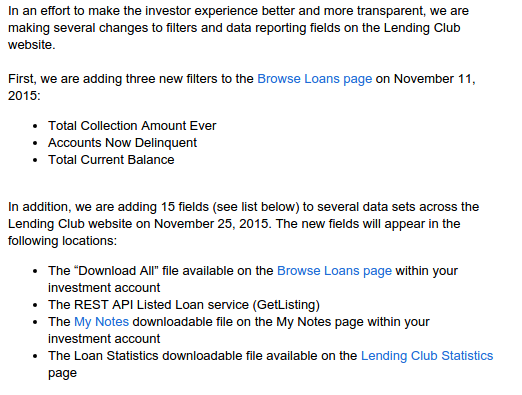
While some investors speculated the move had to do with pressure from Lending Club’s institutional investor base. The more likely reason is increasing scrutiny from federal regulators. Less than two weeks ago for example, the FDIC warned banks about marketplace lending and advised them to perform their own underwriting on the loans they buy and not to rely on originator scoring models. A summary of their letter specifically said:
Some institutions are relying on lead or originating institutions and nonbank third parties to perform risk management functions when purchasing: loans and loan participations, including out-of territory loans; loans to industries or loan types unfamiliar to the bank; leveraged loans; unsecured loans; or loans underwritten using proprietary models.
Institutions should underwrite and administer loan and loan participation purchases as if the loans were originated by the purchasing institution. This includes understanding the loan type, the obligor’s market and industry, and the credit models relied on to make credit decisions.
Before purchasing a loan or participation or entering into a third-party arrangement to purchase or participate in loans, financial institutions should:
– ensure that loan policies address such purchases,
– understand the terms and limitations of agreements,
– perform appropriate due diligence, and
– obtain necessary board or committee approvals.
These guidelines conflict with Lending Club’s long sought after goal of getting investors to trust their A-G scoring grades. The banking regulator is advising banks to basically disregard them. “The institution should perform a sufficient level of analysis to determine whether the loans or participations purchased are consistent with the board’s risk appetite and comply with loan policy guidelines prior to committing funds, and on an ongoing basis,” the more complete memo reads. “This assessment and determination should not be contracted out to a third party.”
A law firm with specialized knowledge of the industry, criticized the FDIC’s move when they wrote on their website, “Ironically, given the Treasury Department’s recent request for information, which supported marketplace lending and focused in part on how the federal government could be supportive of the innovations in marketplace lending, we now have a federal banking agency that is creating roadblocks to having banks participate in this dynamic and rapidly growing space.”
 Asking banks not to rely on marketplace scoring models alone hardly seems like a roadblock, especially when the models are tucked away in algorithmic obscurity, have hardly been around for very long, and would decide the fate of depositor money. And if this directive indeed contributed to Lending Club’s transparency reversal, then it couldn’t have been any more well-timed.
Whether or not the added data points will make any difference to the performance of investment portfolios is irrelevant. If unaccredited investors and/or depositor money are the source of marketplace loan funding, then Lending Club has a responsibility to disclose as much as possible, no matter how little value they believe certain pieces of information are worth. The 15 additional points are a welcome announcement. The question going forward should be, what else can they disclose?
As a company that pledged so strongly to protect corporations from transparency issues in the developing commercial finance market, they should be trying twice as hard to protect the unsophisticated consumers that invest in the loans they approve and make available for investing. Some of these consumers are prodded into putting their retirement funds on the platform and we all know some people will irresponsibly place their entire retirement portfolio in it. The “Number of credit union trades” a borrower has might not unlock the secret to better investing performance but if it’s something Lending Club knows, the investing public deserves to know it too, if only in the name of transparency which they have so committed themselves to uphold…
Negative Experiences and Character
November 17, 2015The holiday season is here and I wanted to share an insightful story of a time where a horrible job position made me realize a lot about the basic standards of conducting business
My last call center position was at a huge customer service center for major retail online stores. This was my third holiday season and I took a position in the Escalations Department. I don’t know if I was just a sucker and couldn’t say no because I felt bad (no one else wanted it), or if I wanted to play the “You Ruined My Christmas” game with the others. The previous year, there was a tally on the white board in the back office where weekly contests were held to count how many times we were individually told that we ruined Christmas. Here’s why…
 The warehouses served as central clearing houses for multiple retailers and stored all types of products. It wasn’t a surprise if someone ordered a baseball jersey and received a Dora the Explorer play set.
The best part was when you went to help the customer with reordering in time, the item was almost always back ordered or out of stock completely. That meant reordering wasn’t even possible. Sorry, you won’t be receiving your item for Christmas.
We knew that if it was out of stock with one company, it was out of stock for all of them. The customers would end up calling different branches of our call center expecting to reach each individual store’s customer service department. They didn’t understand that all the calls were routed to the same place, to us.
By the time the customer called all ten online customer services, they would call back and get Me; An escalation of the first company that messed up everything and I now took time away that couldn’t be replaced. Imagine eight hours of this. Anyways, we ruined a Christmas and there was nothing that we could do. We knew it wasn’t really our fault and that’s what helped us sleep at night.
Fast forward eight years later, I realize that even though my position sucked (lack of a better word), it was needed and how we handled the situations were actually really effective for the company brand. Here is why…
No matter the negative situation, the following verbal comments and impacts are the same when it comes to Customer Relations…
Blame:
- You
- The Company
- The Company’s Process
- The Company’s way of getting to that process
Impact:
- I should have just…
- I will never…
- I’m going to tell/share…
 In retail, nothing can be undone immediately when the customer receives the wrong items. Issues are usually out of the hands of any representative if they followed the procedures given to them by the main source. There is something that could have been done in the process, like quality assurance or better shipment organization but you stick to what you can do and follow appeasement procedures. We do this just to “keep them” and not take the negative experience with them and pass it along. If we didn’t appease after negative situations, we would all base our theory on the saying, “it’s just one customer.” In turn, we would have millions of customers complaining and it would catch attention of prospective customers.
Sounds familiar? It sounds like us.
Negative experiences and providing resolutions reflects on the character of not only the company, but the process that everyone shares within an industry or how we represent a brand. We are all pointing fingers at each other for the negative impacts we endure. Defaults, backdooring, lies. Not only is this reflecting on each other functioning in this industry, but the merchant is getting the worst part of this. Individually we have our own standards and best practices on handling a negative situation, but how a negative situation starts and how we could avoid it, is the first step to change.
In our industry words and actions play hand-in-hand since we are technically online based. Your words are the characterization and the actions solidify the process and trust you are offering when the customer (merchant) comes to you for that product. When it comes to originators and those who are the representations of the direct funding companies you submit to (contracted to originate for), you must characterize yourself to reflect the product they offer by providing correct information and a streamlined process as any customer would expect from any person or company they decide to do business with.
Increasing Barrier to Entry (Self-Regulation)
November 15, 2015 Having been involved in our industry in some capacity since January 2007 (Merchant Services direct sales from 01/2007 – 04/2009 and alternative financing from 11/2009 – 09/2015), it has always been amazing to me to see just how low the barrier to entry is into our space, due mainly to companies relying heavily on the highly profitable Mom and Pop Network.
I have made reference before to The Mom and Pop Network that exists in our industry, which is just a group of random brokers who will resell for free (they cover their own expenses on all commission). A funder might have a Mom and Pop Network of 3,000 brokers that bring in on average of 10 applications a year (30,000 apps), with 35% getting approved (10,500) and 30% closing (3,150), with an average funding per client of $30,000. This is close to $95 million in annual funding volume that comes in very profitable and in a lot of ways, very “risk-free” in terms of new client acquisition ROI.
PROBLEMS WITH THE MOM AND POP NETWORK
Companies in our space relying heavily on The Mom and Pop Network, is why the barrier to entry is so low, as the major players want to continue benefiting from free marketing/advertising by recruiting hundreds to thousands of random, inexperienced, experienced, ethical, or unethical agents/brokers, who are willing to work for free (100% commission) and cover their own expenses, all for the rah-rah sales dream of striking it big.
The reality however, is that The Mom and Pop Network creates a number of problems for our industry which cause merchants to lose faith in all agent/brokers in the space, as well as causing somewhat decent funders, lenders and merchant processors to end up on RipoffReports and other negative review sites. These problems include but are not limited to:
- Merchants being the victim of rogue agents/brokers ripping them off, stealing from them, flat out lying to them, forging signatures, doing bait and switch pricing tactics, and other measures.
- Merchants being the victim to an inexperienced agent/broker providing the wrong information on pricing, terms, conditions, and other aspects which leave Merchants in a bad position long after the “close” of the sale.
- Merchants being the victim to the flat out unprofessionalism on behalf of these rogue and inexperienced agents/brokers.
THE MOM AND POP NETWORK IS THE LAZY WAY TO BUILD A SALES FORCE
The reality is that The Mom and Pop Network is a lazy way of making a profit in the professional Sales game. Instead of actually developing a quality in-house training program that creates a high quality professional Sales Team backed with knowledge, competency, market research, etc., most companies in our space would just rather hire a bunch of random people with a pulse, feed them the rah rah sales motivational dream speech, throw them against a wall and pick off what sticks.
The vast majority of the individual agents/brokers listed in the Mom and Pop Network do not make enough money directly from the activity to make a living, but as a collective whole, the company gains new clients in one of the most profitable and risk-free manners possible.
But in return for that profitable and risk-free procedure, a ton of damage is done to the industry that’s irreplaceable, continuing the threat of government regulation coming in and totally changing the way we all do business for the worse.
RECOMMENDATIONS TO CLEAN UP THE MOM AND POP NETWORK (SELF-REGULATION)
Funders, lenders and merchant processors surely won’t take my advice to end The Mom and Pop Network tomorrow, because it’s simply too profitable, so instead how about we take the following steps to create a more quality Mom and Pop Network?
To clean this up, every funder, lender and merchant processor should require extensive personal and professional background checks on every agent, broker and reseller that they bring on board externally, just as they would do internally with direct employees they would hire on W-2. Just because someone is a 1099 independent contractor, does not mean you might not still be named to a major lawsuit, held liable, etc., for their rogue and inexperienced actions to Merchants in the marketplace.
 For Personal Background Checks:
- Pull their credit: If their credit is bad and they can’t provide some type of reasonable explanation, I wouldn’t approve them to begin reselling your services. Think about it, we are in the financial services industry where the rep is going out to “consult” a merchant on a financial manner, when they can’t even do something as simple as pay minimum payments on a credit card every month? Or pay their taxes on time to avoid getting tax liens? Either they are horrible at managing their finances or they just have bad character, neither of which we want to bring into our industry.
- Look for any previous criminal record history: If you have a felony for any reason, you shouldn’t be allowed to come in and resell services to merchants that give you access to SSNs, DOBs, home addresses, bank accounts, tax returns, financial statements, etc. This should be common sense.
- Look for any previous excessive civil record history: Are they getting sued a lot and if so, what is it for? If it’s something that points to bad judgment or bad character, don’t allow them to resell your services.
For Professional Background Checks:
- Look for any previous sales experience: Our industry is very competitive, so why on Earth would a person without any prior professional sales experience want to run in here and start selling for free (on all commission)? At the very least, look for previous sales experience of at least two years with verified references from the prior employer in terms of performance.
- Look for any type of higher education: I would limit all new entrants only to those who have “some college”. It might just be an associate’s degree or they might have only completed one year of college, but they should have “some college”. College in and of itself might not directly influence a lot of the performance in terms of what makes a good sales professional, but usually a good professional in general in today’s day and age, will have some level of college completed.
- Look for a business plan: Simply, what is their plan of action to come in and begin turning profit in our highly competitive space? Do they have the proper accounting, legal, market research, business planning, strategic planning, marketing mediums, etc. in place? If they don’t, then why are they here?
SELF-REGULATION IS THE ANSWER
 The barrier to entry into our space will be increased when companies using The Mom and Pop Network model (funders, lenders and merchant processors) start conducting more thorough personal and professional background checks on their recruit prospects.
They need to limit their recruiting efforts to individuals who “appear” to be competent, professional, and serious about our industry, rather than just to anybody with a pulse and a heartbeat, without taking into regard their previous criminal history, bad credit, bad character, lack of sales experience and lack of any type of business plan to gain market share.
Grenville Kleiser (personal development author) said, “by constant self-discipline and self-control, you can develop greatness of character.” If we want to eliminate the bad character that’s running rampant in our space, then we are going to have to develop our own forms of “self” control (self-regulation) to produce a better industry, one that’s instead running rampant with great character.
Mr. Funder: Help ME, Help YOU (Rants On Funders and Lenders)
November 13, 2015 As we continue the Year of The Broker, I thought that it was time for a part two to my original rant article that blew off some steam on one of the most crucial elements in our industry, the merchants themselves. For this round, how about we take a look at another crucial element to our industry, the ones who create the platforms, raise the equity capital, create the products, fund the deals and pay the commissions. Of course, I’m talking about the Funders and Lenders.
Help ME, Help YOU
Mr. Funder, please Help ME, Help YOU. We all know the situation of why I, as an independent broker, are working with you and it’s because I’m a part of your Mom and Pop Network. The Mom and Pop Network is just a group of random brokers who will resell for free (we cover our own expenses), so your goal is to recruit hundreds to thousands of us to collectively produce tens of millions in annual funding volume for your organization.
But some of the things that you do Mr. Funder make it difficult for me to help YOU build your Mom and Pop Network, which in terms helps ME build my portfolio and commission stream. So allow me to list out some pet peeves that hopefully you, going forward, can fix.
#1.) New Deal Requirements To Keep Renewal Portfolio
Mr. Funder, you received free marketing and acquired new clients on behalf of my efforts in marketing, selling and closing. You had no cost associated with the acquisition of said client other than the percentage points paid to me in commission, but that was only after the fact that I bought you a quality client (that didn’t default within 30-45 days), there was no risk assumed by you in spending money on marketing with a chance of not recouping profit.
So why in the hell do you put provisions in place to try and cut me OFF from said renewal portfolio? Do you realize that my entire business plan is based on building up a renewal portfolio and “sitting back”? That’s why I’m in Merchant Services related sales, it’s all about the Renewal Portfolio. Mr. Funder, please remove your insane new deal requirements and stop trying to push good brokers out of their Renewal Portfolio.
#2.) Having An Incompetent Process
From the customer service and billing support “little girls” who are flat out rude, to the payment collections team who messes up fixed payment withdrawals, to the underwriters who throw out inaccurate approval numbers, to having an underwriting process that takes 48-72 hours for you to update me on a file, to the excessively long closing process that drags on and on into 10 business days (two weeks) which is way more than the promoted “3 day” closing period, Mr. Funder, can you please take a little more time to fix your process?
#3.) Allowing My Merchants To Stack
So you make sure provisions are in place that I, the Broker, do not stack the merchant and you make this clear in the Broker Agreement that I would be “cut off” from renewals if such action occurs.
But yet, in your Funding Agreement for the Merchant, you have absolutely NO provision, sanction, penalty, or anything in place to punish the Merchant for going out and stacking other than the fact that he might not be approved with you for a renewal (like the Merchant would care, after all, 10 companies are calling him a day offering him money).
This means that the Broker up the street can stack my Merchant with a 2nd position, you will decline them during renewal as a result of such stack, and the other Broker will offer another approval to then 100% steal the client over to their organization going forward. You Mr. Funder get paid off, the merchant gets more money, the other Broker gains a new client……the only one that gets screwed in this situation is ME!
Mr. Funder, please add an Amendment to your Funding Agreements for Merchants that will put fines in place if they stack, similar to how Merchant Processors put ETFs in place to stop merchants from switching their merchant accounts every month to save “$10”. This will STOP the stacking craze when a merchant realizes they will have to pay $7,000 per STACK.
#4.) Still Filing UCCs On Good Accounts
So Mr. Funder, it’s common knowledge that the mass new entrants of brokers into the industry are all pounding away on UCC records, causing said merchants to receive 15 – 20 calls a week for “funding”. So knowing this Mr. Funder, why in the hell do you keep filing UCCs on good accounts?
If an account goes bad, you already have paperwork signed with said Merchant stating that a UCC “will be or could be” filed, can’t you just come back and file the UCCs only on the accounts that went to collections? Why file them on the good paying accounts so the Merchant is harassed all week long?
#5.) Over 30 Day Commission Clawbacks
No more than a 30 day clawback period should be in place. Once we start getting into 45, 60 and 90 day clawback periods, this means that you are inefficiently underwriting the merchant.
#6.) Excessive Stacking and Back-Dooring
Let’s start with back-dooring, once again, you receive free marketing from me and I’m only paid when I bring you a quality deal that funds. So why in the hell are you trying to steal my deals? Aren’t you already getting a good “deal” from me with all of the free marketing I’m doing for you? Mr. Funder, can you please stop back-dooring files?
In relation to Stacking, there’s absolutely no justification you can make for a 3rd, 4th, 5th, and 6th position stack. You can make a case for a 2nd position, even though it might still technically violate the 1st position lender’s Agreement, a 2nd position could work on a case-by-case basis.
There’s absolutely no justification for a 3rd plus position, all you are doing is taking way too much of the merchant’s monthly gross to where he might end up paying 40% (or more) of his monthly gross to Cash Advance companies. This makes absolutely no sense Mr. Funder, so can you please STOP doing this?
Final Word
Mr. Funder, please Help ME, Help YOU. My position as an independent broker in a highly competitive industry is hard enough. I have to cover my own insurance costs and I’m alone in this world in terms of developing my own profitable business plan to not just eat, but cover my other living expenses, pay for taxes (on time) and fund retirement.
Please stop making it harder for independent brokers with the above inefficiencies, keep your process as efficient as possible so that it can increase the probability of more of your independent brokers having career sustainability.
Mike Cagney vs. Todd Baker: The Debate at the Marketplace Lending and Investing Conference
November 6, 2015 “You’re big buyers of some of this paper until you’re not,” said Todd Baker, the managing principal of Broadmoor Consulting, LLC, to a crowd of institutional investors and bankers at the Marketplace Lending and Investing Conference in New York. Seated to his right was his debate adversary, SoFi CEO Mike Cagney, who offered many opposing viewpoints. You can’t choose to not run a business because you fear it could some day shut down, Cagney argued.
The two opponents had battled before though Op-eds published in American Banker. “The hard truth is this: while MPLs [Marketplace Lenders] have introduced valuable innovation into financial services, they carry a fundamental flaw that threatens to undermine their business, destabilize financial markets and cause real economic hardship,” wrote Baker back on August 17th. The flaw he addressed is access to funding. Baker argued that if investors don’t want to buy loans, then the marketplace lender is dead because their existence relies on the transaction fees from loan originations.
Cagney responded directly two days later. “The scenario [Baker] describes can’t happen. It is true that an MPL needs a buyer to originate loans — without one, the marketplace needs to raise rates until a buyer emerges. If there is no buyer, MPLs simply stop lending — they won’t start originating underwater loans.”
That perhaps played partly to Baker’s argument because if indeed there was an absence of buyers then the marketplace lender stops originating loans… and would at least temporarily be dead or would at least not be generating revenue.
 But during the live debate, Cagney cast the suggestion of there being no buyers aside. Companies like his are targeting large market segments, where there will theoretically always be demand at some price, not niche market segments that could dry up in a crisis. “The beauty of marketplace lending is we’re balance sheet light,” Cagney told the crowd while pointing out that banks get into trouble with lending because of how leveraged they are.
That viewpoint contrasted that of two Goldman Sachs VPs that told the same crowd earlier that marketplace lenders would eventually move towards keeping loans on their balance sheets.
SoFi is of course an exception to the mold of the average marketplace lender, which Baker made sure to point out. Most people in the room were aware of SoFi’s $4 billion private market valuation. It’s clear that Cagney knows what he’s doing, Baker said out of respect several times on stage. His comments were directed less at SoFi and more on marketplace lenders in general.
Baker worried that these loans were being classified as fixed income investments too soon. These loans are not backed by large corporations, he warned, but by consumers. They won’t act like fixed income investments forever, he said.
Cagney took the criticism in stride and basically chided Baker and those that share his concerns as being unwilling to pursue opportunities because they are simply afraid of change.
Someone knows where I am at all times, he jokingly warned the audience of bankers, in case any of them had planned to kidnap him and put an end to his disruptive endeavors.
SoFi’s brand is of being an anti-bank or a fixer of the broken banking system so Cagney no doubt expected doubters at a conference produced by American Banker’s parent company.
Baker told Cagney that he had a nice libertarian view that didn’t make sense over in the real world. Cagney gleefully accepted the label of libertarian and rejected the notion that the real world and the libertarian world weren’t one and the same.
The two agreed to cordially disagree and notably did not shake hands when the debate ended. Cagney, the anti-banker, appeared to win over a significant portion of the audience. To his credit, the conference was aptly named the Marketplace Lending and Investing conference, not the Traditional Banking Forever conference.
Both sides made valid arguments, but one thing is for certain, banking will never be the same.
Brokers: It’s Okay To Be A Piker
November 5, 2015The Financial Services Industry is famous for coming up with different connotations that are outside of the comprehension level of the general public. Such connotation listings include terms such as: Derivatives, EPS, Diluted EPS, SPO, EBITA, Par Value, among others.
But there’s one word that I wanted to discuss in particular that comes off as a form of “slang” within the Industry, and that’s the word Piker. To be called a piker by someone in our industry, is to be called a person that thinks small, reaches for small goals and doesn’t dream big.
 MASS NEW BROKER ENTRANTS HAVE BIG DREAMS
The Merchant Cash Advance Industry is in a major bubble right now, with a large quantity of new broker entrants into the market all with big dreams inspired by the myriad of industry recruiting ads, highlighting that with little-to-no experience, you can jump in and make $20k a month. The “rah rah” sales motivational speeches soon follow with examples on how one guy is making $25k per month, how another guy just sold his MCA firm and cashed out for $5 million, how another guy made $1 million last year alone, and how YOU can do all of this too if you just come on in and start dialing!
So the big dreamers begin to dream……
- “This year I’m what Dave Ramsey calls a Whopper Flopper. I hate working in this crappy Burger King drive-thru, it’s time to start making my dreams come true.”
- “Next year, I will be making $20,000 a month and driving around in a Mercedes-Benz S-Class.”
The guy joins the new rolls of rookie/new broker entrants on web based predictive dialers calling merchants about a “UCC” they filed 3- 12 months ago. He will start out with about 150 merchants to call on Monday about this UCC filing, and by the time he calls those merchants on Monday, they would have already been called by 15 – 30 other companies over the previous two weeks alone.
In other words, they will all slam the telephone down in his face after he literally mentions the fact that he’s calling from any “capital or funding” company, without him even being able to get a word in.
 DREAM KILLED (REALITY SETS IN)
The reality is that success in our industry is mainly due to leveraged resources, rather than actual superior “selling” capabilities. What happens is that 20% of the brokers in the market remain profitable and sustain a good career/operations going forward, where as 80% of brokers don’t last more than 3 – 6 months, mainly because the 20% has access to resources that the other 80% don’t have access to, that provides them a significant market competitive advantage. These resources include:
- Having Strategic Partnerships with Banks, Credit Unions, Processors and Other Associations
- Having Access To Financing (Debt and Equity) Allowing For A Much Higher Marketing Budget
- Having Access To Better Base Pricing
- Having Access To Better Quality Data
- Having Access To Better SEO Positioning
- Having Access To Better Marketing Channels
Mr. New Broker, you were hired to be a part of what I call The Mom and Pop Network, which is just a group of random brokers who will resell for free (you pay for all of your expenses). So they might maintain a Mom and Pop Network of 2,000 brokers that bring in on average of 10 applications a year (20,000 apps) with 35% getting approved (7,000) and 30% closing (2,100) with an average funding per client of $30,000. This is $63 million in annual funding volume for the firm from this source alone.
A DIFFERENT APPROACH: THE PIKER APPROACH
So Mr. New Broker, how about instead of following the “rah rah” sales crowd, how about you join me over here on the Piker side and we set some goals on being solidly in the middle class instead?
- Going based on individual income, you are considered middle class in the US for the most part if from staying in an low/average cost of living area, you make over $40k a year (lower middle class), $50k – $60k a year (the middle of the middle class) or $70k – $85k (higher middle class).
- $50k – $60k a year in a low cost of living area will still allow you to live in a great quality Suburb, if you strategically manage your expenses with efficient budgeting and tax reduction strategies.
- You also want to be putting away let’s say $7,500 a year into your retirement/investment accounts. If you do this for 40 years from 25 – 65, with just a conservative 5% per year return, you will have over $1 million at age 65. At 65 you could put that $1 million principal into a long term CD paying let’s say 3% per year, opt to receive the interest every month, and get $30,000 a year. Then when you add in your Social Security payments of let’s say $20,000 a year, this now gives you $50,000 a year in spending power without even touching the $1 million principal.
IMPLEMENTING THE PIKER APPROACH
The first thing you want to do is make sure you stay in a low cost of living area, so if you are in a high cost of living area like NYC or LA, I would move immediately. Secondly, you would setup your virtual office (in the cloud) to include your telephone line, fax line, website, etc. Thirdly, you want to focus on doing market research on various market niche challenges where you can come in and creatively solve outstanding problems, for example, you might do some of the following:
- Find new solutions for niche industries that don’t qualify for most MCAs, but would like an MCA.
- Find new solutions for start-up companies seeking working capital.
- Analyze big data sources to find merchants in particular situations that you could address.
Map out a complete strategic business plan with sales forecast estimates, ROI estimates, and partner with companies that have the infrastructure to help deliver the solutions you laid out. Keep your credit clean and use No Interest Credit Card Promo Deals to creatively finance your marketing efforts.
FINAL WORD – AM I DREAMING TOO SMALL?
Am I dreaming too small? Shouldn’t I be up all night focused on how to be the next CAN Capital?
My issue with the “rah rah” sales speech is that they preach from the TOP of the ladder in terms of the extravagant income estimates ( $250k – $1 million per year), without providing any information to New Brokers on actual strategies, competencies, networks, and resources needed to ACTUALLY amass such levels of annual income. It doesn’t make any sense.
So my advice for all New Brokers is to be a PIKER, which is to establish yourself solidly in the middle class first, then once that’s done, you can look at ways to expand on your competencies, resources and networks to grow into the six figure income range.
Marketplace Lending and Investing Conference (Part 1)
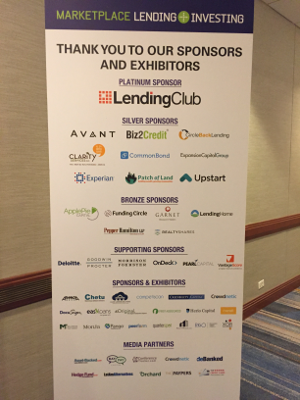
November 5, 2015Source Media’s Marketplace Lending and Investing conference kicked off today with a bang. During the opening keynote, two VPs at Goldman Sachs predicted that the industry would shift to retaining loans on balance sheets instead of continuing with the gain-on-sale model. The irony is that OnDeck appears to be going in the opposite direction since their recent path to profitability is being made possible by their new reliance on gain-on-sales.

The available solutions presented to small business financing problems at the conference covered the entire gamut. Pango Financial president Candice Caruso for example, explained that small businesses can get funding by rolling over money from a qualified retirement plan. Pango’s model capitalizes on The Employee Retirement Income Security Act of 1974 (ERISA), a 40-year old law that can be streamlined with the help of technology. ERISA established the regulation that allows for a private company to use retirement funds as business capital through an Employee Stock Ownership Plan (ESOP).
 Companies like Pango have found a clever way to scale the benefits out of old policies and it’s opportunities like these that have everybody excited. QED Partners founder Frank Rotman summed it up best when he recited his own Wall Street Journal quote, “It feels like the Internet in 2000. Everyone is chasing it, but they aren’t sure what ‘it’ is.”
Rotman also cautioned lenders who are trying to throw money at technology as a fix to scale their businesses. You can’t just throw money at technology, he argued. “Technology needs to be in your DNA.”
For marketplace lenders like QuarterSpot, they fit that bill well. Their CEO Adam Cohen was the Chief Software Developer for JetBlue Airways.
And among some of the other names in attendance, many are on the fast track for success. Expansion Capital Group for example just closed a $25 million credit facility with Northlight Financial and Bastion Management. And there’s also Pearl Capital who was recently acquired by Capital Z Partners. And Herio Capital, founded by one of OnDeck’s earliest employees, recently reached a new funding milestone.
At the end of the day, Anjan Mukherjee, the Counselor to the Secretary and Deputy Assistant Secretary for Financial Institutions of the U.S. Treasury Department told attendees not to bank on regulatory interest being forgotten about with a new presidential administration. Certain agendas can be “de-emphasized”, he said, but overall at least as far as the Treasury is concerned, enough important people will not transition away. They won’t forget everything, he explained.