
How to Prepare for Outside Syndicators
April 29, 2025David Roitblat is the founder and CEO of Better Accounting Solutions, an accounting firm based in New York City, and a leading authority in specialized accounting for merchant cash advance companies.
To connect with David, email david@betteraccountingsolutions.com.
There’s a clear gap of knowledge in our industry, and how merchant cash advance businesses need to prepare themselves to receive outside money in investment or syndication.
Whether you’re seeking your first institutional investment or scaling to eight-figure funding rounds, the preparation required isn’t just about having good portfolio performance—it’s about having the financial infrastructure responsible investors need to see before forking over money to you. Not knowing how to prepare that for them can cost you months of delays or even kill promising funding opportunities entirely.
I’ve seen too many MCA shops operating under a misconception. They believe that the impressive Google Sheets presentation showing their advance volume, daily collection rates, and merchant performance will be sufficient when courting serious investors.
Sometimes that’s enough. When you’re looking to raise money from friends and family, you have flexibility. These investors typically accept basic performance reports showing advance volume and collection rates, might not request detailed merchant-level financials, and generally won’t demand formal audits. Basic spreadsheets might suffice at this stage when you’re raising up to about $1 million in capital to fund your advances.
The financial documentation requirements escalate dramatically when you need more than that.
Once you move beyond self-funding or friends and family money into the realm of raising $5-10 million or more, investors won’t accept your homegrown reporting systems or month-end bundle accounting—they want audited financials and proper transaction-level documentation.
Sophisticated syndicators expect a professional CRM system tracking all merchant relationships, detailed default modeling, GAAP-compliant accounting systems that properly account for income recognition on merchant advances, and as investment amounts increase, audited financials become non-negotiable.
Auditors don’t accept shortcuts in the MCA space. They require transaction-level detail with recognized income on each advance, estimated defaults by cohort, and precise documentation of collection performance. They’re specifically looking for attempts to bundle or obscure individual merchant performance – a common practice in some MCA shops that raises immediate concerns with institutional investors.
Here’s what most MCA operators don’t realize: Getting your books audit-ready isn’t a quick fix. It’s a process that can take several months to update historical advance and collection records, 3-4 months for a first-time audit (always longer than subsequent audits), and additional time for any remediation of collection documentation. In total, you’re looking at potentially 9-12 months from financial disarray to audited statements. That’s an eternity in the fast-moving MCA world when a funding opportunity appears.
If you even think you might seek significant outside capital within the next year, start preparing now. Implement proper merchant tracking systems immediately. Ensure all bookkeeping follows GAAP principles for advance recognition. Consider getting audited financials before you need them.
Yes, this requires upfront investment, but put it in perspective: If you’re raising $5 million to fund your advance portfolio (often just the starting point), the cost of proper financial infrastructure is minimal compared to the capital you’ll secure and the acceleration in your timeline.
The most successful capital raises in the MCA industry aren’t just about having a great portfolio performance – they’re about being ready when opportunity knocks. Don’t be the MCA provider explaining to eager investors why they need to wait a year while you get your advance and collection records in order. The most valuable asset in fundraising isn’t just your merchant performance – it’s being prepared to prove it immediately.
Fundfi Merchant Funding Expands Senior Credit Facility to Accelerate Growth in Revenue-Based Financing
April 7, 2025NEW YORK, NY — April 7, 2025 — Fundfi Merchant Funding, a leading provider of revenue-based financing solutions for small and medium-sized businesses, today announced the successful expansion of its senior credit facility. This strategic financial move will enable Fundfi to increase its funding capacity and support more businesses across various industries.
The expanded credit facility strengthens Fundfi’s position in the alternative lending space and allows the company to meet the growing demand for flexible, revenue-based financing options among entrepreneurs and business owners seeking capital without diluting equity.
“This expanded credit facility marks a significant milestone in Fundfi’s journey and reflects the confidence our financial partners have in our business model and growth trajectory,” said Efraim Kandinov, CEO of FundFi Merchant Funding. “By increasing our lending capacity, we can help more businesses access the capital they need to innovate, expand, and thrive in today’s competitive marketplace. Our revenue-based financing approach continues to resonate with entrepreneurs who value flexibility and alignment with their business performance.”
The increased credit facility will enable Fundfi to extend its reach to underserved markets while enhancing its product offerings to meet diverse business needs.
“The expansion of our senior credit facility provides Fundfi with enhanced financial flexibility and improved terms that will directly benefit our clients,” said Natasha Dillon, CFO of FundFi Merchant Funding. “This achievement reflects our strong financial performance, robust underwriting standards, and the growing recognition of revenue- based financing as a viable alternative to traditional funding options. We’re excited to deploy this additional capital to support innovative businesses that drive economic growth and job creation.”
Fundfi’s revenue-based financing model allows businesses to repay their funding as a percentage of future revenues, creating an aligned incentive structure that adapts to business performance. This approach has proven particularly valuable for seasonal businesses and companies with irregular cash flow patterns.
About FundFi Merchant Funding
Fundfi Merchant Funding is a leading provider of revenue-based financing solutions, helping small and medium-sized businesses access growth capital without sacrificing equity or control. With a streamlined application process and flexible repayment terms, Fundfi has established itself as a trusted financial partner for entrepreneurs across various industries and across the United States and Canada. For more information, visit www.fundfimerchantfunding.com.
Why MCA Companies Need Syndicators
March 21, 2025David Roitblat is the founder and CEO of Better Accounting Solutions, an accounting firm based in New York City, and a leading authority in specialized accounting for merchant cash advance companies. To connect with David or schedule a call about working with Better Accounting Solutions, email david@betteraccountingsolutions.com.
 The merchant cash advance (MCA) business is all about balance—managing risk while keeping capital flowing.
Many funders hesitate to bring in outside capital, especially if they already have a line of credit. The thinking goes: “If I have my own money, why should I split the profits?” But that perspective overlooks the key benefits syndication brings—not just in terms of capital but also risk mitigation and overall profitability.
The biggest advantage of working with syndicators is the ability to do more deals while spreading out risk. The more deals you fund, the more you diversify, which naturally increases your stability. If you’re advancing your own money, you’re taking on 100% of the risk. But with syndicators, that exposure is shared. Even if you already have a line of credit, using syndication means you’re not tying up all your liquidity in a few high-risk advances. Instead, you’re spreading your capital across more opportunities, reducing the chances of any single deal tanking your portfolio.
Syndication also creates a financial buffer through fees that MCA companies collect upfront. Syndicators don’t just bring in money; they pay to participate in your deals. Typically, they compensate the funder in one of four ways: paying an upfront fee (usually 3-5% of the RTR or 5-7% of the principal), paying part of the fee upfront and the rest as the deal is repaid, covering a portion of the origination fee, or splitting the profits at the end of the deal. These fees give MCA companies immediate cash flow, which helps offset risk before repayment even begins.
Consider this: if you fund a $100,000 deal and syndicators take on 50% of it while paying a 4% fee, you’ve immediately reduced your exposure. You’re technically in for only 48% of the deal, not 50%, because that fee cushions your position. On a larger scale, this compounds into significant risk reduction. If your default rate is 15% and syndication lowers your risk by just 5%, that’s a major improvement. A 10% default rate instead of 15% can be the difference between profitability and loss.
Origination fees further sweeten the deal. Some MCA companies split origination fees with syndicators, while others keep the entire portion from the syndicator’s investment. For example, in a $200,000 advance where the syndicator puts in $100,000, a 10% origination fee would total $20,000. If the funder keeps the entire 10% from the syndicator’s portion, that’s $10,000 of instant income—reducing risk right away. This means that even before payments start coming in, the MCA company is in a stronger position.
Profit-sharing models also offer advantages, particularly for MCA companies that want to keep more control over the deal structure. In these setups, syndicators don’t pay an upfront fee but instead share in the profits at the end. This allows funders to leverage external capital while still maintaining higher margins on successful advances. Some models even combine a profit split with an upfront syndication fee, offering the best of both worlds—immediate cash flow and long-term upside.
The bottom line is simple: syndication makes MCA portfolios stronger. It adds a layer of protection, reduces risk, increases deal volume, and injects capital upfront. A stronger, more diversified portfolio leads to more stability and, ultimately, higher long-term earnings.
For any MCA company serious about growth and sustainability, working with syndicators isn’t just an option—it’s a necessity. Overlooking these benefits in the name of not wanting to share profits shows a short-term mindset that may cost more in the future.
Brokers: Making the Leap from Working Capital into Equipment Financing
March 13, 2025 “We can finance anything that doesn’t shoot, fly or float,” says Josh Feinberg, CEO of Everlasting Capital. “So no planes, no boats, no guns.” But any other type of equipment and he’s ready to chat. As a seasoned veteran of the equipment finance industry, that conversational starting point of knowing what to ask and how to answer takes a lot of practice to develop.
“Roleplaying is like stretching before going for a run,” said Feinberg. “It makes it possible for you to be fast on your feet and really be able to have the answers.”
Everlasting Capital is a broker shop based in Rochester, NH that believes strongly in practicing calls with colleagues to develop their skills. It’s a role play. Many shops do it. But becoming seasoned at it for one product doesn’t mean that a broker automatically becomes an expert at any type of call.
“A lot of [working capital] brokers think that they’re the ones that are trying to figure out if the business owner qualifies, but to be honest with you, in the equipment space, it’s vice-versa,” Feinberg said. “The customer is actually trying to qualify you to see if you are apt to be able to finance their equipment.”
Equipment financing flips the stakes and the direction, and with that a fresh need for practice toward managing it successfully. And that’s where some brokers used to other products get stuck, because their confidence drops in being able to navigate something they don’t fully know. To that point, it can feel intimidating to discuss machinery they’re not familiar with or trucks they’ve never driven.
Feinberg believes that anyone can learn this, however, simply by talking to business owners about these things. One doesn’t need to actually spend 20 years in construction to finance equipment in that industry, for example, though it certainly wouldn’t hurt. Feinberg’s own start in the business is very simple to replicate.
“I just started talking to business owners, figuring out what they want. A lot of times [in the very beginning] I didn’t even know what the equipment did. I would have to Google it while I was on the phone with them.”
 That, of course, has changed with experience. Now he and his firm have become so well acquainted with certain industries that they’ve integrated themselves within them. The dump truck market, for example, has become one of their core areas of expertise.
Despite this attainable path to success, some brokers throw up their hands and assume the process will be too hard or the financial incentive too low to even try equipment financing—even though that is generally not the case. In an era where working capital has become so competitive, it should be considered as an additional offering to maximize value at the bare minimum.
“[When] you have the one person calling like, ‘hey we have monthly payments that are single digit rates, and we can do monthly payments one to five years.’ It’s really easy to spark up a conversation and be able to ask the questions that you need to do, and then get answers back,” he said.
Advocating for other brokers to adopt his approach might seem like it would increase competition, but Feinberg explained that the market is wide open with opportunities. Moreover, he feels strongly about matching business owners with the right solution. To that end, he is also the co-founder of Equipment Broker School, a system designed for anyone needing a jump start or a refresher on the art of equipment financing. His company previously starred in an online reality show where new salespeople were trained in person in the office, and Feinberg himself recently appeared as a judge at AltFinanceDaily CONNECT’s Broker Battle in Miami Beach this past February. The event was a roleplaying competition that evaluated brokers on their ability to diagnose needs and propose solutions. It was like just another day in the office for him.
“It made me really excited to be able to be a part of the Broker Battle, just as a lot of people know, and you know especially just for myself, being able to train people on how to be able to promote, how to be able to work, and how to be able to just partake in equipment financing,” Feinberg said. “It has been a super big passion of mine, especially just within the AltFinanceDaily community as a whole.”
How Mike Brooks Battled in the Ring and Won Top Broker in Equipment Financing
March 6, 2025
“Equipment Financing is HUGE,” declares Mike Brooks, CEO of New York-based Best Connect Capital and recent winner at Broker Battle 2025 in the equipment finance category at AltFinanceDaily CONNECT MIAMI. If his name sounds familiar, it’s probably because he appeared on stage as one of six finalists in the previous year’s competition. He refused to give up after his loss and returned this year for round two, leading to him securing a title and prizes along with it. To hear him tell it, it had been a long road to get there.
When Brooks got his start as a 27-year-old broker in 2015, for example, he had technically been battling in a ring for most of his life already.
“I had [boxing] on my mind in high school, without any influence,” says Brooks, “and I walked into a gym one day and the rest was history.” That history includes 60 fights in just amateur-level boxing, resulting in 45 wins and 15 losses. When he followed that at the pro level he went 11-2-1.
“I started fighting at the regular club shows, the Golden Gloves, the metro tournaments, national tournaments, and at one point, I was ranked number seven in the whole country,” Brooks recalls. “I beat some really good fighters, lost to some really good fighters and I made it to the highest levels in the country.”

Some of those fights even aired on live TV. As he bobbed and weaved for years in the ring, he started to think about what a possible career in business might look like afterwards. When that day came, he went to work for a local financial service company on Long Island who taught him about helping small businesses access working capital. Eventually he realized it was a business that he was uniquely suited for and now he runs his own company doing it.
First, there’s the endurance aspect, he explains. There’s a lot of calls, leads that don’t pan out, and heartbreak that hits when deals get declined at the finish line.
“A very small percentage of people can be a successful broker,” Brooks says. “You have to be able to take rejections all day long.”
To that point, Brooks noticed that as the industry grew he was not the only broker offering revenue-based financing to a client. Sometimes there were even as many as four or five other brokers talking to the same client at the same time, which meant that he wasn’t going to win every one and he did not want to bend his ethics just to eke it out. That’s when he started considering another approach and expanded his offerings.
“An equipment financing deal was my first big check during [the covid] lockdowns,” Brooks says. It was a $200,000 deal for a packaging plant. The terms were very attractive and he had the help of an equipment finance veteran who mentored him through it. When it worked out, he knew he had something very big in his arsenal and he’s been offering it ever since to anyone that qualifies for it.
 “I said to myself anybody that needs equipment, this is a no brainer right here,” Brooks recalls of it. Now Brooks says when there is competition, he’s almost always the only one asking questions about equipment and the only one prepared to actually move forward with a deal tied to it. Of that experience, Brooks says he’s realized that some brokers have become so accustomed to the mindset of telling customers to take a specific deal, that they don’t stop to consider what they actually want. So his approach is to go in and diagnose what it is they’re trying to do first and then advise them of their options accordingly. And that’s what he does day after day.
At Broker Battle 2025, it was very much like time spent in the office. He was expected to be his normal self, but on stage in front of a large audience, while three judges played the role of prospective client and asked him questions about what they should do. The end result of it all was that Mike Brooks, former fighter in the ring, walked away as the Broker Battle champion in the equipment finance category in 2025.
“It felt amazing to be able to showcase what I do on a daily basis,” Brooks says, making it a point to say that even the venue took note of his win and offered him a personal congratulations on social media.
In the final photo-op on stage with his prize check, Brooks was the epitome of his dual life—the suit and tie spoke of business, while the cigar and sunglasses hinted at his former life in the ring. “I was a crowd pleaser,” he jokes. “You want to be like ‘bam bam bam’ and the crowd to be like ‘AHHHH!!!’ I want them to do that. I had a great time at AltFinanceDaily.”
Ryan Showe on Winning This Year’s Broker Battle
March 3, 2025 “What being a broker means to me is servicing your clients in the best way possible, really putting their needs before anyone else’s,” says Ryan Showe, VP of Sales at Long Island-based Lexington Capital Holdings. “Ultimately, at the end of the day, we don’t have a job if our clients aren’t happy, so just constantly doing the right thing, putting your best foot forward, and making sure that you’re doing everything ethically and honest.”
Showe was the winner of the 2025 Broker Battle at AltFinanceDaily CONNECT Miami for the revenue-based financing category, earning him the recognition of Top Broker and the recipient of some prizes along with it. Showe has been in the business for just a little over three years, starting at Lexington during its beginnings. Back then, learning the ropes while doing the work meant putting in 70-80 hour weeks on a regular basis. That included not only seeking out advice from the experts but also watching videos and reading books to fully immerse himself in the mindset of what it would take to become successful.
That effort is paying off and today Showe specializes in the most delicate part of the process at Lexington, helping clients who have applied get to the finish line with a deal while managing lender-side negotiations and communications. On the latter side, that means being highly familiar with the guidelines of more than 60 financial service companies at any given time.
“Anybody can get someone to apply and just fill out a quick one-page application, send over a couple bank statements, but really selling the deal, there’s a specific art to it,” says Showe. “It’s really important to be an expert in your industry and know all the lender guidelines, know what the backend process looks like, because every lender is going to have a different process, whether there’s certain steps that some lenders want, whether it’s a manual-login or DecisionLogic. There’s so many ins and outs to every different lender. And just being able to know all that off the top of your head and just really sound like an expert.”
At Lexington, one of the recent educational team-building strategies was to host an internal Broker Battle in which 30 employees participated in a double-elimination competition. The company’s CEO, Frankie DiAntonio, devised the format and questions—not only role‑playing scenarios but also testing general industry knowledge with trivia. Showe says it’s good practice to be put on the spot in front of a crowd, because a key part of sales is thinking on your feet and executing when it counts. Doing it together with colleagues made for a fun experience in a company that prides itself on a family‑like atmosphere, while also mirroring the competitive nature of the industry where many brokers vie to serve the same customers. It’s game time all the time.
“I even tell my clients, ‘competition is always going to breed the best results,'” Showe says. “If you want the best of the best, you have to make people compete. And it goes down to even selling a deal, right? So if I have a deal and another company has a deal, compare my numbers against their numbers. I’m going to do anything I can to win that business.”
By happenstance, Lexington’s Corey Digiantomasso was one of the six finalists selected to compete in AltFinanceDaily’s inaugural Broker Battle in 2024, where he put up a very impressive performance. This year was Showe’s turn where contestants weren’t given much background on the format other than that it would be roleplay-based. Showe kind of liked the mysteriousness of it.
“I’m best at showing up and just getting the job done,” Showe says. “So just doing what I do every single day made it easier for me at least.”
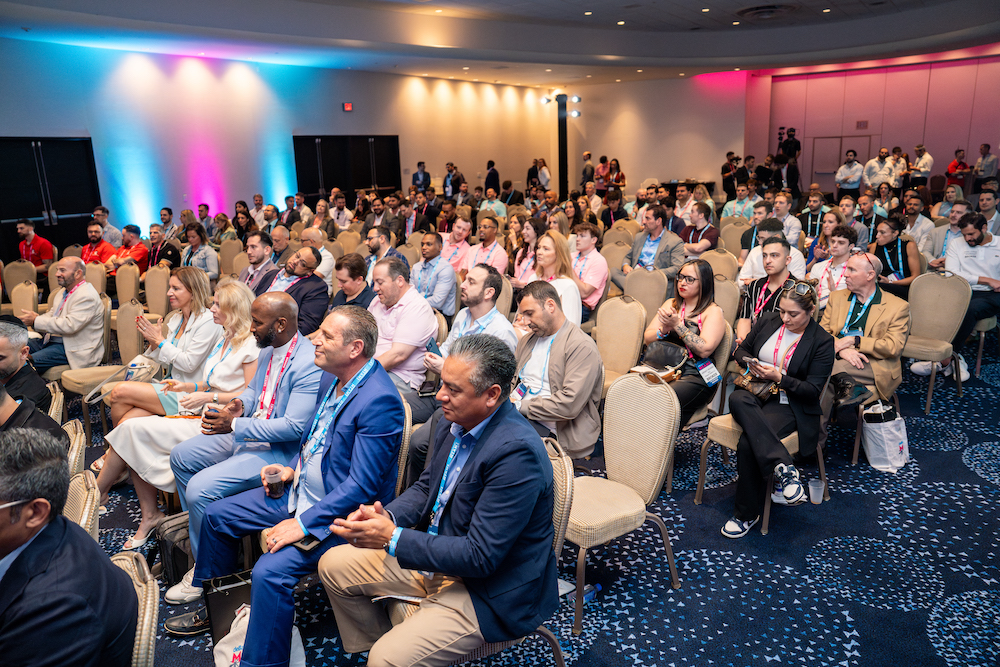
On his victory, Showe described the feeling as awesome while also recognizing that his opponent in the Battle, Joe Sasson, was a very worthy competitor. A large crowed showed up to support both of them during the championship.
“It was great to just see all the hard work that I’ve been putting in over the last three years pay off and be crowned #1 in the industry. It goes a long way for not only myself, but for the company as well.”
NerdWallet: Still Pressure in SMB Loan Originations
March 2, 2025NerdWallet’s CEO Tim Chen explained during the company’s Q4 earnings call that headwinds across both consumer and SMB lending have not let up.
“We continue to see pressure in SMB loan originations with rates remaining elevated and underwriting remaining tight, while also seeing increased pressure in our renewals portfolio as the 10-year rates reversed course and began to climb,” he said.
NerdWallet originates borrowers through the internet, a significant portion of which comes from organic search traffic. That organic traffic dipped about a year ago after changes to Google’s algorithm but has been recovering over the last two quarters for SMB loans. During the earning’s call, one analyst, Ralph Schackart of William Blair & Company LLC, had a question about the continued reliance on that channel given the rise of competing AI chat assistants.
“I guess as you are sitting here today and sort of operating this business, obviously for a while here, how different do you think these changes are to the business with AI overviews?” Schackart asked. “And some digital buyers are saying that the ads that are generated from Gen-AI are actually performing better than some of the organic results. Just kind of curious, what’s your confidence that this is something you’ll be able to navigate longer term versus your previous history? ”
This was Chen’s response:
“I’ll split it up between kind of the shorter-term stuff we’re seeing and longer-term thoughts. I mean in the near term, there’s two drivers here. Which is, one is more ads and modules on top of the search results. And the other factor is rank. Where in the very recent past, financial institutions and some government websites are winning in some areas where they traditionally haven’t, which as I’ve alluded to in past calls, is a bit of a head scratcher when considering consumer intent.
We do think this period of frenetic testing will eventually stabilize, and when that happens, it should play to our favor. Longer term, I do think that it’s important to look at broader industry trends. First, AI search engines or chatbots, are they taking share from traditional search engines?
I mean from what we can tell, not really. If you look top-down, more people are using search engines than they did last year, but you also see triple-digit growth in AI usage. Which says to me that people are basically just asking more questions that they weren’t asking before. And second, the things like AI overviews, how is that affecting the ecosystem?
So I know we’re not focusing on MUUs operationally, but it’s helpful to understand that if simple questions have simple answers, and if a search engine can serve that up in a faster way that consumers prefer, then that’s good for the ecosystem.
And for us, we’re seeing these features do a really good job of answering simple educational questions, and that’s affecting traffic to some of our noncommercial pages. That has not been the case yet for our monetizing pages, which are fundamentally just a little more complicated.
Like if you need to shop for a mortgage for instance, you really need to go through a marketplace experience. So yes, on balance, we think that this period of frenetic testing will stabilize. We’ve seen a few things like this in the past, and we can grow from there.”
Square Loans Originated $5.7B in Business Loans in 2024
February 25, 2025Block subsidiary Square Loans had a huge Q4, originating $1.54 billion in business loans. That brought the year-end total to $5.7 billion, enough to continue their streak as the largest online business lender that AltFinanceDaily tracks. Enova is #2.
Square Loans customers typically experience growth when taking the funds. Block CEO Jack Dorsey said this of the program in the previous quarter:
“In 2013, we began offering capital to sellers because we saw a meaningful gap in the market: small businesses were often denied access to credit, in the same way they were once denied access to accepting credit cards. We utilized our deep understanding of the seller and their business to build a technology that invited them to accept a loan with transparent rates, and pay back simply by making sales to their customers. We called it Square Capital (which is now known as Square Loans).
Since then, we’ve underwritten more than $22 billion in loans globally, with aggregate loss rates below 3%. And we’ve proven we can expand access: 58% of Square Loans are to women-owned businesses, and 36% are to minority-owned businesses, both of which are higher than the benchmark we track If our sellers grow, we grow – and we believe Square Loans has a direct impact on our sellers’ growth. Sellers who take out a Square Loan grew on average 6% faster than sellers who did not take out a loan.
Many financial products trap borrowers in cycles of revolving debt. We don’t allow customers to take on new loans if they have an overdue balance. And repayment is built into how our products work: Square sellers repay loans through a fixed percentage of their revenue, creating a manageable-real-time payment flow.
On credit risk management, we have a long history of maintaining stable loss rates and these products act as working capital, which means they are usually short in duration. What that means for us is that a dollar used on our balance sheet can turn multiple times, driving capital efficiency while providing us with high-quality data to continually refine our technology-driven underwriting.”
-Jack Dorsey