Greenbox Capital Renegotiates Its Credit Facility
February 27, 2018 Miami, FL – Greenbox Capital is happy to announce that they have recently renegotiated their credit facility, lowering their interest rate and doubling their funding capacity in the US, Puerto Rico, and Canada.
The journey to this success has not been a straight shot. Just over one year ago, Greenbox Capital suffered internal theft. Some individuals on their staff were back-dooring deals, looking to make a quick buck, and leaving Greenbox to suffer the consequences.
In March of 2017, AltFinanceDaily reported this internal theft that had dated back to October of 2016. Greenbox launched an investigation, hiring a private investigator and bringing these offenders to justice.
In the midst of this unfortunate circumstance, Greenbox resolved to take a stand for deal security, striving to become the safest funding company to do business with. They’ve executed a strategic network security assessment and have transitioned their controls to that of a banking institution. This assessment was completed in conjunction with the release of their proprietary software, “The Box,” which reduces human interaction with deals, increasing security of merchant sensitive information and security of broker deals.
With the release of The Box in February of 2017, Greenbox has been funding deals faster (and more safely) than ever before, with funding in as little as 24 hours. With some strategic restructuring of the company, i.e., being particularly selective in their hiring process, terminating brokers who create disadvantages for others by manipulating the system, and the release of The Box, Greenbox’s performance has improved exponentially and their credit facility has increased their limits to allow for them to reach their potential in the industry.
Greenbox CEO, Jordan Fein, asserts, “When you reach your potential, you naturally become more attractive and we’re becoming more attractive every day!” With so many positive changes made at every level of the business, 2018 looks bright for Greenbox Capital.
The Madden Decision, Three Years Later
February 18, 2018
At first, reversing the 2015 Madden v. Midland Funding court decision, which continues to vex the country’s financial system and which is having a negative impact on the financial technology industry, seemed like a fairly reasonable expectation.
The controversial ruling by the Second Circuit Court of Appeals in New York, which also covers the states of Connecticut and Vermont, had humble roots. Saliha Madden, a New Yorker, had contracted for a credit card offered by Bank of America that charged a 27% interest rate, which was both allowable under Delaware law and in force in her home state.
But when Madden defaulted on her payments and the debt was eventually transferred to Midland Funding, one of the country’s largest purchasers of unpaid debts, she sued on behalf of herself and others. Madden’s claim under the Fair Debt Collection Practices Act was that the debt was illegal for two reasons: the 27% interest rate was in violation of New York State’s 16% civil usury rate and 25% criminal usury rate; and Midland, a debt-collection agency, did not have the same rights as a bank to override New York’s state usury laws.
In 2013, Madden lost at the district court level but, two years later, she won on appeal. Extension of the National Bank Act’s usury-rate preemption to third party debt-buyers like Midland, the Second Circuit Court ruled, would be an “overly broad” interpretation of the statute.
For the banking industry, the Madden decision – which after all involved the Bank of America — meant that they would be constrained from selling off their debt to non-bank second parties in just three states. But for the financial technology industry, says Todd Baker, a senior fellow Harvard’s Kennedy School of Government and a principal at Broadmoor Consulting, it was especially troubling.
“The ability to ‘export’ interest rates is critical to the current securitization market and to the practice that some banks have embraced as lenders of record for fintechs that want to operate in all 50 states,” Baker told AltFinanceDaily in an e-mail interview.

A 2016 study by a trio of law professors at Columbia, Stanford and Fordham found other consequences of Madden. They determined that “hundreds of loans (were) issued to borrowers with FICO scores below 640 in Connecticut and New York in the first half of 2015, but no such loans after July 2015.” In another finding, they reported: “Not only did lenders make smaller loans in these states post-Madden, but they also declined to issue loans to the higher-risk borrowers most likely to borrow above usury rates.”
With only three states observing the “Madden Rule,” the general assumption in business, financial and legal circles was that the Supreme Court would likely overturn Madden and harmonize the law. Brightening prospects for a Madden reversal by the Supremes: not only were all segments of the powerful financial industry behind that effort but the Obama Administration’s Solicitor General supported the anti-Madden petitioners (but complicating matters, the SG recommended against the High Court’s hearing the case until it was fully resolved in lower courts).
Despite all the heavyweight backing, however, the High Court announced in June, 2016, that it would decline to hear Madden.
That decision was especially disheartening for members of the financial technology community. “The Supreme Court has upheld the doctrine of ‘valid when made’ for a long time,” a glum Scott Stewart, chief executive of the Innovative Lending Platform Association – a Washington, D.C.-based trade group representing small-business lenders including Kabbbage, OnDeck, and CAN Capital — told AltFinanceDaily.
Even so, the setback was not regarded as fatal. Congress appeared poised to ride to the lending industry’s rescue. Indeed, there was rare bipartisan support on Capitol Hill for the Protecting Consumers’ Access to Credit Act of 2017 — better known as the “Madden fix.”

Introduced in the House by Patrick McHenry, a North Carolina Republican, and in the Senate by Mark Warner, Democrat of Virginia, the proposed legislation would add the following language to the National Bank Act. “A loan that is valid when made as to its maximum rate of interest…shall remain valid with respect to such rate regardless of whether the loan is subsequently sold, assigned, or otherwise transferred to a third party, and may be enforced by such third party notwithstanding any State law to the contrary.”
Just before Thanksgiving, the House Financial Services Committee approved the Madden fix by 42-17, with nine Democrats joining the Republican majority, including some members of the Congressional Black Caucus. Notes ILPA’s Stewart: “We were seeing broad-based support.”
But the optimism has been short-lived. The Madden fix was not included in a package of financial legislation recently approved by the Senate Banking Committee, headed by Sen. Mike Crapo, Republican of Idaho. Moreover, observes Stewart: “Senator Warner appears to have gotten cold feet.”
What happened? Last fall, a coast-to-coast alliance of 202 consumer groups and community organizations came out squarely against the McHenry-Warner bill. Denouncing the bill in a strongly worded public letter, the groups — ranging from grassroots councils like the West Virginia Citizen Action Group and the Indiana Institute for Working Families to Washington fixtures like Consumer Action and Consumer Federation of America – declared: “Reversing the Second Circuit’s decision, as this bill seeks to do, would make it easier for payday lenders, debt buyers, online lenders, fintech companies, and other companies to use ‘rent-a-bank’ arrangements to charge high rates on loans.”
The letter also charged that, if enacted, the McHenry-Warner bill “could open the floodgates to a wide range of predatory actors to make loans at 300% annual interest or higher.” And the group’s letter asserted that “the bill is a massive attack on state consumer protection laws.”
Lauren Saunders, an attorney with the National Consumer Law Center in Washington, a signatory to the letter and spokesperson for the alliance, told AltFinanceDaily that “our main concern is that interest-rate caps are the No. 1 protection against predatory lending and, for the most part, they only exist at the state level.”
But in their study on Madden, the Stanford-Columbia-Fordham legal scholars report that the strength of state usury laws has largely been sapped since the 1970s. “Despite their pervasiveness,” write law professors Colleen Honigsberg, Robert J. Jackson, Jr., and Richard Squire, “usury laws have very little effect on modern American lending markets. The reason is that federal law preempts state usury limits, rendering these caps inoperable for most loans.”
While the battle over the Madden fix has all the earmarks of a classic consumers-versus-industry kerfuffle, the fintechs and their allies are making the argument that they are being unfairly lumped in with payday lenders. “Online lending, generally at interest rates below 36%, is a far cry from predatory lending at rates in the hundreds of percent that use observable rent-a-charter techniques and that result in debt-traps for borrowers,” insists Cornelius Hurley, a Boston University law professor and executive director of the Online Lending Policy Institute. Because of fintechs, he adds: “A lot of people who wouldn’t otherwise qualify in the existing system are getting credit.”
A 2016 Philadelphia Federal Reserve Bank study reports that traditional sources of funding for small businesses are gradually exiting that market. In 1997, small banks under $1 billion in assets –which are “the traditional go-to source of small business credit,” Fed researchers note — had 14 percent of their assets in small business loans. By 2016, that figure had dipped to about 11 percent.
The Joint Small Business Credit Survey Report conducted by the Federal Reserve in 2015 determined that the inability to gain access to credit “has been an important obstacle for smaller, younger, less profitable, and minority-owned businesses.” It looked at credit applications from very small businesses that depend on contractors — not employees – and discovered that only 29 percent of applicants received the full amount of their requested loan while 30 percent received only partial funding. The borrowers who “were not fully funded through the traditional channel have increasingly turned to online alternative lenders,” the Fed study reported.
The ILPA’s Stewart gives this example: A woman who owns a two-person hair-braiding shop in St. Louis and wants to borrow $20,000 to expand but has “a terrible credit score of 640 because she’s had cancer in the family,” will find the odds stacked against when seeking a loan from a traditional financial institution.
But a fintech lender like Kabbage or CAN Capital will not only make the loan, but often deliver the money in just a few days, compared with the weeks or even months of delivery time taken by a typical bank. “She’ll pay 40% APR or $2,100 (in interest) over six months,” Steward explains. “She’s saying, ‘I’ll make that bet on myself’ and add two additional chairs, which will give her $40,000-$50,000 or more in new revenues.”
In yet another analysis by the Philadelphia Fed published in 2017, researchers concluded that one prominent financial technology platform “played a role in filling the credit gap” for consumer loans. In examining data supplied by Lending Club, the researchers reported that, save for the first few years of its existence, the fintech’s “activities have been mainly in the areas in which there has been a decline in bank branches….More than 75 percent of newly originated loans in 2014 and 2015 were in the areas where bank branches declined in the local market.”
Meanwhile, there is palpable fear in the fintech world that, without a Madden fix, their business model is vulnerable. Those worries were exacerbated last year when the attorney general of Colorado cited Madden in alleging violations of Colorado’s Uniform Consumer Credit Code in separate complaints against Marlette Funding LLC and Avant of Colorado LLC. According to an analysis by Pepper Hamilton, a Philadelphia-headquartered law firm, “the respective complaints filed against Marlette and Avant allege facts that are clearly distinguishable from the facts considered by the Second Circuit in Madden.
“Yet those differences did not prevent the Colorado attorney general from citing Madden for the broad-based proposition that a non-bank that receives the assignment of a loan from a bank can never rely on federal preemption of state usury laws ‘because banks cannot validly assign such rights to non-banks.’”
Should the Federal court accept the reasoning of Madden, Pepper Hamilton’s analysis declares, such a ruling “could have severe adverse consequences for the marketplace and the online lending industry and for the banking industry generally….”
Banks, Alt Funders Continue to Compete for Small Business
February 13, 2018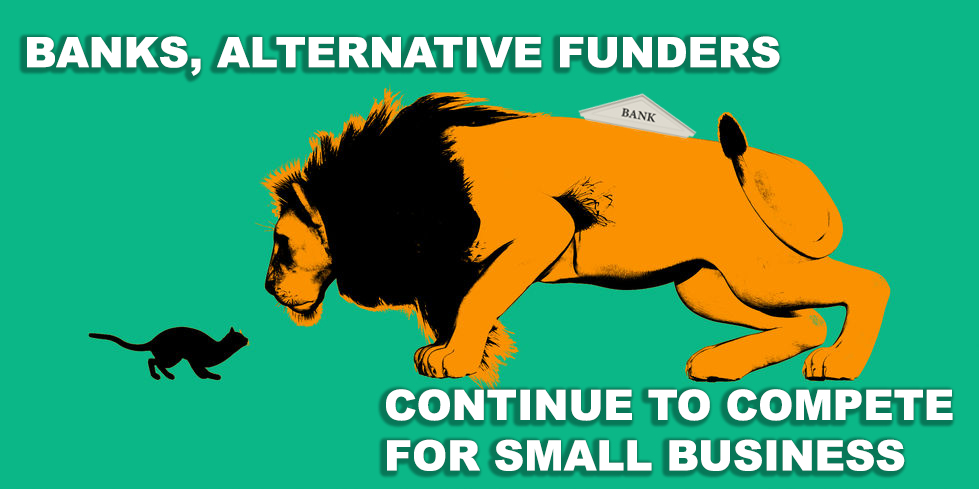
The alternative small-business finance industry owes its very existence to banks’ reluctance to lend money to mom-and-pop shopkeepers, tradespeople and restauranteurs, but bankers’ tight fists may be loosening. Small-business owners are reporting better results when they apply for bank loans.
In fact, small entrepreneurs succeeded in landing bank loans 37 percent of the time in the fourth quarter of 2017, up from 29 percent a year earlier, according to the 1,341 merchants surveyed for the most recent quarterly Private Capital Access Index report provided by Dun & Bradstreet and Pepperdine University’s Graziadio School of Business and Management.
“That’s a big change. It’s outside the margin of error and outside normal statistical variation,” Craig R. Everett, assistant professor of finance at Pepperdine and director of the Graziadio and Dun & Bradstreet Private Capital Markets Project, tells AltFinanceDaily. He’s comparing the shift to patterns established in the nearly six years the quarterly index has pegged small-business trends.
 But the effects of bankers’ increased willingness to lend to small businesses may prove a bit muted in the alternative funding industry. That’s partly because Pepperdine and Dun & Bradstreet define small businesses as having up to $5 million in annual revenue. Alt funders often deal with much smaller enterprises that could still fail to capture the attention of bank loan officers, says Noah Grayson, managing director of South End Capital in Encino, Calif. “If you’re making $5 million in gross revenue, that’s a pretty robust business,” he says of his clients.
Then there are the borrowers whose companies seem small in that they employ just a few people but might rake in $5 million on a single contract – like contractors who specialize in heavy construction equipment or have a presence in the aviation business – but aren’t profitable enough to qualify for bank loans, says Gene Ayzenberg, CEO of PledgeCap, a company with offices on Long Island and in Manhattan that specializes in business and personal loans secured by collateral.
Besides, lots of alternative lenders don’t regard gross revenue as the measure of a business. “I would look at what kind of resources and infrastructure the business has to define what is small and medium-sized,” says David Obstfeld, CEO of New York-based SOS Capital. Many alt lenders cite the importance of net over gross.
The size of prospective borrowers aside, banks are probably lending to small merchants more often these days because small businesses are becoming more profitable in today’s relatively healthy business climate and thus stand a better chance of qualifying for credit, Everett says. The recent reduction in corporate taxes will also improve profits and make small businesses more credit-worthy, he says.
The change in bank lending volume seems tied to those financial gains and doesn’t appear to be linked to any shift in policy among bankers, Everett notes. But new policies at the Small Business Administration could prompt the banking community to view small-business loans more favorably, according to Grayson. The SBA is increasing the percentage it guarantees for some loans and reducing the amount required for a down payment on some loans, he notes. That could make life more difficult for some alternative lenders because most of the small-business loans made by major banks, like Wells Fargo and Chase, are SBA loans, he says. The SBA did not provide details regarding the changes by press time.
 Regardless of what’s making banks loosen their grip on the purse strings, merchants are feeling more optimistic – or at least less gloomy – about obtaining bank loans in the near term, the study by Pepperdine and Dunn & Bradstreet indicates. In the fourth quarter of last year, 55 percent of small-business owners predicted difficulty in raising financing in the next six months, down from 61 percent a year earlier, the survey shows.
“That’s an improvement, but I still think it’s an alarmingly high number,” Ayzenberg says of those findings. “Before they even start worrying about how their operations are going and how good their product is, one in two businesses is already worrying that their bank is not going to be able to fulfill their needs. They shouldn’t have to have those fears.”
So, banks are becoming a bit more likely to loan to small businesses but still aren’t throwing open the flood gates to create a flood of funding. That’s true of banks that qualify as large and those classified as small.
American banks tend to be either small community institutions or huge national concerns that are swallowing up the remaining mid-sized regional banks, observers agree. Between 80 and 90 banks control assets of $10 billion or more and thus qualify as large, while thousands of small banks have more limited resources, says David O’Connell, an Aite Group senior analyst.
Large and small banks exhibit about the same degree of ambivalence toward small-business loans. Banks can mitigate the downside of the loans because they have funds to hire staffs and buy technology to analyze risk, O’Connell says. Executives at small banks can avoid potential problems with small-business loans because they’re often dealing with prospective borrowers who were their high school or college classmates, he notes.
Whether banks are large or small, they have their reasons to deny loans to small businesses. Perhaps foremost among the rationales for denying loans to small businesses is the cost of underwriting, says O’Connell. Banks simply can’t make enough money on the loans to pay the cost of processing them, he says, adding that, “It’s a long-standing problem.” For example, a bank can make a profit by loaning $2 million at prime plus 2 percent, but can’t cover the underwriting costs of an $80,000 loan that also earns prime plus 2 percent. The underwriting costs would be the same in both cases, he notes.
Banks became even more ambivalent about loaning to small businesses after the Great Recession struck in 2008, O-Connell continues. They didn’t want to repeat the mistakes of the freewheeling period that preceded the economic catastrophe. About the same time, private equity and hedge funds began madding more capital available to alternative lenders, he says. Meanwhile, technology and alternative data sets helped the alternative industry understand risk and reduce underwriting costs, he maintains.
Banks also find it more expensive to loan to small businesses these days because the Dodd-Frank Act has increased compliance costs, Everett points out. “Red tape and reserve requirements for the banks have all increased under Dodd-Frank, so making loans to small businesses is less cost-effective than it was before.” Banks now need upwards of $1 billion in assets under management to remain viable, and they feel compelled to expand their staffs to follow all the new rules for lending, he says.
What’s more, bankers still exercise extreme caution when it comes to extending credit to small businesses because stores or restaurants often fail and then the business or the owner defaults on the loan, Everett says. That’s why banks often require business-loan applicants to demonstrate two years of profitability to qualify for credit, he notes. Higher interest that can mitigate that risk, but state usury laws often capping rates at 36 percent or less, Everett notes. New York, for example, limits banks to 16 percent, he says.
State usury laws don’t apply to factoring or merchant cash advances, and that enables alternative funders to charge more for the use of funds, Everett says. “If it’s not called a loan and what the customer is paying is not called interest, then it’s not subject to state usury laws,” he says.
Obstfeld puts it this way: “In would be great to be in a business where nobody defaults. The rates we charge at SOS Capital are necessary to cover our losses and be profitable at the same time.”
The high cost of obtaining funds in the alternative market could eventually prompt the federal government to intervene with regulation but that probably won’t happen anytime soon, Everett predicts. O’Connell agrees, noting that in the current political climate the government has little appetite for new restrictions on a major source of capital for thousands of small businesses.
Because alternative funders have greater flexibility than banks in how much they can charge for access to credit, banks have sometimes formed referral relationships with alt funders to hand off small-business borrowers. “That looks good on paper and makes great headlines, but it’s harder to do in real life,” O’Connell maintains, because the bank loses control of the customer experience. If the alt funder doesn’t manage customers’ expectations effectively, the bank might have to take the blame – at least in some consumers’ minds, he contends. He’s surveyed bankers and found them feeling “really mixed” about such partnerships.
 The impact of such partnerships hasn’t been as great as some anticipated. “We were quite nervous when we heard that JPMorgan would be using OnDeck’s platform,” recalls Obstfeld. “However, it’s been quite some time that they’ve been doing that and it hasn’t seemed to make a dent – at all – in alternative lending.”
But alternative funders can provide borrowers with advantages that banks can’t match. Some alternative lenders can approve a client’s application in a few hours and wire funds to the recipient the same day, Grayson says. Steve Hauptman, chief operating officer at SOS Capital, notes that banks can require weeks or even months to respond to an application.
 That’s why SOS Capital customers sometimes obtains funding from the company as a bridge to keep operating while they’re waiting for an SBA bank loan or to take advantage of an opportunity that requires a quick response, Obstfeld says.
The advantages of the alternative funding industry don’t end there. SBA bank loans require more paperwork than is needed for a merchant cash advance, which can slow the process even further as the client assembles the documentation, Obstfeld notes.
In addition, banks can simply seem slow to respond to the needs of the market. “Banks are banks – they’re never going to be able to do the things we can do,” says Obstfeld. “If one product becomes an issue, we can pivot and create new product tomorrow. It takes banks years to get approval for something new.”
Then there are cards. Besides an increase in banks’ willingness to lend to small businesses, merchants are finding it easier to obtain business credit cards, the index provided by Pepperdine and Dun & Bradstreet finds. In the fourth quarter of last year, 65 percent of survey respondents applied successfully for cards, compared with 51 percent in the corresponding period a year earlier.
 Easier access to credit cards might not make merchants less likely to apply for loans, Everett says. “Usually, credit cards are a backup plan,” he notes. “They’re the poor man’s line of credit. It’s a very high interest rate.” Most businesses would prefer to open a line of credit from a bank with a lower interest rate. Many cardholders use cards only for travel expenses or to ease short-term cash-flow issues, he says.
Finding the right credit card poses a challenge, even for those who are adept at online searches, says Grayson of South End Capital. In addition, many business credit cards carry a low spending limit. A business might qualify for a $5,000 credit limit on the card but could receive a $50,000 loan, he adds. “A card generally doesn’t fill their needs,” he declares.
Others have a slightly different view of business cards. “Once you get approved, it’s easy money,” Obstfeld says of business credit cards. However, cards can’t finance some of the actions that cash from merchant cash advances can cover, such as buying out a partner or opening a second location, he notes.
Moreover, the fact that competitors exist – whether they’re banks, card issuers or other alternative lenders – doesn’t necessarily threaten existing alt funders, according to Hauptman. Remember that banks and alternative lenders aren’t offering the same products, he says. Those products, such as bank loans, factoring and merchant cash advances, each have advantages and disadvantages, which prompt merchants to pursue the vehicles that are right for them, he says.
Having banks and nonbanks in the mix can even prove complementary, too. Pumping more funds into the small-business economy from any source can result in a healthier environment that offers more opportunities for all, Ayzenberg says.
The real danger resides not so much from direct competition but rather from failing to keep pace with the alternative lending industry’s introduction of new products, falling behind in the quest to speed up the decision-making process granting funding or neglecting to obtain technology that eases the application process, Grayson says.
In one recent development, some alternative lenders aren’t reviewing credit histories, he notes. Instead they look just at deposits and can extend credit based just on that, Grayson notes. That’s somewhat like a merchant cash advance, but it’s offered at single-digit rates and on favorable terms, he says. “A lot of lenders are making it very simple for borrowers to get money now,” he continues, concluding that alt funding firms that can’t afford to make such improvements probably can’t remain in business.
Though some players will inevitably disappear, the alternative small-business funding industry in general seems likely to survive so long as banks remain reticent about lending to small businesses – the situation that gave rise to the alternative industry in the first place.
SoFi Personal Loan Performance Suffers
February 11, 2018
A story in the Wall Street Journal last week reported that SoFi borrowers are missing their loan payments at an unexpectedly high rate. The emerging trend is part of the reason the company is said to have missed its internal fourth quarter earnings projections. According to a letter SoFi penned to investors that the WSJ obtained, the company had to mark down the “value of certain personal loan assets due to lower-than-expected credit performance.”
$202.3 million of SoFi’s $9 billion in consumer loans since inception had gone into default as of November 30th, 2017, AltFinanceDaily learned through a report. Consumer loans had been made to a total of more than 266,000 individual borrowers.
A recent ratings agency chart shows the default rates of SoFi Managed Portfolio consumer loans have been increasing since 2015 and that defaults are starting to occur even earlier in the repayment cycle. The April 2015 vintage, for example, showed a default rate near 0.0% by the twelfth month. The April 2017 vintage, by contrast, had already exceeded a default rate of .5% in month eight.
Last March, Bloomberg reported that the company’s personal loan losses at that time were high enough to breach bond triggers that the loans were backed by.
The consumer loan space has become very crowded as of late, with SoFi not only competing against online upstarts like Lending Club and Prosper, but also against banking stalwarts like Goldman Sachs and Discover.
Kabbage Extends Credit Lines to $250,000
February 2, 2018 Kabbage, the online business lender, is now offering credit lines of up to $250,000, which it says is the largest credit line available from any online lender and will allow the company to expand its customer base to serve larger companies.
“Increasing our lines of credit to $250,000 significantly enhances our ability to solve financial hurdles for larger and more specialized businesses,” said Bob Sharpe, COO of Kabbage.
The company finished 2017 having crossed the $4 billion threshold for loans issued to more than 130,000 small businesses. And its Chief Revenue Officer, Victoria Treyger, told AltFinanceDaily back in December that loans were getting larger.
“Our lines of credit and amounts taken continue to increase as we begin serving more and larger small businesses,” she said. “We see great momentum across all industries in all 50 U.S. states.”
Back in September, the Atlanta-based company received an investment of $250 million from Japanese telecommunications company, SoftBank, and the company has been thriving.
By the end of last year, it had lent a total of $4 billion since it was founded in 2009. According to American Banker, Kabbage worked with its banking partner, Salt Lake City-based Celtic Bank, to develop the larger line of credit.
Kathryn Petralia, Kabbage’s president and co-founder, is excited about this new development.
“[This] helps us close the capital gap that businesses encounter today,” she told American Banker. “It allows us to better the customers we have who qualify for more credit.
Finn & Co, Inc. To Manage Two New Equity/Debt Funds
December 14, 2017Below is a letter that was circulated by Finn & Co, Inc.
Finn & Co, Inc. is pleased to report the formation of two new equity/debt private equity funds to be managed by our firm. The first of these two funds is a US$100M equity fund which will seek investments in the MLM Industry (multi-level-marketing). This fund will be seeking and entertaining opportunities in North and South America as well as Europe. It is the intention of the fund to have heavy concentrations of ownership in relatively few investments and in addition to the contribution of the invest cash, it is the intention of the fund to offer geographical business partnerships with Asian ‘like-type’ MLM entities. The second fund is a US$200M debt/equity fund engaged in lending to the MCA Industry (merchant cash advance). This fund will offer senior debt, sub-debt and equity investments to the MCA industry here in America and in specific areas of Asia. The management of these funds will embrace additional industry experienced individuals and hopes to ‘fill a void’ of available capital for these traditionally difficult ‘to bank’ business endeavors.
Finn & Co. Merchant Banking Activities at this time.
Please review the following activities of our firm in the areas of consulting, merger and acquisition assignments and current capital fundraising activities. Finn & Co. has recently completed valuations for operating companies engaged within the Direct Sales/MLM industries and that of aerospace and defense. In addition, we are currently engaged with multiple capital raising assignments for companies within the following industries: Nutrition Products, Merchant Credit Advance (MCA), Medical services, Tobacco, Fish Farming, Oil Refinery, Lodging, Technology, Consumer Water Bottlers and the financing of Credit Card Receivables. Finn & Co., Inc. has active M&A assignments detailed later in this communication. We welcome your inquiries for valuation assignments, merger and acquisition advisory services, and capital fundraising needs.
Merger and Acquisition Assignments:
(1) Binocular Manufacturers: The Purchaser is a manufacturer of ‘high end’ binoculars, ground, airborne and maritime Electro-Optic/Infrared cameras sold primarily to the military and law enforcement communities. This acquirer is engaged in the design, development and sale of advanced optical devices to expand its domestic and international sales and is seeking manufacturers of related devices targeting the commercial, law enforcement and military markets. Asian and European-based manufacturers of binoculars and vehicle cameras are of a particular interest to this acquirer. In addition, the buyer is interested in the purchase of optics companies with strong R&D personnel — specializing in the development of binoculars, rifle scopes, and any and all related advanced EO/IR technology. This acquirer will entertain joint-ventures in place or in lieu of outright purchase or merger.
(2) Fish Processing Companies: The acquirer is an international integrated fishing enterprise engaged in catching, processing, and value-added functions in the worldwide fishing industry. This company desires to acquire a value-added fish processing company located in the USA. The desired company will be profitable at the time of purchase, selling into the retail market, restaurants, and the cruise ship sector of the marketplace.
(3) Health Care:
- (A) Seeking Acquisition Targets operating in business process outsourcing, employment, staffing, billing, surgery centers, and ancillary services to health care industry. The target platform company should have an EBITDA of between US$5M and US$20M.
- (B) Home Health & Hospice: Seeking a home health and hospice platform acquisition in any Geographical area, if the acquisition target enjoys US$3.0M in EBITDA or more AND Management team is willing to remain with the company post the acquisition is completed.
- (C) Large, publicly traded NYSE ‘for profit’ hospital ownership and management company seeking additional ‘hospital’ acquisitions and/or management contracts. While any ‘locale’ will be entertained, the States west of the Mississippi River are preferred.
(4) Multi-Level-Marketing Industry/Direct Sales: We continue to seek North American, Latin American and Asian-based operating MLM/direct selling companies for various buyers and investors. We have multiple buyers of nutritional products, cosmetics, personal and health care companies, lingerie sellers, fashion jewelry and other consumable products. The targeted acquisition or investment opportunity can range in annual sales size from US$25M to as large as multi-hundred million dollar sales companies located in the USA. We have interest in direct sales/MLM companies with annual revenues of US$10M or greater located outside the continental boundaries of the USA. These American and non-American buyers are either currently operating MLM entities or are the investment arm of non-USA based MLM operating companies, all of which have a long and “in-depth” operating knowledge of the industry and are anxious to expand their businesses into the USA, Canada, Latin America and/or Asia. The buyers or investors are prepared to purchase 100% of any entity or are prepared to partner with a seller that wishes to maintain some equity ownership and a management role. Our buyers will require at least 51% equity ownership.
(5) Nutritional Products
- (A) Manufacturers (third party): We are seeking third party nutritional products manufacturers of tablets, capsules, powders, gels, and liquids. There is a particular interest to acquire a liquids manufacturer at this time. The targeted companies should possess the appropriate industry certifications and conform to recent government-imposed manufacturing processing requirements. The targeted companies will have annual sales of US$15M or larger.
- (B) Branded Nutritional Products: Sold via retail chains, direct through mail order or online. The more ‘direct’ the sale method of delivery, the stronger the interest from our buyer.
(6) Food
- (A) Hispanic Food Suppliers: Our client is an acquirer of North American-based manufacturing and distribution companies offering Hispanic foods and related items to the wholesale or retail marketplace. The candidate will have a known brand name and an obvious presence in the Hispanic community and a recognized name or product to the Hispanic food buyer.
- (B) Restaurant Chains: A currently operating restaurant team is seeking restaurant chains with annual sales of US$50M or more and EBITDA of US$5M or more. The target chain could be an independent restaurant concept, a franchisor, or a franchisee. Minority Recaps/and or Growth Equity will also be considered.
- (C) Branded Food companies: We represent a financial buyer of ‘branded’ food companies. The targeted candidate will have annual sales sufficient to generate an EBIT of US$10M or greater. The food offering can be across a wide spectrum of food offerings and will be considered a national brand.
(7) Aerospace/Defense:
- (A) We have multiple buyers seeking aerospace and defense operating companies that will range in annual sales size from US$20M to US$250M. The ideal candidate will currently be a supplier of materials and/or parts to the aerospace after-market, manufacturer of such parts and supplies, a provider to the aerospace/defense industry and/or engaged in a business relationship within the industry that allows it to participate in any of the ongoing support and/or replacement vendor positions in this after-market sector.
- (B) In addition to our above targets, we represent a US$200M sales company, privately-owned, seeking an aerospace manufacturer. Tight tolerance machining and/ or the manufacturing of aerospace/defense parts are the two areas of interest. Turnarounds and under-performing companies will be considered. The preferred size target is an entity generating revenue of US$25M to US$250M.
- (C) We represent a buyer of “Type Certificates” of established aircraft. These airplane types are currently in operation but not in production and range from piston propeller, turbo propeller and/or jet engine type aircraft.
- (D) Security Companies: We are seeking businesses that offer services to the military or law enforcement markets associated with intelligence gathering, manufacturers of security equipment, service companies that are engaged in the guarding and maintaining of premises, sea-going security in the area of anti-piracy and other related services.
- (E) Hand Gun, Rifle and Shotgun Manufacturers: We are seeking USA and/or Western European hand-held weapons manufacturers. There is a particular interest on the part of the buyer in a manufacturer that is currently supplying its weapons to the military and/or law enforcement communities.
The financing of ‘gun’ or related companies in today’s banking marketplace is most challenging. Finn & Co. is in a position to offer short and long term credits as well as growth capital to gun industry-related operating, profitable companies. If you or your clients are in need of working capital or acquisition capital, we would be most pleased to work with you.
- (F) A&D, Medical Products or Photonics Industries: Our Client is seeking a USA-based manufacturing operation in the highly regulated aforementioned industries. Acquisition opportunities with annual sales/revenues of up to US$100M and EBIT of US$10M are the size range of our client’s investment interest.
(8) Oil and Gas
- (A) Service and Support Companies: We are seeking North American-based oil and gas industry service and support companies. The targeted prospect might offer a service for ‘on-shore’ or ‘off-shore’ drillers, maintenance of wells, work-over and stimulation of wells, transportation and security management. The targeted company could be solely domestic or international in its operations. Our clients have a decided interest in targeted acquisitions that represent what would be defined as the larger participants in the industry, in short ‘the bigger the better’.
- (B) Large Oil and Gas proven properties seeking a sale or requiring large capital investment. These properties will be domestic locales with proven oil and/or gas reserves that can be currently producing or not. The buyer/investor will entertain the outright purchase of the property or a joint venture with the current owners.
(9) Trailer Manufacturers and Distributors: We are seeking manufacturers and/or distributors of ‘open and closed’ commercial trailers that would traditionally be pulled by a pickup or SUV and used in a wide variety of activities, both for commercial and private family purposes. Our client has a present interest in acquiring additional closed box trailer manufacturers or large distributors.
(10) Water Treatment Companies: Manufacturers of water treatment equipment, new technologies for the purification of water, and companies offering deliveries of commercial water supplies. All water related opportunities entertained.
(11) Consumer Products, Consumer Durables, Retail or Retail Services: We have a buyer of companies in the aforementioned sectors (logistics, e-commerce, etc.). The minimum required EBITDA is US$3M.
(12) Risk-based Consulting Services: Our client is a platform entity engaged as a provider of risk-based consulting services including – Internal Audit, IT Audit, Information Security, Corporate Governance and Regulatory Compliance. Our client would like to grow their business with the acquisition of similar type functioning companies both domestic and international.
Family Related Operating Companies:
Tethys Corporation: a holding company that has as its investment criteria the acquisition and/or investment in the aerospace/defense/medical or medical service industries. Tethys will also entertain ‘control’ investments in security companies and/or service companies servicing the military, diplomatic or international work-place.
Blue Steel Ventures, www.bluesteelventures.com. This ‘alternative’ wholesale funder of the Merchant Cash Advance (MCA) industry is a provider of senior debt, sub-debt and equity investments to established operators of merchant cash advance providers. Blue Steel Ventures will entertain loans and investments of US$2M to US$30M or more subject to the specifics of the MCA applicant.
Board Assignments:
Members of the Finn & Co organization currently sit on Boards of Directors or finance committees of various commercial and non-profit companies and/or organizations. We particularly wish to expand our assignments of Directors and Members of the Board of commercial companies here in the USA. We are prepared to entertain appointments to private or public corporations, located anywhere in the USA. Any inquiries or suggestions that you might wish to offer would be warmly received.
We would be most pleased to hear from you concerning your interest and needs for any of our consulting services, capital raising or M&A activities listed in this communication. We look forward to hearing from you.
Sincerely yours,
Kenneth R. Finn
Chairman
Finn & Company, Inc.
Kenneth R. Finn
Finn & Co., Inc.
Merchant Bankers
5776-D Lindero Canyon Road, #382
Westlake Village, CA 91362
(818) 219-3097(818) 219-3097
krfinn2001@yahoo.com
Wyoming Location
4350 Fallen Leaf Lane
Jackson, WY 83001
(307) 203-2556(307) 203-2556
krfinn2001@yahoo.com
LENDUP HIRES FIRST CHIEF FINANCIAL OFFICER, ANNOUNCES SIGNIFICANT GROWTH MILESTONES
November 7, 2017San Francisco, November 8, 2017 — LendUp, a socially responsible fintech company for the emerging middle class, today announced that Bill Donnelly, former VP of Global Financial Services for Tesla, has joined as its first CFO. The company further strengthened its leadership team with the addition of a General Manager for its loans business and a Chief Data Scientist.
“Our strengthened leadership team, from some of the world’s fastest-growing and most impactful companies, will help LendUp accelerate our efforts to build a lasting, iconic company that will be a category leader for years to come,” said Orloff.
 Donnelly is a 30-year consumer credit veteran with extensive experience in credit cards and loans products. Donnelly spent the last four years with Tesla as VP of Global Financial Services, responsible for providing financing solutions for Tesla’s customers across 29 countries. He also served as President of Tesla’s captive finance company, Tesla Finance LLC, which offered an industry-leading leasing program innovative for its consumer-friendly agreement and for being the first end-to-end electronic lease with the ability to execute contracts on a vehicle’s touchscreen.
“We couldn’t be more excited to have an executive of Bill’s caliber join our quickly expanding team,” said Sasha Orloff, co-founder and CEO of LendUp. “Tesla is one of the most innovative companies in the world, and completely disrupted the sleepy auto industry. Bill’s experience leading complex global financing programs, and building first-of-their-kind, mobile-first platforms, will be invaluable to us as we continue to build out our product ecosystem and be on the forefront of serving more Americans in need of better financial services options.”
Donnelly previously spent a decade with BMW. As CFO and then President of its industrial bank, he led BMW’s credit card program and was awarded a patent for a new credit card product. In addition, Donnelly’s background includes more than 15 years with the credit card, installment loan, and automotive finance divisions of JPMorgan Chase. He was also President and CEO of retail card issuer First Electronic Bank, where he led the bank’s turnaround and achieved record profits.
“I have long admired LendUp for the important work the company is doing to expand credit access and help people improve their financial health,” said Donnelly. “At Tesla I witnessed how a strong sense of mission combined with a talented, passionate team can lead to incredible success and to overcoming seemingly insurmountable challenges. I have found that same sense of mission among LendUp’s amazingly talented and passionate team. I look forward to leading our finance organization and serving as a strategic partner to the entire team as we continue building innovative and mobile-first financial services products. Together, I can’t wait to achieve extraordinary success — for our customers and for our investors.”
In addition to Donnelly, Anu Shultes has joined as General Manager of the company’s loans business, which recently surpassed $1.25 billion in originations. Shultes has 25 years of experience in financial services across lending and credit card products, primarily focused on underserved consumers. Shultes is passionate about financial inclusion, and has managed multi-billion-dollar loan portfolios and built $1B businesses from product launch to widespread adoption. Shultes most recently served as Chief Operating Officer of mobile-first global gifting platform Swych, and before that served in senior leadership roles at Blackhawk Network, AccountNow, National City Bank, and Providian Financial.
Dr. Leonard Roseman has joined LendUp as Chief Data Scientist, to lead a growing team that uses Machine Learning to improve financial inclusion through expanded credit access and lowering the cost of credit to borrowers. Dr. Roseman has 30 years of experience in modeling credit risk, pricing, and model risk capital. He has worked with a variety of companies as a statistician, technical consultant, and strategy consultant focused on experimental design, predictive modeling, and strategic analysis. Roseman most recently served as Head of Group Decision Sciences at the Commonwealth Bank of Australia, and before that served as Deputy Chief Model Risk Officer at Capital One.
LendUp is also announcing a number of significant growth and social impact milestones. The company has now saved its borrowers $150 million in fees and interest through use of its credit card and loan products. These savings have helped close the gap caused by poor credit, which costs Americans roughly $250,000 more over the course of their lifetimes. Additionally, consumers have taken LendUp’s free online financial education courses more than 1.7 million times. Finally, the company launched one of the most innovative credit cards out of beta at the beginning of 2017.
About LendUp
LendUp is a socially responsible fintech company on a mission to redefine financial services for the emerging middle class—the 56% of Americans shut out of mainstream banking due to poor credit or income volatility. LendUp builds tech-enabled loans and credit cards paired with educational experiences to help people save money and get on a path to better financial health.
Follow LendUp
Twitter: @LendUpCredit
Facebook: facebook.com/LendUpCredit
LinkedIn: linkedin.com/company/LendUp
CFC on the Front Lines of the MCA Regulation Battle
November 6, 2017
As the US Senate attempts to reach a bipartisan agreement on relaxing some of the rules in the Dodd Frank legislation of 2010 that would treat banks more favorably, the MCA industry is having to fend off legislation and regulation of its own at the state and federal levels that could position funders in a similarly crippling position.
MCA regulation has been thrust into the spotlight for a number of reasons, not the least of which has been the Consumer Financial Production Bureau (CFPB). The CFPB is moving forward with the Dodd-Frank Section 1071 rulemaking process for data collection regarding small business lending, a sector of the market for which they do not have jurisdiction, sources say.
Front and center in the policy discussions has been the Commercial Finance Coalition (CFC), a merchant cash advance trade association that is coming up on its two-year anniversary in December. While federal policymakers appear to be listening, state legislatures have been a more difficult nut to crack.
The CFC’s Influence
In its short two-year history, the CFC has been one of the most vocal if not the most influential trade organization lobbying on behalf of the MCA industry, having attended 70 congressional meetings and having led advocacy efforts for the industry in the halls of Albany, Sacramento, Illinois and Washington, D.C.

Dan Gans, executive director of the CFC, has been the voice of the MCA industry on Capitol Hill and has been invited to testify in key congressional hearings. “For whatever reason, the CFC has really become the voice and has taken an active part in the so far successful advocacy efforts to educate and mitigate potential harm to our members’ ability to deploy capital to small businesses that need access,” Gans told AltFinanceDaily.
Most recently the CFC participated in a fly-in, one of two such events this year, to Washington, D.C. in which the association’s counsel Katherine Fisher of Hudson Cook, LLP testified.
In her testimony Fisher said: “The MCA and commercial lending spaces are sufficiently regulated by existing federal and state laws and regulations. Both MCA companies and commercial lenders must comply with laws and regulations affecting nearly every aspect of their transactions, from marketing and underwriting through servicing and collection.”

She went on to explain: “Even if they comply with every applicable law and regulation, small business financers must also be wary of the Federal Trade Commission’s powerful authority to prevent unfair or deceptive acts or practices.”
Fisher told AltFinanceDaily she received a “positive” response to her testimony from funders but has not heard anything from lawmakers.
Gans said Fisher did a fantastic job in articulating the needs and status of the industry.
“She presented a very good case as to why the industry is currently adequately regulated. We don’t feel there is a need for federal regulation. In some cases, less regulation would allow our members to deploy more capital and help more small businesses,” Gans said.
The sweet spot for MCAs, Gans explained, are transactions under $100,000 and probably in the $24,000 – $40,000 range. He said the industry does a fantastic job of being able to deploy financial resources to small businesses in a timely manner that neither banks nor SBA lenders can match. He’s not suggesting MCA is for everybody but for some businesses it’s an essential product that can help. There have been many success stories.
“Competition is all over the place. But that’s great for the merchant. The more options that merchants have, the more we can enforce best practices and more competitive rates. And the more we can keep the government from impeding people from getting into this space, the better off small businesses are going to be,” said Gans.
Setting the Record Straight
The CFC was formed with the mindset that the organization, which is currently comprised of CEOs of small- and medium-sized funders, would take a proactive rather than a reactive approach to industry regulation. In its two-year history the CFC has tasked itself not only with educating policymakers on the role of MCA funders for small businesses but also with undoing the misinformation and misconception surrounding the anatomy of an MCA.
“Unfortunately, because MCA uses the term cash advance in its product name, uninformed people will often confuse MCA as some form of payday lending. And so that has been one of our biggest challenges, educating members of congress and committees that there is absolutely no correlation between MCA products and what their views of consumer payday loans is,” said Gans, adding that the CFC has had to communicate that MCA is a version of factoring has been around for more than 1,000 years.
A common thread that the CFC has been able to weave with lawmakers has been the diverse geographical representation of both the trade group and the House and Senate.
“Most venture capital is deployed in a few spots – New York, California and Texas – and it’s a cliff to get to those three states. So, one nice thing that I take pride in is my members are looking all around the country regardless of the geographic location. That helps us with policymakers, most of whom are not from the New York City metropolitan area or Silicon Valley. It’s nice being able to look at them in the eye and tell them we care just as much about your district as you do,” he said.
The Road Ahead
The CFC has an ambitious long-term agenda, one that includes raising their profile in the industry and participating in events.
“I think one of the ambitions we have is to have an organization where funders and brokers can be at the same table and work though some of the issues impacting the industry and try to make sure people are doing things in the right and best way.”
The trade group is planning to partner up with AltFinanceDaily for Broker Fair 2018 and they’re looking to bolster membership.
“The industry has had a lot of free riders that are benefiting from our advocacy efforts but not supporting it. So, from my perspective, if you’re in this industry, particularly in the MCA space, we’d like to expand membership. If we grow our membership, we can do more things, engage more states and expand our lobbying team,” said Gans. “The more members we have, the more we can do to advance the ball and protect the interests of the industry.”
The CFC will need all the help it can muster given the fight ahead to fend off regulation particularly in Washington, Albany and Sacramento. “I think we could see some harmful regulations and potentially legislation over time. Some of those bad ideas that emanate in states have a tendency to percolate into Washington. If at some point there is a less business-friendly administration in the future, we could see all those ideas get some traction at the federal level,” Gans warned.