Checking in On Stripe Capital
April 15, 2024 Everyone is well aware that Square does revenue-based financing loans, but lesser talked about is that Stripe does too. Stripe has been offering financing to merchants since at least 2019. Valued at more than $65 billion with IPO rumors swirling, Stripe has the potential to become one of the largest online small business lenders in the United States.
Stripe’s loan program is big enough to leave a trail of discussions across the web about their product, including on Reddit where some users have discussed getting loans well into the six figures. In February, one tech founder shared on X that a Stripe Capital loan had been very beneficial for his business.
Originally, Stripe offered a merchant cash advance but has since switched to doing revenue-based loans. In both cases, merchants pay by Stripe withholding a percentage of their card sales in what’s known industry-wide as a split.
Intuit Experiences Big Business Loan Surge
February 26, 2024Intuit experienced a significant surge in small business lending activity, according to the company’s most recent earnings report, originating $469M in FY Q2 2024 (which ended Jan 31, 2024) which was up from $279M in FY Q1 2024. That’s a jump of nearly 70%! Intuit makes these loans via Quickbooks Capital through a partnership with WebBank. The increase warranted no mention during the earnings call.
The positive sentiment echoes that of its rivals, including Square Loans and Enova who both just reported their biggest quarters ever for originations.
The Biggest Small Business Funders
February 21, 2024Although all of the specific data isn’t entirely available, we’ve compiled a short list of who the largest small business funders were in 2023:
1. Square
2. Enova
3. PayPal
4. Shopify
5. Amazon
6. Intuit
7. Parafin

Forget the Metaverse, I Bought Real Land
February 20, 2024 In 1958, developers purchased 82,000 acres of barren land that was situated a hundred miles north of Los Angeles with a plan to build a sprawling metropolis for 400,000 future residents. As it instantly became the third largest city in California by land area, they chose an appropriately symbolic name, California City. It was a flop from the start. Although powerful marketing led to the sale of 50,000 lots by the early 1970s, the city only had a population of 1,300 people by 1969. That was bad enough that the Federal Trade Commission intervened in 1972 and forced a settlement that allowed thousands of landowners to get refunds. California City held on, however, and it’s now home to nearly 15,000 residents. It even has its own airport. But still, what it has become is still remarkably short of the original vision.
All of this history was something I breezed through right before I impulsively clicked a button on my screen asking me to confirm my purchase for a lot there. One click. That’s apparently all it took to become the newest member of a potential future neighborhood in California City, one that might not ever come to fruition. But how I found it in the first place is the real story. It appears that in the modern era this sleepy desert outpost has become a bit of an experimental laboratory for something relatively new in the real estate world, converting properties into NFTs.
 Here’s how it’s done. A landowner places their property into an individual trust and ownership of that trust is governed by whomever owns the corresponding NFT on Ethereum. In effect, the owner of the trust would be defined by their ugly hex address, like this one for example: 0x64233eAa064ef0d54ff1A963933D0D2d46ab5829. It’s actually quite basic and it’s all made possible by a “proptech” company called Fabrica.
Founded in 2018 and backed by investors like Mark Cuban and Zain Jaffer, properties tokenized by Fabrica “can be traded instantly, used as collateral and are compatible with all NFT platforms,” the company states. “The product automates sales transactions, facilitating title transfer, payments and regulatory compliance.” Fabrica facilitates the on-ramping of your land into an NFT and even provides its own marketplace for buyers and sellers. That’s where I got mine. Interested parties can read up on a property’s on-chain history and even check the title. There’s also a cool little Google Earth-like animation that flies the user to their specific plot of land. The experience feels a lot like buying a plot of virtual land in a video game or the metaverse except this land is real. That means that sleek little NFT in your digital wallet comes with real responsibilities like property taxes, which Fabrica works to keep the owner informed about. It also means any and all liabilities of property ownership. The upside is that you can go and visit it in real life and even develop it. You can’t do that in a video game.
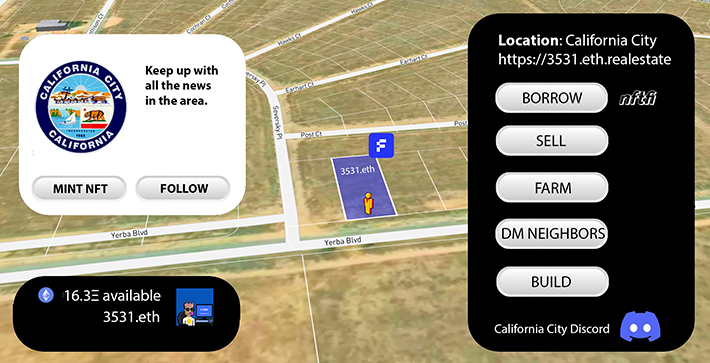
Although I’ve counted six properties in California City that are immediately identifiable as NFTs, it’s hardly the only place in the United States where this is being done. Properties available for sale as NFTs as of this writing include locations across Colorado, Arizona, New Mexico, San Bernardino-CA, and even Orange, New York. Some are very remote and speculative, while others are a part of normal civilization and priced accordingly. Buyer beware of course given the serious nature of these assets.
Perhaps one of the biggest obstacles to understanding how this is all possible is the widespread misconception of what NFTs are. Most of the American population lives under the mistaken impression that NFTs are cartoon art pictures like Bored Apes or CryptoPunks that were all the rage in 2021 and to some extent are still popular in niche circles, but almost anything can be tokenized. More recently, for example, domain names are being converted into NFTs to facilitate faster sales and quicker payouts. The same is true now here with land. Not only can land ownership change hands in the blink of an eye by transferring the NFT but one can also easily tap into the value by pledging it on a peer-to-peer NFT loan marketplace like NFTfi. Fabrica officially announced a partnership with NFTfi this past December, for example. The possibilities are endless
For the perpetual skeptics of all things blockchain that are convinced real business will only ever be done in the real world, a visualization of an NFT on a crypto wallet app might not be all that convincing, especially if the icon for it is situated right next to one of those expensive monkey pictures that kids wouldn’t shut up about years ago. The proof then is in the adventure. With a drive of less than two hours from Downtown Los Angeles, there’s a little plot of land on a quiet street known as Yerba Boulevard. It’s covered in weeds and reddish soil. Empty plains make up most of the backdrop but the suburbs are very slowly creeping their way there. In fact, I’ve since learned who my neighbor is across the street. It’s a 26,000 square foot cannabis facility that was just built in 2022. I bet the owners would be into NFTs (😂). Since that facility is up for sale, numerous 3D surrounding views exist of my plot. Turns out I can even walk to the airport. It’s not much but it’s home to me and all I could afford for the purpose of this story and learning what it was all about. Maybe those 400,000 planned residents will eventually want my land and it’ll make me a millionaire. Ah the allure of California City.
Dedicated Financial GBC Announces Office Relocation and Appoints Jay Keckhafer as President
February 9, 2024Shoreview, Minnesota – February 9, 2024 – Dedicated Financial GBC, a leader in the financial services industry, is proud to announce two significant milestones in its growth. The company has recently relocated its office from Roseville to Shoreview, Minnesota, and concurrently, Jay Keckhafer has been appointed as the new President of Dedicated Financial GBC, effective January 2024.
The decision to move to a spacious 15,000+ square foot building from the previous 3,000 square foot location is in response to Dedicated Financial GBC’s remarkable growth. The company has tripled in size, necessitating a larger facility to accommodate expanding teams and enhance capabilities in first-party servicing, third-party collections, litigation management, bankruptcy servicing, account scoring, and asset management services.
Founder and CEO, Shawn Smith, emphasized the strategic nature of the relocation, stating, “This move supports our expanding team and aligns with our commitment to meeting the rising demands of our clients. We are excited about the enhanced workspace that will not only increase productivity but also prioritize the well-being of our dedicated team members.”
The new office space is designed with employee engagement in mind, featuring sit-stand desks, larger common spaces, additional meeting rooms, offices, and amenities. Dedicated is also actively undertaking initiatives to brand the interior of the office, contributing to the development of a robust and vibrant company culture.
Most notably, Dedicated Financial GBC is excited to announce the appointment of Jay Keckhafer as its new President. With over two decades of experience, Jay brings a wealth of expertise to his new role, having served as the Executive Director of Operations and Legal Outsourcing for the past six years. His extensive career includes notable roles such as Director of Collection Operations at OPTIO Solutions, LLC, and Director of Collections at AscensionPoint Recovery Services.
As president, Jay will oversee the strategic direction and day-to-day operations of Dedicated Financial GBC, leveraging his skills in business analysis, operations management, financial analysis, and business strategy. His leadership is expected to drive the company’s growth and success in the financial services industry.
Shawn Smith, founder and CEO, expressed his excitement about Jay’s appointment, stating, “We are grateful to have Jay Keckhafer as the President of Dedicated Financial GBC. His background in operations, legal outsourcing, and business operations makes him the perfect leader to guide Dedicated to new heights. We look forward to the innovative strategies and insights he will bring to our team and the leadership he will bring in support of our mission to use business to make the greatest impact on people in need locally and globally.”
Dedicated Financial GBC remains committed to providing unmatched financial services to its clients. The office relocation and Jay Keckhafer’s appointment as President mark a monumental moment in the company’s journey as it expands its capabilities and solidifies its position as a leader in the industry.
About Dedicated Financial GBC:
Dedicated Financial GBC shatters the stereotype of a financial services portfolio management company by providing innovative financial and asset solutions to commercial funders. As a single resource, Dedicated offers a complete range of services to the financial sector, including portfolio servicing, first-party solutions, collections, equipment remarketing, voluntary and involuntary repossessions, litigation and bankruptcy management, account scoring, and consulting. Dedicated Financial GBC’s values are grace, growth, significance, and excellence. They drive their mission of using business to change the world on a local and global scale and drive their team toward success for their clients. For more information, please visit dedicatedgbc.com.
PayPal Reiterates Tightening of Business Lending Originations
February 8, 2024 After announcing a sudden pullback on business loans and MCAs in Q3 due to higher than expected charge-offs, PayPal maintained that the belt was still tightened in Q4.
“We have taken a prudent and active approach to managing our overall credit risk, tightening originations within our PayPal business loans portfolio,” said PayPal CFO Jamie Miller on the quarterly earnings call. “We are carrying lower credit receivables after tightening originations last year.”
Tightened originations has led to the company being dethroned as the top online unsecured small business lender. PayPal at the very least held that notable distinction in 2019 and 2020 but they’ve since been overtaken by Square Loans and Enova.
The Story Behind the Broker Battle Champion
January 26, 2024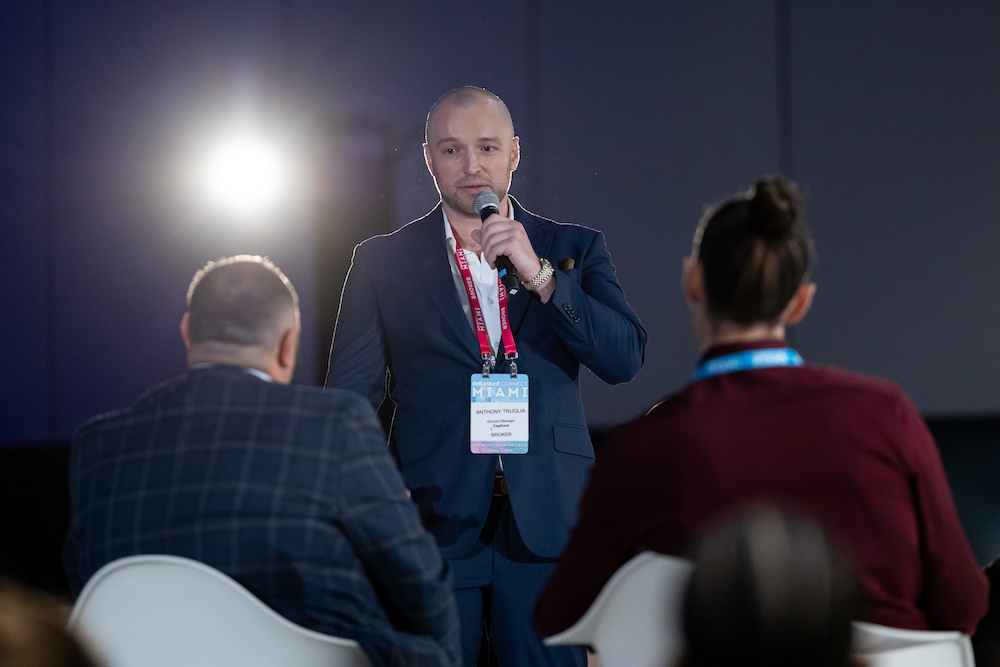 “I think I’m the best because I understand my clients very, very well,” said Anthony Truglia, an Account Manager at CapFront. “I listen to them, I ask the right questions, and I really try to dive very deeply into what it is the problem that they’re facing, and I try to find a solution to it to the best of my abilities.”
Truglia uttered these lines in a calm baritone voice on the red carpet at AltFinanceDaily CONNECT MIAMI just hours before the inaugural Broker Battle in which he had been accepted as a contestant. The contest was designed to showcase the top brokers taking real but hypothetical questions and applying their knowledge live on stage.
At the time, Truglia had no idea how it was going to be conducted, not to mention that the other highly qualified contestants had also projected equally similar confidence in the likelihoods that they were going to win. It was anyone’s game at that point and the suspense was palpable. There had never been anything like it.
“I’m definitely going to be watching that,” said Manny Yosipov of Advanced Recovery Group during a show floor interview before it took place. “I’ve never seen a broker battle, never heard of a broker battle.”
“Broker Battle is huge because it shows the level that you can reach of talking to these clients, dealing with objections, and just selling in general,” said Joshua Hillian, Creative Director at Advance Funds Network. “I think a lot of people have the wrong idea of sales–but at the end of the day it’s question-based, customer focused, and that’s what it’s about.”
Hillian’s colleague Irving Betesh was slated to go first in the Battle later that evening. Betesh, like others, said that they had been preparing for this day well in advance. There was an overwhelming desire from all of them to showcase not only their technical knowledge but also their friendly diagnostic qualities. This was an educational opportunity for everyone.
 When it finally kicked off, Truglia and Betesh squared off against fellow contestants Corey Digi, Stanley Mitchell, Danielle Rivelli, and Mike Brooks.
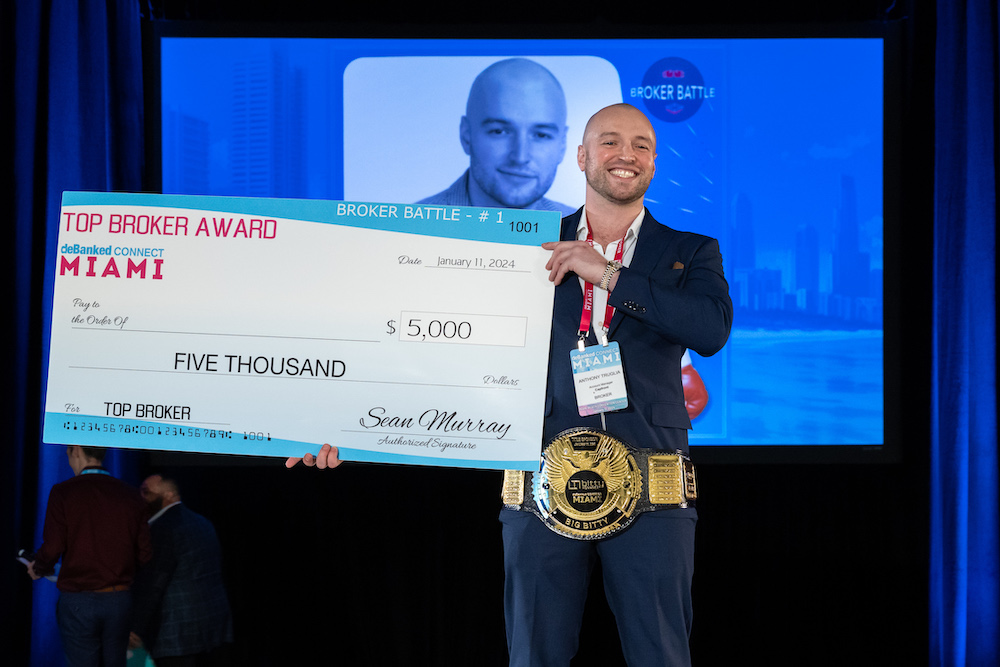
By the time Truglia went on stage, which was last in the order, the four judges and thousands in the audience had already heard five impressive performances. But Truglia delivered, earning a near perfect score that sent him to the final championship round against experienced veteran Danielle Rivelli. And when that close matchup was completed, he found himself wearing a gold belt and holding a big check that duly crowned him as the Top Broker.
For those that didn’t know him, Anthony Truglia was simply the man that had put on the most impressive performance, an Account Manager at CapFront who won the hearts and minds of his peers. AltFinanceDaily wanted to know more as he was little known to the editorial team until the day of his victory. It turns out he’s got an interesting story.
Anthony Truglia
Truglia was born and raised in Stamford, Connecticut and got his education at Lawrence University in Appleton, Wisconsin. He interned for a paper company that he said was reminiscent of Dunder Mifflin in the hit sitcom The Office, where he got a taste of doing sales. There, he discovered his own inner drive but paper was not the business he wanted to be in. “I was very young and I’ve always been very ambitious, always trying to accomplish something,” he said. After that he aimed big and actually launched his own coffee business, which ultimately didn’t pan out. Truglia followed that up with real estate, which he enjoyed, until he met someone that changed everything for him, a mentor that was making a name for themselves in the world of small business financing.
 “See, I know most people when they get into this industry they’re just thrown into the gauntlet, they maybe have a team lead that gives them some supervision and some pointers, maybe you go through like a training for a month with a group of people, but I actually got one on one training with Justin Friedman,” Truglia said. Friedman, as one might already be familiar, is currently the Head of Sales Training & Development for Enova International, the parent company of one of the largest small business lenders in the country. At the corporate level, one could confidently say that he is among the best of the best.
That was in 2018 for Truglia, where that one-on-one training included roleplay rehearsals, ones that eventually resembled the format of the Broker Battle he’d partake in nearly six years later. Truglia’s career has led him to CapFront. He speaks incredibly highly of the company and its CEO Zack Fiddle. If one suspected that Truglia’s time in the business had led him to slow down or retreat to back-office work, they’d be wrong. Truglia says that he’s on the front lines making about 150 customer calls per day on average.
“…my job is to contact [inquiring clients] as soon as possible to get a feel for whether they’re interested, if they’ve already been funded or not, but also just trying to figure out what it is they’re trying to accomplish really, try to gauge their urgency, gauge what their comfortability is, and see if we can find something that they will be comfortable with,” he says. “But also it’s a fine line because people’s aspirations are oftentimes not anywhere close to what they qualify for. And unfortunately, not a lot of people are aware of what lenders look for so that’s where we come into play.”
To get ready every morning to do this job he’s up at 6am and off to the gym before he even has his first cup of coffee. Then it’s game time, a lifestyle he’s accustomed to that doesn’t require anything else to pump him up.
“I’ve just gotten to that point where I’m very confident I know what I’m talking about. I’ve heard every question asked and I just practice it so daily that [outside motivation] is not really needed anymore,” he says.
Truglia is also confident that the type of role he fulfills is here to stay, that even lurking AI technologies are not something to fear.
“I definitely think that AI is not going to take away sales jobs because I’m one of those people that thinks that people enjoy talking to human beings. They don’t like talking to robots,” he says. “I think there’s something about—even if [an AI] sounded good, and you know it’s not really a human deep down, there’s no connection. So there’s no loyalty generated. I think people naturally like to talk to people, they like the personal connections relationship.”
 But in real life, one might not be the only person that a potential client is considering and how they make a final decision to move forward could entirely depend on the best vibe that they feel.
“I always tell clients, ‘check out our company, myself on Trustpilot’ and stuff like that, do they always do that? Sometimes, not always. But from a psychological standpoint, I think a lot of times it comes down to how professional you are, how polished, your tone—just the chemistry that you can develop in that first call is what usually decides if this is somebody that you enjoy speaking to.”
This entire thought process ultimately played out on stage where his approach, one which included warmly thanking the judges for their imaginary call and the reaching in for a fist bump to close a deal, wooed the judges in his favor.
“[My team was] all very ecstatic for me,” he says. “And I thank them very much deeply for it. They were certainly rooting for me.”
The Top Small Business Funders Now Vs. Then
January 11, 2024Top Small Business Funders By Year
| 2008 | 2014 | 2023 |
| AdvanceMe (CAN Capital) | OnDeck | Square |
| First Funds | CAN Capital | Enova (OnDeck / Headway) |
| Merchant Cash and Capital (BizFi) | Kabbage | Shopify |
| BFS | Kapitus | PayPal |
| AmeriMerchant | Rapid Finance | Amazon |
| GBR Funding | National Funding | Intuit |
Many people look at 2023 vs 2008 and arrive at the conclusion that the fintechs rose to the top, but if one were to narrow down the definition of those players a little further, they’d notice that PayPal and Square are payment companies, Shopify and Amazon are e-commerce companies, and Intuit owns the Quickbooks accounting software. These are actually older companies that took an old idea (split-funding) and made it new again with some key changes. Although in the present moment it may feel like some of them cannot be beat (which is how the industry felt about the top funders in 2008), much can change over the course of this decade.
Keep your eye on:
- AI
- Blockchain (as payment rails, record-keeping)
- Regulation