
Lendio Announces Record Fourth Quarter and Fiscal Year in 2016, Executive Promotions
February 8, 2017Lendio, the nation’s leading marketplace for small business loans, today announced that it helped facilitate more than $70 million in financing through its marketplace of more than 75 small business lenders during Q4 2016. The figure represents a 68 percent increase in loans originated through the Lendio platform over Q4 2015. In the last fiscal year, Lendio facilitated more than $240 million in funding, a 87 percent increase over 2015.
The company also announced the promotions of Jim Granat to president and chief revenue officer and Trent Miskin to chief growth officer. Granat formerly served as chief operating officer and Miskin as chief technology officer.
Q4 Highlights:
- Lendio raised $20 million in funding led by Comcast Ventures and Stereo Capital
- More than 3,300 small businesses funded in Q4, including in all 50 states
- Record number of repeat customers – 111 percent year-over-year deal growth from Q4 2015
- Added six new lenders to its marketplace, including: FundingCircle, Able Lending, and Internex
“We are extremely pleased to report a strong year-end performance and look forward to continued success in the months and years to come,” said Brock Blake, founder and CEO of Lendio. “These robust numbers put us in an even better position to help small business owners acquire funding. Looking ahead, we will continue to focus on investing in a superior customer experience, loan application automation, efficient processes and talented personnel that will help simplify small business lending.”
Lendio’s financial performance is the result of helping small business owners across the U.S. gain access to capital. Becca Grider and Lindie Royall of Little Poppy Co., a bow subscription for little girls, needed funding to manage the rapid growth of their company (20 percent month over month). “We started looking online at different options for funding and quickly realized that Lendio was our best choice,” Royall said. “We submitted our information online, they contacted us and showed us our different loan options. We got $75,000 through alternative lending, and because we now have the money on hand, it will help us keep our growth going.”
About Lendio
Lendio is a free online service that helps business owners find the right small business loans within minutes. The center of small business lending, our passion is fueling the American Dream by uniting the small business loan industry and bringing all options together in one place, from short-term specialty financing to long-term low-interest traditional loans. Our technology makes small business lending simple, decreasing the amount of time and effort it takes to secure funding. More information about Lendio is available at http://www.lendio.com.
AltFinanceDaily Begins 2017 With Thickest Magazine Issue Ever
February 8, 2017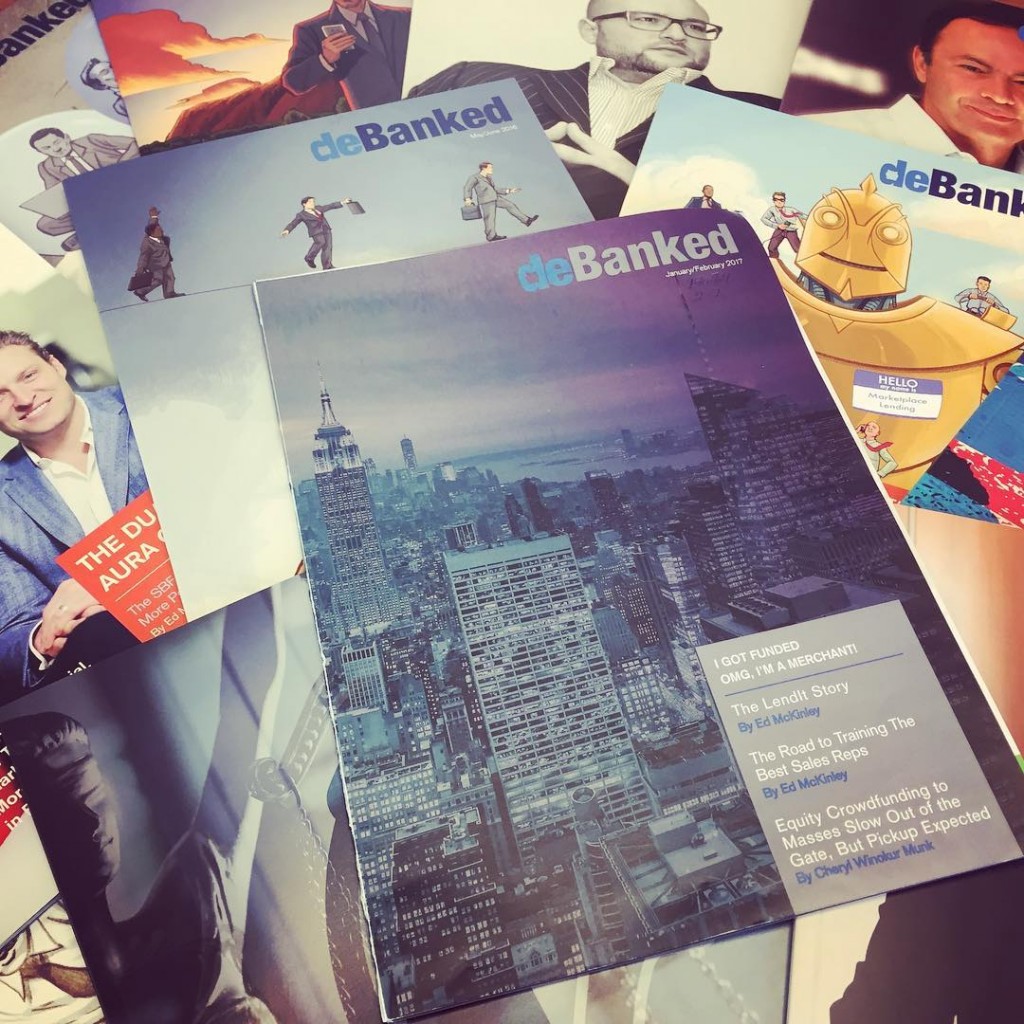 Forty-eight pages. That’s how thick AltFinanceDaily’s January/February 2017 edition is. As the wider industry heads to the LendIt Conference in NYC next month, we decided it was only fitting to feature the city that never sleeps on the cover.
This issue delves into Equity crowdfunding, the story behind the LendIt Conference, and what it’s like to actually be a merchant getting a business loan from one of today’s fintech lenders. There’s more of course, so if you’re not already subscribed, you’ll want to make sure to do that now so that you receive this and future issues FREE.
AltFinanceDaily’s chief editor Sean Murray is a LendIt awards finalist for best journalist coverage. And while there are already 30 pre-selected judges who will decide the outcome, we would like to thank everyone that has supported us and made our publication possible.
In the meantime friends, stay fresh, stay fintech, stay AltFinanceDaily. The future of finance depends on it.
We’ll see you at the Javits Center for LendIt on March 6th and 7th. If you join the Small Business Lending track, you’ll actually be able to grab a copy of this issue at the conference.
What Shakeout? Breakout Capital Secures $25 Million Credit Facility
February 8, 2017 Put a tally up on the board for small business lenders in 2017. McClean, VA-based Breakout Capital, which just announced a move into a larger office last week, has also secured a $25 million credit facility with Drift Capital Partners. Drift is an alternative asset management company.
Breakout is young by today’s industry standards, founded only two years ago by former investment banker Carl Fairbank, who is the company’s CEO. And don’t count them out just because they’re not in New York or San Francisco. Washington DC’s Virginia suburbs have become somewhat of a hotspot for fintech lenders. OnDeck, Fundation, StreetShares and QuarterSpot all have offices there, Fairbank points out. “And Capital One is right up the street,” he adds while explaining that the community has a strong talent pool that is familiar with creative lending. Breakout has already grown to about 20 employees and they’re still growing, he says.
Fairbank considers Breakout to be a more upmarket lender, whose repertoire includes serving the near-prime, mid-prime customer. CAN Capital and Dealstruck had focused on this area and both companies stopped funding new business in 2016. As I point this out, I ask if that suggests that segment is perhaps too difficult to make work.
“Candidly, that’s the part of the market that I feel the best about,” he says matter of factly. The company tries to product-fit deals based on the borrower, and will even make monthly-payment based loans. “I think the subprime side with the stacking and the debt settlement companies is a very very difficult place to play right now,” he says, adding that they have worked with subprime borrowers using their original bridge program but that they’ve kind of pulled back from doing those. As with all programs regardless, their goal is to graduate merchants into better or less costly products later on. We have helped merchants move on to get SBA loans, he maintains.
That all sounds very hands on, and part of it is, Fairbank confirms while asserting that technology does indeed do a lot of the legwork. “There’s absolutely a human element to underwriting these deals,” he says. He also agrees with much of what RapidAdvance chairman Jeremy Brown wrote in a AltFinanceDaily op-ed titled, The New Normal. Both Breakout and RapidAdvance refer to themselves as technology-enabled lenders, an acknowledgement that tech is a component of the company, not the entire company itself.
“I think we will see the beginning of the demise of fully automated, no manual touch funding,” Brown wrote in his article.
Brown also predicted that the legal system will ultimately impose order on some industry practices like stacking or that a state like New York could take a public policy interest in products he believes have legal flaws. As he was writing that, Governor Cuomo’s office published a budget proposal that redefined what it means to make a loan in the state. And it leaves much to be desired, some sources contend. Two attorneys at Hudson Cook, LLP, for example, published an analysis that demonstrates how its wording is ambiguous and far-reaching.
“What they really need to do is take the time to think through the implications and basically do a full study of the market to ensure that what they’re pushing forward is going to have the desired consequences,” Breakout’s Fairbank offers on the matter.
This doesn’t mean he’s anti-regulation. The company already holds itself to high standards and customer suitability and is a founding member of the Coalition for Responsible Business Finance.
“I personally do believe that there’s bad forms of lending or cash advances in the market and I’m sure that’s what Cuomo thinks as well but at the same time, it’s getting pushed very quickly and they really really ought to step back and do the research to understand the broader implications and to understand what exactly they’re trying to accomplish,” he maintains.
His pragmatism extends to the OCC’s proposed limited fintech charter, which he finds intriguing, assuming it gets buttoned up. “I believe it’s a concept worth pursuing,” he says, explaining that regulators will need to get comfortable with unsecured lending.
In the meantime, he’s optimistic about Breakout’s prospects. “In a time when institutional appetite for alternative finance companies has dried up, we believe our ability to raise a credit facility in this market speaks volumes about what we have already accomplished, our position as a leading player in the space, and our prospects for strong, but measured, growth,” Fairbank is quoted as saying in a company announcement. The company was also invited and joined the Task Force for the PLUM Initiative, a collaboration between the U.S. Small Business Administration (SBA) and the Milken Institute to more effectively provide capital to minority-owned businesses throughout the United States. The Task Force consists of a very select group of industry leaders, who are in positions to improve access to capital in underserved markets, according to the announcement.
While other companies are making adjustments or in his opinion, continuing to make questionable underwriting decisions, Fairbank thinks his formula for success works. “I think that we do look at deals differently than most folks because I intentionally built the core of my underwriting team with folks who are not from this space so they take a more traditional approach and mix it with some of the greatest aspects of alternative finance.”
Analysis: New York’s Lender/Broker Licensing Proposal
February 7, 2017
New York Governor Andrew Cuomo’s proposed budget includes a legislative proposal to “allow the Department of Financial Services (“DFS”) to better regulate the business practices of online lenders.”1 This legislation, which would amend Section 340 of the Banking Law, could have a dramatic impact on lending and brokering loans to New York businesses, as such lenders would have to obtain licenses to engage in business-purpose lending and could only charge rates and fees expressly permitted under New York law.2 It may impact the secondary market for merchant cash advances. If passed, the licensing requirements will take effect January 1, 2018.
The proposed law would amend NY Banking Law § 340 to require anyone “engaging in the business of making loans” of $50,000 or less for business or commercial purposes to obtain a license. The term “engaging in the business of making loans” means a person who solicits loans and, in connection with the solicitation, makes loans; purchases or otherwise acquires from others loans or other forms of financing; or arranges or facilitates the funding of loans to businesses located or doing business in New York.
Although the proposed law would require a license only for a person who “solicits” loans and makes, purchases or arranges loans, the DFS takes the position that the licensing law (as currently enacted) applies broadly and that “out-of-State entities making loans to New York consumers . . . are required to obtain a license from the Banking Department.”3 As a result, there is probably no exemption from licensing for a person who does not “solicit” loans in New York.
The potential impact of the legislation is significant.
Potential Impact on Lenders:
Licensing Required and Most Fees Prohibited. New York law already requires a lender to obtain a license to make a business or commercial loan to individuals (sole proprietors) of $50,000 or less if the interest rate on the loan exceeds 16% per year, inclusive of fees. The proposed law would require any person who makes a loan of $50,000 or less to any type of business entity and at any interest rate to obtain a license. And a licensed lender is governed by New York lending law that regulates refunds of interest upon prepayment;4 and significantly limits most fees that a lender can charge to a borrower, including prohibiting charging a borrower for broker fees or commissions and origination fees.5
Essentially, the DFS will regulate lenders who originate loans to businesses of $50,000 or less in the same manner as consumer loans of less than $25,000. The proposed law would exempt a lender that makes isolated or occasional loans to businesses located or doing business in New York.
Potential Effect on Choice-of-Law. The proposed law could lead courts to reject contractual choice-of-law provisions that select the law of another state when lending to New York businesses. With new licensing requirements and limits on loans to businesses, a court could reasonably find that New York has a fundamental public policy of protecting businesses from certain loans, and decline to enforce a choice-of-law clause designating the law of the other state as the law that governs a business-purpose loan agreement.
For example, the holding of Klein v. On Deck6 might have come out differently if New York licensed and regulated business loans at the time the court decided it. In the Klein case, a business borrower sued On Deck claiming that its loan was usurious under New York law. The loan contract included the following choice-of-law provision:
“[O]ur relationship including this Agreement and any claim, dispute or controversy (whether in contract, tort, or otherwise) at any time arising from or relating to this Agreement is governed by, and this Agreement will be construed in accordance with, applicable federal law and (to the extent not preempted by federal law) Virginia law without regard to internal principles of conflict of laws. The legality, enforceability and interpretation of this Agreement and the amounts contracted for, charged and reserved under this Agreement will be governed by such laws. Borrower understands and agrees that (i) Lender is located in Virginia, (ii) Lender makes all credit decisions from Lender's office in Virginia, (iii) the Loan is made in Virginia (that is, no binding contract will be formed until Lender receives and accepts Borrower's signed Agreement in Virginia) and (iv) Borrower's payments are not accepted until received by Lender in Virginia.”
The court concluded that this contract language showed that the parties intended Virginia law to apply. However, the court also considered whether the application of Virginia law offended New York public policy. The court compared Virginia law governing business loans against New York law governing business loans, and decided that the two states had relatively similar approaches. As a result, the court found that upholding the Virginia choice-of-law contract provision did not offend New York public policy.
The loan amount in the Klein case was above the $50,000 threshold for regulated loans in the proposed New York law, so this exact case would not have been affected. However, the court’s analysis in the Klein case would have been the same for loans of $50,000 or less. Accordingly, the new law could cause a New York court to reject a contractual choice-of-law provision.
Effect on Bank-Originated Loans. This proposed law apparently would not directly affect loans made by banks that are not subject to licensing under the statute.7 But, the law would require non-banks that offer business-purpose lending platforms that partner with FDIC-insured banks to obtain a license to “solicit” loans. And, it is possible, that the DFS could later, by regulation or examination, prohibit such licensees from soliciting loans at rates higher than permitted under New York law.
Potential Impact on Merchant Cash Advance Companies:
The proposed law imposes a license requirement if a person “purchases or otherwise acquires from others loans or other forms of financing.” New York law does not define the term “other forms of financing.” However, the DFS may consider merchant cash advance transactions to be a regulated transaction for which licensing is required.
As written, only purchasing or acquiring other forms of financing, such as a merchant cash advance, might require a license. As a result, the proposed law only has the potential for affecting the sale and syndication of merchant cash advances. It is unclear whether buying only a portion of a merchant cash advance, or “participation” could require a license, or if only purchasing the entire obligation could require a license.
Potential Impact on Brokers:
Because the new law would require a license to “arrange or facilitate” a business loan of $50,000 or less, ISOs and loan brokers would need a license. As mentioned above, a licensed lender is prohibited from charging broker fees or commissions. It is not clear at the moment whether an ISO or loan broker could contract directly with the borrower for a commission.8
1 See https://www.budget.ny.gov/pubs/executive/eBudget1718/fy18artVIIbills/TEDArticleVII.pdf, page 243. Although not discussed in this article, the proposal would also impose new licensing requirements on certain consumer lenders.
2 A licensed lender may impose a rate in excess of the 16% civil usury limit in New York, but is still subject to the 25% criminal usury limit. See, New York Banking Law § 351(1) and New York Penal Law § 190.40.
3 See http://www.dfs.ny.gov/legal/interpret/lo991206.htm The term “solicitation” of a loan includes any solicitation, request or inducement to enter into a loan made by means of or through a direct mailing, television or radio announcement or advertisement, advertisement in a newspaper, magazine, leaflet or pamphlet distributed within this state, or visual display within New York, whether or not such solicitation, request or inducement constitutes an offer to enter into a contract. NY Banking Law § 355.
4 NY Banking Law § 351(5).
5 NY Banking Law § 351(6).
6 Klein v. On Deck Capital, Inc., 2015 N.Y. Misc. LEXIS 2231 (June 24, 2015).
7 See NY Banking Law § 14-a; 3 NY ADC 4; NY Gen. Oblig. Law § 5-501.
8 See NY Gen. Oblig. Law § 5-531 that limits fees that brokers can charge on non-mortgage loans to not more than 50 cents per $100 loaned.
Katherine C. Fisher is a partner in the Hanover, MD office of Hudson Cook, LLP. Kate can be reached at 410-782-2356 or by email at kfisher@hudco.com.
Introducing LendingRobot Series: One-Stop Investing in Alternative Lending
January 26, 2017January 26, 2017 – Seattle, WA – LendingRobot, the first robo-advisor for Alternative Lending built for individual investors, announced today the launch of robo-fund LendingRobot Series. Designed as an alternative to traditional fixed income investments, LendingRobot Series is a one-stop solution that combines cloud-based investment automation, fully transparent fund secured by Blockchain technology and sophisticated machine learning algorithms to provide superior, predictable returns uncorrelated to stock market performance.
LendingRobot Series is a unique combination of a robo-advisor and an investment fund, created as one-stop solution for accredited investors looking for a way to easily invest in consumer, small business or real-estate loans diversified across multiple ‘peer lending’ origination platforms.
“Alternative lending proved to return excellent performance and with new origination platforms growing quickly comes the opportunity to diversify further. But fragmentation makes investing even more complex for individual investors” said Emmanuel Marot, CEO of LendingRobot.
Unlike a traditional fund, LendingRobot Series improves liquidity, is flexible with regards to loan selection, and 100% transparent. Investors decide what kind of risk and time horizon they want, and LendingRobot automatically manages their investments.
Hedge Funds typically charge management fees of 2% plus 20% of performance, plus obscure or unlimited fund expenses, which makes their expense ratio disproportionate to fixed income returns. In contrast with traditional investment firms, LendingRobot Series only charges 1.00% of assets under management, and caps fund expenses at 0.59%.
“Turmoil within the past twelve months among some of the largest origination platforms showed that ‘platform risk’ is real, and left many clients increasingly worried about investing only in unsecured consumer loans despite the fact that the returns have remained steady,” continued Mr. Marot. “All investors would be well served by diversifying into multiple marketplaces, but that process is tedious, complicated, and requires a high degree of domain expertise to accomplish correctly. That’s why we’ve created LendingRobot Series: to provide investors that understand the value of investing in Alternative Lending with the confidence that comes from intelligent automation, easy liquidity, and complete transparency.”
LendingRobot manages investments across four different Series, with target maturity going from 20 to 36 months, and net returns up to 9.66%. Investor’s money is converted in Units of ownership in these Series, that are issued on a weekly basis. By default, loans payments keep being re-invested and the Units value increases. LendingRobot publishes every week a detailed ledger of its holdings, down to the value and individual payments made by each note.
A ‘Hash code’ signature of the ledger is integrated in the subsequent versions as well as notarized in Ethereum’s Blockchain to ensure the data is tamper-proof.
To ensure maximum safety, assets are hold in a bankruptcy protection vehicle, with no other liabilities than its investors.
Investors willing to cash simply flip a switch on the LendingRobot website to start redeeming their Units on a weekly basis. Between 33% and 100% of loan payments are distributed in priority for redemption, which means that under normal circumstances investors should be able to cash out entirely in less than 3 weeks.
Investors interested in learning more about LendingRobot Series can visit www.lendingrobot.com/series.
About LendingRobot:
LendingRobot is a fully automated investment service for alternative lending platforms including Lending Club, Prosper and Funding Circle. After signing up for a LendingRobot account, investors select their risk tolerance and enable LendingRobot to instantly make investments on their behalf. Based in Seattle, Washington, LendingRobot serves 6,500 clients totaling over $120M in assets.
The New Normal
January 24, 2017 In March 2014, I wrote the following for DailyFunder.com: I think we are either currently in, or are fast approaching a “market bubble” in MCA. Bubbles never end well…When I see some of the business practices, offers, terms and other aspects of our business today, I am worried…assets are being overpaid for through higher than economically justified commissions …and [funders are] stretch[ing] the repayment term of the MCA or loan even further. I went on to say that this felt to me an awful lot like the subprime mortgage meltdown of 2008.
Like all good bear market prognosticators, I was a touch early in my forecast. 2014 and 2015 were continued boom years for small business alternative lenders (or “small business Alt Lender.” I don’t agree with applying the moniker “online lender” for our industry. It might be sexy, but it’s not accurate.) Loan and MCA terms got longer, loan pricing to the client dropped further, companies grew 100% year over year. And then 2016 happened.
The most shocking event for me in 2016 was the disruption at CAN Capital. They had the most data, the most experience, market dominance, and the most in-depth institutional knowledge. The granddaddy of all of us. Not far behind is the fiasco that is On Deck, the only publicly traded small business Alt Lender. In the past 12 months alone, the stock price has declined by over 40%. And that is after a roughly 50% drop in stock price in 2015. The first 9 months of 2016, driven in part because of market required changes to their business model when they could no longer profitably sell a sufficient volume of loan originations, they have a GAAP net loss of almost $50 million. There have also been a number of other lesser but still high profile failures, shutdowns, and exits from the industry in the past several months alone.
So what is driving this abnormally high rate of failure in the Alt Lending industry? Is it the “New Normal?” And what do I think lies ahead in 2017 and beyond? Before revealing my personal crystal ball again, I will share an anecdote from earlier in my business career.
I was the CFO (and eventually CEO) of a profitable, long-tenured family owned construction company. We had a working capital credit line from a major bank secured by a first position lien on our accounts receivable. The credit line was also personally guaranteed. We borrowed from the credit line for three reasons. For cash flow, when our receivables paid more slowly than expected; we had tax payments due; or we purchased a large piece of equipment. We always paid back the draw on the credit line as quickly as we could, to keep interests costs low, to impose cash management discipline, and to create future availability on the line once repaid.
 The credit line was for one year. It was always renewed. But I was frustrated to have to go through an annual underwrite process with our bank, despite the personal guarantee, consistent profitability, and that we always paid back our draw on the credit line. Our banker (patiently) explained to me that economic cycles changed, and medium sized businesses – we had about 200 employees – suffered ups and downs and sometimes became financially distressed and even went out of business. The bank wanted to protect their position and not overextend the term of the credit line.
When I started RapidAdvance in 2005, I drew on my personal knowledge and previous experience as a borrower. The products we offered made sense based on our customer profile which was main street small business. We needed to protect against economic cycles and the high rate of small business failure. The maximum term offered by any company in 2005 was 8 months, at that time only for an advance product (future purchase and sale of credit card receivables), not a loan. Payment was received daily through a credit card split, thus allowing for a future capital advance (renewal) within about five or six months as the open advance was paid down. Cash advances could be used for taxes, equipment purchases, or business expansion. The price of the product reflected the risk of the credit offered.
What many in the small business Alt Lending industry seem to have forgotten, or never learned, is that our business is fundamentally a subprime credit industry. We are either lending to subprime borrowers, because of either the personal credit of the owner or the balance sheet of the borrower, or if the credit is strong and the business is more substantial, the loan itself is a subprime risk because we are at the bottom of the capital stack – behind the bank loan, the business property mortgage loan, the other personal guarantees of the owner, the factoring company, etc. We are taking the most risk. To offer two and three year terms and to try to pretend to get to “bank like” rates is, in my opinion, committing lending suicide.
At Rapid, we were dragged kicking and screaming into slightly longer term and lower cost products in order to stay competitive with certain customers. But we have kept that pool of customers as a very small percentage of our overall receivables.
Going into 2017 and beyond, I see five major trends. First, terms will get shorter, prices will increase, and offers will become more rational. That is already happening. Second, capital to this industry will become less available. The best companies with proven data driven models, consistent underwriting, a strong balance sheet and predictable loss rates will get financed. The days of easy money chasing this space are over. Equity will be particularly hard to come by.
Third, there will be continued disruption of funding companies. Companies will consolidate and some will disappear. On Deck may be in for a big challenge. They had a tremendous cash burn converting their business model to more balance sheet financed instead of originating and selling loans. Their market cap today is approximately book value, i.e. if you could buy up all the shares of the company at today’s trading price that would be roughly equal to their cash on the balance sheet and the value of their net receivables. The next two quarters are crucial for them to show the market they have turned the corner to become a self-sustaining lender. I am not optimistic, but I am rooting for them to succeed as it is in the best interests of the industry.
 Fourth, stacking will continue to be an issue. I believe that the legal system over the next few years will bring some semblance of order to this industry scourge. At Rapid we have taken an aggressive legal stance against stacking, with some success in the courts. The challenge is that each situation is fact specific, and to prevail in a claim of tortious interference, the first position lender has to prove damages. I think that an unrelated decision at the end of 2016, Merchant Funding Services, LLC vs. Volunteer Pharmacy in New York State, could be a game changer. Because of the form of contract and the business practices in Volunteer, the judge ruled that the transaction constituted criminal usury. Knowing the business practices of the stackers, specifically the practice of writing an agreement that pretends to be a sale and purchase of future receivables but is in fact a loan, which is the basis for the judge’s ruling in Volunteer, I can see lawyers seizing on this precedent to help overstressed small business owners attempt to void their stacked loan agreements. The small business would first block the stacker’s ACH, claim the contract is void because of criminal usury, and then sue the stacking company. There could also be class action lawsuits like we saw a few years ago in California – bundle together a number of these claimants and go after the deep pocketed investors and banks that finance the stacking companies. The State’s Attorney General in New York may take a public policy interest in these types of loans. Once the dominoes start to fall, the costs of stacking – litigation and unpaid loans, in addition to proactive claims for damages – could be enormous for both the stacking companies and their owners and investors.
 Lastly, and to my great pleasure, I think we will stop hearing small business Alt Lenders calling themselves “Fintech.” I think we will see the beginning of the demise of fully automated, no manual touch funding. At Rapid we have data and risk and pricing algorithms but we have always had an underwriter at a minimum review every file. At conferences when I have presented or participated in Fintech panels I always referred to Rapid as a technology enabled, non-bank small business lender. Now even On Deck describes themselves in similar terms.
I titled this post “The New Normal.” In the classic Mel Brooks movie Young Frankenstein, Dr. Frankenstein sends his assistant Igor to steal a brain from a cadaver to implant into his monster. But Igor accidentally drops the genius brain he was supposed to steal, and brings the doctor a different brain without telling him. When the monster awakes and has the personality of a psychotic five year old, Igor tells him he brought him a brain that was labeled “normal” instead of the one he was supposed to steal. It was, as Igor read it, “Abby Normal.” Abnormal, I believe, is the “New Normal” we will be dealing with in 2017.
CAN Capital is Changing the World’s Most Expensive Tire
January 16, 2017
Acting CEO Parris Sanz told the WSJ that what’s happening at CAN Capital right now is akin to changing a flat tire. “We hit a bump in the road and blew out a tire,” Sanz said. “We just need to change out the tire, and we’ll be back on the road.”
But sources say that the company is in the midst of trying to sell off assets including its loan portfolios to raise cash in a hurry. In the span of a few weeks the company has let go of more than half of its employees, has suspended funding new deals, put its top executives on leave, been sued by a shareholder, and suffered a rapid amortization event with its $200 million bond deal. That’s on top of a breach that the WSJ reported with CAN’s $650 million credit facility led by Wells Fargo. A spokesperson for Wells told me they could not provide any comment or information on the matter.
And CAN’s issues aren’t the result of a changing economy, but rather internal systems that couldn’t keep up with their innovations. They’ve even hired a restructuring company to assist them through this crisis. It now being more than a month and a half since the story first broke, the WSJ puts the amount CAN is trying to raise “to strengthen its financial position” at $100 million.
If this is how they go about changing a tire, it may be time they sign up for AAA Roadside Assistance. For the merchant cash advance industry, their predicament is one of the biggest events of the decade by virtue of their history, size and renown. The company has funded more than $6 billion to small businesses since they launched in 1998.
Consider that just a few months ago, CAN was seemingly riding high as it promoted its new lending transparency initiative as part of the Innovative Lending Platform Association. And in July, Sanz represented the MCA & small business lending industry in a congressional hearing dedicated to financial institutions and consumer credit.
CAN’s top competitor is OnDeck whose stock has only inched up 8% since November 29th.
A spokesperson for CAN reiterated that this was an issue that they self-discovered and self-reported. “In the absence of information, people are making incorrect assumptions,” she said. “It affected about 3% of total assets in the portfolio under our senior line. It’s a manageable situation and one we are working through as we position ourselves for success in 2017.”
Marketplace Lending Association Announces 11 New Members
January 12, 2017
WASHINGTON, Jan. 12, 2017 /PRNewswire/ — The Marketplace Lending Association (MLA) today announced the addition of eleven new companies to the Association. The new members join as the MLA works to expand its presence in Washington. The MLA was formed in 2016 by founding members Funding Circle, Lending Club, and Prosper Marketplace with the goal of promoting a transparent, efficient and customer-friendly financial system.
New Members include: Affirm, Upstart, CommonBond, Avant, PeerStreet, Marlette Funding, Sharestates, Able, and StreetShares. New Associate Members of the MLA include dv01 and LendIt.
This expansion represents a new chapter for the MLA, as it extends the group beyond consumer and small business lending to include platforms focused on student loan refinancing and real estate, as well as greater diversity of funding models, including lending platforms that hold loans on balance sheet.
“On behalf of the founding members, I welcome these new members to the Association and I look forward to working with them to advance our mutual public goals both in Washington and in state capitols around the country,” said Nathaniel Hoopes, executive director of the MLA. “As MLA member companies continue to innovate and create new opportunities for borrowers and investors, the MLA will play an important role in sharing data and insights that help educate policy makers on the benefits that these companies bring to consumers, businesses, and our financial system.”
To provide policymakers with a general overview of its 2017 agenda, the Association also today sent letters to the incoming Trump Administration and to the leaders of the 115th Congress.
ABOUT MLA
MLA, a professional trade association, was formed in 2016. The goals of the Association are to promote a transparent, efficient, and customer-friendly financial system by supporting the responsible growth of marketplace lending, fostering innovation in financial technology, and encouraging sound public policy at the state and federal level. To be eligible to join the association MLA companies must abide by the highest standards of business conduct in providing credit and services to consumers and businesses.
For more information about MLA, its members and its membership standards, visit the MLA website at www.marketplacelendingassociation.org.
Media Contacts:
Nathaniel Hoopes – Executive Director
Phone: (202) 660 1825
nat.hoopes@marketplacelendingassociation.org