
Catching Up With Online Lending – A Timeline
October 21, 20177/17
- Online lender Upgrade, launched by former Lending Club CEO Renaud Laplanche, revealed it had already hired about 100 people
- Credit risk startup James closed $2.7M funding found led by Gaël de Boissard
7/18 – Former Bizfi COO Tomo Matsuo joined iPayment as an SVP to oversee its new merchant cash advance division
7/21 – SoFi Chief Revenue Officer Michael Tannenbaum departed the company
7/27
- Lending surpassed $500M in lifetime originations
- RealtyShares acquired marketplace platform Acquire Real Estate
7/28
- Former MB Financial Bank SVP Stan Scott became VP at Gibraltar Business Capital
- Prosper Marketplace shut down its Prosper Daily (formerly BillGuard) app
7/31 – First Associates Loan Servicing announced the opening of their new 1000-seat capacity operations center in Baja California, Mexico
8/1
- Ron Suber joined Credible.com as executive vice-chairman and a member of the board of directors
- PeerStreet integrated with Personal Capital
8/2
- Lending Loop raised $2M, launched automated investment platform
- PeerIQ secured $12M in Series A round
- OnDeck partnered with Payment Source in Canada
- Bread raised $126M in equity and debt
8/3 – Kabbage secured $250M in Series F round from SoftBank Group, was valued at more than $1.25B
8/9
- Former Capital One VP Heather Tuason became Chief Product Officer at StreetShares
- PayPal acquired Swift Capital
8/10 – Coinbase raised $100M at $1.6B valuation
8/11 – Former SoFi employee raised Brandon Charles filed a lawsuit against the company alleging among other things that he witnessed sexual harassment in the workplace
8/14
- Prosper closed $500M securitization, announced $775M in Q2 loan originations, $41.4M net loss
- Bitcoin surged past $4,000
8/15 – iPayment announced the formation of its new merchant cash advance division, iPayment Capital
8/16 – Fifth Third Bank made another equity investment in ApplePie Capital, agreed to purchase loans through the company’s marketplace
8/19 – Former CFO of Credibly became president of Western Funding
8/22 – Former SoFi employees filed a lawsuit against the company over wage issues
8/23 – Ellevest raised $32.5M
8/24 – AutoFi raised $10M in Series A
8/25 – Rep. Maxine Waters called for a congressional hearing on SoFi’s bank charter application and ILC charters in general
8/29 – Snap Finance secured $100M credit facility
8/30
- IOU Financial announced Q2 originations of $26.2M (US) and a net loss of $2.08M (CAD)
- ShopKeep launched ShopKeep Capital, a merchant cash advance service
8/31 – Bizfi wound down operations, sold servicing rights to its $250M portfolio to Credibly
9/2 – Bitcoin surpassed $5,000
9/5 – Former Chief Sales Officer of OnDEck, Paul Rosen, joined CoverWallet as COO
9/6 – Square revealed that they would apply for an ILC charter, following in the footsteps of SoFi
9/7
- Former Director of External Sales at OnDeck, Jared Kogan, joined Pearl Capital as Chief Revenue Officer
- First Internet Bank announces strategic partnership with Lendeavor, Inc.
9/11
- SoFi CEO Mike Cagney announced he had resigned as board chairman and would be resigning as CEO later in the year
- Lenda raised $5.25M Series A
9/12
- Groundfloor announced $100M loan purchase agreement with Direct Access Capital
- Orchard unveiled its Deals platform
- JPMorgan CEO Jamie Dimon called Bitcoin a fraud for stupid people
9/13 – dv01 closed $5.5M Series A
9/14 – SmartBiz surpassed $500M in lifetime SBA loan originations
9/15
- Amid more negative press, SoFi CEO Mike Cagney announced he was resigning as CEO immediately
- Enova announced $25M share repurchase program
9/20 – World Business Lenders acquired strategic assets of Bizfi including the company’s brand and marketplace
9/22 – Prosper Marketplace raised $50M in a Series G round at a 70% lower valuation of $550M
See previous timelines:
5/17/17 – 7/11/17
4/6/17 – 5/16/17
2/17/17 – 4/5/17
12/16/16 – 2/16/17
9/27/16 – 12/16/16
Stacking Lawsuit Could Go to Trial
October 18, 2017 A lawsuit between RapidAdvance and Pearl Capital that has been making its way through the Maryland state court system for two years may be heading to trial.
In this case, plaintiff Small Business Financial Solutions, LLC (SBFS AKA RapidAdvance) alleged that Pearl Beta Funding, LLC (AKA Pearl Capital) interfered with a loan agreement it had with a merchant when Pearl “stacked” financial obligations to Pearl on top of the obligations the customer owed to SBFS. Ultimately the merchant defaulted and SBFS wants to hold Pearl responsible for the damages it incurred.
Pearl originally moved to dismiss the suit but was unsuccessful. Later, Pearl filed a motion for summary judgment. On September 29th, that motion was denied, with the judge opining that issues of fact remained that were best left for a jury.
Unless Pearl appeals the decision or the parties settle, the case will go to a jury.
A representative for Pearl Capital declined to comment on the decision, citing ongoing litigation.
Patrick Siegfried, Assistant General Counsel for RapidAdvance, opted to tell AltFinanceDaily the following:
“The court’s decision from many months ago to reject Pearl’s motion to dismiss and its more recent decision to reject the motion for summary judgment and permit this case to go to trial confirms the anti-stacking position RapidAdvance has consistently taken. The court’s rulings make it clear that when a funding company funds a merchant knowing that doing so is a breach of the customer’s agreement with another funder and the stacker’s funding is a substantial cause of the merchant defaulting with the other funder, its actions constitute tortious interference. As a result, the company that stacked can be held liable for the losses the original funder incurs. While the outcome at trial is impossible to predict as the court will need [to] decide whether there are sufficient facts to satisfy each element, RapidAdvance is pleased that its legal reasoning on stacking has been confirmed in a written opinion and that we now have the roadmap for pursuing others that tortiously interfere with our contracts by stacking.”
Of note, is that RapidAdvance brought this case in The Circuit Court for Montgomery County, Maryland. Few other players in the industry may be able to designate Maryland as the proper venue. The standards for tortious interference may not be the same in other states. There are many circumstances in the case not discussed in this synopsis. Consult an attorney before drawing any conclusions. YOU CAN DOWNLOAD THE FULL DECISION HERE.
The case is Small Business Financial Solutions, LLC v. Pearl Beta Funding, LLC Case No. 411478-V in the Circuit Court for Montgomery County, Maryland.
Lead Generators Facing Rougher Road
October 13, 2017 Lead generators for alternative funders are facing stronger headwinds these days. The business has gotten tougher for a whole host of reasons. A pullback in alternative lending necessitates fewer leads. On top of that, funders, ISOs and brokers have gotten pickier about the types of leads they’ll accept. What’s more, stricter application of the Telephone Consumer Protection Act (TCPA) is hampering lead generators’ ability to solicit business owners. As a result, some lead generators have faded away, while others have been developing additional business lines or are broadening their reach to other areas within financial services to buoy earnings.
“I don’t see any growth in the space for the next six months, or maybe a year,” says Michael O’Hare, chief executive of Blindbid, a lead generation company in Colorado Springs, Colorado. “It’s really unclear right now what’s going to happen, but we’ll see.”
The alternative funding industry has been in somewhat of a funk since spring 2016 when Lending Club grabbed headlines with a scandal that spooked the industry and also took out several senior managers, including the company’s then-CEO.
It was the first time in the industry’s relatively short history that people realized “it wasn’t all puppy dogs and ice cream,” says Justin Benton, a partner at Lenders Marketing in Santa Monica, Calif., a lead generator in the alternative funding space.
Since that time, there’s been a lot of movement in the market, including companies that are consolidating or exiting the business, pumping the brakes or making shifts in product lines, Benton says. These developments have all had a big impact on the sheer number of clients that are looking for leads, he says.
Late last year, for instance, CAN Capital Inc. stopped funding for several months, though it’s back in business as of early July. This summer, Bizfi, one of the stalwarts of the alternative financing space, began giving pink slips to staff and in August the company sold the servicing rights to its $250 million loan portfolio to rival Credibly.
There aren’t as many start-up ISOs or companies entering the alternative funding space—meaning more leads for existing funders—which, of course, is a boon for them.
“There are still roughly 75,000 business owners every week who meet the criteria for an [MCA]. Now instead of there being 5,000 options in the space, there are 2,000, so those 2,000 are gobbling it all up,” Benton says.
 At the same time, however, TCPA regulations have gotten more stringent, making it dangerous to solicit businesses, says O’Hare of Blindbid. “Any phone call you make, you can get sued,” he says.
Large funding companies generally take TCPA very seriously—especially if they’ve gotten hit with violations, O’Hare says. Smaller funders and brokers, however, aren’t always as familiar with the restrictions; they think it’s only an issue if you’re calling consumers, as opposed to calling businesses, but that’s not the case. “A lot of businesses today are using their cell phone as a main business line and also for personal use. If you call a cell phone that’s on the DNC [Do Not Call Registry], you can potentially get sued.”
Last year, he had a situation where a plaintiff pretended to be an interested business. When he passed along the referral, the plaintiff’s attorney claimed TCPA violations and ultimately sued the funder. The funder balked, and it created numerous issues for his company.
His company now tries to educate funders about how to protect themselves from TCPA litigation. He sends out emails to funders with information about TCPA and provides contact information of attorneys who are well-versed in TCPA rules. He also provides funders with risk mitigation tactics and shares his list of known TCPA litigators so funders won’t accidentally call them. He also provides direction to clients that receive a demand letter or complaint on how to respond and offers a list of TCPA defense attorneys, if they need.
“We’ve become almost extreme in how we try to avoid problems related to TCPA,” O’Hare says.
To be sure, some of the changes lead generators are experiencing are indicative of a maturing industry.
A few years ago, lead generators could be less selective who they approached initially because the concept of alternative funding was so new to merchants, says Bob Squiers, chief executive of Meridian Leads, a lead generator in Deerfield Beach, Fla. Now, however, the cat is out of the bag, and, with business owners getting multiple calls a day, it’s harder to get their attention, he says.
“They know, they’ve heard, they’ve been pitched. There’s not too many unturned business owners. It’s about getting them at the right time.”
As a result, lead generation today requires more data to discern the good leads from the bad. Instead of going after half a million restaurants, lead generators are targeting the 20 percent that data suggests are the most viable funding candidates. “It’s more of a sniper approach than a shotgun approach,” Squiers says.
 Rob Buchanan, senior sales executive at Infogroup in Papillion, Nebraska, who focuses on lead-generation for the fintech space, notes that within the past 18 months or so, clients have been going after “low-hanging fruit” when it comes to leads. They are looking for leads where business owners are actively looking for financing as opposed to relying primarily on UCC data. They are still using UCC data, but to a lesser extent than they were in the past, he says.
Not only do clients want very targeted and specific types of companies—but they are changing their minds more frequently about the types of businesses they’re looking for, says Matthew Martin, managing director and principal at Silver Bullet Marketing, a lead-generating and marketing company in Danbury, Conn. They might ask for businesses of a particular size or credit quality—they are even seeking to exclude businesses within certain zip codes. They are also more amenable to leads from industries they deemed too risky a few years ago.
“I have clients that are constantly changing the parameters of what they want,” Martin says.
The problem is that once you start narrowing the leads of possible merchants that can be funded, lead costs go up and many funders don’t want to pay for that, says O’Hare of Blindbid. “The glory days when everything was wide open and you could generate leads really cheaply are pretty much gone.”
Meanwhile, as some lead generators have faded into the sunset, others are forging ahead in search of new opportunities.
Benton of Lenders Marketing, for instance, says his company has started to focus its efforts in other areas of lending, including SBA, new business, mortgage, commercial, residential, auto and student loans.
Digital marketing is another area experiencing increased demand. Business owners that need money tend to use Google to find funding companies. Infogroup’s digital marketing leads these businesses directly to funders, ISOs and brokers, Buchanan says.
“More and more funders, brokers and ISOs are leaning toward doing digital marketing,” he says.
Bizfi Alum Jared Weitz Reflects on Demise of Former Employer and Rise of UCS
October 9, 2017 Jared Weitz has come a long way since his earlier days as one of the original Bizfi employees. Today he’s at the helm of online funding marketplace United Capital Source (UCS), which has been on a tear since AltFinanceDaily last spoke with Weitz a couple of years ago. The UCS founder and chief executive took some time to revisit with us about having to painfully watch the demise of his former employer, which is where he cut his teeth in this business, and the rise of his own company UCS as a funding marketplace.
In some ways, the more things change the more they stay the same. Since the last time Weitz spoke with us, the company’s location remains in the heart of Times Square in New York, and UCS has grown its staff by only four people including two sales reps. What has changed, however, is the amount of funding that the company has done and the size of the average transaction, all of which have blossomed.
“When we first spoke a few years ago we were doing $8 million to $10 million a month in funding volume. Now we are doing between $14 million and $16 million per month,” said Weitz.
He added that where the company differentiates itself is that while a few years ago the products they were selling were predominately in the sub-prime space now they sell other products, which allows merchants to “swim upstream” when they qualify for that.
The result has been bolstered partnerships and product offerings and an average loan size that has jumped from $30,000 to $40,000 per deal to a range of $500,000 to $2 million.
“We opened up the funnel to the kind of relationships we’re able to broker and the kinds of financings we’re able to offer. We’re playing in the field of SBAs, account receivables financing, lines of credit and asset backed loans. By offering these products our volume has jumped significantly and allowed us to talk to different referral partners.”
UCS does all of its own marketing and generates leads for their in-house sales reps. Those sales reps take a file from open to close and they analyze the small business owner’s needs on a consultative call.
“We understand their business and their pain points. The first question we ask isn’t how much do you need but what’s paining you in your business today that we can help you with?”
One such business owner recounted his experience with UCS to AltFinanceDaily, saying that traditional banks were “an absolute pain” to secure funding. He spoke of the “very stressful” and time-consuming process of applying for a loan, saying he doesn’t have time to “jump through a million hoops to get a loan.”
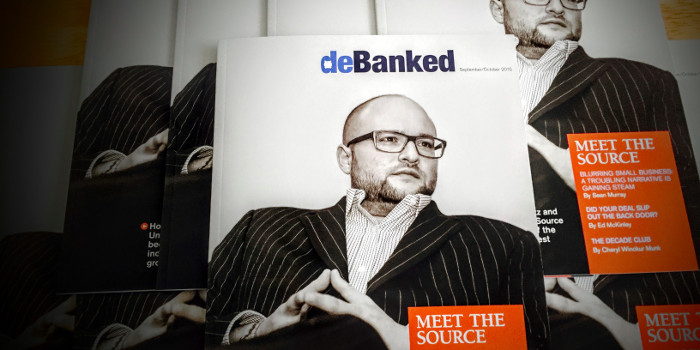
“When I was initially looking to curb my temporary cash flow problem, I searched online for the best alternatives to traditional bank loans. I read all the reviews on companies and decided to call UCS,” the business owner told AltFinanceDaily, adding that he’s been a UCS repeat customer for a number of years and is especially fond of the ease at which the process is completed.
“I could literally call Jared today and have six figures in my account tomorrow. The best part is the pay back process. They only take funds when I run credit card transactions. So, in my slow months, I don’t have to stress and worry about repaying the loan. UCS is a perfect fit for me,” the business owner said.
Eye Opener
As the seventh or eighth employee of Bizfi, Weitz really has been part of the evolution of online funding. He says the rise and fall of Bizfi has been an “eye opener” for him.
“It caused a bunch of funding companies to be a little gun shy when it comes to funding. I told my guys this too shall pass. People are shaken and wondering if it’s a larger global issue. Thankfully it’s not a global issue. There are plenty of funding companies that are well backed that are still funding. My group is well able to pick it back up. We have signed up with more funding companies to increase our offerings and make sure we have no concentration issues,” said Weitz.
And although he left the company to eventually launch UCS, which has proven to be a prudent move, he has nothing but respect for his former employer.
“My history there is very deep and I’ve got a genuine love for the founders of the company. It’s where I cut my teeth. I was really sad the day I heard they’re not funding anymore.”
In fact, Bizfi was one of the funders that UCS counted among its partners.
“We had a good book there. We started to see problems and began to shift where our new business was going. Thankfully it didn’t affect me. But it showed me that you should sign up with more funding companies. If you think the mix should be X go 50% more and be super cautious. This approach has worked out for us,” he said.
Weitz has advice for other funders that might be looking to grow at lightning speed.
“Someone that’s growing so fast while they’re also innovating and looking to close larger transactions that bring them to a bigger place – that’s hard to do all at once. Driving at 200 MPH either works out well and takes you to the finish line or it doesn’t work out really well. It’s really unfortunate that it didn’t work out for them.”
 Deal Competition
For its part, UCS competes with the likes of LendingTree and other online marketplaces, but that seems only to add an ounce of perspective to Weitz and the UCS team, driving them to adjust and remain nimble so that they can get the next deal.
“Healthy competition is good for us. We welcome anything like that. Some of my best learning experiences have been when we were beat out on a deal. I call the merchant personally and say hey, who gave you the deal? Honestly, I want to sign up with them and offer those rates to my clients. We form a friendship with both the funder and the small businesses,” he said.
UCS also counts some high-profile funders among its partners.
“We’ve worked with some funders forever and it’s been great. But we really had to also find folks that offer certain products but at a cheaper rate,” said Weitz, pointing to the scenario of a merchant having a few of those loans under their belt and improved credit as a result. “They are being solicited by depository banks and can qualify for that rate. We don’t want to lose the relationship. My thought process is sign up with similar folks with that product and when the time comes we can swim the merchant upstream.”
For instance, not all funders offer SBA loans but UCS has been doing so for the past two years. “It’s really kind of taken off for us over the last year. The same thing with accounts receivable and future order financing.”
UCS acts as both a broker and investor in their own deals, so they have a vested interest in the underwriting standards. “Investing with some of our funding partners on the syndication side allows us to have buying power and to take an actual interest in the merchant we’re dealing with,” said Weitz, adding that UCS takes a hybrid approach offering both a fully automated underwriting process for those merchants who want it but also having the capability to talk to the business owners, which is what the large majority of business owners prefer.
ISOs Alleged to Be Partners in Debt Settlement “Scam” in Explosive Lawsuit
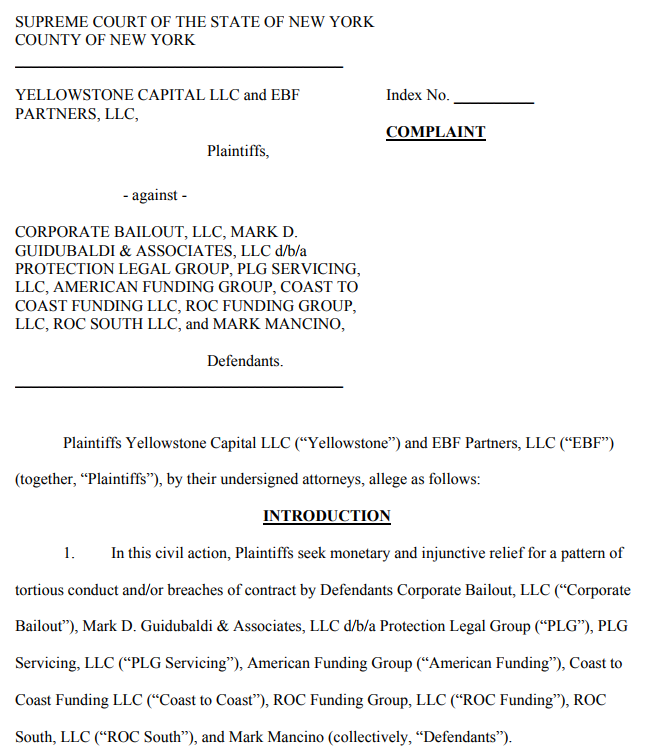
September 28, 2017 ISOs and brokers referring deals to debt settlement companies should pay attention to a lawsuit that was filed in the New York Supreme Court on Wednesday. In it, plaintiffs Yellowstone Capital and EBF Partners (“Everest Business Funding”) allege that certain ISOs are culpable partners in a scam that nefarious debt settlement companies are perpetrating on small businesses.
The debt settlement companies “mislead the merchants as to the services they will perform and the cost to the merchant, and they also conceal their relationships with the ISO Defendants and the fact that they or their affiliates are introducing these same merchants to merchant cash advance providers like Plaintiffs only to later induce those merchants to breach their agreements with their cash advance providers,” the complaint states.
Among the named defendants are:
- Corporate Bailout, LLC
- Mark D. Guidubaldi & Associates, LLC dba Protection Legal Group
- PLG Servicing LLC
- American Funding Group
- Coast to Coast Funding, LLC
- ROC South, LLC
- Mark Mancino
Several defendants are already best known for running an office “so sexually aggressive, morally repulsive, and unlawfully hostile that it is rivaled only by the businesses portrayed in the films ‘Boiler Room’ and ‘The Wolf of Wall Street,’” according to a salacious story that graced the back cover of the New York Post last month.
One paragraph of the complaint summarizes the allegedly collaborative scheme like this:
American Funding, Coast to Coast, […] (the “ISO Defendants”) are independent sales organizations (“ISOs”), companies that ostensibly support the merchant cash advance industry by brokering merchant agreements for companies like Plaintiffs. The ISO Defendants are anything but the proverbial “honest brokers.” As alleged below, they have partnered with companies that purport to offer debt relief services to merchants who have agreements with merchant cash advance companies like Plaintiffs. In practice, for these companies, “debt relief” is a code word for deceiving merchants to breach their existing agreements with Plaintiffs and to instead pay fees to these debt relief entities. In short, they scam merchants into believing that they can save them money when, in fact, they leave these merchants in financial shambles, while causing Plaintiffs to suffer millions of dollars in losses and future los[t] profits.
“’DEBT RELIEF’ IS A CODE WORD FOR DECEIVING MERCHANTS TO BREACH THEIR EXISTING AGREEMENTS”

Central to the plaintiffs’ claim is that they have ISO agreements with the defendants and that the defendants’ conduct is a breach of those agreements. The three causes of action alleged are tortious interference with contract, conversion, and breach of contract. Plaintiffs claim that 100 merchants with more than $3 million in outstanding balances are in breach of their contracts because of the defendants’ conduct.
The complaint was prepared and filed by attorneys at Proskauer, a 142-year old law firm founded in New York City.
Debt Relief Under Fire
The small business debt relief industry has been marred by scandal in recent years. In an unrelated criminal matter being handled in the Western District of New York, the owner of Corporate Restructure Inc. (no ties to Corporate Bailout) is currently residing in the Niagara County Jail awaiting trial on charges of conspiracy to commit mail fraud, wire fraud, bank fraud and money laundering for failing to deliver the debt relief services it charged for. In that case, United States vs. Sergiy Bezrukov, Bezrukov advertised that he could reduce a merchant’s short term debt by up to 75%. He is facing up to 30 years in prison. He was also previously a merchant cash advance ISO.
Two other MCA funding companies, Pearl Gamma Funding and Pearl Beta Funding, filed a lawsuit last November against another debt relief company that calls itself Creditors Relief. The complaint in that case also alleges tortious interference with contract and is still pending.
Meanwhile, a lawsuit filed in May by famous TCPA litigant Craig Cunningham against Corporate Bailout and Mark D Guidubaldi & Associates LLC went unanswered, according to court records. Cunningham, who alleged violations of telemarketing laws, filed for a default judgment against Corporate Bailout on September 12th.
Taking Advantage
Both Yellowstone Capital and Everest would not comment on the lawsuit they filed, citing pending litigation. Sources close to them, however, contend that both companies take matters that involve merchants being taken advantage of very seriously.
“When our own ISOs work directly in concert with companies that induce merchants to breach our contracts, that’s a problem,” said one source who did not wish to be named and was speaking generally about the recent introduction of debt relief service companies to the industry. “They’re taking advantage of businesses that can’t afford to be taken advantage of.”
An email sent by AltFinanceDaily to Mark Mancino early Thursday afternoon, an individually-named defendant alleged to be affiliated with the other defendants, has not yet received a response. This story may be updated if a reply is received.
A COPY OF THE COMPLAINT CAN BE VIEWED HERE.
How LendingTree and SnapCap Crossed Paths
September 25, 2017 LendingTree in recent days revealed the acquisition of online platform for small business lending SnapCap’s non-lending assets in a $21 million deal, including $12 million upfront and $9 million in contingency payments. The deal gives online lending marketplace LendingTree more scale in the small business market ahead of what could shape up to be recovery in 2018.
J.D. Moriarty, LendingTree Chief Financial Officer, told AltFinanceDaily that SnapCap’s 20 employees will stay in Charleston, and the brand will remain intact. “For them, their employer just got both a whole lot more stable and scalable. As with anything we acquire, we will keep the brand in place and test it to see what is most effective,” said Moriarty.
LendingTree has been connecting small businesses with lenders since 2014, and the latest deal reflects a strategy to add scale.
“It’s a bit of what you might call an acqui-hire. LendingTree is growing quickly and scaling. We hired a really good team in SnapCap that will basically be our way of scaling in small business,” said Moriarty.
LendingTree is lifting its profile in the small business segment amid an industry transformation that is thinning the pack and has seen some players shifting gears entirely.
“Small business lending might do very well in 2018. And we are investing now to grow the base of our business. On a macro level, we expect our business to do well in 2018 regardless. But if small business lending recovers and suddenly you see companies like OnDeck doing well, we will benefit from that. But we position any acquisition assuming that the market doesn’t recover and the deal still must be attractive to us, even if the market continues to struggle.”
Moriarty went on to provide a glimpse into the financial structure of the deal.
“Last year, SnapCap set up a special purpose vehicle (SPV), which was funded by outside capital with which they would actually make loans. There’s a balance sheet aspect to that business we are not acquiring. But it was a small percentage of their business,” Moriarty explained.
Inside the Marketplace
LendingTree is largely known as a marketplace for mortgage loans where they represent about 50 percent of comparison shopping for mortgages. “That is how people think of us for sure,” said Moriarty. The revenue drivers have expanded in recent years, however.
For instance, mortgages used to account for 90 percent of revenue. Today, based on the most recent quarter, less than half of business originates from mortgages while the balance is in personal loans, credit cards, home equity, small business and auto loans.
LendingTree is no stranger to acquisitions, having done five such deals since June 2016. “What we’re trying to do is to build other marketplaces where people want to comparison shop,” said Moriarty.
But growth by acquisition is not their only growth strategy. “We’re growing period,” said Moriarty, adding that organic growth has been very good but small business in particular is a tough market to scale.
One of the recent deals, the acquisition of CompareCards a year ago, led them to gain market share in the credit card space. That deal also led LendingTree to SnapCap. CompareCards founder and president Chris Mettler and his wife own more than a one-third equity stake in SnapCap.
“SnapCap was introduced to us through Chris. He’s now a LendingTree employee. The introduction was absolutely from him. But it’s very consistent with our strategy, which we have conveyed to the market. We will continue to make small, accretive acquisitions and that will help us to gain scale in certain businesses and diversify,” said Moriarty.
Hybrid Model
While LendingTree and SnapCap both facilitate loans to the small business community, they take slightly different approaches to get there. “SnapCap’s core business is not unlike ours, meaning they are essentially finding high quality leads for lenders,” said Moriarty.
SnapCap uses a concierge model in which customers have a broker experience. They talk to someone at the company who helps them to identify a lender.
“LendingTree will be bigger and more scalable through both the traditional LendingTree model and SnapCap’s concierge approach. We will simply be able to serve lenders more effectively. If I’m a lender making small business loans, this is a pretty good thing.” he said.
SnapCap, meanwhile, is looking forward to the very same scale that LendingTree is targeting.
“The mission of SnapCap has always been to serve small business owners with access to funding. LendingTree’s leading online lending marketplace combined with SnapCap’s successful concierge model will enable us to serve an even wider range of business owners,” Hunter Stunzi, co-founder of SnapCap, told AltFinanceDaily.
What Will it Take to Grow OnDeck’s Stock Price?
September 20, 2017OnDeck closed at the exact same price on September 14th as it did on July 20th, $4.58. In between, OnDeck reported one of their best quarters ever (they released their 2nd quarter earnings on August 7th) and experienced a temporary boost to $5. Even then, the stock was 75% down from the IPO price and more than 80% down from their all-time high, yet that too couldn’t be sustained.
In Q2, OnDeck only had a GAAP net loss of $1.5 million and announced that they had expanded their collaboration with JPMorgan Chase for up to four years to provide the underlying technology supporting Chase’s online lending solution to its small business customers.
In the rest of the lending world, optimism is in style. Square is up 121% year-to-date, according to the AltFinanceDaily Online Lender Tracker and even Lending Club is up 14%.
More traditional finance companies like American Express and Intuit are meanwhile hovering near their 52-week highs, according to the Specialty Business Lending Tracker.
Some of OnDeck’s former employees at least appear to be doing well. Just recently, the former Chief Sales Officer was named COO of CoverWallet, the former Director of External Sales was named Chief Revenue Officer of Pearl Capital and the former Director of Portfolio Management and Credit Operations was named SVP at Breakout Capital.
The Google Battle for Lending and SMB Finance Keywords
September 14, 2017The online lending battle is at least in part being fought online. Below is a chart of organic page 1 rankings in Google for some of the industry’s biggest players, banks, and the SBA. (Hat tip to Fundera and NerdWallet):
| Keywords | OnDeck | Kabbage | Fundera | Lending Club | NerdWallet | National Funding | Traditional Banks | SBA.gov |
| business loan | 1 | 9 | 3 | 5 | 4,7 | 6 | ||
| merchant cash advance | 2 | 3 | 4 | 8 | ||||
| working capital | 9 | 4 | ||||||
| commercial loan | 3 | 2,7 | ||||||
| small business loans | 2 | 3 | 5 | 7 | 1 | |||
| business line of credit | 3 | 2 | 11 | 1,4 | 6,7,8,9,10 | 5 | ||
| fast business loan | 1 | 4 | 2 | 5,6 | ||||
| business loan with bad credit | 7 | 1 | 2 | 3 |
The Top 10 Google Search Results for Merchant Cash Advance in February 2012 compared to now:
| February 2012 | September 2017 |
| MerchantCashinAdvance.com | Wikipedia |
| Yellowstone Capital | OnDeck |
| Entrust Cash Advance | Fundera |
| Merchants Capital Access | NerdWallet |
| Merchant Resources International | Businessloans.com |
| American Finance Solutions | Bond Street |
| Nations Advance | Capify |
| Bankcard Funding | National Funding |
| Rapid Capital Funding | CNN |
| Paramount Merchant Funding | CAN Capital |
The top result in 2012 is a great example of how much easier it was to game Google’s system back then. After achieving rank #1 for MCA and 300 other related keywords, MerchantCashInAdvance.com, which was just a lead generation site, sold for $75,000 in December 2011. The site was later clobbered by Google Penguin for black hat SEO and banished from visibility.
A major shift has obviously taken place over the last 5 and a half years. Is the search results game rigged to advance Google’s own interests? Three years ago I put forth my theory on that.
One thing that’s different between then and now is that Google now has 4 paid links above the organic search results as opposed to 3 and the paid links blend in more with the organic results. With the organic results pushed further down the page, they’re not as visible as they were five years ago.
Read my previous analyses on the industry’s search war over the years:
December 2015 Google Serves Low Blow to Merchant Cash Advance Seekers
March 2015 Google Culls Online Lenders – Pay or Else?
October 2014 Merchant Cash Advance SEO War Still Raging
August 2014 Six Signs Alternative Lending is Rigged: Do Lending Club and OnDeck have a helping hand?
October 2013 Google Penguin 2.1 takes swing at the MCA industry
August 2013 Your merchant cash advance press release may be hurting you
December 2012 Is Google your only web strategy?
July 2012 The other 93% [of leads]
April 2012 The SEO war continues
February 2012 The SEO War for Merchant Cash Advance: The first story on this topic