
Maxim Commercial Capital Doubled Fundings in Q3 2023
October 19, 2023LOS ANGELES, CALIF. (Oct. 17, 2023) – Maxim Commercial Capital (“Maxim”) announced robust demand across its diverse financing programs for the third quarter of 2023. The hard asset secured lender reported a 100% year-over-year increase in truck financings for the period. Furthermore, it experienced a surge in demand for second-lien mortgages to refinance Merchant Cash Advance (MCA) loans and to support working capital. Maxim is a national provider of loans and leases from $10,000 to $3 million collateralized by class 6 and 8 trucks, trailers, heavy equipment, and real estate.
“The current climate of healthy residential real estate valuations, coupled with low-cost first mortgages and conservative banking practices, makes our Real Estate and Structured Finance programs highly appealing,” noted Michael Kianmahd, Maxim’s Executive Vice President. “Many homeowners don’t realize they have liquidity in their homes that can be tapped to grow their businesses, often at significantly less expense than MCA loans.”
Notable fundings during the period include a $400,000, 5-year second-lien mortgage at a 60% combined loan-to-value (LTV) for an experienced optometrist with four business locations in Los Angeles. The funds were used to pay off MCA loans, reducing monthly debt service by $15,000, and for working capital. Maxim also funded aa $125,000 second-lien mortgage to an experienced construction project manager in Las Vegas at 58% combined LTV to fuel business growth and pay off an expensive MCA loan.
Maxim’s credit matrix featuring lower down payments for truck owner-operators, ranging from better credit to subprime borrowers, continued to prove popular among loan brokers and truck vendors in Q3 2023. Truck financings during the period included 75% purchase financing for an experienced owner-operator with a 607 FICO to buy a 2018 Peterbilt 579 with 399K miles for $58,695; 68% purchase financing for an owner-operator with a 593 FICO to buy a 2019 Peterbilt 579 with 547k miles for $62,250; and 71% financing for a start-up owner-operator with a 618 FICO to buy a 2020 Freightliner Cascadia with 465K miles for $51,275.
“Fortunately, the used truck market has softened in light of the current economic volatility “We are committed to helping hard-working truck drivers stay on the road, earning a living,” noted said Behzad Kianmahd, Maxim’s Chairman and CEO. “The current economic volatility has improved truck pricing while also causing some lenders to retract, creating an opportunity for Maxim to fill a void.”
About Maxim Commercial Capital
Maxim Commercial Capital helps small and mid-sized business owners nationwide by providing loans and leases (“financing”) from $10,000 to $3 million secured by trucks, trailers, heavy equipment, and real estate. It funds equipment purchase financings and leases, working capital, and debt consolidations. Maxim’s more creative financing structures leverage equity in real estate and owned heavy equipment to facilitate growth and preserve customers’ cash. As a leading provider of transportation equipment financing, Maxim supports startup and experienced owner-operators and non-CDL small fleet owners by funding loans and leases for class 8 and class 6 trucks, trailers, and reefers. Learn more at www.maximcc.com or by calling 877-776-2946.
###
Contact:
Michael Kianmahd
Executive Vice President
Maxim Commercial Capital
michael@maximcc.com
(213) 984-2727
Experts: How GFE Went Big
September 6, 2023The Brewster Building is an icon in Long Island City, a bustling district of Queens that’s right across the water from Manhattan. Most people know the building as the official headquarters of JetBlue because their giant logo on the roof can be seen from miles away. Others identify it as a major corporate hub for The Estée Lauder Companies since they sublease a substantial amount of office space inside. But up on the eighth floor, men and women traversing the hallways in suits work for another employer that’s making a splash in a different industry altogether. The sign on their door says GFE, which is short for Global Funding Experts. It’s a company that provides working capital to small businesses nationwide and they just recently secured a senior debt facility of up to $100 million.

Boris Musheyev, GFE’s CEO, founded the company almost a decade ago with partner Viacheslav “Steve” Eliyayev. Musheyev was working mainly in real estate when he learned about an innovative way to support small businesses by purchasing their future receivables. A cautious investor, he didn’t just jump right in. Instead, he bided his time with research on how it worked. He crunched numbers and analyzed the risks before he was confident it was something he wanted to do.
“From the outset, I’ve only channeled funds into ventures I wholeheartedly believed would both succeed and offer genuine value,” Musheyev told AltFinanceDaily. “This commitment was evident in 2013 when we began by investing our capital.”
Alas, Global Funding Experts was born. The company’s model is referral partner driven, meaning they rely on ISOs for submissions and there’s no internal sales force. Today, GFE has an estimated 1,500 ISOs signed up and they receive about 700 applications on an average day. It’s a level of scale that wouldn’t be possible if they didn’t have an efficient CRM, something Musheyev predicted the necessity and utility of long before. GFE began building its own proprietary CRM in 2017 and the company used that to accelerate growth beyond its early startup days.
 With its momentum, GFE brought on Boris Shakhmurov to serve as COO in 2019, a traditional banking executive with 20 years experience. Shakhmurov was previously an Executive Director at JPMorgan Chase and had overseen mainly cybersecurity, technology controls, and compliance before making his move to GFE. The two Boris’s knew each other previously, having been friends for over 30 years already. At GFE, Shakhmurov’s pitch that “banks don’t lend to small businesses” lands differently given his background.
“As an expert in Governance, Risk, and Compliance, when I joined the organization in 2019, our goal was to establish a best-in-class MCA Operational Resilience framework to address current and future challenges facing our industry,” Shakhmurov said. “With a focus on building strong and resilient operational controls, we used a multidisciplinary approach to assess the risk across all of our information assets and business processes. The Zero Trust and Defense-in-Depth approach enabled us to focus on early detection, rapid response, enhanced protection, and reducing single points of failure throughout the entire MCA lifecycle.”
For all the technical talk, Shakhmurov said what really stands out is the firm’s family-like atmosphere, which one can see for themselves in their spacious office. That environment has been achieved all while tightly controlling and compartmentalizing access to data, the company says. Security is paramount.

With the infrastructure in place, GFE hired Jonathan Mayer to be their CFO, a veteran accountant who previously spent more than 10 years at Grant Thornton LLP. Mayer first met Musheyev and Shakhmurov in 2021 and he echoed a similar sentiment about how he ended up at GFE. “The work ethic and trust and family environment really stood out to me,” Mayer said.
Between Musheyev, Eliyayev, Shakhmurov, and Mayer, the firm was then off to the races, ultimately leading up to the securing of a debt facility last month of up to $100 million. A lot went into making that happen, including the enlistment of a well known industry law firm to perform the due diligence, they say.
“Through consistent communication with our merchants and operational adaptability, we’ve not only met but surpassed our profitability benchmarks, all the while ensuring minimal defaults in our portfolio,” Musheyev said.
The company also credits having a qualified CFO and robust CRM technology as being necessary ingredients to getting a serious deal done. GFE’s signature products include purchases of future receivables, reverse consolidations, and more recently something called “Incremental Funding.” There’s also no commission clawbacks, they tout. Overall, GFE has funded over $400 million in capital to small businesses since inception.
The executive team heaped praise on the staff for being integral to their success.
“What we have is trust,” Shakhmurov said, who comes back again and again to the importance of building a business that will endure. “If you look at the banking industry, you need operational resilience,” he said.
After Comeback WBL Hits The “Express” Lane
August 10, 2023 When World Business Lenders (WBL) resumed funding in April, they made it a point to announce that it wasn’t just going to be some regular old reboot with fresh capital. The company was going digital. At the helm of the changes taking place is a new face, John Milligan, who has more than 25 years of experience in maximizing profitability and long-term growth for lending companies. He’s now not only the company’s Managing Director and the Chief Operating Officer but he’s also spearheading loan production. And one of the first initiatives he touted was a more streamlined process for ISO partners.
The company’s ambitions first had to contend with any fallout of having paused lending in the first place, which started on December 9, 2022. At the time, WBL CEO Doug Naidus Cited “unplanned growth given market conditions” as the cause and loan applications in the pipeline that were caught off guard by the unexpected news entered a sort of suspended animation. WBL later secured financing in April that not only enabled the company to resume originating and funding loans “but afforded access to more lending capacity than ever before.”
The resumption spurred a race to revisit those pending deals from five months earlier to see what, if anything, might still be willing and eligible to move forward.
“The merchants in our active pipeline were our first priority,” Milligan said, “and we are pleased that many of them were able to complete their loan once we relaunched.”
That they waited the whole time was a big sign of confidence for WBL. The company’s unique product offering might have played a role in why the borrowers and their ISOs were so patient, however. WBL offers real-estate backed commercial loans in a field of competitors that are mostly pre-occupied with unsecured working capital financing, for example. Although it stands apart, the pace of funding and potential unfamiliarity with the process could be a drawback for ISOs not used to it. That was part of the inspiration for WBL’s “ISO Express.”
“First, ISO Express was conceived based upon feedback from ISOs that a faster, more streamlined program would be beneficial,” Milligan said. “Second, there are many ISOs which are unfamiliar with our real estate collateralized commercial loan products and ISO Express is a perfect introduction for them.”
The ISO Express program consists of 1-2 hour pre-qualifications after submission and 10-day closing guarantees for loans collateralized by residential properties. They accept pledges of second homes, investment properties and primary residences (in most states) as collateral; and say that being in a junior lien position is acceptable. Loans that are to be collateralized by commercial properties can also be submitted through ISO Express but Milligan says those are better suited for their Account Executive channel where ISOs can still engage with a traditional rep.
WBL also simplified their product to a standard interest rate and term, which they feel will make the total loan process faster and easier to understand. Overall, their return to the industry and these changes have led to an outcome that they’re happy with so far.
“In fact, since we relaunched, we have seen an increase in the total of number ISOs registered with WBL,” said Milligan, “driven by a combination of our new ISO Express program, an increased demand by small businesses for capital, and general tightening of credit guidelines throughout the market.”
Lightspeed Capital Generated $8.1M in MCA Revenue Last Year
June 23, 2023 When Lightspeed announced it was expanding its MCA program to the United Kingdom, Australia, New Zealand and Quebec, one may have been wondering who they were. The POS e-commerce platform has actually been around since 2005 and has been slowly building up its MCA offerings. Indeed, last quarter AltFinanceDaily pointed out that the company had been increasing its volume.
As of the company’s fiscal year-end of March 31, 2023, the company had an MCA receivable balance of $29.5M, up from $6.3M YoY. Altogether, Lightspeed generated $8.1M in revenue in FY 2022, amounting to only about 1% of its overall revenue. That means there’s still a lot more room for growth.
“We believe real-time access to capital is one of the largest challenges facing merchants today,” said JP Chauvet, Lightspeed CEO in a press release. “This expansion of Lightspeed Capital provides a simple, streamlined opportunity for our merchants to invest in their business. Our goal is to help turbocharge their operations … all through a single, integrated commerce solution.
WBL Secures Anchor Institutional Financing and Resumes Full Operations and Funding
April 24, 2023 World Business Lenders (WBL) is resuming funding this week and relaunching originations through its Traditional, Digital API, and ISO Express channels, following a financing arrangement announced today by WBL CEO Doug Naidus.
“I am excited to welcome our new financing partner, not only enabling WBL to resume loan origination and funding, but affording access to more lending capacity than ever before,” said Naidus. “We are eager to return to market and launch our new business model.”
Initially, WBL will prioritize funding the customers who have remained in its pipeline since December 2022 when the company temporarily paused funding. WBL will begin accepting new loan submissions from its ISO partners, with respect to which additional detail will be provided over the coming days. In parallel with accepting new submissions, WBL will roll out a full-service Digital API business model and a self-service ISO Express business model, for certain qualified ISOs. At the helm of the new business model launch is John Milligan, WBL’s Chief Operating Officer, who now heads loan production.
“The API model will enable larger ISOs to leverage a digital integration that will automatically submit merchant applications straight to WBL. The ISO Express model empowers ISOs with the ability to generate offers for their merchants directly online. Both of these digital offerings are high-growth opportunities that will maximize the earning potential of our ISO partners through a combination of speed and simplicity.” said Milligan.
To learn more about how your business can maximize profits by partnering with WBL and leveraging its new API business model, please reach out to John Milligan’s team directly at isorelations@wbl.com. Also, be sure to inquire about meeting times with the WBL team at the upcoming Broker Fair on May 8th, of which WBL is pleased to be a sponsor.
Square Loans Completes Monster Funding Year
February 26, 2023 Square Loans rose to the top of AltFinanceDaily’s small business loan originations leaderboard last year after announcing $1.16B in originations in Q4. That brought the company, which is a subsidiary of Block (formerly Square), to over $4B funded for the year total, spread out across 461,000 loans.
In its annual shareholder letter, Block said that “Square Loans achieved strong revenue and gross profit growth during the fourth quarter of 2022.” Demand for loans has been steady and loss rates have stayed consistently within historical ranges.
Square Loans typically approves merchants for less than 20% of a merchant’s expected annual Square gross payment volume, is repaid by withholding a percentage of credit card sales, and enjoys a borrower base that pays off its loans in less than 9 months on average.
Block’s business is so large and now has so many components that Square Loans did not even come up in Block’s Q4 earnings call. Overall, the company generated $5.7B in revenue in 2022.
The small business loans originations leaderboard contains a lot of blanks. That’s because several public companies have attempted to obscure their business lending figures or non-public ones have opted to not disclose their figures. If you want your company’s figures to be added, email info@debanked.com.
Shopify Capital Seeing “Incredibly Strong Renewals From Previous Borrowers”
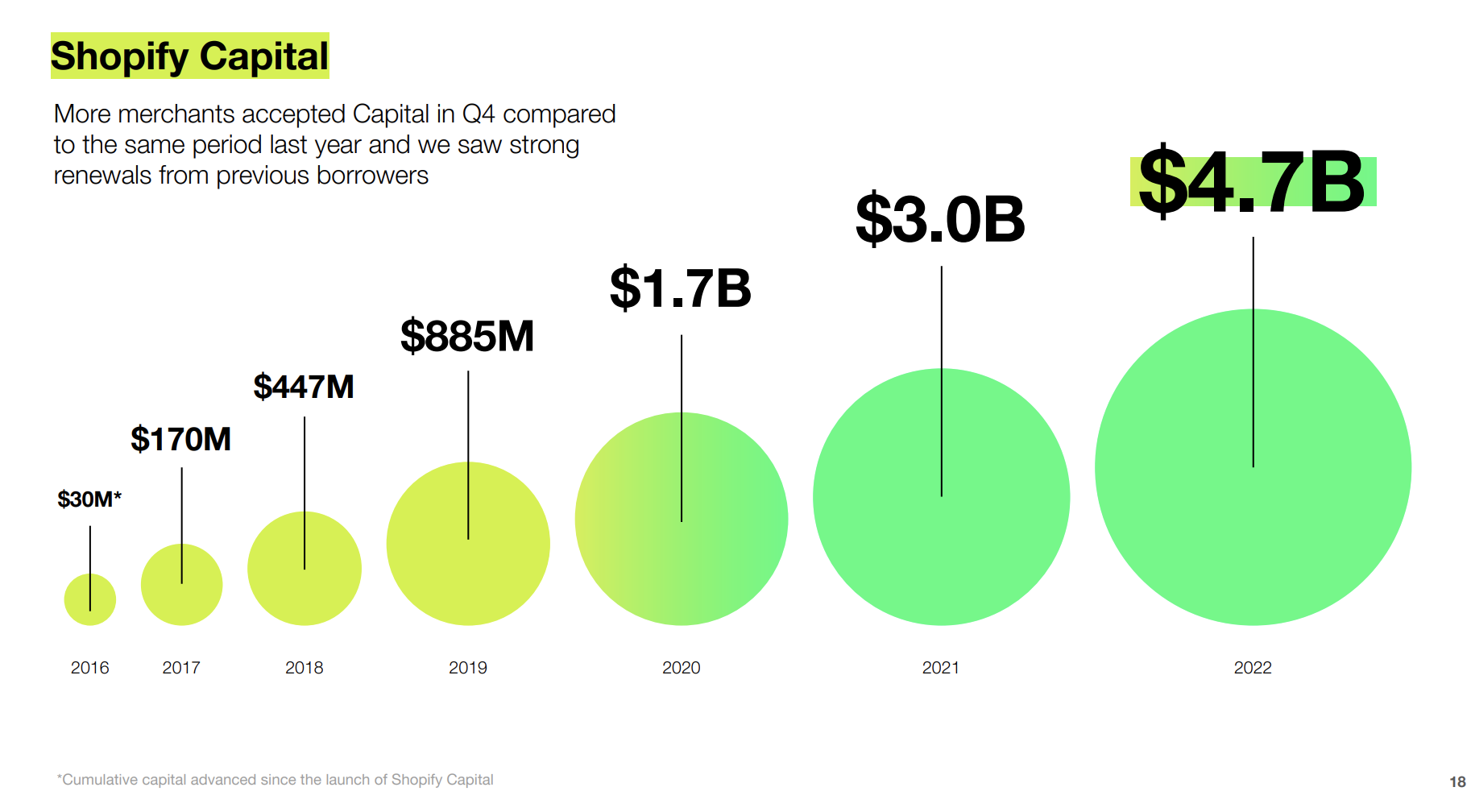
February 16, 2023Shopify Capital originated $393.2M in MCAs and business loans in Q4, an increase of 21% YoY, the company revealed. The company also began funding small businesses in Australia last year, bringing the total countries it does business in to four.
“[Shopify] Capital has acted as a lifeline for merchants, especially through the pandemic and this tough macro environment, allowing them to conveniently access capital when they need it most,” said Shopify President Harley Finkelstein. “Capital is now available in four countries, and our machine-learning algorithms to underwrite merchants keeps getting better.”
Finkelstein also noted that the company is “seeing incredibly strong renewals from previous borrowers.”
The graphic below, illustrating the cumulative growth of Shopify Capital’s originations, was shown in the company’s Q4 earnings presentation:
Lendica Integrates with Shopify and Salesforce
February 7, 2023 Shopify and Salesforce users will now be able to access loan products through Lendica. Now, how does it work? Lendica gives their software to Independent Software Vendors (ISVs) and once installed, their customers will have access to Lendica’s funding products (PayLater, FundNow, and DrawDown).
PayLater is similar to how BNPL works, allowing vendors to delay their payments to a weekly basis. FundNow resembles an accounts receivable product where merchants can get paid up to 90 days ahead of the seller terms offered from their wholesale account. DrawDown is working capital that allows businesses to borrow against their future cash flow. These three products can be integrated into Shopify and Salesforce with an embedded funding or pay later button.
“We’re giving this tool to these ISVs so that their customers can instantly access our product and then learn about our other funding tools,” said Jared Shulman, CEO at Lendica.
“The most important piece, and this is kind of the excitement of Salesforce and Shopify is that what Lendica was doing is building this missing infrastructure in the small business lending space…,” said Shulman. “And what that is, is this standardized lending language, we call it the Lendica token that allows any financial institution to get a complete picture of a business, and then a point of reference on what that picture means.”
Lendica has experienced strong adoption of its products. According to Shulman, its PayLater product alone has garnered more than 10% growth month over month.