
MCA’s Top Social Media Voice
December 18, 2017 LinkedIn has unveiled its top 10 voices for marketing and social media. Fintech did not make the list, but perhaps the social networking site didn’t look hard enough. If they had been following Jennie Villano, who on Dec. 1 joined Kalamata Advisors as vice president of business relationships, that list might have included a nod to the MCA industry.
By most standards she’s a newbie to fintech, having joined her previous employer Pearl Capital only two years ago. But that hasn’t prevented her from making her social media presence known. And while she reserves Facebook for her personal life, if you know Villano then you wouldn’t be surprised at her success on LinkedIn, as she seems to have a knack for social media.
“I felt like I needed a very strong presence in this industry to get anywhere,” Villano told AltFinanceDaily. “It’s funny, I think a lot of people associate sales with a type A personality and being pushy. I’m not an aggressive, pit-bull woman. You don’t have to be that type of woman to get ahead. I thought about how am I going to show this to the industry? Social media was my answer. My Facebook and LinkedIn attract a lot of views.”
Indeed, it was because of her Facebook profile that Villano was featured by a famous painting by David Uhl. The painting, dubbed Steampunk Seduction, is the first in Uhl’s Steampunk series. “I got that through Facebook,” Villano explained. “Someone saw my profile on Facebook, reached out and said, ‘you should contact the artist.’ I told them they were crazy. They insisted, and he chose me. It’s been a blessing.”
Meanwhile, her LinkedIn posts designed for MCA ISOs have similarly caught on like wildfire, and she only “amped up” her activity on the site in July. Villano has been posting on LinkedIn once per week, and the proof is in the pudding. “Since then, in September, October, and November, we broke funding records every month. It works,” said Villano of her previous employer Pearl Capital.
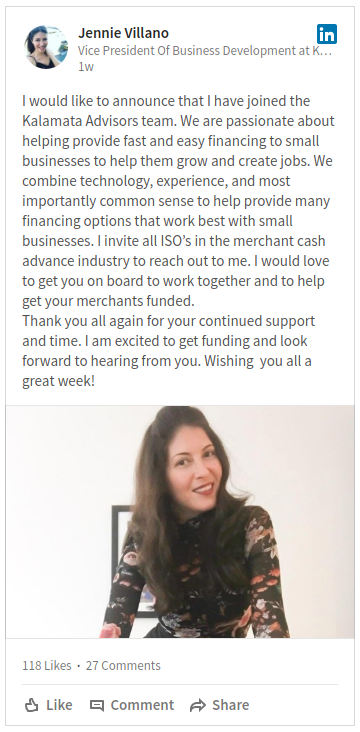
Underpinning that deal flow has been a flow of new relationships she’s forming, evidenced by more than 500 ISOs having contacted Villano on LinkedIn via her previous employer’s Salesforce network.
“That was from posting one time per month and just educating; not posting pictures of me on a beach sipping a Pina Colada,” said Villano. Instead, she was educating them about Pearl’s funding options, the types of deals they wanted, their bonus structure, etc. “So, it’s very basic information. I was just letting them know what they can expect from Pearl, what kind of fundings we were doing, just being a constant reminder,” she added.
While Villano is no longer employed by Pearl Capital, her posts from her tenure there have had a lasting impact. “[Last month] I put up a post announcing that I was leaving Pearl Capital,” Villano said. “The post generated more than 35,000 views.” Meanwhile, since she’s been posting, she’s seen the number of LinkedIn connections skyrocket.
Villano is continuing her social media push at her new employer, Kalamata Advisors.
“Kalamata has a partnership-culture mentality. It’s an amazing opportunity to be elected a partner, like a partner at Goldman Sachs or McKinsey, here after a couple of years. Then you have a real stake in the company and work at a firm where everyone wants to pitch in,” she explained. “Second is their great reputation. The partners put their mission and values first. They’ve grown so fast; but they’ve grown with the purpose to genuinely help people. And lastly, they’re very respected in the industry. Everyone here is very responsive, honest and professional.”
And while she’s no longer employed by Pearl Capital, she has nothing but respect for her former employer as well. The feeling is mutual, evidenced by a going away party that they threw for her on her way to Kalamata.
Gender Gap
 So why isn’t social media more pervasive among MCA market participants? According to Villano, the reasons are two pronged, the first of which is compliance. “It’s very important to make sure we convey ourselves properly,” she said.
The other has to do with the fact that MCA is a male-dominated industry. “Women are more conversationalists through texting or social media. I find women are more intimate with it on a professional level. I have to say that I have the most active social media in our industry,” said Villano, who again only joined fintech two years ago. She’s inspired by the many women who are behind the scenes at ISO shops, many of whom she explained work as processors.
We asked Villano about whether sharing her trade secrets with competitors in the industry made her uncomfortable. “Not at all. I’m not made like that,” she said. “And Kalamata believes trust is the importance of every brand. With transparency, there is trust. Everyone is authentic and unique. Everyone should have the opportunity to share his/her own self in any industry.”
Hard Work, Big Success – The True Story of an MCA Broker
December 15, 2017Sales is a tough field for anyone to break into even if they come from the most ideal of circumstances. At some point, the rubber meets the road for every MCA broker, at which time they must decide whether they’ve got what it takes to make it in this business.

This is what makes Lerry Dore’s story so remarkable, as it seems that the more he got knocked down in life, the higher he was destined to rise. Today he’s employed as an MCA broker at Cresthill Capital. And while education has been paramount to getting him here, evidenced by the fact that during his entire employment he has been in college and he is still one of the funding company’s most successful brokers, Dore more than anything else was trained at the school of hard knocks.
Coming to America
Dore was born in South Florida, but he wouldn’t stay in the United States for long. After his parents split up, his mom was having a tough time making ends meet and made the impossible decision to send him to Haiti to live with extended family.
“My mom had a very hard time supporting us right out of the gate. Soon after I was born, I was sent to Haiti to live with my aunt and cousins,” he said, adding that this gave his mom a chance to get on her feet. “She needed to get a job so that she could provide for us at a basic level.”
Dore would remain in Haiti for the first three years of his life, where his first language would become Haitian Creole. But you wouldn’t detect a hint of an accent talking to him today at the age of 23.
Dore’s mom eventually found a job. She was only earning minimum wage at a hospital, but it was enough to get the wheels in motion to bring her son home.
“She was in a position to provide food, electricity and shelter for us. That’s why I came back,” said Dore, adding that he doesn’t remember much of Haiti with the exception of the plane ride home. “That’s where my memories start,” he said. Perhaps it was somewhere over the Caribbean that young Dore’s dreams began to form.
When he got back to Florida, Dore was able to meet his mom for what felt like the first time for him. He also met his brothers and sisters for the first time ever. He explained how at this point, his mom was still getting adjusted to life in America as an adult immigrant.
 “There were a lot of things that I went through as a kid to this point that she couldn’t give me guidance on. She simply didn’t have that experience. That brought a challenge,” he said. Little did he know that these obstacles would help shape him into the resilient person and successful MCA broker he is today.
While getting used to the American culture was a challenge, something that his mother never lost sight of was the importance of education. “She was very big into education,” he said. Dore’s mom discovered Head Start, a government subsidized program that provided a pre-school education for families who couldn’t otherwise afford it. That was where it would all begin for Dore, and come hell or high water his mother was going to enroll him. Without the luxury of an air-conditioned vehicle to drive in the hot Florida heat, the pair set off on foot to sign up. Some 12-15 blocks later they arrived.
“Both of us were sweating bullets. She didn’t know it, but there was a small registration fee. At the time, she didn’t have it,” Dore explained. It was then that fate seems to have stepped in in the form of the woman who was handling registration. She pulled the pair aside and told them that after witnessing the dedication that this mother had toward her son, she was going to waive the fee. In return she only asked that they keep it on the down low.
“That small gesture made a dramatic difference in my life,” Dore said. “If I was not able to attend, I wouldn’t start school until I was seven or 10 years’ old. That was a very important moment in my life.”
Indeed, it was, as it would set in motion a series of events that would lead Dore to where he is today, a successful MCA broker at Cresthill Capital. But before he would join the firm, there were still more hardships waiting for him, not the least of which was the death of a friend in his teenage years. “That could have been me,” Dore exclaimed.
For the average person, life’s setbacks could have held them down forever. For Dore, they seem only to have propelled him further. “The reason why I stayed out of trouble was I was in school and my mother kept us grounded,” he said.
During his teenage years, Dore and his family lived in an apartment complex in a neighborhood of immigrant Haitians where he said the median income was $25,000 to $30,000 per year. He shared a room with his brothers and sisters.

“I focused on athletics,” he said, adding: “That’s where I got my competitive nature. Also, my thick skin,” both of which, incidentally, are characteristics that would serve him well as a broker later in life.
While he excelled at basketball at his Boca Raton high school, Dore wouldn’t be able to pursue those dreams for long. He and his family would be uprooted from their home time and time again amid landlord trouble. This series of setbacks, which involved him sleeping on his brother’s couch for a time, instilled a sense of maturity in Dore at a very young age.
He had a few Division II and Division III offers to play basketball in other states, but he turned them down. Instead of chasing his own dreams, Dore decided to focus on business and find a way to sustain and support his family “Once I graduated, I was not interested in basketball. I wanted to finish college,” said Dore, and lucky for the MCA industry he had his sights set on the field of finance.
Funding Merchants
After High School, the first thing that Dore did was to go online and look for a job. As it so happens, the first ad he saw was at a stock brokerage in Boca Raton. “That’s where I started, in phone sales. I didn’t have a Series 7 license at the time. I was just calling from the Yellow Pages. Once I got someone on the phone, I would transfer the call to someone who had a license,” he explained.
This went on for a couple of months until he heard about a startup company in nearby Delray Beach. “At the time, they were prospecting merchants. That’s how I got into the industry,” he said.
 His first job in the MCA niche was with a very small ISO shop. But it was there that he would make a connection to change the course of his career. He was working on a deal that was hard to place and was only getting rejections. That is until he came across Mike Daniels, Cresthill’s No. 1 producer.
“I couldn’t get the deal done anywhere else. The merchant was getting frustrated with the process. I heard of a company that takes chances on merchants with imperfect credit,” he said. That funder was Cresthill Capital. Little did he know at the time, but they would eventually become his employer.
He sent the merchant file over to Daniels, who then reached out to the merchant and got the deal funded. It was at that point, Dore said, that he started to fall in love with Cresthill “because of how [Daniels] was able to treat the merchant with respect and get the deal done.”
For the next six months, Dore would proceed to trust all of his business with Cresthill. He was still employed by the small ISO shop, but he began to outgrow his environment and long for a platform that allowed him to explore his talent and excel. But his pursuit only left him frustrated and thinking about leaving the MCA industry, something he confided in Cresthill Capital’s Daniels, who was turning into a mentor, about.
It was at this point in his life and career that instead of being the rock, Dore needed to lean on someone else. Daniels and Cresthill Capital were there for him. He was invited in for an interview, and as they say the rest is history.
“I was shocked at how diverse the workforce is. There were different types of people with different backgrounds. I liked it right off the bat. And then everyone was very friendly to me from the moment I walked in,” he said. He was greeted at the front door by Cresthill Capital’s Mike Marano, who then proceeded to interview him.
 “I’ve actually interviewed and sat with every single person at my company and hired them personally. What I can say about Lerry is that from the moment I looked at his face and saw his eyes, I knew intuitively that he was a good person. And responsible. I had no idea how deep of a person he was, how much humanity he would show. He was a willing student, and we were happy to teach him. And he continues to soak it up like a sponge,” Marano told AltFinanceDaily.
Dore was convinced Cresthill Capital was the right place for him when Marano insisted that Dore stay in school and continue his education. “They said, ‘we will work around your schedule,’ and that really drew me in,” he said, adding that the dog-friendly environment was a bonus.
Dore has been employed by Cresthill Capital for the past 18 months and is graduating from college this week. He is not only supporting himself, but he’s the highest earner in his family, which has allowed him to help support them.
Paying it Forward
As if on cue from the mystery lady that paid his school tuition when he was just a child, Dore is now interested in paying it forward in life. He said that similar to how Cresthill Capital is involved with philanthropy, he’d like to give back to the community. But his vision goes beyond his neighborhood.
“I want to help kids that are similar to me, who are in programs that try to help them excel in this country. I want at some point to work with immigrants that come in from Haiti and work with them to give them a platform, like the lady who gave us a chance,” said Dore.
Since the Haiti earthquake, his extended family has relocated north to Canada. “But I still feel to some degree a responsibility to try and help out the people in that country and the ones who come here through immigration,” he said.
As for Marano, he said all Dore needs to do is exactly what he’s been doing. “When he leaves me, he won’t have to work again. But knowing this kid, he probably will anyway,” Marano said.
Closing Loans and MCAs — From the Bedroom to the Office
December 8, 2017 The merchant cash advance industry has gone mainstream so quickly that it has become more difficult to identify potential customers.
Market saturation and industry consolidation have caused the cost of sales leads to increase sharply. Yet a New York business loan broker is finding success by applying lead generation and online marketing strategies to merchant cash advance, or MCA, while expanding the number of services he offers prospects. Funding is just the foot in the door.
Philip Smith, founder and CEO of PJP Marketing Inc., told AltFinanceDaily the MCA industry’s acceptance has made it more difficult for sales lead generators to produce profits. But expanding the number of services that independent sales organizations (ISOs) offer can offset the contraction. Smith’s life as a stay-at-home-dad, was recently featured in Innovate Long Island, a regional newspaper.
An ISO can’t just be a broker anymore. It needs to change, identify new revenue streams to excel. In doing so, a lead generator transforms itself into a business consultant that prospective customers turn to for additional services they often didn’t even know existed, Smith said.
For example, business loans and MCA is Smith’s largest business generator. But his most popular add-on services with such sales leads are credit repair and credit monitoring.
“The market is relatively easy,” Smith said. “The hard part is monetizing. The ISOs are going out of business because they refuse to monetize the other, non-cash advance leads.”
Smith, armed with a degree in business/e-business from the University of Phoenix, is also an advocate for entrepreneurs who want to work from home. It’s a viable model for lead generators because low overhead costs provide entrepreneurs an opportunity to capitalize on aggressive business strategies.
As such, Smith markets his pajama-centric business model with IWorkInMyJams.com. But he acknowledges that working from home presents its own challenges. Entrepreneurs need to be extra focused and tough to distract. No watching Dr. Phil during work hours.
Since they don’t work with more experienced managers, work-from-home entrepreneurs also need to seek their own sources of business advice and strategies. They deal with the reality that some lenders may deem them too small to do business. “Not everyone will work with you,” he said.
Working from home also requires a entrepreneur to set office hour limits and parameters to prevent burnout, Smith said.
“Do you know when to turn it off?” he asked. “That’s my problem. I’m up until 1 o’clock in the morning because I can.”
Smith now brokers sales leads in several verticals such as credit repair, tax relief, mortgage and solar energy. He claims revenue of $1.6 million last year and plans to reach $2 million this year.
When he was just 23, Smith launched his first company, We Link You Internet Services, a business that evolved into a web hosting concern.
He later worked for New York-based Canrock Ventures to launch a search-engine optimization platform called SEOPledge that was acquired in 2013. The following year, he founded what is now called PJP Marketing to broker leads amid the rapidly rising MCA space using the digital marketing skills he’d learned from the previous positions.
In October, AltFinanceDaily reported that several factors have contributed to several changes in the MCA industry, including consolidation, making it more difficult for alternative-funding business lead generators.
ISOs and brokers have gotten pickier about the types of leads they’ll accept as MCA evolves from a niche business to one that’s more commonplace. Also, a stricter application of the Telephone Consumer Protection Act (TCPA) has chilled soliciting and hamstrung the ability to connect with business owners who are prospective clients.
Last year’s LendingClub Corp. scandal ousted several senior managers, including the company’s then-CEO. Last summer, Bizfi laid off workers and sold the servicing rights to its $250 million loan portfolio to rival Credibly.
The result has been a consolidation of the alternative funding business.
“There are still roughly 75,000 business owners every week who meet the criteria for an [MCA],” California-based Lenders Marketing partner Justin Benton told AltFinanceDaily. “Now instead of there being 5,000 options in the space, there are 2,000, so those 2,000 are gobbling it all up.”
 David Ross, a 12-year veteran of the MCA industry and owner of Pro Leads NYC, said MCAs higher profile has been a game changer for lead generators.
“MCA is beyond saturation,” he said. “All of the merchants know about it and understand it. Now, [funders] want exclusive leads.”
Working from home is a possible option for ISOs that are wizards at online marketing. But it’s less attractive for the conventional lead generator who relies on backing from a marketing team, Ross said.
“Realistically, if you’re a broker and want to make money you have to be on someone’s floor,” he said. “You need marketing.”
Last year, a Bryant Park Capital report estimated the MCA market to be worth about $12.8 billion. It’s projected to top $15 billion this year. Smith expects the continued strong demand for MCAs regardless of all the industry consolidation and costlier lead generation.
“I think they will always be fine because they can live through the storm,” he said. “It’s now a mainstream service so more people know about it.”
Smith told Donna Drake during an appearance on the Live It Up television program that going it alone as entrepreneur takes a “do-not-quit attitude” that has served him well so far.
“Any business is pretty much a numbers game,” he said. “I live and breathe it every single day.”
Originations Since Inception
December 8, 2017After several company announcements recently, we’ve compiled a milestone chart to plot where they rank. Originations may indicate business loans or MCAs funded on balance sheet, brokered, or placed through a marketplace. These rankings are a work in progress. This chart may not include companies for which public data is not available. If you’d like your figures to be listed here, e-mail sean@debanked.com.
| Company | Origination Volume Since Inception | Year Founded |
| OnDeck | $8 Billion | 2007 |
| Kabbage | $4 Billion | 2009 |
| Yellowstone Capital | $2 Billion | 2009 |
| BFS Capital | $1.7 Billion | 2002 |
| Funding Circle | $1 Billion (US only) | 2010 |
| IOU Financial | $500 Million | |
| Lending Club | $500 Million (SMB loans only) | 2006 |
| SmartBiz Loans | > $500 Million (SBA loans) | 2009 |
| Lendio | > $500 Milllion | |
| Forward Financing | $275 Million | 2012 |
| Blue Bridge Financial | $200 Million | 2009 |
Kabbage Crosses $4 Billion in Loans, Taps C-Suite Exec for Intl Expansion
December 6, 2017
Alternative lender Kabbage is exiting 2017 with a bang, having just crossed the $4 billion threshold for loans deployed across more than 130,000 small businesses so far. The latest milestone represents a 30% spike in both total funding and the number of merchants on its platform since April 2017, which is when they celebrated their previous new threshold. Victoria Treyger, chief revenue officer for Kabbage, took some time to talk with AltFinanceDaily about the latest milestone, international expansion and mobile strategy.
“Our lines of credit and amounts taken continue to increase as we begin serving more and larger small businesses. We see great momentum across all industries in all 50 U.S. states,” Treyger said, adding that the momentum is particularly evident among the restaurant, construction, professional services and automotive industries for funding strategic investments such as new locations, specialty equipment, business expansion, etc. The $4 billion milestone is the result of the company’s direct business in America only.
According to recently released data by Kabbage cited in CrowdFund Insider, nearly three-quarters of 400 small business owners polled are forecasting higher revenues by year-end. More than 50% of those merchants are targeting a jump of at least 10%. Kabbage certainly appears to be benefiting from this optimism and an economy that is functioning on all cylinders. Treyger points to the lender’s “fully automated lending process and unique, live data connections with our customers.”
Fintechs & Banks
The relationship between alternative lenders and banks has been at the forefront, and Kabbage has been involved in some of the most high-profile pairings, evidenced by SoftBank’s famous investment. And while there’s no crystal ball, fintech and bank partnerships are one of the trends that will likely persist in 2018.
“Data will be at the heart of everything, how it’s shared, accessed, applied, protected and given back. Expect to hear more about the personalization of lending and to see stronger partnerships between fintechs and banks,” said Treyger. Consumer data, of course, is the Holy Grail for lenders, with banks having a tendency to keep that information close to the vest. And with the Equifax breach so recent in the rearview mirror, the importance of data security is certainly paramount.
“The CFPB recently published data-sharing guidelines between banks, their customers and financial services they choose to permission their data. Kabbage applauds the CFPB guidelines, small business owners should control how, where and with whom their data is shared to best serve their needs. Security is the primary concern, as it should when handling customers’ data. All entities, from fintechs to data aggregators should be held accountable to the same security standards as banks,” Treyger said.
She also pointed to a mobile push in yet another sign that the industry has turned a corner. “Anticipate greater adoption in mobile lending. Today, approximately 20% of Kabbage’s originations come from mobile. We’re the only provider that allows its customers to apply, qualify and draw funding from a mobile app; we have seen growth and expect to see more in 2018,” she said.
Kabbage’s Global Ambitions
Meanwhile, as Kabbage sets its sights on global expansion, they’ve tapped a C-Suite executive from the consumer goods industry who has held leadership roles across North America, Europe and Asia. Robert Sharpe was tapped for the newly created position of COO at Kabbage. Most recently, Sharpe served as president and COO at National DCP, LLC, a supply chain management company. He has also led CSM Bakery Solutions and Spain’s Campofrio Food Group, serving as chief executive at both companies.
According to the press release: “Sharpe will be responsible for Kabbage’s continued growth and operational oversight as the company expands internationally and scales its services to serve more and larger small businesses.”
As Kabbage readies its 2018 roadmap, notwithstanding its $200 million revolving credit facility with Credit Suisse in November, don’t be surprised to see them revisit the capital markets.
“Continuing to diversify our funding options for small business lending is certainly of interest,” noted Treyger.
Law Firm or Law Fail? Debt Settlement Company’s Legal Footing Called into Question
December 6, 2017The first major volley in the lawsuit filed by plaintiffs Yellowstone Capital and EBF Partners (“Everest Business Funding”) against a debt settlement company and their alleged ISO partners has been exchanged. And it’s a doozy.
Three of the eight defendants, Mark D. Guidubaldi & Associates, LLC (d/b/a Protection Legal Group) aka PLG, Corporate Bailout, LLC, and PLG Servicing, LLC have sought to collectively dismiss the complaint on the grounds that they are attorneys “engaged in the practice of law with the Merchants as their clients.”
PLG, a self-described “multi-jurisdictional law firm that practices law in various jurisdictions nationwide,” argues in their motion papers that those employed by Corporate Bailout and PLG Servicing carry out certain administrative and support tasks for PLG. And it’s okay that no one at either of those companies are attorneys, they claim, because PLG supervises it all. That enables them to be covered as attorneys in an attorney-client relationship, they assert.
 If true, they might want to try harder at supervising. As you might remember, Corporate Bailout, a telemarketing debt settlement firm, was featured on the cover of the New York Post earlier this year after being sued for running an operation “so sexually aggressive, morally repulsive, and unlawfully hostile that it is rivaled only by the businesses portrayed in the films ‘Boiler Room’ and ‘The Wolf of Wall Street.’”
Corporate Bailout’s principal office is in New Jersey. PLG, the law firm, is based in Illinois. Can it really be that the former is considered a law firm through a relationship with the latter?
Whoa, not so fast, says an amended complaint filed by the plaintiffs on Tuesday, which argues that not even PLG is a legitimate law firm. “In fact, none of the Debt Relief Defendants is a law firm engaged in the provision of legitimate legal service,” they contend. “PLG is not even registered as a law firm in Illinois, as required by the rules of the Illinois courts,” they add.
If true, then this case could potentially have far-reaching consequences beyond simple tortious interference.
Some excerpts from this bombshell allegation:
PLG has one employee who is a lawyer, but does not as a rule advise or represent its customers. The advice those merchant customers receive is given by non-lawyers at Corporate Bailout and PLG Servicing, who approach and recruit merchants in ways no lawyer subject to the Rule of Professional Conduct 7.3 would ever be permitted to solicit clients. The non-lawyer personnel at Corporate Bailout and PLG Servicing are not supervised by the solitary lawyer at PLG, but by [Mark] Mancino and [Michael] Hamill, who are not lawyers – an arrangement that, if PLG were a law firm engaged in the provision of legitimate legal services, would violate Rule of Professional Conduct 5.3. To the extent that any of the advice the non-lawyers at Corporate Bailout and PLG Servicing give to merchants in furtherance of the Debt Relief Defendants’ tortious activity is legal advice at all, giving it violates the prohibition on the unauthorized practice of law. PLG orchestrates this activity, which damages the merchants as well as their Merchant Cash Advance Providers, in flagrant and deliberate disregard of the law.
[…]
Although the merchants are told that they are paying the funds into an “escrow account,” in reality PLG does not treat the funds like client escrow funds; it pays itself from them from the beginning, regardless of whether it is providing any services, and with no differentiation between client funds and funds payable to PLG. If PLG really were a law firm engaged in the provision of legitimate legal services, its practices with respect to client funds would be barred by the Rule of Professional Conduct 1.15.
– plaintiffs in the Amended Complaint (<-- click to download a copy)
Plaintiffs have also added Michael Hamill as an individual defendant. Fellow co-defendants Mark Mancino, American Funding Group, Coast to Coast Funding, LLC, ROC Funding Group, LLC, and ROC South, LLC did not file a response to the original complaint.
SBA Loans Go Online: A Q&A With SmartBiz
November 28, 2017 A while back, a merchant AltFinanceDaily interviewed told us they had obtained what sounded like impossibly good terms from an online lender not known for low rates. When I requested a fact check of it, we learned that the online lender had actually referred the borrower to SmartBiz and that SmartBiz had secured an SBA loan for them. It was so seamless that the borrower had hardly noticed.
Curious, I caught up with Sean O’Malley, president and co-founder of SmartBiz last month at Money2020. Below is a modified excerpt of our conversation:
AltFinanceDaily: [tells the above story about the merchant who got an SBA loan] – So you actually have other alternative lenders and online lenders going through you too. What is really the biggest channel that you tap into to get small business owners to you? Is it other online lenders or do you go direct to merchants?
O’Malley: Well, there are three different areas where customers come to us. The first is through our marketing efforts. We have our own online presence and marketing initiatives that go on, where small business owners are interested in the SBA loan product. The second area lies in our strategic relationships. These are partnerships with companies like Sam’s Club where we’re actually on their lending center; we have been doing that for a number of years. Another channel would be partnerships with companies like Fundera who bring customers to us through their online channels.
AltFinanceDaily: How about like Lendio?
O’Malley: Yes. We’ve built a relationship with them over the years. Lastly, the third area is the independent financial consultant channel, like our partnerships with accountants.
AltFinanceDaily: Okay. Didn’t SmartBiz recently celebrate a major milestone?
O’Malley: Yes! We recently passed the $500 million threshold of originated capital on the platform.
AltFinanceDaily: All SBA loans?
O’Malley: Correct, all the originated capital is a result from SBA 7(a) loans. Today, we have six bank partners on our platform who are doing SBA loan origination. It’s all been facilitated through our platform. There are really four major components to what we do. The first part is we provide an online presence and origination solution for small businesses. They come through our technology solution and then they go through an application process where we’re able to pre-qualify them. So, that’s the first piece. The second piece is really the technology platform around packaging of the loan.
AltFinanceDaily: What do you mean by packaging?
O’Malley: After a business pre-qualifies, there are still documents that need to be captured and some of the specific analysis also needs to be done. A large piece of that is automated through our platform. Some of it does require sort of a white glove experience for small business. We provide that as well. Then the third piece is the bank’s underwriting platform, where we digitize the bank’s underwriting and provide them with an underwriting platform that they license from us. Leaving us with the fourth part, the marketplace.
AltFinanceDaily: Can you explain the fourth piece, marketplace?
O’Malley: The core of what we do is we connect small business owners with banks. And the interesting part of that is that because we’re the marketplace, we’re able to say yes more to the small business than any single bank because they all have their own different credit boxes. In effect, we’re able to get more customers approved because we’re able to fit more use cases for that small business owner. If you combine all these, the ultimate value prop is that we’ve reduced the time to originate a loan. It traditionally takes about 120 days for a bank to originate an SBA loan. We’ve reduced that to as little as seven days. And on the bank side, we’ve reduced their costs up to 90%. As a result, we’ve made these loans more profitable for banks. And they’re then more willing to originate as part of their standard business. Whereas you know, in the small business space, banks have not been super eager to be making smaller sized loans because it costs as much for them to originate that type of loan as it does for them to originate a $5 million loan. So, we’ve made it super efficient.
AltFinanceDaily: So you’re kind of filtering out applicants on your own that they would normally have to deal with.
O’Malley: That’s right. Our platform allows us to filter out all the applications and only feed a bank the deals that they can do. When we provide a deal to a bank, they’re funding it anywhere between 90-95 percent of the time. They’re funding the deals that come from us because we have the knowledge of how the bank looks at their deals.
AltFinanceDaily: Is there a world in which you move outside of SBA loans and potentially offer other types of bank loans or maybe even non-bank loans or facilitate them? Not necessarily make them, but facilitate them?
O’Malley: We recently just launched a conventional bank loan. So, yes, we are expanding on our product line, and we did this as a result of really looking at that type of product and filling a gap in the marketplace as well. We’re trying to help the customers out and support their needs.
AltFinanceDaily: Are you noticing a trend with maybe borrowers applying for loans on like a mobile phone? I mean, any loan is a pretty big commitment, right? They go online and apply for $5,000, you know what I mean, for a personal expense or whatever and that’s not such a huge deal because it’s a small loan. I think an SBA loan is a much bigger commitment, you know, it’s long term. Are you seeing borrowers apply for the loans you offer from a mobile device?
O’Malley: About a quarter of our small businesses start the applications over a mobile device. And they are able to get pre-qualified through a mobile device. That said, the majority of borrowers still want to talk to someone. There are still a lot of traditional relation-based elements to a small business lender. When somebody is taking out a couple hundred thousand dollars, like you said, there needs to be some white glove experience for that. And it can’t just be 100% automated. In fact, small businesses a lot of times don’t want 100% automation.
AltFinanceDaily: Because it’s such a big commitment.
O’Malley: That’s right. And that’s where the market is today. In the future, we look to certainly automate as much as possible, but we hyper-target where we interact with the customer so that we provide the most unique customer-centric solution so that they feel comfortable about the process. If you look at our TrustPilot customer reviews that we use on our site, you will note that people really speak very highly about their experience. We’re super proud of that because we’ve been able to match up technology with people in the right way so that we can hyper-target where human interaction is needed to make sure that the customer feels at ease with the process. We’ve been able to become the trusted source for them getting the loan that they’re looking for.
AltFinanceDaily: Do you think in the future borrowers will apply for SBA loans entirely online? Will there be an age where they’re not necessarily going to the bank to meet somebody to talk about an SBA loan? Do you think it’s all going to kind of become like an online digitized process or will it always be a layer of I wanna go and sit and talk with somebody in the bank office?
O’Malley: Well, we’re proving small businesses want to do it primarily online. In fact, you know, the point too is that if you just consider the small dollar amount category, we are now the largest provider of SBA loans in the country for loans under $350,000.
AltFinanceDaily: Anything else I should know about SmartBiz?
O’Malley: We really seek to be an advocate for small businesses. We have gone beyond SBA in supporting our customers with the more conventional product, but we’re always trying to get businesses into SBA loans because it’s the best product out there. And so, our focus is always first and foremost trying to get our businesses SBA loans if at all possible. And it appears to be working. Recently, we were named as one of the fastest growing companies in the Bay area. We’re looking at certainly scaling this solution with as many small businesses as possible.
DataMerch.com Surges Past 10,000 Records
November 28, 2017 Tampa, FL, November 28, 2017 – Today, DataMerch.com, an online underwriting database for the alternative financing industry, announced that they have surpassed over 10,000 records in their database. After creating the online database only 2 years ago, DataMerch has experienced rapid growth in users and records to reach this milestone.
Director of Credit Risk Management at 1 st Merchant Funding LLC Dylan Edwards commented, “DataMerch has been an excellent resource for 1 st Merchant. We’ve been able to get additional information on potential clients that we wouldn’t have had otherwise. This really helps our underwriting decisions and adds another layer of safeguard. It’s something our industry needed for a long time.”
“DataMerch has been an excellent resource for 1st Merchant. We’ve been able to get additional information on potential clients that we wouldn’t have had otherwise.”
– Dylan Edwards, Director of Credit Risk Management at 1st Merchant Funding
“We make it easy for our members to search and enter records on our platform,” said Co-Founder Scott Williams. “Members can easily enter records manually, send us an excel spreadsheet for mass uploads, or they can integrate their underwriting software using our API to automate the process.” Scott added, “We are thrilled to see the enthusiasm and positive feedback we have received. Funders see the value DataMerch brings by revealing if a future client has a bad track record in the alternative funding industry. DataMerch can literally save a funder hundreds of thousands of dollars; that’s why we have been able to grow so much in the first few years. We expect the growth of members and records to continue to grow at a rapid pace.”
DataMerch’s leadership said they plan to continue to add new features and improvements to their platform. DataMerch currently offers members fraud alerts, API access, unlimited searches and uploads, personal support, and more. They plan to offer data reporting and analytics for trends within different categories soon.
About DataMerch
DataMerch LLC was founded in 2015 and is designed to help Funders determine if a future client of theirs has a bad track record in the alternative finance industry. DataMerch members can scrub their files using DataMerch’s specifically designed FEIN search and enter unsatisfactory businesses into the database. DataMerch currently has over 40 industry-leading subscribed members working together as a community. DataMerch continues to grow subscriber base and record count daily. DataMerch can be accessed at https://www.datamerch.com and contacted at support@datamerch.com
Source: DataMerch LLC