
Elevate’s Net Income Soared in Q1 Year-Over-Year
May 6, 2018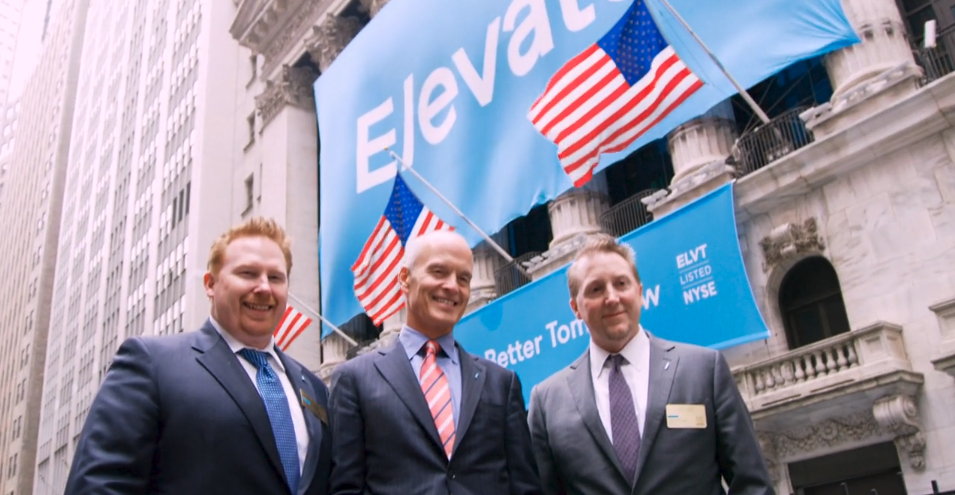 Elevate’s net income increased 459 percent from $1.7 million in Q1 2017 to $9.5 million in Q1 2018, according to the company’s Q1 financial statement released on April 30th.
“What you are now seeing is a business beginning to leverage its scale in a market that is almost boundless,” said Elevate CEO Ken Rees. “We are gratified by our strong start to 2018 and by the fact that we’ve done it offering what we believe are the most responsible credit products available to non-prime borrowers today.”
Elevate (NYSE: ELVT) provides funding solutions to non-prime consumer customers. They offer three products: RISE, a state-licensed online lender that offers up to $5,000 in unsecured installment loans and lines of credit, Elastic, a bank-issued line of credit, and Sunny, a short-term loan product for customers in the UK. RISE and Elastic serve the US market.
The RISE product has performed well, likely buoyed by the hiring of Tony Leopold a year ago to build on the product. Elevate is still new as a public company. It recently celebrated its one year anniversary on the New York Stock Exchange in April.
According to the Q1 earnings report, the total number of new customer loans for the first quarter of 2018 was approximately 70,000, an increase of 32.1 percent compared to approximately 53,000 new customer loans in the first quarter of 2017.
Founded in 2014, the Fort Worth, TX-based company has originated $5.5 billion to 1.9 million customers. The company also has offices in Dallas, TX, San Diego, CA, and in the UK, in London and Bury St. Edmunds.
Square Funded $339M to SMBs in Q1
May 2, 2018
Square’s small business funding arm, Square Capital, made over 50,000 business loans for a total of $339 million in Q1, according to the company’s latest earnings report. That figure is a 35% increase year-over-year and puts them on pace to break last year’s $1.177B total. OnDeck, by comparison, who is arguably their top rival, made $2.11B in business loans last year.
“[..] they just don’t have another way to get access to that sort of capital. And when they get it, they invest in their business,” Square CFO Sarah Friar, said of their merchants during the earnings call. “They’re buying inventory, they’re hiring new employees, they may be taking any lease hold and opening that second location. And when they do that, their business grows and hence our business grows. So, we still think we have a unique product that no one else can really follow us into.”
Square also earned $34 million in revenue from bitcoin, thanks to the Cash App they launched in January that allows users to buy and sell bitcoin. Bitcoin was mentioned an eye-opening 37 times in their quarterly shareholder letter, while their loan program is only referenced 7 times.
Overall, the company brought in $669 million in revenue and recorded a $24 million loss. They also entered into an agreement to buy Weebly, a company that helps people build professional websites and online stores.
“Weebly will expand Square’s customer base globally and add a new recurring revenue stream. Weebly has millions of customers and more than 625,000 paid subscribers,” the company wrote.
Shopify Capital Issued $60.4M in Merchant Cash Advances in Q1
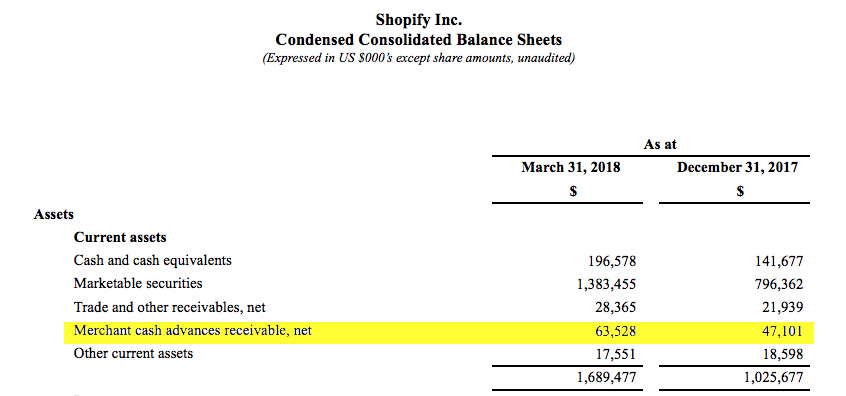
May 1, 2018 Shopify Capital, Shopify’s small business funding arm, issued $60.4 million in merchant cash advances in Q1, according to the company’s earnings report, an increase of more than 300% year-over-year. The company has advanced $230 million to merchants since April 2016.
On the company’s earnings call, Canaccord Genuity equity researcher David Hynes, inquired about the patterns of seasonal demand one could expect for the company’s merchant cash advances.
“So in terms of seasonality on Shopify Capital,” said Shopify COO Harley Finkelstein, “it’s important to note that the use of proceeds for Shopify Capital for most of our merchants tend to be in the realm of inventory or marketing spend, which we quite like, because that leads to more sales, which makes it easier for them to return the capital to us.
“Obviously, there’s the seasonality of capital reflecting the seasonality of retail in general, which is certainly more of a Q4 issue than it is a Q1 issue,” he added.
Canaccord’s Hynes also referred to Shopify’s product as a loan but was corrected by Finkelstein.
“Just keep in mind, these are not loans, these are cash advances, so I want to be very clear about that,” Finkelstein explained.
Shopify is a Canadian e-commerce company headquartered in Ottawa, Ontario. It is also the name of its proprietary e-commerce platform for online stores and retail point-of-sale systems
View the company’s earnings report here
BlueVine Announces $200 Million Credit Facility
May 1, 2018
BlueVine announced today that it has secured a $200 million asset-backed revolving credit facility with Credit Suisse. This will be used to expand its business line of credit product and the company’s customers will now be eligible for a credit line of up to $250,000.
“Capital markets partnerships are critical to our ability to scale and effectively serve our expanding customer base,” said BlueVine CFO Ana Sirbu. “This financing will support our next phase of growth [as] we continue to build a business for the long-term by offering the best working capital financing solutions to business owners.”
The company offers two products – invoice factoring and business lines of credit. The latter was introduced in January 2016 with a maximum credit line of $30,000, Sirbu told AltFinanceDaily. That maximum soon became $50,000 and has steadily risen. In February, the company increased its business line of credit from $150,000 to $200,000.
Founded in 2013 by CEO Eyal Lifshitz, the company first offered only factoring in March 2014. Now, Sirbu said that the breakdown of its business is about even between its factoring and business line credit offerings.
This is BlueVine’s first facility with Credit Suisse. Not counting this facility, the company had $318 million in funding as of October 2017, according to Crunchbase.
BlueVine is headquartered in Redwood City, CA, with other offices in Jersey City, NJ, New Orleans, LA, and a large office in Tel Aviv, Israel, where most of its Research and Development team is based. Altogether, BlueVine employs about 200 people.
Yellowstone Capital Funded $61 Million in April
May 1, 2018Yellowstone Capital originated $61 million in funding to small businesses in April, according to the company. The year-to-date total now exceeds $200 million.
Yellowstone Capital, which is based in Jersey City, NJ, originated $553 million in 2017.
Tips For More Successful Marketing
April 30, 2018 In marketing, there’s a basic tenet that it takes seven “touches” within 18 months to prod someone into action.
Nowadays, with customers exposed to thousands of ads a day and across so many channels, it takes several times that in interactions to generate viable sales leads, according to Samantha Berg, a marketing and strategic partnerships executive with 6th Avenue Capital in New York.
That’s why it’s so important for funders, ISOs, brokers and other alternative funding professionals to have a solid marketing and lead-generation strategy that incorporates multiple channels such as search engine optimization, digital ads, direct mail, email and social media. The challenge, of course, is to find the right balance between being invasive and being top of mind, industry professionals say. Here are a few ways tried and true ways to generate warm leads and potential new business:
DON’T DIS DIRECT MAIL
Many marketers have a negative view about the importance of direct mail to consumers. But consumers may be more interested in this medium than you think. Consider a survey of more than a thousand consumers by Yes Lifecycle Marketing, a provider of email and digital marketing services. According to this study, 56 percent of all consumers say they find direct mail influential when researching a purchase. By contrast, a separate survey by Yes Lifecycle Marketing paints a very different picture of how marketers view direct mail; 78 percent of those polled say they believe direct mail is not influential for any age group.
 One good thing about direct mail is that it can be opened at the merchant’s convenience, unlike a phone call which some merchants find annoying, especially since they often get multiple calls a day from numerous funders. With direct mail, even if a business does not need funding immediately, there’s a decent chance the merchant will keep your information on file for future reference, says Glen Faulhaber, vice president of sales at G-Plex Direct Mail Services in Holtsville, N.Y. Sending a follow-up mailing within a week of the first helps you gain additional brand recognition, he says.
Of course, for direct mail to be successful, certain parameters should be followed. For starters, mailings have to be based off good data; meaning the people or businesses you are sending to have a high likelihood of needing funds. Without worthwhile data, you’re basically throwing money out the window, Faulhaber says.
Timing is also important, he says. With direct mail, Faulhaber says you have about five seconds to get someone’s attention, so your message has to be catchy.
MAKE YOUR WEBSITE SHINE
Trey Markel, a software specialist at CentrexSoftware, a customer relationship management software company in Costa Mesa, Calif., says it’s shocking how many funders don’t use their websites to generate leads. Markel, who consults with B2B lenders and MCA providers on marketing strategies using enterprise software, recommends funders spend time working on their website so that it appeals to all types of visitors: those who want to read relevant articles, those who want to watch webcasts and those who want to listen to podcasts.
The idea is for funders to use their website to provide helpful information to merchants that will, in turn, encourage them to seek funding from you. For instance, you might consider hosting monthly webinars on topics such as how businesses can use loaned money to increase their marketing budget. Another topic merchants may find appealing is how to use credit cards to increase customers. “You give them a solution to a problem, and then you give them the money to go afford that solution,” Markel says.
Many funders know how to close a deal, but they fail to understand that the consultative approach over time will gain them even more business, Markel says. “Becoming a trusted information source in the industry is so much more valuable to customers than just being a funder,” he says. The industry needs “professionals who are going to tell you how to solve a problem.”
GET PERSONAL
Jennie Villano, vice president of business development at Kalamata Advisors LLC, says ISOs looking to build their business should attend networking events where small businesses are present. Sounds simple, but many ISOs don’t take advantage of this, meaning a missed opportunity to connect with “people from every facet” including accountants and other business professionals who can be a good source of referrals.
She also recommends ISOs hire at least one professional who is warm, trusting and engaging to visit merchants at their place of business. She recommends they pick places such as local strip malls which have a sizeable number of merchants. If you saw 20 merchants a day and only two funded with you that amounts to 40 extra deals a month, she points out. “Many ISOs would benefit from an extra 40 deals a month,” she says. On top of that, you have additional touchpoints because each of the merchants you visit may tell other businesses about your services, she says.
USE SOCIAL MEDIA
ISOs should also use social media more often than they do now—and not just to find sales help, Villano recommends. She uses it to target ISOs, but in the course of that, she gets inquiries from small businesses. ISOs should be using social media to find small businesses in need of funds. “I just don’t know why they aren’t using it more. It has tremendous reach,” she says.
To be sure, you don’t have to bombard your connections with posts. Once every other week is a good target. Make sure to include your business name and phone number, but posts shouldn’t be a hard sell. “There are ways to stand out and get your message across without appearing pushy or too sales oriented. The two-minute video ‘Cooking with Kalamata Capital’ that went viral in the industry is an example,” she says.
Also remember there are many social media venues. Sometimes funders focus their efforts on LinkedIn, Facebook and, to a lesser extent, Twitter. But Instagram and Pinterest can also be used to target potential customers. Posting aspirational videos or photos in these venues can help encourage businesses to think about ways to fund the things they might need, says Berg of 6th Avenue Capital.
USE EMAIL MARKETING TO YOUR ADVANTAGE
Some funding professionals say text messaging works well for them, though others prefer email for a host of reasons.
For one thing, it’s a “little less intrusive” than a telephone call or a text, Berg says. Also, with email, there’s ample ability to personalize, and you can run analytics to determine helpful metrics such as open rates and click-through rates, for example. You can compare how these metrics change when you tinker slightly with email subject lines or messages.
“We see email as a very viable channel,” she says.
Another advantage of email is that it helps funders and brokers get around the restrictions imposed by the Telephone Consumer Protection Act (TCPA) that has hampered lead generators’ ability to solicit business owners, says Michael O’Hare, president of Blindbid, a B2B lead generation site.
With email, you can direct the prospect to click on a link, which then triggers a phone call from a sales rep. In an environment when cold-calling can result in a lawsuit, email is a viable alternative, says O’Hare, an outspoken opponent of TCPA restrictions for business-related matters.
A growing number of funders are also using or exploring the use of artificial intelligence to help with lead generation, says Matthew Martin, managing director of Silver Bullet Marketing, a provider of trigger lead data.
One company that’s working in this area is AI Assist. Using Conversica, an AI-powered virtual sales assistant, funders can send automated emails to prospects. The automated sales assistant determines whether the prospect is interested, and if so, it alerts a human sales representative. The automated sales assistant can also gather additional information from a lead, such as the best phone number and best time to call. The entire “dialogue” is available for the human sales rep to review.
“AI is not going to make the sale for you, but it’s going to give you enough information to move forward,” Martin says.
 REFINE YOUR LEADS
To generate leads, funders, ISOs and brokers tend to buy banner ads on Google or send an email blast with a link for interested businesses to click on. The link usually directs businesses to an online form that typically asks for their name, telephone number, email and how much money is being requested.
But it doesn’t generate meaningful information about the business or what type of funding product the business is looking for, says O’Hare of Blindbid. These forms don’t typically include critical information such as whether the person has been in business for less than a year, whether he or she has mounds of debt or what kind of funding the business is seeking.
One way to get better, more tailored leads is with “lead quizzes” similar to those used by the online insurance industry, he says. Instead of a basic form, potential leads would be directed to fill out a form that has much more pointed questions about the person, the business and the type of funding sought, he explains. Some questions might be, for instance: Is your credit score over 500? Have you been in business for more than a year? And, what type of funding are you seeking? Based on the merchant’s responses, he or she could be directed to a certain funding product or a specific funder, if you’re an ISO working with multiple providers. The funder could also decide to pass on an opportunity based on a merchant’s answers to the lead quiz.
O’Hare says he doesn’t know of MCA providers currently using this type of form, but it’s one of the things he’s working on as a way to generate better leads for his clients. With the basic forms many funders use today, you get a “lot of garbage,” O’Hare says.
Certainly, there are many ways to market and get leads, but industry professionals say one thing is clear: you can’t rely on one avenue alone. According to Markel of CentrexSoftware, too many in the industry put too much faith in raw data that gets plugged into a phone system dialer. The quality of this data isn’t always the best, which means funding professionals are wasting a lot of time, he says. “There are only so many small businesses in the country and an even smaller amount that are fundable,” he says.
6th Avenue Capital Announces Promotion of Darren Schulman to President
April 26, 2018Former Chief Operating Officer also appointed to company’s Board of Directors along with Chief Executive Officer Christine Chang
 New York City – April 26, 2018 – 6th Avenue Capital, LLC (“6th Avenue Capital”), a leading provider of choice for alternative small business funding, announced today the promotion of Darren Schulman to President, effective immediately. In his new position, Schulman has oversight over originations, underwriting, operations, collections and strategic initiatives. He previously served as Chief Operating Officer, and will continue to report directly to Chief Executive Officer Christine Chang.
The company also announced today that Chang and Schulman have been appointed to the company’s Board of Directors.
“We are extremely fortunate to have a well-respected industry expert and innovator like Darren on our leadership team,” said Chang. “He’s made immeasurable contributions to our strategic direction and growth since joining us last year. I am confident Darren will continue to play a critical role in guiding our business forward in his new position as President.”
Schulman brings two decades of experience in small business financing and additional experience in banking to his new position. He joined 6th Avenue Capital in March 2017. Previously, Schulman served as COO at Capify (formerly AmeriMerchant), a global small business financing company, and President and CFO at MRS Associates, a Business Process Outsourcing (BPO) company specializing in collections. In addition, Schulman was an Executive Vice President at MTB Bank.
“6th Avenue Capital is made up of exceptional individuals who are focused daily on advancing the capital needs of small businesses. I am honored by the promotion and delighted to be joining the Board with Christine,” said Schulman. “Together we will continue to set a strategic course for our company and build on the momentum we’ve established over the past year helping small businesses across the country grow.”
For more information on these updates, or if you’re interested in discussing partnership opportunities with 6th Avenue Capital as an ISO, please contact Marc Seidel at bizsuccess@6thAveCap.com. You can also use that same email address to schedule time to meet with members of the team at the National Association of Equipment Leasing Brokers (NAELB) conference in Las Vegas from April 26 to 28.
About 6th Avenue Capital, LLC
6th Avenue Capital is changing the small business funding landscape by offering a data-driven underwriting process and fast access to capital with variable payment options. 6th Avenue Capital employs a unique blend of industry experts who are committed to the highest operating standards, including high touch service and a policy of direct merchant access to underwriters. For more information, visit www.6thavenuecapital.com or email bizsuccess@6thAveCap.com.
Media Contact
Bill McCue
Indicate Media
bill@indicatemedia.com
718.208.7391
Gale Force Twins
April 24, 2018
As Hurricane Irma swept through the Caribbean and barreled toward the Florida Keys early last September, Wendy Vila, chief executive, at Unicus Capital evacuated her home in West Palm Beach and decamped to Panama City in the Florida panhandle where “it was just a little bit rainy.”
After safely waiting out Irma, she says, her return south was precarious. The roads were strewn with tree branches and other debris. Fuel was scarce. Many gas stations were either closed or posted signs reading “No Gas.” “Restaurants had run out of food,” Vila adds, “so there was nothing to eat” along the highway.
She returned to West Palm Beach but didn’t stay long. Instead, Vila again drove west, this time across the Florida peninsula to the South Florida city of Naples, not far from where Irma had made landfall. “I went there to volunteer with Samaritan’s Purse for two days,” she says, referring to the Boone, N.C.-based Christian organization that provides humanitarian aid to people in physical need. “Things were a lot worse there than in West Palm Beach,” she reports. “A lot of trees were down, houses were flooded and people had to throw all of their belongings out onto the street.”
Meanwhile, many of the Florida merchants whom Unicus funds were distressed. “If people had no power,” Vila says, “they couldn’t function. A lot of businesses had to close down. For some merchants in the affected areas,” she adds, Unicus extended “a 90-day grace period.”

Vila’s experience with Hurricane Irma – both professionally and personally — is not an isolated one. She is among several business lenders whom AltFinanceDaily interviewed about the storm and its aftermath. This article grew out of AltFinanceDaily’s Florida networking event at the Gale Hotel in South Beach in late January. We went back to many of the attendees as well as to other business-funders in The Sunshine State and sought out their experiences before, during and after the powerful tempest.
At one point, Hurricane Irma was the strongest hurricane ever recorded in the Atlantic by the National Hurricane Center. As Irma took dead aim at Florida, it packed sustained winds exceeding 157 miles per hour, earning it the designation of a Category 5 storm, the highest and most destructive. It slammed into the Florida Keys as a Category 4 hurricane, reached the Gulf of Mexico, and then came ashore a second time on Florida’s west coast at Marco Island, just south of Naples, and began traversing the state as a Category 3 hurricane, gradually losing strength. By the time Irma exited Florida, it had been downgraded to a tropical storm. According to the National Hurricane Center, Irma caused an estimated $50 billion in damage in the U.S., making it the fifth-costliest hurricane to hit the mainland.
Financiers and brokers told personal stories of working with and assisting merchants across Florida who sought to regain their lost footing and keep from going — literally — underwater. In many cases, members of the alternative business financing community said, they were simultaneously assisting troubled merchants while they themselves struggled with Irma-occasioned troubles that ranged from inconvenience to hardship.
“I was ten days without power,” says Manny Columbie, funding manager at Axiom Financial, based in South Miami. Columbie, who lives in the residential Westchester district of Miami, not far from the campus of Florida International University, says that he conducts much of his business from his home. That power loss not only constrained his ability to keep working but posed a life-or-death situation for his family: Columbie’s 90-year-old grandmother, who lives with him and his girlfriend, depends on electrical power to operate her oxygen pump.
 Fortunately, he says, he had a backup generator, the use of which alternated between providing power for his grandmother’s oxygen and the family’s refrigerator. Meanwhile, his roof was leaking and there was six inches of rainwater swamping the house — the water gushing into the kitchen through the laundry room, dishwasher and even the oven.
While Columbie saw instances of tempers growing short in Miami’s September heat, he was nonetheless cheered by the way his community responded. “Neighbors were coming by to see if I needed gasoline for my generator,” Columbie says. “People were firing up food on their outside grills. There was no air-conditioning or cold showers but we cooled off by jumping in a neighbor’s pool. I saw a lot of people coming together.”
At the same time, he was doing what he could to assist merchants who did business with Axiom. Only one – a retail clothing store in Miami – was permanently shuttered. One of his clients, Oscar Pratt, owner of Odessy Party Supplies in Miami Gardens, was grateful for a moratorium on daily payments.
“We’re in the business of selling party accessories for events from births to funerals and everything in-between,” Pratt says. “Baby showers, christenings, birthdays, quinceaneras, ‘Sweet Sixteens,’ graduations, weddings, and all kinds of themed parties like Halloween,” he says. “We sell plates and cups, candy bags, cake-toppers, small favors, pinatas…”
Pratt said he’d called his funders ahead of the storm and “requested some leeway” from payments. Once the storm hit – and for two weeks afterward while there was no electricity – the party-supply business was pretty much on hold. “We had a few days without electricity or phone,” he says. “We couldn’t open the doors and do business because we use computer-generated receipts. Our customer base was down to just about nothing. Without electricity, people weren’t working and they weren’t having parties.”
Following the two-week grace period, Pratt says that his funders, which included QuarterSpot, granted a second two-week period of leniency in which Odessy was allowed to make reduced payments. “It was very difficult,” he says. “There was no help from FEMA (Federal Emergency Management Agency) or from our insurance company since we’re on high ground and there were no physical damages, just the electricity.”
He reckoned that Odessy, which boasts annual revenues of $1.2 million, was deprived of roughly $50,000-$60,000 in sales because of Irma. Pratt reports that if his lenders had “played hardball” and demanded that he make his payments, he could have stayed in business thanks to “cash on hand” but it wouldn’t have been easy.
Meantime, his lenders’ forbearance was soon rewarded. By October, business was back to normal and he resumed making payments in full. “As soon as the lights went on,” Pratt says, “the parties started again.”
Similarly, says Paul Boxer, chief marketing officer at Quicksilver Capital in Brooklyn, the ultimate impact of Hurricane Irma on his firm’s funding business was to build trust and cement relationships with clients in South Florida. “We had a full team on board to answer the large number of calls coming in and to assist our merchants with any questions they had,” he says.
 Many affected merchants, Boxer reports, were forced to evacuate ahead of the storm. When they returned, it was common for them to discover that their shops and stores sustained flooding damage from the heavy rains and a storm surge. Roofs were blown-off and structures were battered by 100-plus mile-an-hour winds, falling trees, and whipped-up debris. Even businesses that suffered little damage were paralyzed by the loss of electricity, impassable roads, and the absence of customers.
“Some were down for a few days,” Boxer reports. “Some were down a month to two months. We kept in touch. We were really on top of things with our merchants and asking them what they needed. We even fielded general safety questions and directed them on whom to call with insurance questions and other related business questions. It was good business,” he adds, “because it showed you cared. We were looking to do the right thing by our merchants and they appreciated it.”
Quicksilver typically offered merchants a two-to-three week “reprieve” on payments, Boxer says. For those businesses and entreprenuers whose operations were “completely out of commission” and needed more time, he says, the company suspended payments for as long as two months.
In the end, Quicksilver’s policy of forbearance reaped dividends. It not only built up good will with its customer base but also with the Independent Sales Organizations (ISOs) who’d brokered many of the firm’s Florida deals. “We helped grow that relationship,” Boxer says of the merchant-ISO connection. “They (ISOs) love getting renewals. It’s been a win-win for everybody.”
Doug Rovello, senior managing partner at Fund Simple, Inc., an alternative business lender and broker in Palm Harbor, a beach town just outside Tampa, says the Tampa-St. Petersburg area was spared from severe flooding but “we did experience power outages.” Among his clients, he reports, businesses in the food industry were among the most vulnerable. “I had one restaurant that lost $200,000 in business in the month of September,” he says.
 When the electricity went down, grocery stores and bodegas, restaurants, bars, pizzerias, sub shops, delis and luncheonettes suffered outsized losses. Without power, businesses in the food industry were forced to dump spoiled meat, rotting fish, unusable dishes like appetizers and other foodstuffs requiring refrigeration.
Rovello reports that the hurricane managed to bollix up the business of one top client, a leading ticket broker in the area with a reputation for obtaining “exclusive” tickets to major events such as A-list rock concerts and featured sporting contests – including the Super Bowl. “He buys tickets in advance and when one big event was canceled he got stuck with $30,000 in tickets that he had to eat,” Rovello says.
Other kinds of businesses that depend on alternative lenders and got hit hard from the loss of power, Rovello observes, were medical clinics, doctors’ offices, pain-management centers, and assisted-living quarters – particularly those south of Sarasota. A number of golf courses also closed down for a couple of weeks, Rovello notes, further impairing the tourism and entertainment economy. “They were not allowed to move any of the damage that was done – poles, trees, et cetera until FEMA got there,” he says.
For some 30 days following Irma’s arrival, Rovello reports that he asked clients to make modest payments – perhaps $100 instead of a $750 monthly payment — “to keep their accounts active.” He also used his connections with FEMA adjusters and interceded with funders on behalf of clients– and even businesses that were not clients – who found themselves in arrears.

While many Floridians were seeking higher ground or hightailing it out of state, Jay Bhatt, who is a senior vice president of marketing at Breakout Capital in McLean, Va., was catching one of the last Jet Blue flights into Orlando to help out his aging parents. They are now in their late 60s and 70s, he reports, and living in a retirement community in Polk County, about ten miles south of Disney World.
Irma was still a Category 1 hurricane with 100 mph winds when it hit Orlando. The electrical grid went down, but Bhatt was able to purchase a generator – the kind designed specifically to provide electricity for oxygen respirators — from Home Depot. During his stay, Bhatt made several car trips in search of fuel, each of which took him probably 35-40 minutes. “We also leveraged some of the neighbors’ sockets,” he says, “but they were so small that the wattage only allowed for the operation of the fridge and a fan.”
Electricity was restored after four or five days. “The fact that it was a retirement community might have been why we got power back so soon while it took two or three weeks for many others,” he reckons.
 While Bhatt’s attention was focused on his parents, his employer – which had just offered a blanket hold on payments to its merchant accounts in 11 Texas counties that had been simultaneously inundated and walloped by Hurricane Harvey – now faced the challenge of responding to the second hurricane in two weeks. With Irma, Breakout chose to deal with its customers individually. “We didn’t do an immediate blanket response” as in Texas, Bhatt says, adding: “We were able to contact each one and we only wrote off one small business.”
Rakem Lampkin, senior customer service representative at Pearl Capital, a New York-based alternative funder, says that his firm funds “roughly 175” businesses in South Florida. In addition to those establishments already mentioned as economically reeling because of Irma, such as restaurants, he cited “car dealerships, automotive repair shops and tech companies” as among the hardest hit, especially from the lack of electricity.
Lampkin also noted that many of Pearl’s merchants felt Irma’s wrath when colleges and state schools closed their doors. “Everything from transportation, lunches, sports equipment, even mom-and-pop florists” were slammed, he says, adding: “When the schools shut down, our payments slowed down.”
Pearl provided preferential treatment to merchants on the coast who were granted “a hold on debit payments,” Lampkin says. Even for coastal businesses that remained “structurally sound,” the business owners’ and employees’ “homes were affected, which kept them from getting to work,” he says.
As for businesses situated inland, “We were still sympathetic,” Lampkin says, but after an initial five-day grace-period their discounts were in the range of 66%-75% “so that we could focus our resources toward the people on the coast.”
To monitor the situation from New York, Lampkin says, the company was able to rely on accounts in the local news media, Google Maps, and other Internet sources. “We evaluated the situation case-by-case and week-by-week,” he says.
Jennifer Legg, a co-owner of Rochelle’s Jewelry & Watch Repair at the Indian River Mall in Vero Beach, is a Pearl-funded merchant who says she shut down the family-run business “for six or seven days” after Irma while the electricity went out. “Trees were down and a lot of people lost food and trailers, but we were not impacted as much as we were supposed to be,” she remarked.
Most of the shop’s business consists of customers stopping in for a new battery or a watch-band. Once they’re in the store, there’s a chance that they’ll purchase something else. But Irma put the kibosh on mall traffic. “A lot of people left the state, so that hurt business,” Legg says.
The store – which records annual sales of about $200,000 — lost probably $10,000 in revenue because of Irma. “It was very hard for that month of September,” Legg says. “Even after the doors opened, it was dead. No money came in for about two weeks.”
Fortunately, though, her capital source “did not take money out for a week,” she says. “If they’d kept taking it out,” she added, “we would have defaulted.”