
California DBO Making Progress On Finalizing Rules Required By The New Disclosure Law
July 29, 2019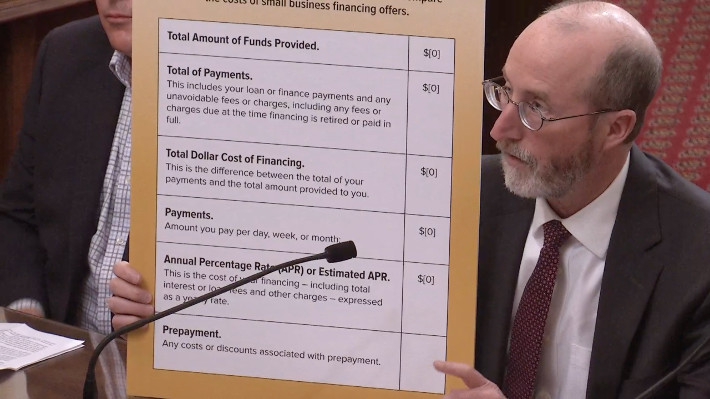 Last October, California Governor Jerry Brown signed a new commercial finance disclosure bill into law. The bill, SB 1235, was a major source of debate in 2018 because of its tricky language to pressure factors and merchant cash advance providers into stating an Annual Percentage Rate on contracts with California businesses. The final version of the bill, however, delegated the final disclosure format requirements to the State’s primary financial regulator, the Department of Business Oversight (DBO).
The DBO then issued a public invitation to comment on how that format should work. They got 34 responses. Among them were Affirm, ApplePie Capital, Electronic Transactions Association, Commercial Finance Coalition, Fora Financial, Equipment Leasing and Finance Association, Innovative Lending Platform Association, International Factoring Association, Kapitus, OnDeck, PayPal, Rapid Finance, Small Business Finance Association, and Square Capital.
On Friday, the DBO published a draft of its rules along with a public invitation to comment further. The 32-page draft can be downloaded here. The opportunity to comment on this version of the rules ends on Sept 9th.
You can review the comments that companies submitted previously here.
Amazon Now Among The Top Online Small Business Lenders in The United States
May 8, 2019
Amazon has joined PayPal, OnDeck, Kabbage, and Square as being among the largest online small business lenders. On Tuesday, Amazon revealed that it had made more than $1 billion in small business loans to US-based merchants in 2018. Amazon says the capital is used to build inventory and support their Amazon stores.
By selling on Amazon, “SMBs do not need to invest in a physical store or the costs of customer discovery, acquisition, and driving customer traffic to their branded websites,” the company says. Small and medium-sized businesses selling in Amazon’s stores now account for 58 percent of Amazon’s sales. More than 200,000 SMBs exceeded $100,000 in sales on Amazon in 2018 and more than 25,000 surpassed $1 million.
You can view the full report they published here.
| Company Name | 2018 Originations | 2017 | 2016 | 2015 | 2014 | |
| PayPal | $4,000,000,000* | $750,000,000* | ||||
| OnDeck | $2,484,000,000 | $2,114,663,000 | $2,400,000,000 | $1,900,000,000 | $1,200,000,000 | |
| Kabbage | $2,000,000,000 | $1,500,000,000 | $1,220,000,000 | $900,000,000 | $350,000,000 | |
| Square Capital | $1,600,000,000 | $1,177,000,000 | $798,000,000 | $400,000,000 | $100,000,000 | |
| Amazon | $1,000,000,000 | |||||
| Funding Circle (USA only) | $792,000,000 | $514,000,000 | $281,000,000 | |||
| BlueVine | $500,000,000* | $200,000,000* | ||||
| National Funding | $494,000,000 | $427,000,000 | $350,000,000 | $293,000,000 | ||
| Kapitus | $393,000,000 | $375,000,000 | $375,000,000 | $280,000,000 | ||
| BFS Capital | $300,000,000 | $300,000,000 | $300,000,000 | |||
| RapidFinance | $260,000,000 | $280,000,000 | $195,000,000 | |||
| Credibly | $290,000,000 | $180,000,000 | $150,000,000 | $95,000,000 | $55,000,000 | |
| Shopify | $277,100,000 | $140,000,000 | ||||
| Forward Financing | $210,000,000 | $125,000,000 | ||||
| IOU Financial | $125,000,000 | $91,300,000 | $107,600,000 | $146,400,000 | $100,000,000 | |
| Yalber | $65,000,000 |
OnDeck Slips To #3 in Tight Pack of Top Small Business Lenders
May 3, 2019 With most 2019 Q1 earnings in for public companies, the industry’s biggest lenders are off to the races. Square reported on Wednesday that Square Capital, its business lending arm, originated $508 million in loans in the first quarter of the year. Meanwhile, OnDeck originated $636 million this quarter, according to its earnings report released yesterday. Kabbage, which is not a public company, has been trailing very closely behind OnDeck for the last few years but someone familiar with the company said that Kabbage’s originations in the first quarter of this year surpassed OnDeck’s.
Then there is PayPal, which has not released official origination numbers for 2019 Q1. But earlier statements from PayPal that they had surpassed a billion dollars in quarterly small business funding in 2018 (already more than OnDeck), would put it in the #1 slot for originations. Additionally, a comment made by PayPal CEO Dan Schulman during the company’s earnings call last week implied that its Q1 2019 earnings are again over a billion dollars.
PayPal’s estimated originations number represents its US and international originations, including their business financing products available in the UK, Australia, Germany and Mexico. Likewise, OnDeck’s number represents originations from the US along with its smaller markets in Australia and Canada.
Square Capital operates exclusively in the US, so its originations number is US-only. And Kabbage’s undisclosed estimated originations number represents purely US originations.
| Company Name | 2019 Q1 Funding Volume |
| PayPal | $1,000,000,000+ |
| Kabbage | $650,000,000* |
| OnDeck | $636,000,000 |
| Square | $508,000,000 |
Shopify Capital Issued $87.8M in Merchant Cash Advances in Q1
April 30, 2019Shopify’s small business funding division, Shopify Capital, issued $87.8 million in merchant cash advances in the first quarter of 2019, according to the company’s earnings report. The figure is a 45% increase over the same period last year. Overall, the company has funded more than $535 million in MCAs since inception.
Shopify is primarily an e-commerce platform, but they are quickly becoming a competitor to both Square and PayPal, both of whom also offer funding solutions.
Online Loans You Can Take To The Bank
April 16, 2019
OnDeck, the reigning king of small business lending among U.S. financial technology companies, is sharpening its business strategies. Among its new initiatives: the company is launching an equipment-finance product this year, targeting loans of $5,000 to $100,000 with two-to-five year maturities secured by “essential-use equipment.”
In touting the program to Wall Street analysts in February, OnDeck’s chief executive, Noah Breslow, declared that the $35 billion, equipment-finance market is “cumbersome” and he pronounced the sector “ripe for disruption.”
While those performance expectations may prove true – the first results of OnDeck’s product launch won’t be seen until 2020 – Breslow’s message seemed to conflict with OnDeck’s image as a public company. Rather than casting itself as a disruptor these days, OnDeck emphasizes the ways that its business is melding with mainstream commerce and finance.
 Consider that the New York-based company, which saw its year-over-year revenues rise 14% to $398.4 million in 2018, is collaborating with Visa and Ingo Money to launch an “Instant Funding” line-of-credit that funnels cash “in seconds” to business customers via their debit cards. With the acquisition of Evolocity Financial Group, it is also expanding its commercial lending business in Canada, a move that follows its foray into Australia where, the company reports, loan-origination grew by 80% in 2018.
Perhaps most significant was the 2018 deal that OnDeck inked with PNC Bank, the sixth-largest financial institution in the U.S. with $370.5 billion in assets. Under the agreement, the Pittsburgh-based bank will utilize OnDeck’s digital platform for its small business lending programs. Coming on top of a similar arrangement with megabank J.P. Morgan Chase, the country’s largest with $2.2 trillion in assets, the PNC deal “suggests a further validation of OnDeck’s underlying technology and innovation,” asserts Wall Street analyst Eric Wasserstrom, who follows specialty finance for investment bank UBS.
“It also reflects the fact that doing a partnership is a better business model for the big banks than building out their own platforms,” he says. “Both banks (PNC and J.P. Morgan) have chosen the middle ground: instead of building out their own technology or buying a fintech company, they’ll rent.
 “J.P. Morgan has a loan portfolio of $1 trillion,” Wasserstrom explains. “It can’t earn any money making loans of $15,000 or $20,000. Even if it charged 1,000 percent interest for those loans,” he went on, “do you know how much that will influence their balance sheet? How many dollars do think they are going to earn? A giant zero!”
Similarly, Wasserstrom says, spending the tens of millions of dollars required to develop the state-of-the art technology and expertise that would enable a behemoth like J.P. Morgan or a super-regional like PNC to match a fintech’s capability “would still not be a big needle-mover. You’d never earn that money back. But by partnering with a fintech like OnDeck,” he adds, “banks like J.P Morgan and PNC get incremental dollars they wouldn’t otherwise have.”
The alliance between OnDeck and old-line financial institutions is one more sign, if one more sign were needed, that commercial fintech lenders are increasingly blending into the established financial ecosystem.
Not so long ago companies like OnDeck, Kabbage, PayPal, Square, Fundation, Lending Club, and Credibly were viewed by traditional commercial banks and Wall Street as upstart arrivistes. Some may still bear the reputation as disruptors as they continue using their technological prowess to carve out niche funding areas that banks often neglect or disdain.
Yet many fintechs are forming alliances with the same financial institutions they once challenged, helping revitalize them with new product offerings. Other financial technology companies have bulked up in size and are becoming indistinguishable from any major corporation.
Big Fintechs are securitizing their loans with global investment banks, accessing capital from mainline financial institutions like J.P. Morgan, Goldman Sachs and Wells Fargo, and finding additional ways — including becoming publicly listed on the stock exchanges – to tap into the equity and debt markets.
 One example of the maturation process: through mid-2018, Atlanta-based Kabbage has securitized $1.5 billion in two bond issuances, 30% of its $5 billion in small business loan originations since 2008.
In addition, fintechs have been raising their industry’s profile with legislators and regulators in both state and federal government, as well as with customers and the public through such trade associations as the Internet Lending Platform Association and the U.S. Chamber of Commerce. Both individually and through the trade groups, these companies are building goodwill by supporting truth-in-lending laws in California and elsewhere, promoting best practices and codes of conduct, and engaging in corporate philanthropy.
Rather than challenging the established order, S&P Global Market Intelligence recently noted in a 2018 report, this cohort of Big Fintech is increasingly burrowing into it. This can especially be seen in the alliances between fintech commercial lenders and banks.
“Bank channel lenders arguably have the best of both worlds,” Nimayi Dixit, a research analyst at S&P Global Market Intelligence wrote approvingly in a 2018 report. “They can export credit risk to bank partners while avoiding the liquidity risks of most marketplace lending platforms. Instead of disrupting banks, bank channel lenders help (existing banks) compete with other digital lenders by providing a similar customer experience.”
It’s a trend that will only accelerate. “We expect more digital lenders to incorporate this funding model into their businesses via white-label or branded services to banking institutions,” the S&P report adds.
Forming partnerships with banks and diversifying into new product areas is not a luxury but a necessity for Fundation, says Sam Graziano, chief executive at the Reston (Va.)-based platform. “You can’t be a one-trick pony,” he says, promising more product launches this year.
Fundation has been steadily making a name for itself by collaborating with independent and regional banks that utilize its platform to make small business loans under $150,000. In January, the company announced formation of a partnership with Bank of California in which the West Coast bank will use Fundation’s platform to offer a digital line of credit for small businesses on its website.
 Fundation lists as many as 20 banks as partners, including most prominently a pair of tech-savvy financial institutions — Citizens Bank in Providence, R.I. and Provident Bank in Iselin, N.J. — which have been featured in the trade press for their enthusiastic embrace of Fundation.
John Kamin, executive vice president at $9.8 billion Provident reports that the bank’s “competency” is making commercial loans in the “millions of dollars” and that it had generally shunned making loans as meager as $150,000, never mind smaller ones. But using Fundation’s platform, which automates and streamlines the loan-approval process, the bank can lend cheaply and quickly to entrepreneurs. “We’re able to do it in a matter of days, not weeks,” he marvels.
Not only can a prospective commercial borrower upload tax returns, bank statements and other paperwork, Kamin says, “but with the advanced technology that’s built in, customers can provide a link to their bank account and we can look at cash flows and do other innovative things so you don’t have to wait around for the mail.”
Provident reserves the right to be selective about which loans it wants to maintain on its books. “We can take the cream of the crop” and leave the remainder with Fundation, the banker explains. “We have the ability to turn that dial.”
The partnership offers additional side benefits. “A lot of folks who have signed up (for loans) are non-customers and now we have the ability to market to them,” he says. “After we get a small business to take out a loan, we hope that we can get deposits and even personal accounts. It gives us someone else to market to.”
As a digital lender, Provident can now contend mano a mano with another well-known competitor: J.P. Morgan Chase. “This is the perfect model for us,” says Kamin, “it gives us scale. You can’t build a program like this from scratch. Now we can compete with the big guys. We can compete with J.P. Morgan.”
For Fundation, which booked a half-billion dollars in small business loans last year, doing business with heavily regulated banks puts its stamp on the company. It means, for example, that Fundation must take pains to conform to the industry’s rigid norms governing compliance and information security. But that also builds trust and can result in client referrals for loans that don’t fit a bank’s profile. “For a bank to outsource operations to us,” Graziano says, “we have to operate like a bank.”
Bankrolled with a $100 million line of credit from Goldman Sachs, Fundation’s interest rate charges are not as steep as many competitors’. “The average cost of our loans is in the mid-to-high teens and that’s one reason why banks are willing to work with us,” Graziano says. “Our loans,” he adds, “are attractively structured with low fees and coupon rates that are not too dramatically different from where banks are. We also don’t take as much risk as many in the (alternative funding) industry.”
Despite its establishment ties, Graziano says, Fundation will not become a public company anytime soon. “Going public is not in our near-term plans,” he told AltFinanceDaily. Doing business as a public company “provides liquidity to shareholders and the ability to use stock as an acquisition tool and for employees’ compensation,” he concedes. “But you’re subject to the relentlessly short-term focus of the market and you’re in the public eye, which can hurt long-term value creation.”
Graziano reports, however, that Fundation will be securitizing portions of its loan portfolio by yearend 2020.
 PayPal Working Capital, a division of PayPal Holdings based in San Jose, and Square Inc. of San Francisco, are two Big Fintechs that branched into commercial lending from the payments side of fintech. PayPal began making small business loans in 2013 while Square got into the game in 2014. In just the last half-decade, both companies have leveraged their technological expertise, massive data collections, data-mining skills, and catbird-seat positions in the marketplace to burst on the scene as powerhouse small business lenders.
With somewhat similar business models, the pair have also surfaced as head-to-head competitors, their stock prices and rivalry drawing regular commentary from investors, analysts and journalists. Both have direct access to millions of potential customers. Both have the ability to use “machine learning” to reckon the creditworthiness of business borrowers. Both use algorithms to decide the size and terms of a loan.
Loan approval — or denials — are largely based on a customer’s sales and payments history. Money can appear, sometimes almost magically in minutes, in a borrower’s bank account, debit card or e-wallet. PayPal and Square Capital also deduct repayments directly from a borrower’s credit or debit card sales in “financing structures similar to merchant cash advances,” notes S&P.
At its website, here is how PayPal explains its loan-making process. “The lender reviews your PayPal account history to determine your loan amount. If approved, your maximum loan amount can be up to 35% of the sales your business processed through PayPal in the past 12 months, and no more than $125,000 for your first two loans. After you’ve completed your first two loans, the maximum loan amount increases to $200,000.”
PayPal, which reports having 267 million global accounts, was adroitly positioned when it commenced making small business loans in 2013. But what has really given the Big Fintech a boost, notes Levi King, chief executive and co-founder at Utah-based Nav — an online, credit-data aggregator and financial matchmaker for small businesses – was PayPal’s 2017 acquisition of Swift Financial. The deal not only added 20,000 new business borrowers to its 120,000, reported TechCrunch, but provided PayPal with more sophisticated tools to evaluate borrowers and refine the size and terms of its loans.
“PayPal had already been incredibly successful using transactional data obtained through PayPal accounts,” King told AltFinanceDaily, “but they were limited by not having a broad view of risk.” It was upon the acquisition of Swift, however, that PayPal gained access to a “bigger financial envelope including personal credit, business credit, and checking account information,” King says, adding: “The additional data makes it way easier for PayPal to assess risk and offer not just bigger loans, but multiple types of loans with various payback terms.”
While PayPal used the Swift acquisition to spur growth and build market share, its rival Square — which is best known for its point-of-sale terminals, its smartphone “Cash App,” and its Square Card — has employed a different strategy.
OF A FREIGHT TRAIN
By selling off loans to third-party institutional investors, who snap them up on what Square calls a “forward-flow basis,” the Big Fintech barged into small business lending with the subtlety of a freight train. In just four years, Square originated 650,000 loans worth $4.0 billion, a stunning rise from the modest base of $13.6 million in 2014.
 Square’s third-party funding model, moreover, demonstrates the benefits afforded from being deeply immersed in the financial ecosystem. Off-loading the loans “significantly increases the speed with which we can scale services and allows us to mitigate our balance sheet and liquidity risk,” the company reported in its most recent 10K filing.
Square does not publicly disclose the entire roster of its third-party investors. But Kim Sampson, a media relations manager at Square, told AltFinanceDaily that the Canada Pension Plan Investment Board — “a global investment manager with more than CA$300 billion in assets under management and a focus on sustained, long term returns” – is one important loan-purchaser.
Square also offers loans on its “partnership platform” to businesses for whom it does not process payments. And late last year the company introduced an updated version of an old-fashioned department store loan. Known as “Square Installments,” the program allows a merchant to offer customers a monthly payment plan for big-ticket purchases costing between $250 and $10,000.
Which model is superior? PayPal’s — which retains small business loans on its balance sheet — or Square’s third-party investor program? “The short answer,” says UBS analyst Wasserstrom, “is that PayPal retains small business loans on its balance sheet, and therefore benefits from the interest income, but takes the associated credit and funding risk.”
Meanwhile, as PayPal and Square stake out territory in the marketplace, their rivalry poses a formidable challenge to other competitors.
Both are well capitalized and risk-averse. PayPal, which reported $4.23 billion in revenues in 2018, a 13% increase over the previous year, reports sitting on $3.8 billion in retained earnings. Square, whose 2018 revenues were up 51 percent to $3.3 billion, reported that — despite losses — it held cash and liquid investments of $1.638 billion at the end of December.
King, the Nav executive, observes that Able, Dealstruck, and Bond Street – three once-promising and innovative fintechs that focused on small business lending – were derailed when they could not overcome the double-whammy of high acquisition costs and pricey capital.
“None of them were able to scale up fast enough in the marketplace,” notes King. “The process of institutionalization is pushing out smaller players.”
Affirm Partners with Walmart for Payments
February 28, 2019 Walmart customers can now pay for items using credit from Affirm, the online consumer lender announced yesterday. Walmart customers can find out how much they qualify for online and then make online or in-store purchases with in three, six or twelve monthly installments. A credit decision is made in real time and does not affect the customer’s credit score, according to Affirm.
“Walmart serves millions and has become a leader in the retail landscape with its commitment to help shoppers ‘save money and live better,’ which closely mirrors our own mission to ‘improve lives’ with our products,” said Max Levchin, founder and CEO at Affirm, as well as a founder of PayPal. “I’m looking forward to introducing Walmart customers to a modern and innovative way to buy the things they need.”
Affirm is now available as a payment option on Walmart purchases ranging from $150 to $2,000. This is not Walmart’s first foray into financing. In fact, in July of last year, Walmart entered into an exclusive partnership with Capital One to issue a Walmart credit card. But Elizabeth Allin, Vice President of Communications at Affirm, said that this partnership is the first point-of-sale loan product partnership for Walmart.
“They’ve really embraced e-commerce and the evolution of digital and mobile,” Allin said of Walmart, which has been the biggest retailer in the world for years.
Now 57 years old, the retail giant is pursuing partnerships with financial organizations to facilitate access to customer credit. But back in 2006, Walmart set its sights on bringing these lending operations in house, by becoming bank. Using a controversial statute, it attempted to get a charter to become an ILC bank. Met with strong opposition from banks and other opponents, Walmart backed down.
Fundbox Increases Speed of B2B Transactions
January 29, 2019 Prashant Fuloria, COO, Fundbox
At the end of last week, Fundbox announced that it has launched an AI-enabled platform for B2B companies at the point of transaction, or check out.
“We’re positioning ourselves to be the PayPal for B2B transactions,” a company spokesperson, Tim Donovan, told AltFinanceDaily. “And that means becoming as ubiquitous as finding Visa, Amex or PayPal in a B2C checkout flow.”
As part of this new e-commerce feature, Fundox can underwrite companies looking to make a purchase in as fast as 45 seconds, Donovan said. And sellers get paid right away. This, of course, is a boon for sellers, who often must wait to get paid. (Fundbox takes on the risk of potentially not getting paid.) For buyers, Fundbox’s terms are generally better compared to using a credit card, Donovan said. As long as the buyer’s credit is approved, they can purchase inventory on an online platform within 3 minutes.
“This [new feature] marks our evolution from a product-centric company to a platform-centric company,” said Prashant Fuloria, COO of Fundbox.
Fundbox offers a number of small business products including small business loans, factoring and lines of credit. Fundbox is partnered with larger companies like Eventbrite, for event organizing, and QuickBooks, for accounting, to help lend to small businesses that use these platforms.
Joust Launches Banking Platform for Entrepreneurs
January 17, 2019 Lamine Zarrad, CEO, Joust
This week marked the launch of the Joust iOS app, a platform for freelancers and small businesses that provides banking, payments, collections and invoice factoring solutions. The Android App is scheduled for release on February 1, 2019.
“We straddle three different domains: payments, merchant processing, and factoring, all in one app,” said Joust co-founder and CEO Lamine Zarrad. “Most freelancers have a bank account, then add a payments account using Stripe or Paypal, or both.Then you need an invoicing tool. Now you’ve accumulated three or four different tools to bill your customers. What Joust did, in partnership with [our banking partner], is we were able to consolidate all of these tools.”
Zarrad said that Joust has three categories of customers: traditional small businesses, part-time freelancers, and full-time freelancers, or “solopreneurs” – people who dedicate all of their efforts to their entrepreneurial endeavors.
Some of the most common financial problems among solopreneurs that Joust aims to fix are stabilization of cash flows, gap financing, and integration of payments and banking.
In conjunction with an online banking platform, called Cambr, Joust provides customers with a bank account as well as a merchant account, which gives them the ability to accept credit cards directly into their account, Zarrad said. Cambr was created by StoneCastle, a technology enabled financial services company managing over $15 billion on behalf of its clients. It stores cash within a network of 850 community banks in all 50 states.
Another significant pain point for freelancers is collection of unpaid receivables. Zarrad said that entrepreneurs in general lost 14% of their receivables to non-paying or extremely delayed paying clients in 2018. The Joust platform/app also includes a collections service, which is a series of five emails strategically spaced out.
“Most bills don’t get paid not because people don’t want to pay, but because it’s been de-prioritized,” Zarrad said, “and having a third party act on behalf of a freelancer is immensely more powerful.”
If there is no response after the fifth email, Joust then outsources the collections. Having a Joust bank and merchant account is completely free, with the exception of credit card processing fees, which Joust passes on to the customer. Joust anticipates making money in part by bringing business accounts to StoneCastle and primarily from its factoring capabilities. Zarrad said they make 1 to 6% on guaranteeing invoices.