BFS Capital Announces New CEO
November 28, 2018 BFS Capital announced today that it has appointed Mark Ruddock as CEO, effective immediately. Co-founder Marc Glazer, who has served as interim CEO since the departure of Michael Marrache earlier this year, will be Chairman.
“I sense there is tremendous potential in this firm,” Ruddock told AltFinanceDaily. “It has in its DNA an innate understanding of the needs of small business and I think the opportunity for it is to leverage significant increases in data science and technology to help scale and deliver on this potential.”
Most recently, Ruddock served as interim CEO for nearly two years at 4finance, one of the largest European consumer focused online lenders, with more than 3,000 employees and customers across 17 countries. Ruddock said that at 4finance, every day they would issue more than 16,500 loans and make about 22,500 risk decisions. And the entire process was automated.
“There is an opportunity to achieve real scale [in small business lending] through the use of leading edge technology,” Ruddock said, and that is what he intends to do at BFS Capital. Ruddock is relocating to Florida from Berlin, Germany.
Glazer will remain a key part of the operations at BFS Capital.
“One of the biggest assets this company has is Marc Glazer,” Ruddock said. “The two of us see this very much as a joint endeavor moving forward…and I’m going to hold him to remaining actively involved here.”
Their offices are right beside each other, Ruddock said.
“[Ruddock] has an outstanding track record of transforming financial services and technology companies by accelerating their innovation and business growth,” Glazer said. “His diversity of experience, from founder to growth stage executive, across a wide variety of industries and geographies makes him an exceptional choice for BFS Capital at such a pivotal stage in our evolution.”
Ruddock was the founder and CEO of INEA Corporation, an enterprise software firm focused on the financial services industry that was acquired in 2005. Following INEA, he became CEO of mobile software company Viigo, whose flagship app became one of BlackBerry’s most downloaded apps of all time by the time the company was acquired by RIM (Blackberry) in 2010. He held a number of other positions before becoming interim CEO at 4finance in 2017.
Headquartered in Coral Springs, FL, BFS Capital funds American and Canadian small businesses with merchant cash advances and business loans. Through its affiliate, Boost Capital, the company also provides funding to small businesses in the UK. Since 2002, BFS Capital has funded more than $1.9 billion. The company also has offices in New York, California and the UK.
Bankers Healthcare Group Expands Beyond Healthcare
November 20, 2018Bankers Healthcare Group (BHG), which provides financing solutions to healthcare professionals, announced at the end of last week that it is expanding into small business lending with a new license to offer SBA loans through its wholly-owned subsidiary, FundEx Solutions Group. Fundex is now one of only 14 non-bank lenders in the country that offers an SBA 7(a) Loan Guarantee Program, according to the company.
“We’re thrilled to announce that we’ve earned licensure as a non-bank SBA lender,” said Mark Schmidt, CEO of FundEx. “Not only is this a great opportunity for the BHG brand to grow, but it’s a terrific new option for customers who may require loan amounts or terms that are not available through BHG in order to accomplish their business goals.”
BHG, through FundEx, will now be able to provide SBA-backed loans to licensed professions in a variety of sectors including accounting, architecture, law, engineering, financial services and insurance. Loans will go up to $5 million, with terms of up to 25 years. And the loans may be used for a number of different purposes, including real estate acquisition, renovation or expansion, purchase of equipment, business acquisition or commercial debt consolidation.
“There’s market demand for larger loans and we’re excited to offer another innovative lending solution to help licensed professionals grow their own businesses,” said Al Crawford, the original founder, Chairman and CEO of BHC. “We built FundEx Solutions Group based on our tenured success in medical financing to be flexible and fast with excellent customer service.”
Founded in 2001, BHG, based in Syracuse, New York, has provided more than $3.5 billion in funding to to over 110,000 healthcare professionals.
Selling a Home, Selling Commercial Financing – What’s the Difference?
November 16, 2018 Alternative funding brokers come from all different backgrounds, but for many them, being a broker is not their first job in sales. Some sold equipment, some sold cars and others sold homes. They were realtors. AltFinanceDaily found two alternative funding brokers with a background in residential real estate and we asked them to compare the similarities and differences between selling a home and selling money.
Alex Alpert is the owner and CEO of Philadelphia-based Solomon Commercial Lending, which provides clients with a wide variety of funding from SBA loans, equipment leasing, factoring and some MCA. Before starting his company, he had worked as a residential realtor for about five years. When asked about his approach to selling a home versus selling money, he sees them as very different.
“When I consider non-investment home ownership, it is 100% emotional,” Alpert said. “If you think about it, the most expensive and most intimate and emotional purchase that you’re ever going to make is going to be your home. As people, we pour ourselves into our homes. Our homes speak so much about our personalities – what we like, what we don’t. It’s literally like a biography [of someone.]”
Alpert spoke about the intangibles involved in residential real estate, how a lot of it is about the feel of a home, which is highly subjective.
“Instead of you manipulating what they want, it’s just guiding them to reach that ‘ah-ha’ moment,” Alpert said. “I didn’t walk around the house with them and say ‘This is the bedroom and this is the bathroom.’ I would stay back and just say ‘Take a walk around, see how it fits, jump in the bed if you want to, and see how you feel.’ And when they came back down, one of my common first questions would be, ‘Can you picture yourself living here?’ Because that question makes you visualize yourself waking up there. If you can pick up on what the person is showing at that moment, you can guide them better…I think I’m successful because I’m honest, I’m transparent, and I will tell you things you won’t expect. And at the end of the day, that’s how you build referrals and address the needs of an emotional transaction.”
On the other hand, Alpert sees non-primary home deals as more transactional.
“When it comes to business, it’s much less personal,” Alpert said. “People will certainly do their research on who they engage with. Most all of my business comes from referrals. But still, you don’t know me from Adam, and you’re sending me over everything…With [business transactions,] it’s based on need and your ability to serve that need. The emotional part, just from the start, is not that present. It’s a need and solution type of approach.”
Alpert will work with clients with tens of millions of dollars in revenue. But he acknowledged that for some of his smaller “mom and pop shop” clients, transactions can be emotional, like with a small town dance studio client he is helping to secure a 7(a) SBA loan for.
James Celifarco, President of Horizon Financial Group in Brooklyn, which offers mostly small business loans and MCA, currently works as a realtor as well. He doesn’t see much of a difference in the way he approaches residential real estate clients versus small business merchants.
“I think they’re very similar in that if [people] are buying or selling a home, it’s their most coveted possession,” Celifarco said. “It’s what they’ve worked the hardest to obtain. It’s their biggest asset. And it’s the same thing when dealing with a business owner. Business owners are probably more passionate than a homeowner. Either way, if you’re dealing with a business owner or a homeowner, it’s their prized possession.”
While not using the word “emotional,” Celifarco seemed to suggest that non-residential real estate deals are just as emotional.
“[For both homeowners and business owners,] you really have to deal with kid gloves in that they play very close to the vest,” Celifarco said. “You have to have a certain approach where they feel comfortable speaking with you about their home and their finances or their business and their finances. They want to know that their information is protected.”
Celebrity residential real estate agent Ryan Serhant, who spoke at Broker Fair 2018, said that he lives be three rules to successful in real estate: Follow up, Follow through and Follow back. The last refers to following back a client on social media. This part might not always apply, but Celifarco said that the same persistence is required regardless of the sales client.
“It’s all sales,” he said. “You eat what you kill. You close a deal, you make money. You sell a house, you make money. If you don’t, if you’re not reaching out to your clients, you’re not going to make any money. It’s the same in that you get paid for how hard you work.”
Dan DeMeo is Back in Action… at Lendr
November 15, 2018 Daniel DeMeo has been hired as Chief Revenue Officer by the Chicago-based funder, Lendr.
DeMeo has been working as an independent consultant for the last two years, according to LinkedIn. Prior to that he was the CEO of CAN Capital, a company he had dedicated himself to for nearly seven years until an internal account performance issue led to several senior executives taking an immediate leave of absence.
Under DeMeo, CAN enjoyed success as one of the nation’s largest non-bank small business financiers, partially attributed to the company’s major head start in pioneering merchant cash advance products when the company was founded in 1998. DeMeo even landed on the cover of AltFinanceDaily’s November/December 2015 issue, around the time when the company was widely believed to be planning an IPO.
It never happened.
The systems issue that toppled CAN’s top execs including DeMeo, brought the company to its knees, putting all new funding on hold for six months until it was saved by a capital infusion from Varadero Capital in July 2017. CAN Capital survived while DeMeo has notably since then kept a low public profile.
Now he’s back in action at Lendr, an ambitious funding company that offers MCAs, small business loans, equipment financing, and just recently, factoring.
“Dan is a highly strategic and thoughtful leader with broad perspective of the industry that enables him to understand specific challenges we face as a growing company,” said Tim Roach, CEO of Lendr. “Dan’s experience is a perfect addition to the team as we accelerate our growth plans, raise Lendr’s brand recognition, and further increase our market share.”
“I’m thrilled to be joining such a dynamic and progressive company,” said DeMeo. “Lendr has emerged as one of the leaders in the financial solutions space and we are poised to build strategic partnerships and alliances with those who share the same zeal in helping small- and medium-sized businesses grow.”
Lendr is setting its sights high. “We’ll be north of $100 million in our first year of factoring,” Lendr co-founder and CEO Tim Roach told AltFinanceDaily in September.
The company has also been showing off its technological and fundraising prowess as of late. This past March, they closed on a $25 million credit facility that’s expandable up to $50 million. That news was followed by the announcement of a new funding option made possible through virtual and physical debit cards.
Lendr has offices in Chicago and New York and employs over 45 people.
Payroll Costs Still Exceed Revenues at StreetShares
November 7, 2018 According to the June 30 fiscal year-end earnings report for StreetShares, the veteran-run small business lender, the company’s annual payroll expenses of $4,580,130 exceeded its annual revenue of $3,078,766.
StreetShares, which focuses on lending to veteran-owned small businesses, posted a loss of $6,559,702, more than last year’s loss of $6,193,154. But revenue did increase year over year, from $2,168,067 to $3,078,766.
“Our patient approach means we’re not going to be profitable for a couple more years,” StreetShares CEO Mark Rockefeller told AltFinanceDaily back in January in response to the fact that the company’s losses from 2017 exceeded its revenues by about 4 million. “But it also means we’ll still be here in 50 years.”
The gulf between StreetShares’ losses and revenues is narrower this year, but still considerable. In January 2018, StreetShares completed a $23 million series B funding round led by Rotunda Capital Partners, LLC.
StreetShares offers term loans and business lines of credit from $2,000 to $250,000. This in an increase from last year’s maximum loan amount of $150,000. Loans can be repaid between three months and three years.
Founded in 2013 and based in Reston, VA, StreetShares now employs 46 people, up from 32 last year.
“Out Of State” MCA Funder Not Precluded From Entering COJs in New York, Court Rules
October 18, 2018In May 2017, Funding Metrics (FM), a small business funding provider, entered a signed Confession of Judgment (COJ) in Westchester County, NY against a California-based customer. The Court issued a judgment a mere five days later.
That should have been the end of it, but on July 26th, the customer hired law firm White & Williams to challenge the judgment’s validity on the basis that New York Business Corporations Law § 1314 limits the circumstances in which a non-resident corporation may bring an action or special proceeding against another non-resident corporation. Neither FM nor the customer were based in New York nor had any connections to New York whatsoever, they alleged, which precludes such a judgment from being entered there. But it’s doubly bad, defendants argued, because the judgment by confession statute in New York is unconstitutional as it waives the defendants’ due process rights.
The Honorable Terry Jane Ruderman was unmoved by the arguments, pointing out that not only was FM registered to do business in New York and claimed to have an office there but that defendants incorrectly relied on § 1314 because a Confession of judgment is not an action, nor a special proceeding.
[…]That statute does not preclude the judgment entered here, entered by confession of judgment. By such a document, a person “agree[s] to the entry of judgment upon the occurrence or nonoccurrence of an event” (see Black’s Law Dictionary [10th ed. 2014]), giving the holder a remedy that does not require proof of the nature of the transaction or allow for interposing defenses (see Soler v_Klimova, 5 AD3d 294 [1st Dept 2004]). Therefore, in entering the judgment, the court does not inquire into the underlying transaction, including with regard to such matters as the home state of the corporate plaintiff.
Moreover, while the Business Corporations Law § 1314 applies to “maintaining actions or special proceedings,” the statute providing for judgments by confession does not require commencement of an action; it clearly states that “a judgment by confession may be entered, without an action, … upon an affidavit executed by the defendant” ( CPLR 3218 [emphasis added]).
Defendants’ constitutionality argument was rejected as “meritless” and all of their other arguments not discussed in the order were explicitly rejected.
You can download the decision here.
The case # is 57737/2017 in Westchester County in the New York Supreme Court. The law firm representing plaintiff Funding Metrics was Stein Adler Dabah & Zelkowitz.
NYIC – IFA Northeast – AFBA – AltFinanceDaily Conference Recap
October 17, 2018
Yesterday, the New York Institute of Credit (NYIC) hosted a conference in Manhattan with attendees from several segments of the commercial finance industry, including factoring, MCA, and asset based lending. Approximately 100 registrants gathered at Arno Ristorante in the garment district section of midtown. In addition to local New York firms, attendees travelled from as far as Chicago and California to be at the event.
“By all accounts, it was a big success,” said Harvey Gross, Executive Director of the NYIC, which recently celebrated its 100th anniversary. The half-day conference was a collaboration of the NYIC, the Alternative Finance Bar Association (AFBA), the IFA Northeast, and AltFinanceDaily.
“The joint conference was truly groundbreaking,” said Lindsey Rohan, a cofounder of the AFBA, who also moderated a legal panel. “Having the various business models that make up the alternative finance space in the same room created an opportunity for honest and impactful conversation. While we only scratched the surface and I have many new questions, I’m confident that new business relationships were created and this will open the door to a continued exchange of ideas.”

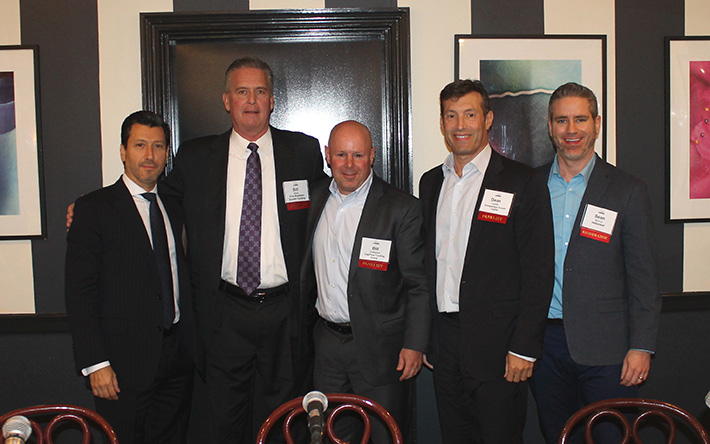
Nineteen panelists, many of them executives at financial companies and lawyers, contributed to four panels that filled the afternoon with lively and thoughtful conversation. Regulations coming out of California and just recently from New Jersey, were hot topics of discussion.
AltFinanceDaily founder Sean Murray moderated a panel on Best Practices. “These type of collaborative events are necessary as commercial finance offerings continue to expand. Education and debate create a more fluid marketplace,” Murray said.
Andrew Bertolina, whose company Finvoice offers factors and asset-based lenders a sleek software solution, said it was “great to see everyone at the Lending Conference and cross-pollination of MCA, factors and fintech players. Most cross-pollination at this IFA NYIC event than in prior factoring events.” Bertolina is the co-founder and CEO.
Robert Zadek, an attorney with Buchalter said, “that was a great meeting. It was so instructive to hear intelligent, honorable representatives of factoring and of alternative finance, who share clients and have overlapping products cordially comparing notes and sharing somewhat different views of the marketplace and the future of SMB financing. It is fascinating to see how much each can learn from the other, and to witness how such different financial products are moving towards each. The lesson – adapt or perish.”
The conference was sponsored by Change Capital, Finvoice, law firm Platzer, Swergold, Levine, Goldberg, Katz & Jaslow LLP, Aurous Financial, and Financial Poise.

Lendio Surpasses $1 Billion in Originations
October 16, 2018 Lendio announced today that it has facilitated $1 billion in financing to more than 51,000 small businesses across the U.S. since it was founded 2011. It reached the $500 million mark just a little over a year ago in July 2017.
“We are a marketplace, not a lender, which means we can help a lot more small business owners,” Lendio co-founder and CEO Brock Blake told AltFinanceDaily. “We can say ‘Yes’ more often because we have more options.”
Brock attributes the company’s recent growth to its marketplace business model, its team and all of its business partners. Lendio works with over 75 lenders on its platform and it also operates a turndown program where participating lenders refer to applications to Lendio that they have declined, but which might be funded by a different lender that Lendio works with.
Lendio also has about 30 franchisees that operate in 50 markers in the U.S. A market could be a single city or a handful of counties, and some franchisees cover multiple markets, according to Blake. Franchisees work with accountants, attorneys and chambers of commerce to inform local business owners about Lendio and ultimately get them to use the Lendio platform when looking for a small business loan.
Lendio has over 150 employees split between its headquarters in the Salt Lake City, Utah area and an office on Long Island.
Prior to co-founding Lendio, Blake created a company called Funding Universe, which connected entrepreneurs to venture capitalists in what he described was like speed dating. But he said that he soon realized that most American businesses need smaller amounts of capital, so he pivoted into small business lending.
“Across 75 lenders and 15 different loan products, it [can be] a challenge to really figure out which business owner fits with which loan product and to help that deal get funded,” Blake said. “But feel like over the last 18 months to 2 years we really have that process down. And now we’re gaining that flywheel effect. We’re continuing to gain more and more momentum. The ceiling is much higher and I’m really excited about the future in front of us.”