
2019 Alternative Finance Predictions
December 21, 2018
With 2019 approaching, AltFinanceDaily asked executives in the funding and payments industry if they had any predictions for the new year. We kept it pretty open-ended and received forecasts regarding technology, regulations, and the evolving relationship between fintech companies and banks. And yes, we also asked a few lawyers in the small business lending space for their two cents. Below is what they had to say:
 “The hype around cryptocurrencies is nearly gone, and it’s time to focus on the more interesting part of it – the blockchain technology. In 2019 we expect to see first use-cases of such technology for logging and sharing data among lenders. There is a true potential for real-time data sharing which will help lenders avoid lending to clients which just took similar loans from other lenders, in a decentralized and anonymous way. This will allow the industry to overcome one of the challenges quick loan approvals bring: real time loans stacking.”
Ido Lustig, Chief Risk Officer, BlueVine
 “We look forward to big changes coming. Four years ago banks still were not sure about Fintech firms. Now the banks are approaching alternative lenders trying to figure out various partnership options. We think in 2019 we will see banks engage in various levels of mutually prosperous partnerships…We believe new products will be launched in 2019 that will continue to support small business growth. And as the Alt Lenders are able to access cheaper cost of capital, it will give more options to small business owners.”
Robert Gloer, President and COO, IOU Financial
 Given the explosive growth of MCAs and the fact that MCAs have evolved from an early stage industry to a mainstream industry – MCAs have been around for decades – we expect regulation of the industry to become a reality. At 6th Avenue Capital, we believe regulation will be healthy for the industry and will reduce the industry’s bad actors, allowing those institutions that practice transparency and industry best practices to thrive.
As a former Chief Compliance Officer, I set up the company with regulation in mind. In fact, we are the only firm to be a member of both ILPA and SBFA, both organizations that are active participants working with regulators to help create a regulatory environment beneficial to both SMBs and SMB funders. The need for alternative credit, and access to fast capital, continues to grow and the industry is not going away with regulations. The winners in the MCA space will be those that adopt sound practices early.
Christine Chang, CEO, 6th Avenue Capital
 “We will likely continue to see state efforts to enact disclosures in MCA and small business lending transactions. We will also likely see efforts at the state level to ban practices viewed as aggressive by elected officials. These efforts will lead to a weeding out of the weaker players in the space and will strengthen the companies dedicated to compliance and customer service.
Catherine Brennan, Partner, Hudson Cook
 “A business slowdown (possible but hard to predict, at least by me) will test the effectiveness of algorithm-based credit granting. I am not optimistic. Mid-market banks might start to purchase MCA-type technology and try their hand at selling it, albeit at a lower cost.”
Robert Zadek, Of Counsel, Buchalter
“Older, more traditional SMBs will broaden their lending horizons. In 2017, 30% of business owners looked for a small business loan online. The 70% who didn’t are predominantly older, and more traditional in their approach to seeking financing. In 2019, we will see a more aggressive push by SMB lenders to tap into a more mainstream audience of business owners who have not been looking online for financing options. This will be driven in part by increased competition between the SMB lenders, and a larger push by those lenders to market themselves to a broader audience of SMBs.”
Charles Amadon, VP of Business Development & Strategic Partnerships, BlueVine
“In 2019, we’ll see more and more retailers offer flexible, pay-over-time financing options and promotional 0% tools to drive sales and make gifting more affordable for customers. As customers continue to look for online pay-over-time options, we can expect to see savvy [merchants] taking advantage of these trends to both improve performance and meet the expectations of the modern shopper.”
Kate Levin, Vice President of Merchant Success, Bread
“Large corporations, from card payment organizations right through to banks, are making significant investments in reinventing themselves. I think some of them will be very successful in doing this…like Marcus by Goldman Sachs and also First Data’s Clover product. These both demonstrate that long-established companies are starting to really get it right when it comes to being innovative with fintech. I believe in the next five years, we’ll see other huge companies begin to get it right with fintech.”
Simon Black, CEO, PPRO
For Sale: 60,000+ Leads From 1st Global Capital
December 21, 2018 Since 1st Global Capital went out of business, the company’s treasure trove of leads has been up for sale. Beginning in October, 41 companies were propositioned by 1st Global Capital’s bankruptcy advisors to make a bid on the company’s data. Ten companies actually entered into non-disclosure agreements to access a data room. That led to four official proposals which was narrowed down to two formal negotiations and ultimately the selection of one final stalking horse bidder.
In Advance Capital’s high bid came in at $105,000 for data that includes 57,000 non-funded applications and 4,760 funded applications. That dollar figure is actually an upfront fee against future commissions because the arrangement requires the buyer to pay 1st Global Capital a commission for every merchant on the list that they end up funding in-house or elsewhere. The total purchase price therefore is likely to exceed $105,000 over time. The buyer is not permitted to stack any merchant on the list.
As the stalking horse, In Advance’s bid will be honored unless new companies outbid them between now and January 7. If two or more qualified bids are received, a formal auction will take place on January 8. A hearing on the outcome will take place on January 9.
THE ABCs OF SBDCs
December 16, 2018 An often-overlooked national network of nearly a thousand Small Business Development Centers has the potential to help alternative funders cement relationships with existing clients and locate new ones. The centers, known as SBDCs, offer free or low-cost training and consultation to established and aspiring merchants and manufacturers.
The earliest SBDCs have been around for four decades. The centers operate in conjunction with the Small Business Administration as public-private partnerships and serve about 1.5 million clients annually.
Centers help small-business owners evaluate ideas, organize companies, find legal assistance and obtain operating capital.
But not everyone knows all that. “The network is underutilized,” says Donna Ettenson, vice president of operations for Washington-based America’s SBDCs, which functions much like a trade association for the centers scattered across the nation. “We’re one of the best-kept secrets in the United States federal government.”
That means alternative funders can assist customers by simply informing them that the centers exist and can offer potentially beneficial services. Providing basic information on the SBDCs could become part of a consultative approach to selling that brings repeat business, especially with merchants who lack business skills or experience, observers suggest.
What’s more, alt funders who want to increase their chances of benefitting from SBDCs can go beyond merely providing clients with a rundown on the centers. The funders can become actively involved with the work of carried out at the centers.
One way of taking part is to contact nearby centers and offer to make presentations at seminars or workshops, Ettenson says. Funders could provide information to fledgling business owners on the instruments available through the alternative-funding industry, such as cash advances, loans and factoring, she suggests.
 To get started, alternative funders can visit the America’s SBDC website, where they’ll find a search tool that provides contact information for their nearest centers, Ettenson says. From there, they could discuss possible connections with officials at the local centers, she advises.
That involvement would not only provide exposure to merchants in need of capital but also to center officials who point merchants toward capital sources. If enough members of the alt funding industry took part, their work could eventually give rise to something akin to the lists of attorneys that some centers maintain, Ettenson says.
Centers often tap attorneys—perhaps quarterly—to lecture on a rotating basis on what type of business to form. That could mean organizing as a corporation, limited-liability partnership or some other form. In much the same way, funders could share their knowledge of instruments for obtaining capital.
Funders could emulate the lawyers who use the centers as a forum for soft marketing, Ettenson says. The speaker becomes a familiar face and can leave business cards that students could use to contact them as questions arise. However, speakers must provide general information and are prohibited from using speaking opportunities as blatantly self-promotional unpaid advertisements, she cautions.
What’s more, the centers have to exercise caution to avoid recommending specific attorneys, accountants or sources of capital because they could incur liability if events go sour and a service provider absconds to Bogata, Columbia, Ettenson points out. That keeps the centers “ecumenical,” in that they provide a list of professionals for clients to interview and rather than pointing to a single source.
Alternative funders can explore other ways to become involved with SBDCs, too. The national organization presents an annual trade show and professional development conference for service-center directors and service-center staff members who teach or consult with clients. Alternative funders who have taken booth space on the exhibition floor or made presentations in the accompanying conference include RapidAdvance, Breakout Capital, Kabbage and Newtek Business Services.
When America’s SBDCs issues a call for presentations at the annual conference, it receives approximately 300 applications for about 140 speaking slots. Some of the speakers come from the rosters of presenters at past shows, while companies newer to the trade show can purchase an entry-level sponsorship that includes booth space and the right to conduct a workshop.
The attendees at those annual conferences can tell their clients about the funders they encounter there. Attendees can also find out more about the alternative- funding industry and then pass that information along to merchants.
Some regional centers in states with large populations—such as California—can also hold conventions for their officials, says Patrick Nye, executive director for small business and entrepreneurship at the Los Angeles Regional SBDC Network, which is based at Long Beach City College. His state was planning its second statewide gathering this year and intends to do it again every other year. Alternative funders could participate, he says.
With so much going on at the centers, someone has to front the cash to keep the lights on. Local organizations are funded partly through federal appropriations administered by the SBA. “In order for the federal money to be pulled down, a matching non-federal dollar must be provided as well,” Ettenson says. The federal funds are apportioned based on the amount of matching funds the centers provide.
The matching funds usually flow from colleges, universities and state legislatures. “It’s a mix,” Ettenson says of the sources. Institutions of higher learning often meet part of their matching-fund goals by providing “in kind” resources—such as classrooms, services and instructors—instead of cash.
In the six states that administer the centers through their economic development departments, the state legislatures generally appropriate matching funds. In Texas, the representatives of the state’s four regional programs combine forces to lobby the legislature for matching funds, and that teamwork reduces the cost of their efforts in Austin.
The federal funds and matching funds support local and regional centers that belong to a network based on 62 host institutions. Of the 62, six operate through the economic development departments of state governments. They’re in Indiana, Illinois, Ohio, West Virginia, Minnesota and Colorado. The rest of the host institutions are mostly universities or community colleges. Some are based in economic development agencies.

One can think of the regional centers as something akin to corporate headquarters and the local centers as retailers, says Nye, who administers the Southern California regional center. The local centers under his regional’s jurisdiction are located in only three counties but pull in the sixth-largest share of funding because of Southern California’s huge population, he notes.
The local service centers provide training and consulting for entrepreneurs starting or expanding their enterprises. About 60 percent of the clients are already in business. Of the 40 percent who don’t own a business, about half launch one after receiving assistance from an SBDC, Ettenson says.
The centers don’t charge for consulting services, and the fees for training are just large enough to cover expenses. The training fees usually remain in the centers that provide the instruction where they’re used to cover expenses like buying computers.
In Southern California centers, the business advisors are usually under contract and have knowledge to share from their experience in business, marketing, banking, social media, consulting or other realms, says Nye. Not many college instructors work in the centers, he notes, adding that the centers are monitored to avoid conflicts of interest among advisors.
To track how well advisors are performing, the national organization produces economic impact statements by interviewing thousands of clients. Interviews generally take place two years after consulting sessions. That should provide enough time to get results, Ettenson says
Thus, America’s SBDCs this year surveyed clients who received services in 2016. Those long-term clients received $4.6 billion in financing, while last year the clients surveyed who got underway in 2015 had received $5.6 billion in financing. She could not break down that financing by categories like banks and non-banks.
Discussing those surveys, Ettenson offers some details. “If you talk to us for two minutes, we don’t consider you a client,” she emphasizes. The SBDC definition of what constitutes a client calls for at least one hour of one-to-one consulting or at least one two- hour training session, she says. The organization defines “touches” as people with less exposure, such as those who call on the phone with a question.
When an SBDC client needs funding, officials at the centers have no qualms about including alternative funders in their recommendations to clients who are seeking funds, says Ettenson. “We don’t exclude anybody in any way, shape or form unless there’s some reason to think they’re fraudulent,” she notes.
But malfeasance isn’t the worry it once was, Ettenson asserts, noting that alternative funders have gained credibility in the last five or so years as they began policing their own industry. “They’ve learned to keep track of who’s in their space and how they’re operating,” she says.
Alternative financing has established a niche that benefits small-business people who know how to use it, Ettenson maintains. “They understand that they’re borrowing money for a short period of time and it’s going to cost you a fair amount,” she says. “It’s a short-term bridge to get to whatever your goal is.” Merchants seeking funders should learn the differences among alternative funders—whom she says all operate a little differently from each other—to choose their best option.
And opportunity for alternative funders may abound at the centers in the near future. Nye cites the two biggest goals for his centers as new business starts and capital infusion. Center advisors help develop business plans that aid clients in obtaining financing, he says. Last year, his region received a little over $4 million from the SBA and used it to help start 365 new businesses and raise $148 million in capital infusions. Those efforts created 1,700 jobs, he says.
The Funder: From Office of One to Eighteen in Under a Year
December 13, 2018 Not even a full year in business, Velocity Capital Group announced that it has secured $15 million in financing; $5 million in a series A, plus a $10 million line of credit. The entire investment comes from a family hedge fund in California, according to Jay Avigdor, Velocity’s President and CEO. Twenty-six year old Avigdor started the company out of his home in February and now employs 18 people in an office in Cedarhurst, Long Island.
Avigdor told AltFinanceDaily that he started Velocity earlier this year with $50,000 of his savings, having spent nearly five years working for Pearl Capital. Already, he said that Velocity, which finances MCA deals, has funded over $20 million. Avigdor said he started at Pearl shortly after finishing college when he was about 19. (He said he graduated early thanks to credits he used from studying abroad and because he started college at 16). At Pearl, Avigdor said he wanted to get on the phones immediately. But with only two days of training, they wouldn’t let him.
“I thought ‘screw it,’” he recalled. “I only had $16.25 to my name and I wanted [the opportunity] to make money.”
So he said he found an old yellow pages phone book, brought it to the office with his phone charger and just started making calls from his own phone. Shortly thereafter, from his own cold calling, he said he closed a $250,000 MCA deal with an auto dealer in California.
“When I went back to the office the following day, they had two computers set up for me,” Avigdor said.
While Velocity funds a variety of businesses, Avigdor said they most commonly fund medical, technology and construction companies.
Avigdor said that while Velocity uses technology for efficiency, they also have a personal touch. For instance, he said they use an automated onboarding process for brokers, yet the actual underwriting and funding calls with merchants are done on the phone. At least that’s the way it works now.
“We crawl before we walk before we run,” Avigdor said.
He said that they give 10% of the net of proceeds on each file to a charity, which changes each month. Currently, it’s The Wounded Warriors.
Avigdor said tries to follow the advice of a rich, wise man he knows, who told him: “You won’t be remembered for how much gold you had, but for how many gold bars you’ve given away.”
Velocity Capital Group (VCG) Secures $15 Million Series A Financing
December 11, 2018
CEDARHURST, NEW YORK—DECEMBER 10,2018–Velocity Capital Group recently secured another $15 million in financing. This will strengthen their ability to provide assistance to more small businesses and organizations. While the name might be new to some, Velocity Capital Group is no stranger to the business world. Servicing small businesses for over 7 years, there have been more than 15,000 clients who’ve received the financial boost they needed due to the available funding from VCG.
CEO/Principle Jay Avigdor couldn’t be happier to reach this point. Jay started the business in a small room of his home with only a laptop, and in just a short period of time has transformed VCG into a large and highly respected financial group that services organizations with speed and dedication. With an aim to merge the finance industry with technology, VCG aims to leave funding at your fingertips. To date, VCG is making strides as one of the fastest growing finance companies in the industry.
When businesses have financial demands, their situation is urgent and must be addressed immediately. Going through a lengthy process that could end up in a loss would be a waste of time, but with Velocity Capital Group, the relationship is taken seriously from the onset. With a staff of over 20 employees, VCG strives to get you what you need when you need it. A few of the industries that Velocity takes pride in assisting include:
- Accounting & Collection Agencies
- Construction, Machinery, Mechanics, & Manufacturing
- Electronic & Media/Entertainment
- Healthcare Services & Rehab Center
- Religious Organizations
- Restaurants & Retail
- Technology & Wireless
- AND MORE!
The $15 million funding access will help VCG build solid foundations and partnerships. With Velocity’s breakdown of available funding ($5mil in series A round & a $10 million line of credit), they’re able to provide more funding for more businesses. In fact, many customers have already stated that the VCG team is “resourceful” and “always available.” Others have even said that they “love the charity aspect” of Velocity, because they give back to aiding organizations monthly. Their attention and consistency prove that they are more than just the average financial group; they’re family! Winston Churchill said it best: “From what we get, we can make a living; what we give, however, makes a life.” Velocity Capital Group takes pride in giving to others so they can ultimately help others make a life.
Companies and small businesses are urged to contact Velocity Capital Group today and see what financial options are available. With urgency and compassion, the knowledgeable staff of Velocity is ready to build your business or brand. The funding is there, the foundation is there; all it takes is one step. That one step can be the greatest decision for success in business.
Velocity Capital Group is ready and able to serve you. For additional information, visit our website at www.velocitycg.com, send an email to info@velocitycg.com, or call 833-VCG-FUND (833-824-3863). We’re also available on social media outlets.
Cross River Bank Raises $100 Million
December 11, 2018Cross River Bank, which provides banking services to fintech companies, announced last week the completion of a funding round of roughly $100 million. This was comprised of a $75 million equity investment from KKR, along with capital from Andreessen Horowitz, Battery Ventures, Rabbit Capital, and funding from new investors CredEase and Lion Tree. This adds to a $28 million raise a little over two years ago.
Cross River, which originated more than $5 billion in loans as of the end of August 2018, has developed partnerships with fintech leaders to build fully compliant and integrated products within the lending marketplace and payment processing spaces. They have about 15 lending platform partners, including fintech clients Affirm, Best Egg, RocketLoans, Coinbase and TransferWise.
According to the announcement, this new capital will be used to allow Cross River to continue building a complete banking platform where fintech companies can leverage best-in-class banking technology coupled with compliance.
“Cross River offers solutions to fintech companies by giving them access to a full suite of banking solutions and services in a single, fully compliant and innovative platform, making it an increasingly attractive and valuable franchise in a dynamic marketplace,” said Dan Pietrzak, Member and Co-Head of Private Credit at KKR, Cross River’s leading investor.
According to its website, Cross River was named “most innovative bank” by LendIt in 2017 and 2018. Founded in 2008, the Fort Lee, NJ, business-oriented bank has more than 180 employees.
MCA Participations and Securities Law: Recognizing and Managing a Looming Threat
December 11, 2018Authors: Gregory J. Nowak and Mark T. Dabertin
Due to the high volume of relevant judicial decisions issued by New York courts over the past two years, the risk that enforceability of a merchant cash advance (MCA) contract1 might be successfully challenged as a disguised usurious loan has received ample attention in law firm white papers and published legal articles, including articles by Pepper Hamilton attorneys.2 Avoiding this risk of “loan re-characterization” is essential if the MCA industry is to achieve wider acceptance as a source of small business financing. But another risk—which we believe is largely unrecognized—could significantly throttle further expansion of MCA financing. This risk is that the funding structures MCA providers rely on to generate funding from third-party investors could be found to involve the issuance of unregistered securities. Unless an exception is available, that would be unlawful and could result in fines, penalties, defense costs and even rescission of the entire transaction, with the “issuer” being required to return investor capital.
Many MCA providers raise new funding by offering “participation interests” in their MCA contracts to third-party investors. These are usually structured in one of two ways. Under a “true participation,” the participant acquires the right to receive payments, and a resulting return on the participant’s investment, exclusively from the MCA provider. To this end, the participant receives no rights to enforce, nor any direct interest in, the underlying MCA contracts. Alternatively, the participation agreement may be structured so as to make each investor a pro rata “co-funder” of the underlying MCA contracts in an agreed-upon percentage (the “participation share”). Under this structure, the MCA provider’s contract with the merchant typically acknowledges the possible existence of “co-funders” in general terms, and does not require the merchant to ratify and accept named co-funders as they come into being. This add-on is usually accomplished through a novation to the MCA contract.
Under either of the above-described participation structures, the nature of the participant’s investment is purely passive, with no possibility for active involvement in the underlying MCA relationships. In fact, the participation agreement likely expressly prohibits such interference. The passive nature of a participant’s investment matters, because the presence of passivity, and the resulting reliance on the efforts of another party (i.e., the party offering the investment) to realize a profitable return, is a key factor for purposes of determining whether a security exists under the federal securities laws.
In SEC v. WJ Howey Co.,3> the U.S. Supreme Court established the following four-factor test for identifying the existence of a security: (1) an investment, (2) in a common enterprise, (3) with a reasonable expectation of profits, (4) to be derived from the entrepreneurial or managerial efforts of others. The facts of Howey concerned investments in an orange grove operation, where the investors were entirely dependent on the efforts of the orange grove manager/promoter to maintain the trees that the investor had invested in. In the case of an MCA participation structured as described above, all four Howey factors are arguably present. An investment is made with the expectation of realizing a profit. In addition, as discussed above, because that investment is passive in nature, its success hinges on the efforts of the MCA provider. Finally, at least one court has opined that the existence of common enterprise is inherent to any participation relationship.4
The Howey test, which seeks to identify the presence of an “investment contract,” is not the sole means for evaluating whether an investment constitutes a security. In Reves v. Ernst & Young, the U.S. Supreme Court recognized that the expansive definition of the term “security” under the Securities Act of 1933 and the Security Exchange Act of 1934 extends to other forms of “notes” besides investment contracts.5 In determining whether the “demand notes” at issue in Reves constituted a security, the court applied what is commonly known as the “close resemblance” test. Under this test, if the note in question bears a close resemblance to a type of note that has been judicially recognized as not involving a security, that note likewise will not be considered a security. For example, on its face, an MCA contract closely resembles “a short-term note secured by a lien on a small business or some of its assets.”6 However, in an MCA contract, the purchased future receivables provide the source of repayment of the advanced funds, as opposed to providing security for a lien.
This distinction is important. because in an MCA, the receivables do not yet exist, so there is nothing to lien. Rather, the MCA involves receivables to be created, presumably using the proceeds of the MCA to do so. Properly drafted MCAs sidestep all “note-like” characteristics, and make it clear that the MCA is a contract to purchase an asset (i.e., receivables) that are yet to be created. There is no sum certain for repayment – unlike a note, if the receivables turn out to be bad, the MCA provider has no recourse back to the merchant that created them. The receivables are not security for a loan; rather, the receivables are the property being forward purchased. MCAs are different in kind and extent from loans.
Notwithstanding the Howey test, and as noted above, it is possible to argue persuasively that an instrument that appears to be a security instead describes the terms of an individually negotiated contractual agreement. In this regard, in Marine Bank v. Weaver,7 the U.S. Supreme Court held that a contract between a bank and a married couple that called for the latter to pledge a certificate of deposit as security for a loan between the bank and an unrelated corporate borrower in exchange for the opportunity to share in the latter’s future profits did not involve a security. In doing so, the court distinguished the note in question from investments that fall within the “ordinary concept of a security. . . [which are offered] to a number of potential investors.”8 In contrast, the Court in Marine Bank found that the contested note created “a unique agreement [that was] negotiated one-on-one by the parties” and was therefore, “not a security.”9
In the absence of an applicable statutory exemption, the public offering of unregistered securities constitutes a criminal violation of the federal securities laws. Because securities can generally only be sold to the public by a registered broker-dealer, people who engage in selling such securities, as well as their related corporate actors, may be subject to monetary penalties for the resulting violations of law. An improperly structured MCA participation presents the risks that: (i) sales of participations made under the flawed structure could be declared void and subject to rescission; and (ii) both the MCA provider and its primary individual actors could be subject to criminal prosecution and resulting monetary penalties. In the remainder of this article, we discuss ways for effectively mitigating these risks.
Structuring the MCA participation so as to make each participant not merely a “co-funder” in name, but an actual party to each underlying MCA contract by means of a contract novation signed by the merchant and naming the individual participants, would arguably eliminate any risk that the structure might be deemed to involve the unlawful issuance of securities. Under this structure, each participant, at least in theory, could enforce the MCA contracts directly against the applicable merchants, without having to rely on the MCA provider. The main flaw with this option is that the MCA participation agreement necessarily prohibits such independent actions by the participant, because those actions could directly conflict with the economic interests of either or both the MCA provider or additional participants. Hence, any actual ability of the participant to be actively engaged in the underlying merchant relationships will be missing. As the number of participants increases to more than a handful, this structure – requiring as it does that the merchant ratify and accept every new participant as each participant is added, is unwieldy and becomes infeasible to administer.
One could also argue that including a requirement in the MCA participation agreements that the participant must evaluate independently the quality of each MCA contract before the purchase of the participation share precludes the existence of a common enterprise. However, unless each participant has its own series of MCAs, this distinction is unlikely to be of significance, because all participants are participating in the same MCA. Also, notwithstanding the obligation to conduct independent reviews, the MCA participant must still rely on the MCA provider to source qualified merchants. In addition, as noted above, the investor also must depend on the MCA provider’s success in collecting payments from merchants, which will determine whether a profitable return is achieved. Finally, where a pool of investors all share in the risks and benefits of a particular business enterprise (known in securities law as “horizontal commonality”), the resulting presumption of a common enterprise is extremely difficult to disprove.
In view of the above, we suggest that the best way to manage the risk that the participation structure might be viewed as involving the unauthorized issuance of securities is to embrace the substance, if not the precise letter, of the federal securities laws. Specifically, by structuring the participation in a manner that complies with the safe harbor from the requirement to register securities described in Section 506 of the SEC rules under the Securities Act of 1933. This entails: (i) only selling participations to accredited investors; (ii) describing the applicable risks (i.e., the risk factors) and potential conflicts of interest in an addendum to the participation agreement; (iii) making sure that all sales of participants are made on a one-to-one basis, with no general solicitation or marketing; and (iv) advising participants that the resale of their participation share may be subject to a one-year minimum holding period. (Of course, if the MCA pays off before the one year period and extinguishes the MCA, that is not an issue under this rule.)
We caution that the securities laws are both difficult to navigate and prone to divergent interpretations. The consequences of misinterpretation can be severe and could result in the rescission of existing participations and monetary penalties. Hence, this is not a DIY proposition.
Pepper Points
-
The risk that an MCA participation structure could be found by a regulator or court to constitute the unlawful issuance of securities is under appreciated, and has serious consequences that could throttle the availability and growth of MCA financing.
-
Although legal arguments can be made in support of the position that the most commonly used MCA participation structures do not involve the unlawful issuance of unregistered securities, none of those arguments is sufficiently persuasive to preclude the need for additional risk mitigation efforts.
-
Mitigation plans for managing the risk that a given MCA participation structure involves should incorporate complying with the substance, and the precise letter, of the federal securities laws.
The federal securities laws are difficult to navigate and prone to divergent interpretations. The consequences of misinterpretation are severe and could include the rescission of existing participations and assessments of monetary penalties, including against individual actors.
Endnotes
1 An MCA is a business financing option that involves the advance of funds to a merchant, typically to assist the merchant in managing its short-term cash flow needs, in exchange for the sale of a specified percentage of the merchant’s future receivables at a sizeable discount. It is a relatively new offshoot of “factoring,” which likewise involves the purchase and sale of receivables at a discount in exchange for an advance of funds to a business, with the primary difference being that the receivables in the case of MCA financing are not yet extant. An MCA contract might be deemed a disguised usurious loan for many reasons, including the inclusion of a set term within which the advance must be repaid in full to avoid default. The most critical factor in this regard is whether the MCA provider is looking to the purchased receivables for repayment, or to the merchant itself or its individual owner(s); e.g., in the form of a financial guarantee given by the owner(s).
2 For a broader discussion of MCA financing, and the risk of re-characterization as a usurious loan, see: https://www.pepperlaw.com/publications/recent-litigation-illustrates-why-merchant-cash-advances-are-not-loans-2017-04-20/.
3 328 U.S. 293 (1946).
4 Provident National Bank v. Frankfort Trust Co., 468 F. Supp. 448, 454 (E.D. Pa. 1979) (By its “very nature” any participation involves a common enterprise.).
5 494 U.S. 56, 64 (1990) (“The demand notes here may well not be ‘investment contracts,’ but that does not mean they are ‘notes.’ To hold that a ‘note’ is not a ‘security’ unless it meets a test designed for an entirely different variety of instrument ‘would make the Acts’ enumeration of many types of instruments superfluous’ Landreth Timber, 471 U.S. at 692, and would be inconsistent with Congress’ intent to regulate the entire body of instruments sold as investments, see supra at 60-62”.).
6 Id. at 65.
7 455 U.S. 551 (1982).
8 Id. at 552.
9 Id.at 560. In Vorrius v. Harvey, 570 F. Supp. 537, 541 (S.D.N.Y. 1983), the court followed Marine Bank in finding that a contested loan participation agreement involved an individually negotiated contract versus a security. A key factor in that case, however, was the existence of a comprehensive federal regulatory scheme apart from the federal securities laws in the form of banking laws and regulations, which made application of the former unnecessary for purposes of protecting the interest of investors. No such alternative regulatory scheme exists in the case of the MCA industry, which is generally unregulated.
The material in this publication was created as of the date set forth above and is based on laws, court decisions, administrative rulings and congressional materials that existed at that time, and should not be construed as legal advice or legal opinions on specific facts. The information in this publication is not intended to create, and the transmission and receipt of it does not constitute, a lawyer-client relationship.
What We Learned About Credibly From Credibly’s Securitization
November 29, 2018Today, Credibly CEO Ryan Rosett told AltFinanceDaily that the company’s October securitization will be used, in part, to roll out its new Market Expansion Product (MXP), which will allow Credibly to service merchants with FICO scores as low as 500 and those that have been in business for less time.
“We believe the MXP will open up the funnel by allowing us to serve business owners that we previously couldn’t,” Rosett said.
Kroll Bond Rating Agency assigned preliminary ratings to three classes of notes as part of Credibly’s first securitization. Rosett said this securitization follows a large warehouse line of credit from SunTrust Bank which is also the primary underwriter, of the securitization.
In addition to the new MXP product, Rosett said that Credibly intends to launch a line of credit product in 2019. Currently, Credibly provides merchant cash advances up to $150,000, business expansion loans up to $250,000, with terms up to 24 months, and working capital loans up to $250,000 with terms up to 17 months. Rosett said that the company’s working capital loan is its most popular product.
In an interview yesterday with Benzinga, Rosett said that he has seen a strong increase in demand for Credibly’s products and that they are currently evaluating over 10,000 applications per month.
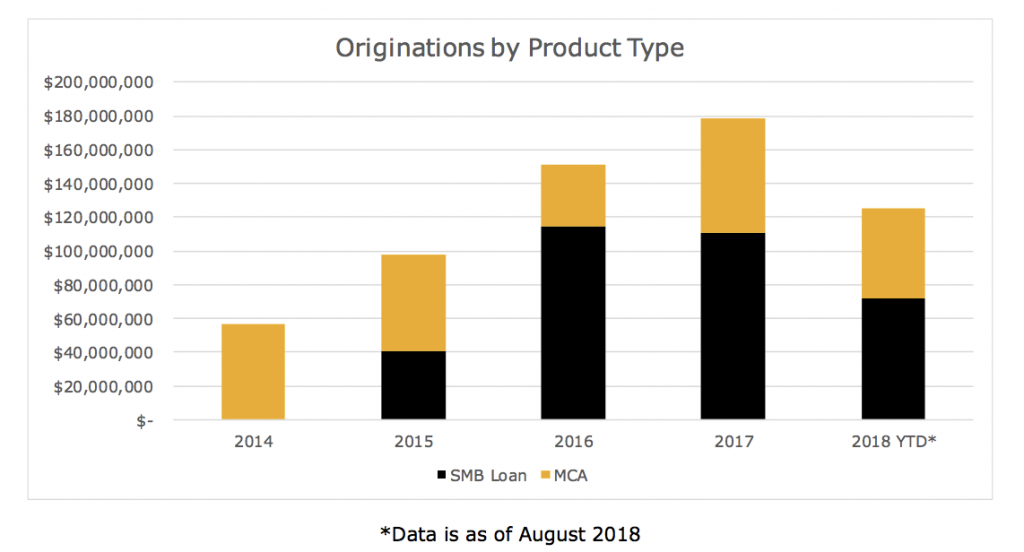
2017 net revenue before provisions: $33 million
2017 earnings: $1.4 million
Total shareholder equity: $18.7 million
Lifetime funding volume: $700+ million
Raw # of fundings: 17,000+
Majority owned by: Flexpoint Ford
# of employees: 140
Notable deal: Acquired the rights to service BizFi’s $250 million MCA portfolio in August 2017
Provides: Small business loans (in 37 states and D.C.) and merchant cash advances
Founded: 2010 by co-CEOs Edan King and Ryan Rosett
Generates deals via: Brokers and inside sales