
Merchant Cash Advance is The Real Square IPO Story
November 22, 2015 Square’s debut on the New York Stock Exchange is being talked about as one of the more consequential IPOs of 2015. As a mobile payments company famous for both losing money and its founding by Jack Dorsey, Twitter’s CEO, the $2.9 billion valuation pales in comparison to its rival First Data that went public just a month before. First Data, which was founded in 1971, is worth five times more than Square with a market cap of $14.7 billion to Square’s $2.9 billion. But it’s Square that everyone’s talking about and not necessarily in a positive way. Cast as the poster child for runaway private market valuations in Fintech, Square’s Series E round just a year before had supposedly increased its worth to $6 billion.
Robert Greifeld, the CEO of Nasdaq, had warned people just weeks earlier about the validity of private market valuations. “A unicorn valuation in private markets could be from just two people,” he said. “Whereas public markets could be 200,000 people.”
And while Square’s IPO was relatively well-received, closing at 45% above its offered price, there’s an entire story beyond payments hidden in the company’s financial statements under the label of “software and data products.” That’s code for merchant cash advance, the working capital product they offer to customers that currently makes up 4% of the company’s revenue.
“Since Square Capital is not a loan, there is no interest rate,” states the company’s FAQ. That echoes what dozens of other merchant cash advance companies have been saying for a decade. “You sell a specific amount of your future receivables to Square, and in return you get a lump sum for the sale,” marketing materials explain.
Lenders that don’t approve of this receivable purchase model are lobbying politically against it, some of whom are well-known. Lending Club for example, is a signatory to the Responsible Business Lending Coalition’s Small Business Borrowers Bill of Rights (SBBOR), committing themselves to things like transparency and the disclosure of APRs even for non-loan products.
 But disclosing an APR on a receivable purchase merchant cash advance transaction is not only impossible since there is no time variable, but would violate the spirit of the contract even if estimates were used to fill in the blanks. Nonetheless, Fundera CEO Jared Hecht, whose marketplace platform has also signed the SBBOR told Forbes in September that “small business owners have been sold by pushy salespeople, hiding terms, disguising rates and manipulating customers into taking products that aren’t good for them.”
Ironically, Fundera’s own merchant cash advance partners have not made any such pledge to disclose APRs. No one’s commitment is verified anyway. “Neither Small Business Majority nor any other coalition member independently verifies that any of these signatory companies or entities in fact abide by the SBBOR,” the group’s website states. This isn’t to say that their intent is misguided, there’s just very little substance to it below the surface.
For example, while the coalition has made some subtle and not so subtle digs about merchant cash advances over fairness and transparency, it’s the lending model used by some of the SBBOR’s signatories that is being challenged by the courts right now. Because of Madden v. Midland, Lending Club’s practice of using a chartered bank to originate loans could potentially be in jeopardy. The ruling was just appealed to the U.S. Supreme Court. At the heart of the issue is the ability to usurp state usury caps through the National Bank Act. For a company that has pledged to offer non-abusive products, it’s ironic that their model relies on preemption of state interest rate caps all the while reassuring their shareholders that there’s no risk because of their Choice of Law fallback provision. In truth, Lending Club uses a state chartered bank and not a nationally chartered bank and thus would be somewhat shielded in an unfavorable Supreme Court ruling.
Those concerned in years past that receivable purchase merchant cash advances were full of regulatory uncertainty had shifted towards the model that Lending Club uses since it was perceived to have more nationally recognized legitimacy. However, with that model seriously challenged, old school merchant cash advances are once again looking pretty good. That’s probably why publicly traded Enova International Inc. (NYSE:ENVA) bought The Business Backer this past summer. And it’s why Square skated through their IPO without much resistance to their merchant cash advance activities.
The story of Square was either that it was overvalued, that CEO Jack Dorsey couldn’t handle running two companies, that they were losing money, or that their deal with Starbucks was a mistake. Meanwhile Square has processed $300 million worth of merchant cash advances, a product that doesn’t disclose an APR since it’s not a loan. “Nearly 90% of sellers who have been offered a second Square Capital advance cho[se] to accept a repeat advance,” their S-1 stated.
“If our Square Capital program shifts from an MCA model to a loan model, state and federal rules concerning lending could become applicable,” it adds. And right now partly due to Madden v. Midland, the loan model looks pretty shaky. Square proved many things when they went public on November 19th and one was that merchant cash advances are just the opposite of what critics have argued in the past.
Battery Ventures’ general partner Roger Lee told Business Insider, “the [Square Capital] product itself will have unique advantages in the market, and it’s a big market.”
Kabbage, Fora Financial and Square Have a Roaring Wednesday
October 15, 2015 Wednesday, October 14th was packed with exciting industry news. Right after Congressman David Scott blessed online lenders, Kabbage announced a Series E round investment led by Reverence Capital Partners for $135 million. The Wall Street Journal said the deal valued the company at over $1 billion, a figure that elevates Kabbage to unicorn status.
At the same time, Fora Financial announced that a Palladium Equity Partners affiliate had made a significant investment in the company. In the official release, Palladium principal Justin Green said, “we believe Fora Financial has developed a highly attractive credit offering and technology platform that have made it a valued provider of financing to thousands of small businesses seeking capital.”
Palladium once held a stake in Wise Foods, the potato chip snack company, and currently counts PROMÉRICA Bank, a full-service commercial bank in its active portfolio. They have more than $2 billion in assets under management.
And then there’s Square, the payment processor and merchant cash advance company who publicly filed their S-1 for an IPO. Their registration form uses the term merchant cash advance 16 times so there is no doubt it’s a significant part of their business. “Square Capital provides merchant cash advances to prequalified sellers,” the document states. “We make it easy for sellers to use our service by proactively reaching out to them with an offer of an advance based on their payment processing history. The terms are straightforward, sellers get their funds quickly (often the next business day), and in return, they agree to make payments equal to a percentage of the payment volume we process for them up to a fixed amount.”
As of June 30th, Square had already racked up a net loss for the year of nearly $78 million. In 2014, the company lost $154 million. While the losses stem mainly from their payment processing operations, they had outstanding merchant cash advance receivables of $32 million as of mid-year which illustrates how much exposure they have with that product.
The three announcements ironically coincided with comments made by SoFi CEO Mike Cagney about the industry’s lack of ambition. “The problem with fintech is that it’s not ambitious enough in terms of its objectives. It’s not really transforming anything,” he’s quoted as saying in the San Francisco Business Times. Cagney went on to categorize Lending Club as just an electronic interface bolted onto a bank to originate loans for them. While his comments hold weight given that his lending company recently just raised $1 billion in a Series E round led by Softbank, it may be fair to say however that Wednesday proved there was anything but a lack of ambition in the space right now.
A Square IPO Would Be Alternative Lending’s Third
July 26, 2015 First Lending Club, then OnDeck, and now… Square? The news media was flooded with stories late last week that payments company Square had filed their S-1 in secret. The move can be done under a JOBS Act provision that allows companies that grossed less than $1 Billion in revenue in the most recent fiscal year.
Square’s merchant cash advance arm, Square Capital, reportedly funded $100 million to small businesses in 2014, a figure large enough to earn them a spot on the AltFinanceDaily leaderboard.
While often reported as a lending program, Square’s own website describes their working capital transactions as sales of future credit card receivables. At face value, and aside from what their contracts might actually say, it’s a textbook merchant cash advance.
While some publicly traded companies have dabbled in merchant cash advances, the financial product is one of Square’s two major products, the first obviously being payments.
And while OnDeck offers loans that are very similar to merchant cash advances, Square could potentially be the first true merchant cash advance IPO.
Also on the IPO watch list is CAN Capital, a company that offers both loans and merchant cash advances. In November of last year, Bloomberg and WSJ claimed the company was already working on it. While it has been eight months since that news came out, word on the street is that a CAN Capital IPO is still very much a possibility.
Unfortunately, because of the same JOBS Act provision that allowed Square to file an S-1 (if they actually did) also applies to CAN Capital. There is no way to know what’s going on behind the scenes until the filing is made public or leaked to the media.
Either way, the end of 2015 will likely end in at least one more IPO for the commercial side of alternative lending.
Could Jack Dorsey and his wacky beard be the future face of the merchant cash advance industry?
BREAKING: JACK DORSEY’S BEARD pic.twitter.com/Quv8nVG9PZ
— Nicholas Carlson (@nichcarlson) June 12, 2015
Square Bears Attack
April 21, 2014It was the PR nightmare that wouldn’t end. With Easter Sunday still warm on everyone’s minds, bloggers went for the jugular over Square’s acquisition rumors. Whether based on fact or fiction (nobody seemed to know for sure), Alistair Barr, Douglas Macmillan, and Evelyn Rusli of the Wall Street Journal single-handedly hit Jack Dorsey’s famous payment company with a fresh dose of healthy skepticism. With that came the revelation that Square had lost $100 million in 2013, a dangerously large figure for a company that is apparently plagued with shrinking margins, not growing ones.

What was happening behind the scenes at Square differed in dramatic context depending on which news site you read. Some writers claimed Square executives were considering a well thought-out strategic acquisition in light of a liquidity shortfall, while others insinuated that Jack Dorsey had last been seen raging drunk at a Market Street Starbucks wearing nothing other than flip flops. He reportedly told spectators that a 2% swipe fee was impossible and then he fled out the back door as four Baristas tried to wrestle him down.
When an IPO was taken off the agenda in February, some analysts wondered if their historic rise had come at a cost. In the Wall Street Journal article, it was alleged that the company was potentially less than a year away from insolvency. The quote was, “During the first quarter of 2014, a Square executive told a potential acquirer that the company had nine months before it would hit a predetermined ‘cushion’ of funds set aside as a last resort.” Thanks to the new credit facility they landed this month of nearly $200 million, they should have no problem with cash flow.
 But questions remain. People supposedly close to Square confirm that the company had practically begged Visa and Google to acquire them. Though there were stiff denials from all parties throughout the day, it made for some enticing headlines. Square Bears were out in droves today:
Square Is Losing Millions Of Dollars And Wants To Sell – Huffington Post
Why Square Needs To Sell Itself And Do It Quickly – Forbes
Mobile payment startup Square plans sale as losses widen – Reuters
Did Jack Dorsey Do the Math on Square – UpStart Business Journal
Square denies sell-out plans; all eyes on the dicey-looking financials – ZDNet
Mobile-Payments Startup Square Discusses Possible Sale
Company Faces Wider Loss, Less Cash; Google Considered Potential Acquisition – Wall Street Journal
What should also be of note is Square’s recent venture into the merchant cash advance business, which in practice should be a major liquidity drain. One has to wonder if this is a good time to position themselves as a working capital provider when they’re hemorrhaging cash from their payments operations. Besides, providing funding to micro-merchants in return for a split of their future card sales is an incredibly risky business model. One thing the established players in that market have learned is that it’s really easy to lose money if you don’t know what you’re doing.
I sure hope they know what they’re in for. Otherwise Dorsey might really run off drunk to Starbucks.
Hello Square Capital
March 1, 2014We’ve seen copies of this notice posted on a few websites now:
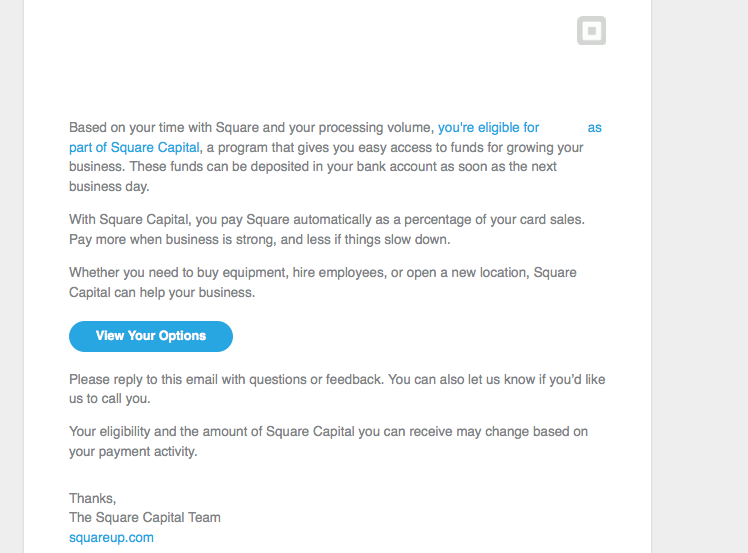
Square, the well-known micro-merchant processor with celebrity CEO Jack Dorsey is debuting a merchant cash advance program. Truthfully, I’m not surprised in the slightest. Come on in Square, the water’s fine!
What is still interesting to this day is the realization that so many small business owners have never even heard of the concept. You can check out comments by people on the mr. money mustache forum regarding Square Capital here.
Sell my future credit card sales? What the HECK?!
It’s a 16 year old industry now my friends. One of these days it’d be nice if people just knew this product existed. That seems to be the hardest part…
Look What We Got: Square
December 13, 2011The folks at Square were nice enough to send us their mobile phone hardware for free to review and play with. We’ll be doing a video review and demonstration within the next week. Stay tuned.
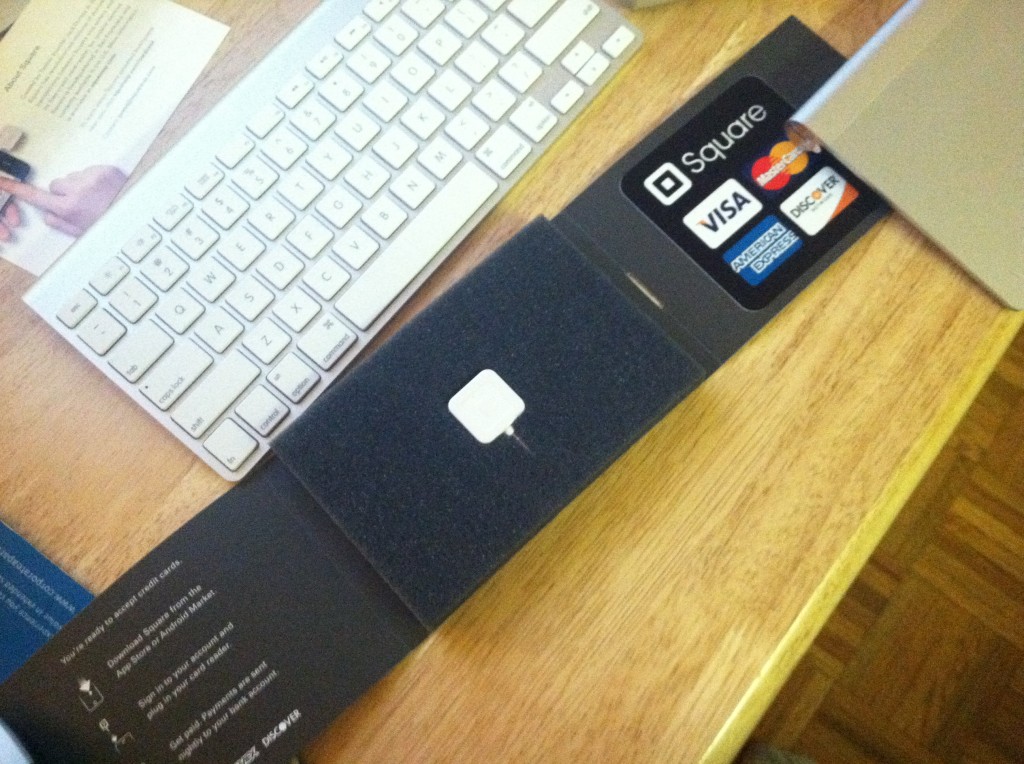
Thanks Square!
Square Eliminates 15% Transaction Fee
August 23, 2011
According to their Twitter Feed, Square, the iPhone, Android, and iPad Card Reader has announced the removal of the 15 cent transaction fee. The card swipe rate will remain at 2.75%. For low ticket, high volume businesses, this will significantly improve margins.
About
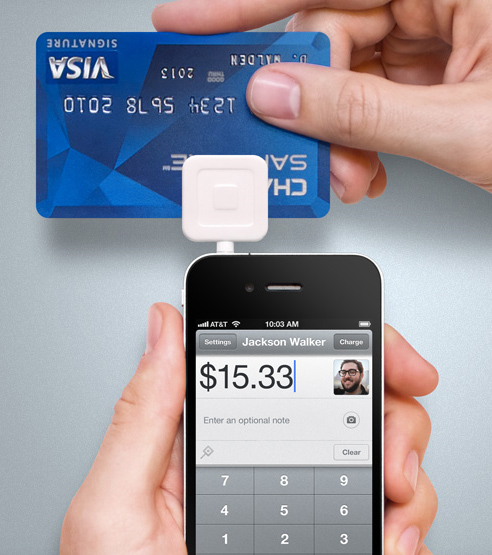
Square is a revolutionary service that enables anyone to accept credit cards anywhere. Square offers an easy to use, free credit card reader that plugs into a phone or iPad. It’s simple to sign up. There is no extra equipment, complicated contracts, monthly fees or merchant account required.
Co-founded by Jim McKelvey and Jack Dorsey in 2009, the company is headquartered in San Francisco with additional offices in Saint Louis and New York City. They can be found at: www.squareup.com
– AltFinanceDaily