Ascentium Capital Reports $2.5 Billion in Managed Assets
July 23, 2020Ascentium Capital announced it has reached $2.5 billion in managed assets, a new record for the Kingswood, Texas-based alternative funder. The news comes after the firm finished Q2 of 2020 with a funding volume of $225 million. Being a subsidy of Regions Bank, Ascentium has been funding businesses since 2011.
“Ascentium’s executive team has successfully weathered several periods of economic uncertainty and we are leveraging this to respond to the current situation as the US faces unexpected uncertainty for an unexpected duration,” Executive Vice President Tom Depping noted in a statement. “Our specialized finance platform incorporates process flexibility which enables us to adjust quickly. We have a strong team in place that is dedicated to meet market demands while managing risk.”
Kabbage Launches Checking Accounts for SMBs
July 22, 2020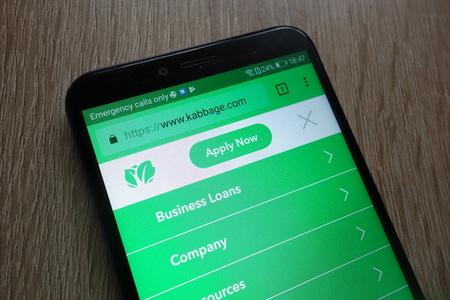 Today Kabbage announced the launch of its latest service, business checking accounts. Targeting small-sized businesses and offering no monthly fees, 1.10% APY, and a Kabbage debit card; Kabbage Checking is available now and is part of an effort by Kabbage to transition from being a pure SMB-funding company into a cash-flow management company.
“Kabbage is a full financial services platform that’s focused on solving on cash-flow management for small businesses.” President Kathryn Petralia explained in an email. “A business checking account is a core function of how they manage their money, and we saw an opportunity to build them a solution specifically designed for them – while simultaneously reducing their costs and increasing their yield.”
Launched in the wake of a study which reports that over 40% of small businesses are looking to change their bank following struggles with their Paycheck Protection Program applications, Kabbage is optimistic that fintechs an online lenders will benefit from a wave of interest following the failures of financial institutions in the face of the coronavirus.
“Amidst one of the largest financial crises in history, we helped over 225,000 small businesses access services many of their long-time bank partners would only provide to their largest customers,” the President said in a statement. “We believe in the businesses too often left out, overlooked, and underestimated. Kabbage Checking is a new banking service built to give those small businesses an upper hand to earn more, save more, and grow their business faster without sacrificing anything they expect from a bank.”
Clearbanc Launches Valuation Service for Founders
July 16, 2020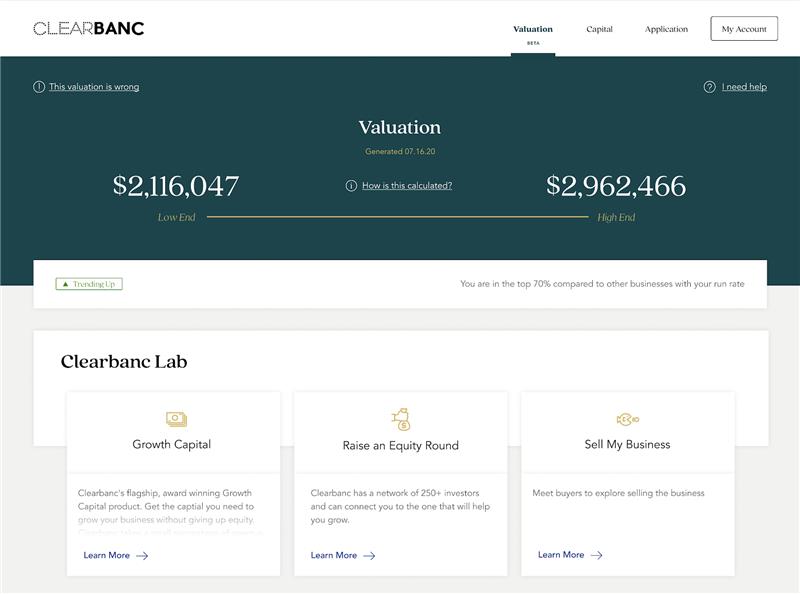
Today Clearbanc, the Toronto-based alternative finance company, has launched its latest service, Valuation, allowing founders to gauge their company’s value. Being an extension to Clearbanc’s platform, the service will be free to everyone and promises an estimation within 24 hours that can be checked weekly.
Valuation also offers three options to founders upon receiving their company’s value: the chance to access capital via Clearbanc’s funding channels, connect with investors in order to raise an equity round, and investigate possible acquisition opportunities. For the last two of these options, Clearbanc makes introductions to a selection of venture capital investors that have connected with the program.
As per the requirements, founders will have to connect a selection of private data points. Their business accounts, payment processor, accounting platform, and their admin account will all be required. As well as this, public data is also used to arrive at a valuation, basing the estimations on information specific to the company as well as the industry it is in.
“We think this could be as revolutionary as what Credit Karma did when they launched free credit scores for everyone and gave consumers access to their own information,” explained Clearbanc CEO Michele Romanow. “We’re really excited about this as it represents our first non-capital launch, and we think that it’s part of a much bigger vision of how we help founders win in this environment.”
“People are Starting to Come Out of Their Caves”: How 2M7 got through the lockdown
July 13, 2020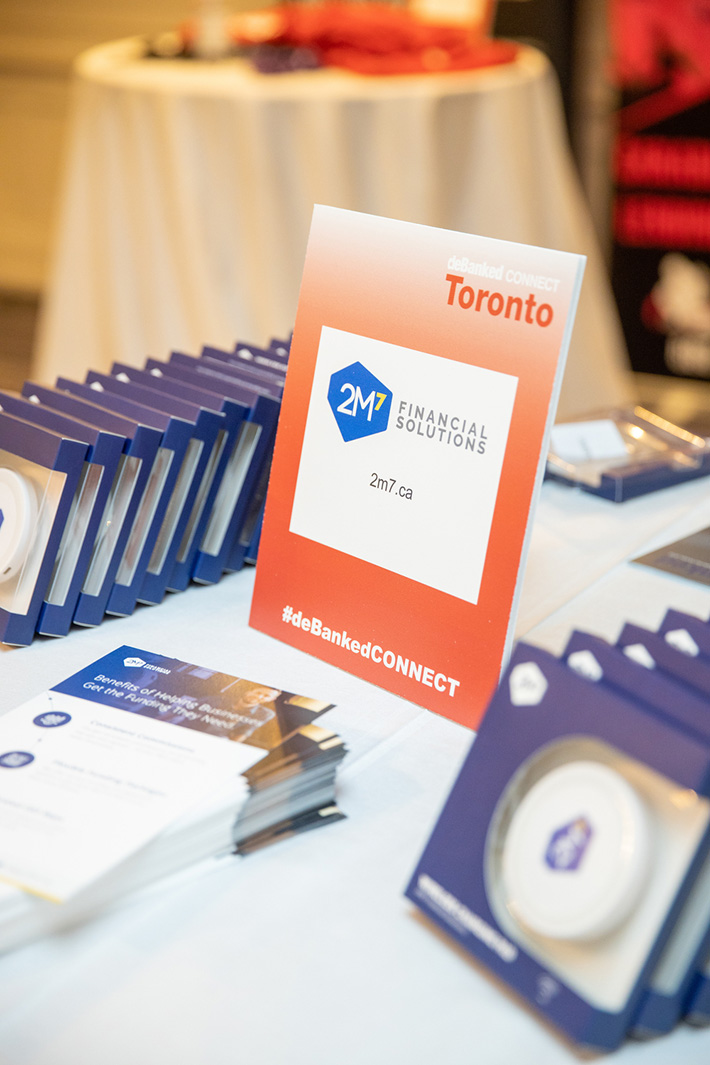 For 2M7, the Toronto-based alternative funding company, the concept of a global economic shutdown was far-fetched. January and February of 2020 had been some of their best months in business yet. But, like every company, 2M7 was forced to reckon with the unreckonable and feel the effects of an economic lockdown.
“In terms of client onboarding and funding volume, in terms of collecting volume, and in terms of any metric you would look at, [January and February] were two very strong months,” CEO Avi Bernstein explained in a call. “And then in March, I don’t want to say we slammed on the brakes, but in the first or second week of March we basically just said, ‘you know what, we just need to really change the focus of what we’re doing.”
Saying that they were a week or two ahead of the curve, Bernstein notes that in the leadup to the shutdown their customers had already been asking for deferred or reduced payments. And with anxiety and concern in the air, 2M7 changed course and moved from focusing on bringing in new customers and increasing collections, they “hunkered down” and worked exclusively on the needs of existing clients.
“We funded throughout very minimally … and really our main effort was to get in touch with all our existing merchants and see how they were being affected, if they needed a payment plan, or if they needed a little bit more capital to tide them over. And we adjusted each one on an ongoing basis as we kind of floated through the panic of the lockdown to the waiting time to when we really started to reopen. … And you know, the ones that were still operating in the kind of environment that they were operating, if they had any additional expenses, they had additional requirements for capital.”
This approach lasted up until mid-June, around the time that the Canadian economy began to reopen. Lasting all of three months, this halting was not without victims as 2M7 had to furlough a number of staff members, many of whom were on the sales team that had reduced responsibilities during this time. Since then though, these employees have been brought back in, new customers have been brought on, and 2M7 has returned to its offices.
“As the Canadian economy started reopening and wrapping up even a little bit earlier than we were, we worked with provinces that were already more advanced in the opening stages. Saskatchewan, Nova Scotia, New Brunswick, Newfoundland, they were doing better in terms of reopening and they were ahead of us. … We were able to work with them in terms of ramping up. Now as the economy’s kicking into gear, we’re seeing more and more demand from businesses and we’ve started feeling our how much of their client base is still in existence, how much of their market is still in existence; whether it be manufacturing or transportation, or whatever it is.”
Looking ahead, Bernstein is cautiously optimistic, believing the worst is behind them but that there is still a ways to go for the Canadian market that has shown resilience in that last four months. Explaining that he think the shutdown won’t lead to any great reset of the Canadian market, the CEO thinks that it will instead act as a catalyst for events that were already in motion: debt-laden companies will struggle and possibly perish.
But beyond that, Bernstein is feeling positive about the future, saying that “people are starting to come out of their caves, and slowly but surely businesses are starting to reopen and invest. A lot of businesses are hiring back their employees. So that’s good news for Canada and good news for small businesses in the Canadian marketplace. … I feel like we’re going to come out okay.”
Companies On PPP List Claim to Have Received No PPP Money
July 9, 2020 On Monday the SBA released a list of all the companies who received Paycheck Protection Program loans to the amount of $150,000 and over. Detailing company names, locations, industry, reported jobs supported, as well as the range of the loan received, the list highlights roughly 660,000 loans, or 15% of the total loans issued by the SBA.
Showing off a minority of businesses who were in the upper tier of amounts received, there are some recognizable names in there. Kanye West’s Yeezy clothes company; a number of high-profile and high-cost law firms; a selection of well-known startups; and, in a stroke of irony, the Ayn Rand Institute, a libertarian think tank which received between $350,000 and $1 million, all make appearances.
Hours after the information’s release, companies began disputing the SBA, saying that they didn’t receive funding despite appearing on the list. Bird, an electric scooter rental startup that was founded in 2017 is one of these.
“Bird was erroneously listed as a company that filed for a PPP loan,” a statement on the issue said. “We did not apply for nor did we receive a PPP loan. We decided as a company not to file an application as we did not want to divert critical funding from small and local businesses.”
This assertion was then followed up by Bird CEO Travis VanderZanden on Twitter, saying that “Bird spoke with Citi early on, but decided not to apply for PPP b/c the money was more deserved by small and local businesses. Citi will confirm this. … It looks like Citi started an application while they waited for our decision on whether to formally apply. We discussed internally and told Citi we didn’t want to apply via email on April 23rd. They confirmed that the temp app was cancelled that evening and never submitted.”
Similarly, venture capital fund Index Ventures claims that it was falsely included in the list. In a tweet, the fund stated that “earlier today, there was an erroneous entry that Index Ventures applied for a PPP loan. We can confirm that Index Ventures did not apply for a PPP loan at any point. Our legal team is looking into why our name is listed and looking to correct it ASAP.” There has yet to be a follow-up statement.
And then, in an odder turn of events, a 72-year-old woman from Millwaukee told CNBC that she had been listed as having received between $5 and $10 million. Geraldine Brimley claims that she actually applied for a PPP loan for her mail delivery company of over $9,000 and received close to $2,300. Asked about the amount the SBA listed her as receiving, she joked saying “I could use it.”
With Brimley having applied through Radius, Bird through Citibank, and Index Ventures claiming to have not applied at all, it seems there were flaws in multiple banks’ processes. If these allegations prove to be true, and these businesses were falsely listed, then it is yet to be clarified where exactly the listed funds are.
Whether they remain with the bank, were deposited in an incorrect account, or if there are cases of fraud to be considered and investigated is yet to be announced. But with the possibility of millions in SBA funds having been miscounted, the $521 billion that is said to have been handed out to PPP applicants may have to be reconsidered and recalculated.
Breakout Capital Weathered The Storm And Came Out With Expanded Access to Credit
July 8, 2020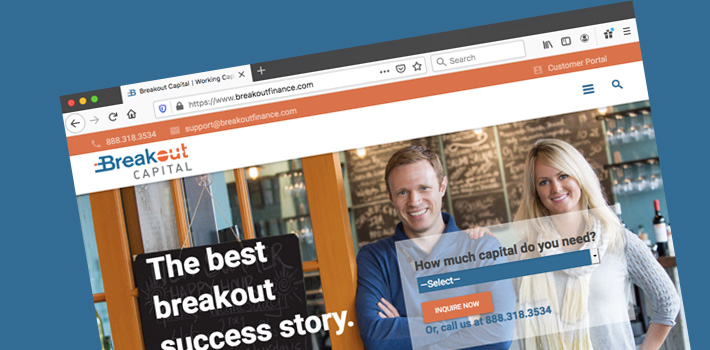 Breakout Capital never stopped funding. That’s what CEO & President McLean Wilson recently shared with AltFinanceDaily. The company not only weathered the storm but has come out with expanded access to credit totalling $20MM with Medalist Partners, one a current term loan facility and the other a new term loan facility with “attractive” forward flow features.
The company said in its announcement that these facilities will allow Breakout to increase loan originations across all of its product offerings, including its term-loan product, FactorAdvantage®, and its newest factor product, FactorBridge.
“Small businesses are at the core of our economy and they were, as we were, largely blindsided by recent economic interruptions,” Wilson told AltFinanceDaily. “We adapted quickly and rolled with the punches and never stopped funding. It is a testament to the resiliency, loyalty and borrower first mentality that Breakout Capital has not only weathered the storm, but has strengthened our company throughout the past few months. We quickly adapted to a new way of thinking, which helped us serve our clients in real time and forge ever closer relationships with our factor partners, lenders, online marketplaces, ISOs and borrowers.”
John Slonieski, Director of Private Credit for Medalist Partners, said in the announcement that “We are pleased to enhance our relationship with Breakout Capital in our asset-based lending strategy. Their high-quality underwriting and SMB-friendly lending solutions, coupled with their talented credit and management team, provide us confidence as we continue working closely with them to successfully scale their lending program.”
Keeping Up With The Winklevii
July 6, 2020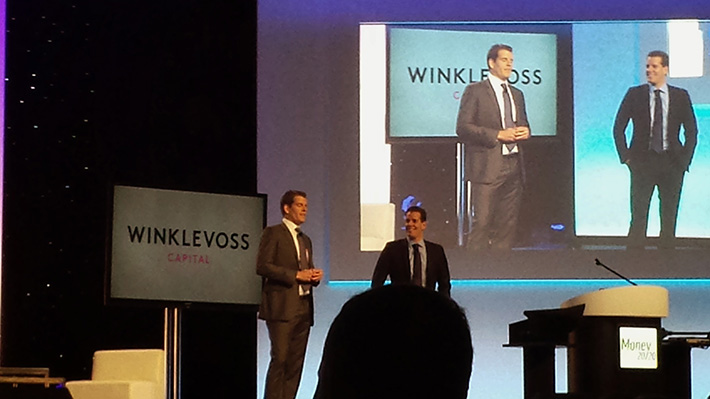 Spending the previous three and a half months indoors, locked away from others, and sat at homebound desks have had differing effects on everyone. Some have had a period of intense productivity, some have fallen into bad habits, and some have spent an inordinate amount of time on social media. The Winklevoss twins, famous for playing a role in the founding of Facebook, are of the latter sort.
Cameron and Tyler, aged 38, are two entrepreneurs with a particular focus on cryptocurrencies. Having experimented with social media in its early days with Mark Zuckerberg at Harvard, the pair later sued the Facebook CEO in 2008, the same year they rowed for the USA in the Beijing Olympics. From here the twins went into venture capital; led a seed-funding round for BitInstant, a Bitcoin payment processor; claimed to have accumulated 1% of all Bitcoin by 2013 between them; and launched Gemini, their own cryptocurrency exchange, in 2014. Since then, as Bitcoin’s value has surged and fluctuated, the pair have become figureheads for the cryptocurrency, having been proponents of the decentralized currency from the days when it was worth less than $10, to its highest valuation in 2017 at just below $20,000, to its current price of just over $9,000.
And with quarantine providing all the time in the world to ponder the future of Bitcoin, the twins have been posting daily on Twitter about the crypto, relating it to any and all topics that proved popular. Cancel culture? There’s a tweet for that. George Orwell’s magnum opus, 1984? There’s a tweet for that. Vaccinations and their alleged comparability with cryptocurrency? There’s a tweet for that.
 Beyond comparing and relating Bitcoin to everything that comes up in the news cycle, the twins brought up an idea a number of times on social media over quarantine: that the pandemic has set the stage for a decentralized world.
While it is clear that this has happened to a point already, given the global move toward working from home, Cameron believes it will go further, mentioning in a tweet that the pandemic will be “an inflection point for Bitcoin and the Metaverse.” Choosing not to expand on this lofty statement, the specifics of Cameron’s claim can’t be known for sure, but the idea behind the Metaverse, a collectivized virtual space based off the setting of a 1992 sci-fi novel which is capable of replacing the functions and opportunities granted by the real world, is one well suited to Bitcoin, or, at least the idealized vision of what Bitcoin could become.
 As well as this prophesizing of a virtual utopia, the brothers displayed an intense distrust and paranoia of government, currencies that are regulated by centralized banks, and the role of big tech. With tweets criticizing the Federal Reserve’s decision to inject $1.5 trillion into the economy, YouTube’s ongoing debate over whether the First Amendment applies to a private business, and warnings against the threat of a government willing to grab more power during a pandemic, the billionaires’ tweets appeared at times to reach Elon Musk’s recent anti-government messages via Twitter.
With the twins having noted their disappointment in the US government earlier in the year at a conference in January, that time regarding the government’s slow adoption of cryptocurrencies, it is not so much of a surprise to see these further critiques, especially with them largely taking aim at the government’s employment of federally printed money, or “toilet paper,” as they call it.
All this being said, the twins appeared to be just like everyone else during quarantine: left with not much to do with a stable internet connection and a charged phone. And so conspiracies and cryptocurrencies aside, the brothers also made time for the irreverent and the relatable, posting about the possibility of a Groundhog Day-style scenario during quarantine as well as the importance of “sunsets, the stars, and true friends” in a tweet that wouldn’t be amiss in a Disney film.
Ultimately though, the sooth-saying and future-gazing done by the Winklevii in quarantine will take years, if not decades, to come about, if it ever does. One thing is certain though, the twins won’t stop talking about it until then.
Google Pay Launches SMB Loans in India, Plans to Expand American Features
June 30, 2020 This week Google announced that it is expanding its service offerings in India, with small and medium-sized businesses in the country now being able to apply for loans via the Google Pay for Business app. The result of partnerships with banks, Google also announced that it will be rolling all of its SMB-related services into one platform; these include Google My Business, an app that allows owners to make a business profile and get a Google Maps listing; and Google Pay Spot, which lets entrepreneurs customize their digital storefront, as seen by customers in the Google Pay app.
This is just the latest of features released in India by the tech giant, with it launching the ability to transfer money between Google Pay users earlier this year. What makes this interesting though is that in a recent interview with Business Insider, a Google spokesperson noted that the company’s decisions in global markets have become increasingly more influenced by its trialing of new features in India.
“We’re always trying to understand and learn from changing consumer behaviors worldwide so we can build more helpful features,” the spokesperson explained. “Our learnings from Google Pay in India will enable us to make digital money experiences simple, helpful, and accessible and create new economic opportunities for both users and our partners around the world.”
So does this mean Google will soon be joining the likes of Square and Clover and begin offering funding to American small businesses? The future is not so clear, but with the company announcing two weeks ago that it plans to incorporate digital storefronts into Google Pay, serving as an in-app portal to purchase goods, it appears that long-time features of the Indian version are beginning to bleed into the American counterpart.
Having announced its intentions to offer checking accounts in 2020, and with leaks earlier this year pointing towards a Google Pay debit card, it appears as if Google is following in the steps of its rival, Apple, and wading further into the financial services sector.